×
Request Free Sample ×

Kindly complete the form below to receive a free sample of this Report

* Please use a valid business email

Leading companies partner with us for data-driven Insights

clients tt-cursor
Hero Background

WI SUN Technology Market

ID: MRFR/ICT/7223-CR
135 Pages
Ankit Gupta
January 2020

Wi-SUN Technology Market Research Report By Application (Smart Metering, Smart Lighting, Smart Grid, Home and Building Automation), By Connectivity Type (Point-to-Point, Point-to-Multipoint, Mesh), By End Use (Utilities, Industrial, Residential), By Frequency Band (Sub-GHz, 2.4 GHz) and By Regional (North America, Europe, South America, Asia Pacific, Middle East and Africa) - Forecast to 2035.

Share:
Download PDF ×

We do not share your information with anyone. However, we may send you emails based on your report interest from time to time. You may contact us at any time to opt-out.

WI SUN Technology Market Infographic
Purchase Options

WI SUN Technology Market Summary

As per MRFR analysis, the WI SUN Technology Market Size was estimated at 3103.33 USD Million in 2024. The WI SUN Technology industry is projected to grow from 3355.63 USD Million in 2025 to 7332.23 USD Million by 2035, exhibiting a compound annual growth rate (CAGR) of 8.13 during the forecast period 2025 - 2035.

Key Market Trends & Highlights

The WI SUN Technology Market is poised for substantial growth driven by smart technology integration and data-centric strategies.

  • The integration of smart technologies is transforming the WI SUN Technology Market, particularly in North America.
  • Data-driven decision making is becoming increasingly prevalent, influencing various sectors including utilities and healthcare.
  • Collaboration for innovation is fostering advancements in smart metering and smart agriculture applications.
  • Rising demand for smart city solutions and government initiatives are key drivers propelling market expansion.

Market Size & Forecast

2024 Market Size 3103.33 (USD Million)
2035 Market Size 7332.23 (USD Million)
CAGR (2025 - 2035) 8.13%

Major Players

Silicon Labs (US), NXP Semiconductors (NL), Texas Instruments (US), STMicroelectronics (FR), Microchip Technology (US), Renesas Electronics (JP), Analog Devices (US), Infineon Technologies (DE), Cypress Semiconductor (US)

WI SUN Technology Market Trends

The WI SUN Technology Market is currently experiencing a transformative phase characterized by the increasing integration of smart technologies into various sectors. This market encompasses a range of applications, including smart cities, agriculture, and industrial automation, which are all leveraging the capabilities of wireless sensor networks. The growing emphasis on energy efficiency and sustainability is driving innovation within this domain, as stakeholders seek to optimize resource management and reduce environmental impact. Furthermore, advancements in communication protocols and sensor technologies are enhancing the functionality and reliability of WI SUN systems, making them more appealing to a broader audience. In addition, the demand for real-time data analytics is reshaping the landscape of the WI SUN Technology Market. Organizations are increasingly recognizing the value of data-driven decision-making, which is facilitated by the deployment of wireless sensor networks. This trend is likely to continue as more entities adopt smart solutions to improve operational efficiency and enhance user experiences. As the market evolves, collaboration among technology providers, government agencies, and end-users will be crucial in addressing challenges and unlocking new opportunities for growth. The future of the WI SUN Technology Market appears promising, with potential for further advancements and widespread adoption across diverse industries.

Integration of Smart Technologies

The WI SUN Technology Market is witnessing a notable trend towards the integration of smart technologies across various sectors. This integration enhances operational efficiency and promotes sustainability, as organizations increasingly adopt wireless sensor networks for applications in smart cities, agriculture, and industrial automation.

Emphasis on Data-Driven Decision Making

There is a growing emphasis on data-driven decision making within the WI SUN Technology Market. Organizations are leveraging real-time data analytics to optimize processes and improve user experiences, indicating a shift towards more informed and strategic operational practices.

Collaboration for Innovation

Collaboration among technology providers, government agencies, and end-users is becoming increasingly vital in the WI SUN Technology Market. This trend suggests that partnerships will play a crucial role in addressing challenges and fostering innovation, ultimately driving market growth.

WI SUN Technology Market Drivers

Market Growth Projections

The Global Wi-SUN Technology Market Industry is projected to experience substantial growth over the coming years. Current estimates suggest that the market will reach 3.02 USD Billion in 2024, with expectations of expanding to 7.33 USD Billion by 2035. This growth trajectory indicates a compound annual growth rate of 8.4% from 2025 to 2035. Such projections highlight the increasing relevance of Wi-SUN technology in various sectors, including utilities and smart cities, as stakeholders recognize the value of efficient and reliable communication networks.

Rising Demand for Smart Cities

The Global Wi-SUN Technology Market Industry is experiencing a surge in demand driven by the increasing focus on smart city initiatives. Governments worldwide are investing in infrastructure that supports IoT applications, which require reliable and efficient communication networks. For instance, cities are deploying smart meters and street lighting systems that utilize Wi-SUN technology to enhance energy efficiency and reduce operational costs. This trend is expected to contribute to the market's growth, with projections indicating a market size of 3.02 USD Billion in 2024, and a potential increase to 7.33 USD Billion by 2035, reflecting a compound annual growth rate of 8.4% from 2025 to 2035.

Advancements in IoT Connectivity

The Global Wi-SUN Technology Market Industry is significantly influenced by advancements in Internet of Things (IoT) connectivity. As more devices become interconnected, the need for robust communication protocols becomes paramount. Wi-SUN technology offers a unique solution by providing long-range, low-power connectivity that is essential for applications such as smart grids and environmental monitoring. The proliferation of IoT devices is likely to drive the adoption of Wi-SUN technology, as it enables seamless data transmission across various sectors. This trend is indicative of a broader shift towards smart infrastructure, which is anticipated to bolster the market's growth trajectory.

Growing Focus on Energy Efficiency

The Global Wi-SUN Technology Market Industry is witnessing a growing focus on energy efficiency, which is driving the adoption of smart technologies. Organizations and municipalities are increasingly recognizing the importance of reducing energy consumption and operational costs. Wi-SUN technology enables the implementation of smart grids and energy management systems that optimize energy usage. By facilitating real-time data collection and analysis, Wi-SUN networks empower users to make informed decisions regarding energy consumption. This trend aligns with global sustainability goals, suggesting a robust market outlook as more entities seek to leverage Wi-SUN technology for energy efficiency.

Government Initiatives and Regulations

Government initiatives and regulations play a crucial role in shaping the Global Wi-SUN Technology Market Industry. Many countries are implementing policies that promote the adoption of smart technologies to improve energy efficiency and sustainability. For example, regulatory frameworks are being established to support the deployment of smart metering systems that utilize Wi-SUN technology. These initiatives not only facilitate the integration of renewable energy sources but also enhance grid reliability. As governments continue to prioritize sustainability, the demand for Wi-SUN technology is expected to rise, further propelling market growth.

Increased Investment in Smart Infrastructure

The Global Wi-SUN Technology Market Industry is benefiting from increased investment in smart infrastructure. As cities and businesses strive to modernize their operations, there is a growing emphasis on deploying technologies that enhance connectivity and efficiency. Wi-SUN technology is at the forefront of this transformation, providing a reliable communication framework for various applications, including smart lighting and waste management. The anticipated growth in infrastructure spending is likely to create new opportunities for Wi-SUN technology adoption, thereby contributing to the overall market expansion.

Market Segment Insights

By Application: Smart Metering (Largest) vs. Smart Agriculture (Fastest-Growing)

In the WI SUN Technology Market, Smart Metering leads with the largest market share, showcasing its critical role in energy management and sustainability initiatives. This segment benefits from the growing adoption of IoT technologies, which facilitate efficient resource consumption and improved metering accuracy. Smart Agriculture follows closely, tapping into the increasing demand for precision farming solutions driven by the need for higher crop yields and resource efficiency. The market share distribution reflects a strong inclination towards automation and technological integration in energy and agricultural applications.

Smart Metering (Dominant) vs. Smart Cities (Emerging)

Smart Metering has positioned itself as a dominant force within the WI SUN Technology Market, focusing on improving energy consumption data accuracy and optimizing energy distribution networks. This segment leverages advanced sensor technologies and robust data analytics, making it indispensable for utilities aiming to enhance operational efficiency. In comparison, Smart Cities represent an emerging segment, driven by urbanization and the integration of smart technologies into urban infrastructures. While still in its growth phase, Smart Cities are evolving with innovative solutions in transportation, waste management, and public safety, enhancing the livability and sustainability of urban environments.

By End Use: Utilities (Largest) vs. Healthcare (Fastest-Growing)

The WI SUN Technology Market showcases distinct segment values, with Utilities holding the largest share due to its critical role in energy production and distribution. This sector utilizes advanced solar technologies to enhance efficiency and grid reliability. Meanwhile, Healthcare is emerging rapidly, driven by the increasing demand for renewable energy solutions in medical facilities and services. As hospitals and clinics adopt solar technologies, the sector's growth is significantly accelerated, reflecting a shift towards sustainable practices in healthcare delivery.

Utilities: Dominant vs. Healthcare: Emerging

In the WI SUN Technology Market, Utilities serve as the dominant segment, leveraging extensive infrastructure and regulatory support for renewable energy adoption. This segment benefits from large, long-term investments and stable demand as utilities transition to greener energy solutions. On the other hand, Healthcare represents an emerging segment, gaining momentum as health institutions prioritize energy efficiency and sustainability. The integration of solar technologies in healthcare not only helps in reducing operational costs but also aligns with global health goals, making it a pivotal area for future investments and innovations in the WI SUN Technology Market.

By Technology: Wireless Communication (Largest) vs. Cloud Computing (Fastest-Growing)

In the WI SUN Technology Market, the segment of Wireless Communication holds a substantial portion of the market share due to its critical role in providing connectivity solutions across various applications. This segment is characterized by significant investments in infrastructure and the development of advanced communication technologies, catering to both consumers and businesses alike. Meanwhile, Cloud Computing, although not the largest, is rapidly gaining traction as organizations prioritize flexibility and scalability in their operations, pushing its growth in recent years. The growth trends in this segment are driven primarily by the increasing demand for real-time data access and communication. The rising number of Internet of Things (IoT) devices further amplifies the need for robust Wireless Communication solutions, while Cloud Computing is being propelled by the shift towards digital transformation across industries. As more companies migrate their operations to cloud platforms, we expect this area of technology to continue its upward trajectory, supported by innovative advancements and user-friendly services.

Wireless Communication: (Dominant) vs. Cloud Computing (Emerging)

Wireless Communication stands out as the dominant force within the WI SUN Technology Market, with its established presence and essential role in facilitating seamless communication across diverse platforms. This segment encompasses a wide range of technologies including cellular networks, satellite communications, and Wi-Fi solutions that are vital for both personal and business interactions. On the other hand, Cloud Computing is emerging as a pivotal player in this space, characterized by its ability to offer flexible, cost-effective solutions that enhance operational efficiency. The increasing reliance on data storage and processing capabilities provided by cloud services is steering its growth. As more businesses recognize the strategic advantages of cloud integration, this segment is likely to capitalize on the growing trend towards remote work and digital innovation.

By Device Type: Smart Sensors (Largest) vs. Smart Controllers (Fastest-Growing)

In the WI SUN Technology Market, the device type segment is primarily dominated by Smart Sensors, representing a significant portion of the overall market share. Smart Sensors have become integral in various applications due to their ability to provide real-time data collection and efficient monitoring of environmental conditions. On the other hand, Smart Controllers, while currently holding a smaller share, are gaining momentum as more industries adopt automation and IoT technologies, contributing to a diversification in market dynamics. The growth trends in the device type segment are steered by advancements in connectivity and enhanced functionalities of smart devices. Smart Controllers are quickly emerging as the fastest-growing segment, driven by the increasing need for automated control systems across various sectors. This trend is further fueled by an expanded focus on energy efficiency and sustainability, prompting businesses to adopt smart technologies that offer both operational savings and improved performance.

Smart Sensors (Dominant) vs. Smart Appliances (Emerging)

Smart Sensors are currently the dominant player in the WI SUN Technology Market, characterized by their widespread adoption and critical role in data acquisition for smart environments. They are extensively utilized in applications ranging from smart homes to industrial automation, offering real-time insights that enhance operational efficiency. Conversely, Smart Appliances are an emerging segment that caters to the evolving preferences of consumers who prioritize convenience and smart functionalities in their everyday devices. These appliances integrate advanced technologies to promote energy savings and intuitive user experiences. As the market progresses, the convergence of Smart Sensors and Smart Appliances will likely foster innovative solutions that enhance the overall consumer experience, driving further growth.

By Market Type: Public Sector (Largest) vs. Private Sector (Fastest-Growing)

In the WI SUN Technology Market, the market share distribution reveals a significant presence of the Public Sector, which dominates overall engagement with sustainable energy initiatives. This sector's commitment to adopting innovative technologies and enhancing infrastructure ensures its stability and sustained interest from providers. The Private Sector follows closely, rapidly gaining traction as businesses increasingly recognize the importance of sustainable practices in their operations, leading to a competitive shift in service offerings.

Market Type: Public Sector (Dominant) vs. Private Sector (Emerging)

The Public Sector in the WI SUN Technology Market is characterized by a strong regulatory framework that supports renewable energy adoption and technological advancement. It prioritizes social welfare and environmental responsibility, making it a key player in driving demand for sustainable technologies. On the other hand, the Private Sector is emerging with dynamic growth driven by innovation and speed to market. Businesses are pivoting towards sustainability to enhance brand reputation and operational efficiency. This segment is marked by competitive investments in cutting-edge technologies, making it agile and responsive to market changes.

Get more detailed insights about WI SUN Technology Market

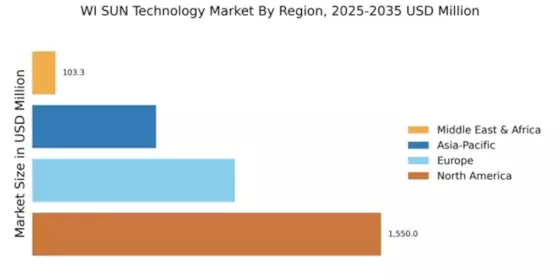
Regional Insights

North America : Innovation and Market Leadership

North America continues to lead the WI SUN technology market, holding a significant share of 1550.0. The region's growth is driven by robust demand for smart home devices, IoT applications, and energy-efficient solutions. Regulatory support for green technologies and smart city initiatives further catalyzes market expansion. The increasing adoption of wireless technologies in various sectors is also a key driver, positioning North America as a pivotal player in the global landscape. The competitive landscape is characterized by major players such as Silicon Labs, Texas Instruments, and Microchip Technology, which are at the forefront of innovation. The U.S. remains the largest market, with Canada and Mexico also contributing to growth. The presence of leading semiconductor companies fosters a dynamic ecosystem, enhancing collaboration and technological advancements in WI SUN technology.

Europe : Emerging Market with Growth Potential

Europe's WI SUN technology market is poised for growth, with a market size of 900.0. The region benefits from increasing investments in smart grid technologies and IoT applications, driven by regulatory frameworks aimed at sustainability and energy efficiency. The European Union's Green Deal and various national initiatives are pivotal in promoting the adoption of wireless technologies, enhancing market dynamics and demand trends. Leading countries such as Germany, France, and the Netherlands are at the forefront of this growth, supported by key players like NXP Semiconductors and STMicroelectronics. The competitive landscape is evolving, with a focus on innovation and collaboration among industry stakeholders. The presence of established companies and startups alike fosters a vibrant ecosystem, driving advancements in WI SUN technology.

Asia-Pacific : Rapid Growth and Adoption

The Asia-Pacific region is witnessing rapid growth in the WI SUN technology market, with a size of 550.0. This growth is fueled by increasing urbanization, rising disposable incomes, and a growing demand for smart devices. Governments in countries like China and Japan are implementing supportive policies to enhance technological adoption, particularly in smart city initiatives and energy management systems, which are critical for market expansion. China, Japan, and South Korea are leading the charge in this competitive landscape, with significant investments from key players like Renesas Electronics and Cypress Semiconductor. The region's market is characterized by a mix of established companies and emerging startups, fostering innovation and collaboration. This dynamic environment is expected to drive further advancements in WI SUN technology, positioning Asia-Pacific as a key player in the global market.

Middle East and Africa : Emerging Market with Unique Challenges

The Middle East and Africa region is gradually emerging in the WI SUN technology market, with a size of 103.33. The growth is driven by increasing investments in smart infrastructure and energy-efficient solutions, supported by government initiatives aimed at enhancing connectivity and sustainability. However, challenges such as regulatory hurdles and varying levels of technological adoption across countries may impact market dynamics. Countries like South Africa and the UAE are leading the way, with key players beginning to establish a presence in the region. The competitive landscape is still developing, with opportunities for growth as local companies and international firms collaborate to address market needs. The potential for innovation in WI SUN technology is significant, as the region seeks to modernize its infrastructure and improve energy management systems.

Key Players and Competitive Insights

The WI SUN Technology Market is currently characterized by a dynamic competitive landscape, driven by the increasing demand for low-power, wide-area network solutions. Key players are actively pursuing strategies that emphasize innovation, regional expansion, and strategic partnerships to enhance their market positioning. Companies such as Silicon Labs (US), NXP Semiconductors (NL), and Texas Instruments (US) are at the forefront, leveraging their technological expertise to develop advanced solutions that cater to the growing Internet of Things (IoT) ecosystem. Their collective focus on enhancing product offerings and expanding into emerging markets is shaping a competitive environment that is both collaborative and competitive.

In terms of business tactics, companies are increasingly localizing manufacturing and optimizing supply chains to enhance operational efficiency. The market structure appears moderately fragmented, with several key players exerting influence over various segments. This fragmentation allows for a diverse range of solutions, yet the presence of major companies like STMicroelectronics (FR) and Microchip Technology (US) ensures that competition remains robust, driving innovation and customer-centric approaches.

In November 2025, Silicon Labs (US) announced a strategic partnership with a leading telecommunications provider to enhance its connectivity solutions for smart cities. This collaboration is poised to leverage both companies' strengths, potentially accelerating the deployment of smart infrastructure and positioning Silicon Labs as a leader in the urban IoT space. The strategic importance of this partnership lies in its potential to create synergies that enhance product offerings and expand market reach.

In October 2025, NXP Semiconductors (NL) unveiled a new line of low-power chips designed specifically for industrial applications, aiming to capture a larger share of the growing industrial IoT market. This move reflects NXP's commitment to innovation and its strategic focus on addressing the unique needs of industrial customers. By enhancing its product portfolio, NXP is likely to strengthen its competitive position and drive revenue growth in this segment.

In September 2025, Texas Instruments (US) expanded its manufacturing capabilities in Europe, investing €100 million to enhance production efficiency and meet the rising demand for its semiconductor solutions. This investment underscores Texas Instruments' strategy to localize production and reduce supply chain vulnerabilities, which is increasingly critical in today's market. The expansion is expected to bolster the company's ability to respond swiftly to customer needs and market fluctuations.

As of December 2025, current competitive trends in the WI SUN Technology Market are heavily influenced by digitalization, sustainability, and the integration of artificial intelligence (AI) into product offerings. Strategic alliances are becoming more prevalent, as companies recognize the value of collaboration in driving innovation and addressing complex market demands. Looking ahead, competitive differentiation is likely to evolve, with a pronounced shift from price-based competition to a focus on technological innovation, reliability in supply chains, and sustainable practices. This evolution suggests that companies that prioritize these aspects will be better positioned to thrive in an increasingly competitive landscape.

Key Companies in the WI SUN Technology Market market include

Industry Developments

Recent developments in the Wi-SUN Technology Market reflect a surge in innovation and strategic moves by key players such as Silicon Labs, Microchip Technology, and Digi International. There has been an increased focus on enhancing connectivity solutions, particularly with the rise of smart city initiatives and the Internet of Things (IoT). Companies like Semtech and Sierra Wireless are actively expanding their product offerings to cater to these demands, which has resulted in increased market valuation. Notable mergers and acquisitions include moves by NXP Semiconductors and EnOcean, aiming to bolster their technological capabilities and market reach.

The competitive landscape is further intensified as Analog Devices, Qualcomm, and Renesas Electronics explore partnerships to enhance their Wi-SUN capabilities. Cisco Systems, Texas Instruments, and Itron are also playing pivotal roles in shaping the market dynamics through innovative solutions and strategic collaborations. The continuous growth in demand for energy-efficient, long-range wireless communication products is substantially impacting the market, pushing companies to invest heavily in enhancing their Wi-SUN technology offerings. This investment climate suggests a robust trajectory for the Wi-SUN market as it evolves in alignment with technological advancements and customer requirements.

Future Outlook

WI SUN Technology Market Future Outlook

The WI SUN Technology Market is projected to grow at an 8.13% CAGR from 2024 to 2035, driven by advancements in IoT integration, energy efficiency, and regulatory support.

New opportunities lie in:

  • Development of smart grid solutions for enhanced energy management.
  • Expansion into emerging markets with tailored WI SUN applications.
  • Partnerships with utility companies for integrated service offerings.

By 2035, the WI SUN Technology Market is expected to achieve robust growth and increased global adoption.

Market Segmentation

WI SUN Technology Market End Use Outlook

  • Utilities
  • Manufacturing
  • Transportation
  • Healthcare

WI SUN Technology Market Technology Outlook

  • Wireless Communication
  • Sensor Networks
  • Data Analytics
  • Cloud Computing

WI SUN Technology Market Application Outlook

  • Smart Metering
  • Smart Agriculture
  • Smart Cities
  • Industrial Automation

WI SUN Technology Market Device Type Outlook

  • Smart Sensors
  • Smart Controllers
  • Smart Actuators
  • Smart Appliances

WI SUN Technology Market Market Type Outlook

  • Public Sector
  • Private Sector
  • Residential Sector

Report Scope

MARKET SIZE 20243103.33(USD Million)
MARKET SIZE 20253355.63(USD Million)
MARKET SIZE 20357332.23(USD Million)
COMPOUND ANNUAL GROWTH RATE (CAGR)8.13% (2024 - 2035)
REPORT COVERAGERevenue Forecast, Competitive Landscape, Growth Factors, and Trends
BASE YEAR2024
Market Forecast Period2025 - 2035
Historical Data2019 - 2024
Market Forecast UnitsUSD Million
Key Companies ProfiledSilicon Labs (US), NXP Semiconductors (NL), Texas Instruments (US), STMicroelectronics (FR), Microchip Technology (US), Renesas Electronics (JP), Analog Devices (US), Infineon Technologies (DE), Cypress Semiconductor (US)
Segments CoveredApplication, End Use, Technology, Device Type, Market Type
Key Market OpportunitiesIntegration of Internet of Things (IoT) solutions in the WI SUN Technology Market enhances connectivity and efficiency.
Key Market DynamicsRising demand for low-power, wide-area network solutions drives innovation in WI SUN Technology applications and deployments.
Countries CoveredNorth America, Europe, APAC, South America, MEA

Market Highlights

Author
Ankit Gupta
Senior Research Analyst

Ankit Gupta is an analyst in market research industry in ICT and SEMI industry. With post-graduation in "Telecom and Marketing Management" and graduation in "Electronics and Telecommunication" vertical he is well versed with recent development in ICT industry as a whole. Having worked on more than 150+ reports including consultation for fortune 500 companies such as Microsoft and Rio Tinto in identifying solutions with respect to business problems his opinions are inclined towards mixture of technical and managerial aspects.

Leave a Comment

FAQs

What is the expected market size of the Wi-SUN Technology Market by 2032?

The Wi-SUN Technology Market is expected to reach a value of 5.8 USD Billion by 2032.

What is the projected CAGR for the Wi-SUN Technology Market from 2024 to 2032?

The projected CAGR for the Wi-SUN Technology Market from 2024 to 2032 is 8.13%.

Which region is expected to hold the largest market share in the Wi-SUN Technology Market by 2032?

North America is expected to hold the largest market share in the Wi-SUN Technology Market, valued at 2.4 USD Billion by 2032.

What is the market value for Smart Metering in the Wi-SUN Technology Market by 2032?

The market value for Smart Metering in the Wi-SUN Technology Market is expected to reach 1.6 USD Billion by 2032.

Who are the key players in the Wi-SUN Technology Market?

Key players in the Wi-SUN Technology Market include Silicon Labs, Microchip Technology and Digi International, among others.

What is the expected market size for Smart Lighting in the year 2032?

The expected market size for Smart Lighting in the Wi-SUN Technology Market is anticipated to be 1.4 USD Billion by 2032.

What is the value of the APAC region in the Wi-SUN Technology Market by 2032?

The APAC region is expected to be valued at 1.25 USD Billion in the Wi-SUN Technology Market by 2032.

What is the projected market size for Smart Grid applications by 2032?

The projected market size for Smart Grid applications in the Wi-SUN Technology Market is expected to be 2.0 USD Billion by 2032.

What challenges are influencing the growth of the Wi-SUN Technology Market?

Challenges influencing growth in the Wi-SUN Technology Market include competition and technological advancements.

What is the estimated market size for Home and Building Automation by 2032?

The estimated market size for Home and Building Automation in the Wi-SUN Technology Market is expected to reach 0.8 USD Billion by 2032.

Download Free Sample

Kindly complete the form below to receive a free sample of this Report

Compare Licence

×
Features License Type
Single User Multiuser License Enterprise User
Price $4,950 $5,950 $7,250
Maximum User Access Limit 1 User Upto 10 Users Unrestricted Access Throughout the Organization
Free Customization
Direct Access to Analyst
Deliverable Format
Platform Access
Discount on Next Purchase 10% 15% 15%
Printable Versions