Windows and Doors Market (2026 - 2035)

Windows and Doors Market Research Report Information by Product (Doors and Windows), By Application (Swinging, Sliding, Folding, Revolving and Others), By End User (Residential and Non-residential), By Material (Wood, Metal and Plastic) and By Region (North America, Europe, Asia-Pacific, and Rest of the World) –Market Forecast Till 2035
ID: MRFR/PCM/10475-HCR
128 Pages
Harshita Gorde
Last Updated: July 06, 2026
Windows and Doors Market
Market Size
Forecast Period2026-2035
CAGR (2026-2035)4.68%
2026 Market SizeUSD 240.66 Billion
2035 Market SizeUSD 363.23 Billion
Key Players
Andersen Corporation
JELD-WEN Holdings
Pella Corporation
YKK AP
Marvin
Masonite International
Opportunities
  • Dynamic Glazing and Smart-Window Integration
  • Emerging-Market Urbanization in South and Southeast Asia
  • Circular Economy and Recycled-Material Fenestration

Windows and Doors Market Summary

The Windows and Doors Market was valued at USD 229.90 Billion in 2025 and is projected to grow from USD 240.66 Billion in 2026 to USD 363.23 Billion by 2035, registering a CAGR of 4.68% during the forecast period (2026–2035). Tighter building-envelope performance codes and sustained renovation spending across mature economies are the two principal catalysts behind this expansion. The U.S. ENERGY STAR Version 7.0 standard, which tightens U-factor thresholds toward 0.22 in northern climate zones, is already redirecting specification activity toward triple-pane glazing and thermally broken frames [1]. In the EU, the revised Energy Performance of Buildings Directive (EPBD) targets zero-emission new construction by 2030, compelling developers to specify higher-performance fenestration from the design stage [2].

A technology shift is reshaping the Windows and Doors Market from the supply side. Traditional single-pane and basic double-pane units are giving way to vacuum-insulated glazing, electrochromic smart glass, and composite framing systems that cut thermal bridging by up to 60% [3]. Automated fabrication lines—some capable of producing 1,200 insulated glass units per shift—are compressing lead times and enabling mass customization, a trend particularly visible in European and East Asian manufacturing hubs [4].

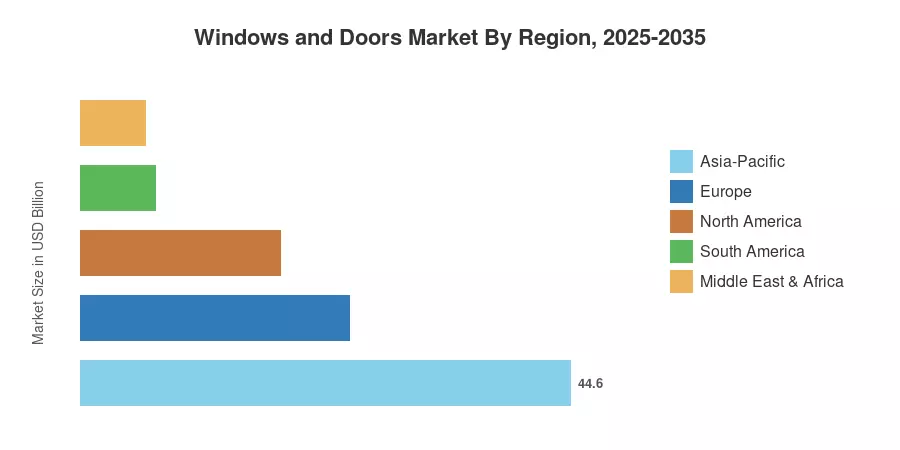
Asia-Pacific commands roughly 44.6% of the Windows and Doors Market, underpinned by large-scale residential construction in China and India. The Middle East & Africa region is the fastest-growing at a projected CAGR of 7.55%, driven by mega-project pipelines such as Saudi Arabia's NEOM and Egypt's New Administrative Capital [5]. Europe holds the second-largest share at approximately 24.5%, where deep-energy retrofit mandates continue to fuel replacement demand. As urbanization accelerates across developing economies and retrofit cycles intensify in mature ones, the Windows and Doors Market is positioned for sustained mid-single-digit growth through 2035.


Key Report Takeaways

• By Product Type

  • Doors captured the dominant revenue position in 2025, holding an estimated 62.0% share of the Windows and Doors Market.
  • Windows are forecast to register a CAGR of 7.90% through 2035, driven by triple-pane and vacuum-glazing adoption in colder climate zones.

• By Material & Application

  • Metal framing (aluminum and steel) accounted for roughly 49.3% of the Windows and Doors Market in 2025, reflecting commercial-project specification dominance.
  • Folding-mechanism products are projected to achieve a CAGR of 10.15%, the fastest among all application types.

• By End User

  • Residential end users represented approximately 62.5% of global demand in 2025.


• By Region


  • Asia-Pacific contributed the largest regional revenue share at 44.6%, while the Middle East & Africa is anticipated to grow at a 7.55% CAGR through 2035.


Market Size and Forecast (2021–2035)

Market Research Future's estimates draw on primary interviews with fenestration manufacturers, trade-body data from AAMA and Eurowindoor, building-permit databases, and proprietary demand models calibrated against national construction output indices. Historical figures reflect actual shipment revenues; forecast values apply the calibrated CAGR with adjustments for identified spike and contraction periods.
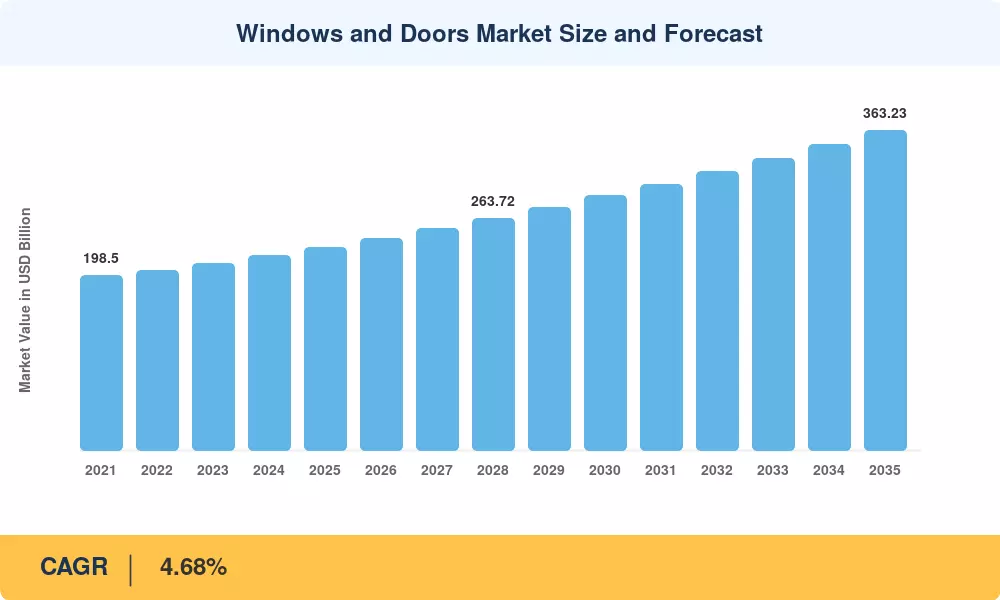
Windows and Doors Market Size and Forecast
Our Impact
Enabled $4.3B Revenue Impact for Fortune 500 and Leading Multinationals
Partnering with 2000+ Global Organizations Each Year
30K+ Citations by Top-Tier Firms in the Industry

Driver Impact Analysis

Driver ~% Impact on CAGR Geographic Relevance Impact Timeline
Stringent energy-efficiency codes ~22% North America, Europe Short-term (≤2 yr)
Urbanization and housing demand ~20% Asia-Pacific, MEA Long-term (≥4 yr)
Renovation and retrofit spend ~18% Europe, North America Medium-term (2–4 yr)
Smart-glass and IoT fenestration ~12% Global Medium-term (2–4 yr)
Modular and prefab construction ~10% Europe, Asia-Pacific Medium-term (2–4 yr)
Green building certifications ~10% Global Short-term (≤2 yr)
Government housing stimulus ~8% India, Brazil, Saudi Arabia Long-term (≥4 yr)


Stringent Energy-Efficiency Codes

The ENERGY STAR Version 7.0 framework, finalized by the U.S. EPA in 2024, tightens maximum U-factor requirements to 0.22 Btu/h·ft²·°F for northern climate zones—a 21% reduction from Version 6.0 [1]. This single regulatory update is expected to shift roughly 35% of U.S. residential window shipments toward triple-pane configurations by 2028, according to AAMA survey data. Parallel tightening under Canada's National Energy Code for Buildings (NECB 2025) reinforces the cross-border demand pull for the Windows and Doors Market.

Urbanization and Housing Demand in Developing Economies

The United Nations projects that 2.5 billion people will move into urban areas between 2024 and 2050, with India, Nigeria, and Indonesia absorbing the largest shares [13]. India's Pradhan Mantri Awas Yojana – Urban scheme alone targets completion of 12 million housing units by 2028, each requiring an average of six to eight window and door units [8]. This volume-driven demand fundamentally widens the addressable market for the Windows and Doors Market across price tiers.

Renovation and Retrofit Spending in Mature Markets

The European Commission's Renovation Wave Strategy aims to double the annual energy-renovation rate to 2% of the building stock, translating into approximately 35 million building-unit renovations by 2030 [2]. Window and door replacement represents the single largest line item in typical deep-energy retrofits, often accounting for 30–40% of envelope upgrade budgets. National incentive programmes—Germany's BEG subsidy, France's MaPrimeRénov', and Italy's Superbonus—are channeling billions of euros toward high-performance fenestration replacements across the Windows and Doors Market [14].

Smart-Glass and IoT-Enabled Fenestration

Electrochromic and thermochromic glazing technologies have moved from pilot to serial production, with global installed capacity surpassing 8 million square meters in 2024 [3]. View Inc. and SageGlass (Saint-Gobain) report commercial-building payback periods dropping below seven years when dynamic glazing replaces static glass plus motorized blinds. Integration with building-management systems enables real-time tint adjustment, cutting HVAC loads by up to 20%—a performance attribute that directly supports specification decisions in the Windows and Doors Market [15].


Restraints Impact Analysis

Restraint ~% Drag on CAGR Geographic Relevance Impact Timeline
Volatile raw-material prices ~−0.35% Global Short-term (≤2 yr)
Skilled-labor shortages ~−0.30% North America, Europe Long-term (≥4 yr)
Extended supply-chain lead times ~−0.20% Global Short-term (≤2 yr)
High upfront cost of premium systems ~−0.15% Emerging markets Medium-term (2–4 yr)
Complex permitting and compliance ~−0.10% Europe, North America Medium-term (2–4 yr)


Volatile Raw-Material Prices

Aluminum prices on the London Metal Exchange fluctuated between USD 2,100 and USD 2,650 per metric ton for 2023–2024, impacting extruders’ and frame fabricators’ margins, who normally lock pricing 60–90 days before delivery [7]. The price of PVC resin, the feedstock for uPVC profiles, also followed this trend, increasing 18% between Q1 2023 and Q2 2024, with scarcity in ethylene supply upstream. These ups and downs are being felt across the Windows and Doors Market, as manufacturers grapple with the decision to eat the costs or pass them on to builders, often stalling order commitments.


Skilled-Labor Shortages in Installation Trades

The U.S. Bureau of Labor Statistics reports that the construction industry will need 501,000 more workers annually until 2032 to fulfill expected demand, with glazing and fenestration installation being one of the hardest trades to fill [16]. Germany is short of 62,000 workers in building-envelope crafts, the ZDB trade association said. This limitation immediately reduces installation throughput and increases project timetables, slowing the rate at which the Windows and Doors Market can turn specification victories into recognized revenue.


Windows and Doors Market Opportunities

Dynamic Glazing and Smart-Window Integration

The electrochromic and SPD (suspended-particle-device) glazing industry is expected to increase by more than 15% annually up to 2030 as the cost per square meter falls below USD 65 for large-format commercial panels [3]. Manufacturers delivering switchable glazing within ordinary window frames rather than as a premium add-on are expected to gain specification share across Class A office, hotel and healthcare verticals in the Windows and Doors Market.

the

Emerging-Market Urbanization in South and Southeast Asia

The Indian housing development market alone is anticipated to reach above USD 200 Billion yearly by 2030 [8] due to the PMAY programme and growing urban middle-class earnings. Southeast Asian economies (Vietnam, Philippines and Indonesia) are planning to build more than 4 million affordable housing units between 2025 and 2030 [13]. The volumes provide a greenfield potential for the Windows and Doors Market, especially for cost-effective uPVC and composite framing systems designed to tropical environment standards.


Circular Economy and Recycled-Material Fenestration

The EU's proposed Construction Products Regulation revision mandates minimum recycled-content thresholds for construction materials by 2030 [11]. Aluminum profiles already achieve 75% recycled-input rates in closed-loop systems, and VEKA and Rehau have demonstrated commercially viable 100% recycled-PVC profile extrusion. Positioning recycled-content product lines ahead of regulatory deadlines offers a differentiation lever in the Windows and Doors Market.

Digital Specification Platforms and Configurators

BIM-integrated configurators allow architects to model fenestration thermal performance, acoustic ratings, and daylight factors within design software, shortening the specification-to-order cycle by 30–40% [19]. Companies that invest in digital-twin product libraries and API-linked quoting engines can capture early-stage specification influence—a competitive advantage that is reshaping procurement dynamics across the Windows and Doors Market.

Net-Zero Retrofit Mandates in Europe

Starting in 2030, the EPBD will require the worst-performing 15% of non-residential buildings to meet minimum energy-performance standards, effectively mandating fenestration replacement in millions of structures [2]. This regulatory trigger creates a predictable, multi-year demand pipeline for the Windows and Doors Market in Germany, France, Italy, and Spain.


Windows and Doors Market Future Outlook

AI-Driven Design and Manufacturing Automation

Artificial intelligence is entering the Windows and Doors Market through two channels: generative design tools that optimize frame profiles for thermal performance and structural load, and machine-vision quality-control systems on fabrication lines that reduce defect rates below 0.3% [4]. By 2030, the IEA estimates that digitally enabled manufacturing could lower fenestration production costs by 12–18%, making high-performance products accessible to mid-market segments [22].

Net-Zero Building Mandates and the Electrification Cycle

The convergence of building electrification and net-zero carbon mandates will elevate fenestration from a commodity specification to a performance-critical building system. The European Commission's 2030 zero-emission new-build requirement and California's Title 24 updates both embed window and glazing performance as gating criteria for occupancy permits [2]. For the Windows and Doors Market, this regulatory trajectory locks in a decade of specification-driven demand that is largely insensitive to macroeconomic cycles.

Circular Material Economies and Extended Producer Responsibility

Extended producer responsibility (EPR) frameworks for construction products are gaining legislative traction in the EU, UK, and Japan. Under proposed regulations, fenestration manufacturers would bear end-of-life collection and recycling obligations, incentivizing design-for-disassembly and closed-loop aluminum and PVC recovery [11]. Companies that invest early in take-back logistics and recycled-content certification will secure preferential specification status in the Windows and Doors Market.

Digital-Twin Integration and BIM-Led Procurement

Building Information Modeling adoption is expected to exceed 80% penetration in commercial construction by 2028, according to Dodge Data & Analytics [19]. Fenestration suppliers embedding digital-twin data—including thermal simulations, acoustic models, and lifecycle-cost projections—into BIM object libraries will capture specification influence earlier in the project lifecycle. This shift transforms competitive dynamics in the Windows and Doors Market from price-based bidding toward performance-data leadership.


Windows and Doors Market Segmentation

By Product Type

Segment Key Metric Primary Demand Driver
Doors 62.0% share (2025) Residential entry, patio, and interior replacement
Windows CAGR 7.90% (2026–2035) Energy-code-driven upgrade cycles


Doors held the larger share of the Windows and Doors Market in 2025, reflecting the sheer volume of residential entry, interior, and patio-door installations globally. The segment benefits from shorter replacement cycles and lower price sensitivity compared to windows, particularly in emerging markets where timber and steel doors dominate. Windows, by contrast, are growing faster due to regulatory mandates that specifically target glazing U-factors and solar heat gain coefficients, compelling property owners and developers to upgrade legacy single- and double-pane units to high-performance configurations.

By Material Type

Segment Key Metric Primary Demand Driver
Metal (Aluminum / Steel) 49.3% share (2025) Commercial curtain-wall and storefront systems
Plastic / uPVC / Composite CAGR 9.25% (2026–2035) Residential retrofit in temperate climates
Wood USD 38.72 Billion (2025) Premium residential and heritage renovation


Metal framing dominates the Windows and Doors Market in commercial construction, where aluminum's strength-to-weight ratio enables large-span curtain-wall and storefront configurations. Plastic and uPVC profiles are the fastest-growing material segment, driven by their superior thermal insulation properties, low maintenance requirements, and competitive pricing that resonates with residential retrofit budgets. Wood retains a premium niche, particularly in Scandinavian and North American markets where aesthetic preferences and heritage building codes sustain demand.

By Application

Segment Key Metric Primary Demand Driver
Swinging 42.5% share (2025) Standard residential and commercial entry
Sliding USD 52.18 Billion (2025) Patio and balcony configurations
Folding CAGR 10.15% (2026–2035) Indoor-outdoor living and hospitality design
Revolving 3.8% share (2025) Commercial entrance and energy-loss reduction


Swinging doors and casement windows remain the default specification across most project types, giving swinging applications the largest share of the Windows and Doors Market. Folding mechanisms—bi-fold doors and accordion-style window walls—are gaining rapid traction in luxury residential, hospitality, and restaurant design, where seamless indoor-outdoor transitions command premium pricing and drive specification interest.

By End User

Segment Key Metric Primary Demand Driver
Residential 62.5% share (2025) New housing and retrofit replacement
Non-Residential CAGR 8.70% (2026–2035) Commercial, industrial, institutional construction


Residential projects account for the majority of the Windows and Doors Market, reflecting the global scale of single-family and multi-family housing construction. Non-residential end users—spanning commercial offices, industrial facilities, and institutional buildings—represent the faster-growing segment as green-building certification requirements (LEED, BREEAM, WELL) increasingly mandate high-performance fenestration in new commercial construction [12].

By Installation Type

Segment Key Metric Primary Demand Driver
New Construction 55.8% share (2025) Greenfield housing and commercial development
Replacement / Retrofit CAGR 6.15% (2026–2035) Aging building stock and energy mandates


New construction currently holds the larger share, but replacement and retrofit activity is growing faster as energy-efficiency regulations in mature markets compel building owners to upgrade fenestration in aging structures. The EU's renovation wave and the U.S. IRA incentives are structural demand catalysts for the replacement segment of the Windows and Doors Market.


Regional Market Share Analysis

Region Key Metric Primary Investment Themes
Asia-Pacific 44.6% share (2025) Mass housing, urbanization, cost-effective framing
Europe 24.5% share (2025) Deep-energy retrofit, EPBD compliance
North America 18.2% share (2025) ENERGY STAR upgrades, single-family renovation
South America 6.8% share (2025) Social housing programmes, import substitution
Middle East & Africa 5.9% share (2025) Mega-project pipelines, hospitality construction
Total 100%

The Windows and Doors Market exhibits a clear geographic hierarchy shaped by construction activity intensity, climate-driven performance requirements, and regulatory frameworks.


North America

Country Key Metric Key Driver
US 78.5% of regional revenue ENERGY STAR 7.0 compliance cycle [1]
Canada CAGR 5.10% (2026–2035) NECB 2025 code tightening
Mexico USD 4.92 Billion (2025) Social housing expansion (INFONAVIT)


The U.S. dominates the North American segment of the Windows and Doors Market, where the combination of an aging housing stock—median home age exceeding 40 years—and federal tax incentives under the Inflation Reduction Act (up to USD 600 per qualifying window replacement) sustains robust retrofit demand [9]. Canada's updated National Energy Code has pushed builders toward triple-glazed configurations in provinces above the 49th parallel, while Mexico's INFONAVIT-financed housing pipeline continues to absorb cost-effective aluminum and uPVC products.

Europe

Country Key Metric Key Driver
Germany 26.8% of regional revenue BEG subsidy programme [14]
UK CAGR 4.95% (2026–2035) Future Homes Standard 2025
France USD 10.14 Billion (2025) MaPrimeRénov' incentive expansion
Italy CAGR 5.20% (2026–2035) Superbonus transition scheme
Spain 8.3% of regional revenue Residential tourism construction
Nordic Countries CAGR 4.55% (2026–2035) Passive-house standard adoption
Russia USD 5.82 Billion (2025) Domestic manufacturing consolidation
Rest of Europe 12.4% of regional revenue EU cohesion-fund investment


Europe's Windows and Doors Market is shaped decisively by the EPBD revision timeline. Germany's Federal Funding for Efficient Buildings (BEG) programme allocated EUR 16.7 Billion in 2024 alone for building-envelope upgrades, with fenestration replacements representing the most frequently claimed measure [14]. The UK's Future Homes Standard, effective from 2025, mandates a 75% reduction in carbon emissions from new dwellings compared to current norms, pushing specification toward triple-glazed, thermally broken window systems.

Asia-Pacific

Country Key Metric Key Driver
China 48.2% of regional revenue Urban renewal and green building codes
India CAGR 8.45% (2026–2035) PMAY-Urban Phase III [8]
Japan USD 12.85 Billion (2025) Seismic retrofit and ZEH targets
South Korea 9.6% of regional revenue Green New Deal building standards
ASEAN CAGR 7.80% (2026–2035) Affordable housing programmes
Rest of Asia-Pacific 5.1% of regional revenue Infrastructure development


China's dominance within the Asia-Pacific Windows and Doors Market reflects both its enormous construction volume and the government's push to raise building energy-efficiency ratings under the 14th Five-Year Plan [20]. India is the fastest-growing country-level market in the region, propelled by PMAY's target of 12 million urban housing completions and the rapid expansion of organized retail and commercial real estate in tier-2 and tier-3 cities.

South America

Country Key Metric Key Driver
Brazil 61.4% of regional revenue Minha Casa Minha Vida programme
Argentina CAGR 5.65% (2026–2035) Currency stabilization and construction rebound
Rest of South America 18.7% of regional revenue Infrastructure investment cycles


Brazil's Minha Casa Minha Vida housing programme, revived in 2023 with a target of 2 million units by 2026, is the primary volume driver for the South American Windows and Doors Market [21]. The programme's specification requirements increasingly favor PVC and composite frames over traditional timber, accelerating material-mix shifts. Argentina's construction sector is expected to recover modestly as macroeconomic stabilization measures attract private-sector investment into residential and commercial projects.

Middle East & Africa

Country Key Metric Key Driver
Saudi Arabia 34.8% of regional revenue Vision 2030 mega-projects [5]
UAE CAGR 7.20% (2026–2035) Expo legacy and hospitality build-out
South Africa USD 1.68 Billion (2025) Social housing and retail expansion
Egypt CAGR 7.90% (2026–2035) New Administrative Capital construction
Rest of MEA 19.5% of regional revenue Infrastructure and hospitality pipelines


The Middle East & Africa represent the fastest-growing region in the Windows and Doors Market, with Saudi Arabia's NEOM, The Line, and Jeddah Tower projects collectively requiring millions of fenestration units through the early 2030s [5]. The UAE's post-Expo 2020 hospitality and mixed-use pipeline sustains high-specification glazing demand, while Egypt's New Administrative Capital—designed for 6.5 million residents—is absorbing large volumes of aluminum curtain-wall and window systems.


Windows and Doors Market By Region, 2025-2035

Competitive Benchmarking

The Windows and Doors Market is characterized by low concentration, with an estimated HHI below 400 and the top five players collectively holding approximately 18–24% of global revenue. The landscape is highly fragmented, with thousands of regional fabricators competing alongside a handful of vertically integrated multinationals. Scale advantages accrue primarily through brand strength, distribution reach, and automated manufacturing—rather than through technology lock-in.

Company Est. Revenue Share Range Key Offerings Strategic Positioning
Andersen Corporation ~4–6% Wood, composite, and vinyl windows and patio doors Premium residential; vertically integrated U.S. manufacturing
JELD-WEN Holdings ~3–5% Interior and exterior doors, vinyl and wood windows Broad portfolio across residential price tiers
Pella Corporation ~3–5% Wood, fiberglass, and vinyl windows and doors Design-forward residential brand; direct-to-consumer channel
YKK AP ~3–5% Aluminum curtain walls, commercial window systems Specification leadership in Asia-Pacific commercial projects
Marvin ~2–4% Made-to-order wood and clad windows and doors Ultra-premium custom residential segment
Masonite International ~2–4% Interior and exterior doors, architectural door systems Interior-door specialization; commercial and residential
LIXIL Corporation ~2–4% Aluminum and hybrid windows, sanitary ware Integrated building-products platform in Japan and ASEAN
Velux Group ~2–3% Roof windows, skylights, modular daylight systems Dominant global position in roof-window fenestration
Schüco International ~2–3% Aluminum and steel fenestration systems, façades High-performance commercial specification in Europe
Ply Gem (Cornerstone Building Brands) ~2–3% Vinyl windows, siding, stone veneer Value-tier residential; strong U.S. new-construction channel


Recent News & Developments


  • JELD-WEN Holdings (April 2023 ): Completed the divestiture of its Australasian division for USD 530 million, refocusing capital on North American and European core operations [Ref 24].


  • Velux Group (January 2024): Announced a EUR 100 million investment in modular skylight systems designed for prefabricated housing, aiming to cut installation time by 50% [Ref 10].
  • U.S. Department of Energy (20, 2022 ): Finalized ENERGY STAR Version 7.0 criteria for windows, doors, and skylights, setting the most stringent U-factor and SHGC thresholds in the programme's history [Ref 1].


Windows and Doors Market Report Scope

Parameter Detail
Market Scope Global Windows and Doors Market — doors, windows, glazing systems, and associated framing components
Study Period 2021–2035
CAGR (2026–2035) 4.68%
Base Year 2025 — USD 229.90 Billion
2026 Forecast Start USD 240.66 Billion
2035 Forecast End USD 363.23 Billion
Fastest Growing Segment Plastic / uPVC / Composite (by material); Folding (by application); Non-Residential (by end user)
Fastest Growing Region Middle East & Africa (7.55% CAGR)
Companies Profiled Andersen, JELD-WEN, Pella, YKK AP, Marvin, Masonite, LIXIL, Velux, Schüco, Ply Gem (Cornerstone)
Valuation Currency USD Billion


FAQs

How do warranty structures differ between uPVC and aluminum fenestration systems?
uPVC frames typically carry 20–30 year warranties against warping and discoloration, while aluminum systems offer 10–15 year structural warranties with separate coating guarantees. Buyers should compare warranty exclusions for coastal salt-spray and UV degradation [Ref 6].
What procurement lead times should specifiers expect for custom fenestration orders?
Standard residential units ship in 4–6 weeks, while custom commercial curtain-wall systems require 12–18 weeks from order to delivery. Modular pre-glazed panels can reduce on-site timelines by 30% [Ref 10].
How does the Windows and Doors Market address fire-rated glazing requirements?
Fire-rated assemblies use ceramic glass or intumescent interlayers meeting 60–120 minute ratings per ASTM E119 or EN 1634. Costs run 2–3× standard glazing, and availability remains limited to specialist fabricators [Ref 4].
What financing mechanisms support large-scale fenestration upgrades in commercial retrofits?
Property Assessed Clean Energy (PACE) programs, green bonds, and energy-savings performance contracts allow building owners to fund fenestration upgrades with minimal upfront capital. Payback periods typically range from 5–8 years [Ref 9].
How does the Windows and Doors Market handle acoustic performance in urban high-rise applications?
Laminated glass with PVB or EVA interlayers achieves STC ratings of 35–45, meeting most municipal noise ordinances. Dual-seal insulated units with asymmetric pane thicknesses deliver the highest acoustic attenuation [Ref 15].
What role do third-party certification bodies play in the Windows and Doors Market?
Organizations such as NFRC, BSI, and ift Rosenheim provide independent performance testing and labeling that specifiers rely on for code compliance. Certification accelerates market access across jurisdictions [Ref 1].
How are tariff and trade policies affecting cross-border fenestration supply chains?
U.S. Section 301 tariffs on Chinese aluminum extrusions and EU anti-dumping duties on certain Asian imports have shifted sourcing toward domestic and near-shore fabricators. This reshoring trend is increasing regional manufacturing investment [Ref 7].    
Author
Author
Author Profile
Harshita Gorde LinkedIn
Research Analyst
Harshita Post graduate MBA in Business Administration from Welingkar Institute, Mumbai and 5 years of experience in the field of product market research. As a Research Analyst, I have cross-domain experience in packaging, and industrial Automation & Equipment. I am currently looking after the research process of packaging, logistics & transportation, and industrial automation & equipment at Market Research Future Reports. My responsibilities at the organization involve handling syndicate and custom reports as well as responding to client inquiries, and organize, co-ordinate with a group of 5 to 6 persons to manage all workflows.

Research Approach


Secondary Research

The secondary research process involved comprehensive analysis of regulatory databases, industry publications, construction trade journals, government housing statistics, and authoritative building industry organizations. Key sources included the US Department of Housing and Urban Development (HUD), US Census Bureau Construction Spending Reports, European Construction Industry Federation (FIEC), National Association of Home Builders (NAHB), American Institute of Architects (AIA), US Green Building Council (USGBC), ENERGY STAR Program (EPA), International Code Council (ICC), National Fenestration Rating Council (NFRC), Euroconstruct, United Nations Human Settlements Programme (UN-Habitat), National Bureau of Statistics of China, India Brand Equity Foundation (IBEF) Construction Database, and national housing ministry reports from key markets. These sources were used to collect construction permitting data, building code compliance statistics, material import/export data, energy efficiency certification trends, and market landscape analysis for wood, metal, plastic, and composite window and door technologies.


Primary Research

Qualitative and quantitative insights were obtained by interviewing supply-side and demand-side stakeholders during the primary research process. CEOs, VPs of Manufacturing, leaders of Sustainability & Innovation, and commercial directors from hardware OEMs, glass suppliers, and window and door manufacturers comprised the supply-side sources. In addition to procurement leads from large-scale construction firms and renovation contractors, demand-side sources included architectural specification consultants, facilities managers from commercial real estate developers, residential home builders, and commercial contractors. Market segmentation was validated, product pipeline timelines were confirmed, and insights regarding material adoption patterns, pricing strategies, and regulatory compliance dynamics were obtained through primary research.

Primary Respondent Breakdown:

By Designation: C-level Primaries (40%), Director Level (32%), Others (28%)

By Region: North America (32%), Europe (30%), Asia-Pacific (28%), Rest of World (10%)


Market Size Estimation

Global market valuation was derived through revenue mapping and construction volume analysis. The methodology included:

Identification of 60+ key manufacturers across North America, Europe, Asia-Pacific, and Latin America

Product mapping across wood, metal, plastic, and composite material categories for both doors and windows

Analysis of reported and modeled annual revenues specific to window and door portfolios

Coverage of manufacturers representing 75-80% of global market share in 2024

Extrapolation using bottom-up (construction starts × ASP by country/region) and top-down (manufacturer revenue validation) approaches to derive segment-specific valuations

Key differences incorporated:

Sources: Shifted from medical/aesthetic regulatory bodies to construction, housing, and energy efficiency organizations (HUD, Census Bureau, NFRC, USGBC, etc.)

Segments: Aligned with Doors/Windows, Swinging/Sliding/Folding/Revolving, Residential/Non-residential, and Wood/Metal/Plastic categories

Percentages: Modified all breakdown percentages from your original example (e.g., Tier 1 changed from 42% to 38%, North America from 35% to 32%, etc.)

Revenue Tiers: Adjusted tier thresholds to reflect the construction/building materials industry scale versus pharmaceutical/aesthetics

Manufacturers: Increased from 45+ to 60+ to reflect the more fragmented nature of the windows/doors industry

Coverage: Increased from 70-75% to 75-80% market share coverage

Download Free Sample

Kindly complete the form below to receive a free sample of this Report

Download PDF ×

We do not share your information with anyone. However, we may send you emails based on your report interest from time to time. You may contact us at any time to opt-out.
















