×
Request Free Sample ×

Kindly complete the form below to receive a free sample of this Report

* Please use a valid business email

Leading companies partner with us for data-driven Insights

clients tt-cursor
Hero Background

Wireless Power Transmission Market

ID: MRFR/SEM/1725-HCR
200 Pages
Aarti Dhapte
October 2025

Wireless Power Transmission Market Research Report By Technology (Magnetic Resonant Coupling, Inductive Coupling, Capacitive Coupling, Microwave Power Transmission), By Application (Consumer Electronics, Electric Vehicles, Industrial Applications, Medical Devices), By End Use (Residential, Commercial, Transportation, Healthcare), By Power Range (Low Power, Medium Power, High Power) and By Regional (North America, Europe, South America, Asia Pacific, Middle East and Africa) - Forecast to 2035

Share:
Download PDF ×

We do not share your information with anyone. However, we may send you emails based on your report interest from time to time. You may contact us at any time to opt-out.

Wireless Power Transmission Market Infographic
Purchase Options

Wireless Power Transmission Market Summary

As per MRFR analysis, the Wireless Power Transmission Market Size was estimated at 13.61 USD Billion in 2024. The Wireless Power Transmission industry is projected to grow from 16.39 USD Billion in 2025 to 104.95 USD Billion by 2035, exhibiting a compound annual growth rate (CAGR) of 20.4 during the forecast period 2025 - 2035.

Key Market Trends & Highlights

The Wireless Power Transmission Market is experiencing robust growth driven by technological advancements and increasing adoption across various sectors.

  • The market is witnessing increased adoption in electric vehicles, particularly in the Asia-Pacific region, which is the fastest-growing market.
  • Integration with smart home devices is becoming prevalent, especially in North America, the largest market for consumer electronics.
  • There is a notable focus on sustainability and energy efficiency, influencing consumer preferences and corporate strategies.
  • Key market drivers include the rising demand for consumer electronics and advancements in technology, which are propelling growth in both the consumer electronics and electric vehicle segments.

Market Size & Forecast

2024 Market Size 13.61 (USD Billion)
2035 Market Size 104.95 (USD Billion)
CAGR (2025 - 2035) 20.4%

Major Players

Qualcomm (US), Nippon Telegraph and Telephone Corporation (JP), WiTricity Corporation (US), Energous Corporation (US), Powercast Corporation (US), Samsung Electronics (KR), Sony Corporation (JP), Ossia Inc. (US)

Wireless Power Transmission Market Trends

The Wireless Power Transmission Market is currently experiencing a transformative phase, driven by advancements in technology and increasing demand for efficient energy solutions. This market encompasses various applications, including consumer electronics, electric vehicles, and industrial equipment, which are progressively adopting wireless charging systems. The integration of wireless power technology into everyday devices appears to enhance user convenience while reducing the clutter associated with traditional charging methods. Furthermore, the growing emphasis on sustainability and energy efficiency is likely to propel the market forward, as stakeholders seek innovative solutions to minimize energy loss and improve overall performance. In addition, the Wireless Power Transmission Market is witnessing a surge in research and development activities aimed at enhancing the efficiency and range of wireless charging systems. Companies are exploring various technologies, such as resonant inductive coupling and microwave power transmission, to address the limitations of existing solutions. This focus on innovation suggests a competitive landscape where firms strive to differentiate their offerings and capture market share. As the market evolves, collaboration between technology providers and end-users may play a crucial role in shaping the future of wireless power transmission, ensuring that solutions meet the diverse needs of consumers and industries alike.

Increased Adoption in Electric Vehicles

The Wireless Power Transmission Market is seeing a notable rise in the adoption of wireless charging systems for electric vehicles. This trend is driven by the need for convenient and efficient charging solutions that align with the growing popularity of electric mobility. As infrastructure develops, more consumers may opt for vehicles equipped with wireless charging capabilities, potentially transforming the automotive landscape.

Integration with Smart Home Devices

Another emerging trend within the Wireless Power Transmission Market is the integration of wireless charging technology into smart home devices. As homes become increasingly automated, the demand for seamless energy solutions is likely to grow. This integration could enhance user experience by providing hassle-free charging options for various smart devices, thereby promoting the adoption of wireless power solutions.

Focus on Sustainability and Energy Efficiency

The Wireless Power Transmission Market is also witnessing a heightened focus on sustainability and energy efficiency. Stakeholders are increasingly prioritizing solutions that minimize energy loss during transmission. This trend reflects a broader societal shift towards environmentally friendly practices, suggesting that future developments in wireless power technology may emphasize eco-friendly designs and materials.

Wireless Power Transmission Market Drivers

Market Growth Projections

The Global Wireless Power Transmission Market Industry is poised for substantial growth, with projections indicating a market size of 7.33 USD Billion in 2024 and an anticipated increase to 25 USD Billion by 2035. This growth trajectory suggests a compound annual growth rate (CAGR) of 11.8% from 2025 to 2035. The expansion is driven by various factors, including technological advancements, rising demand for electric vehicles, and increasing consumer electronics usage. As the industry evolves, it is likely to witness innovations that enhance efficiency and user experience, further solidifying its position in the global market.

Advancements in Technology

Technological innovations in wireless power transmission systems are propelling the Global Wireless Power Transmission Market Industry forward. Developments in resonant inductive coupling and microwave power transmission have enhanced efficiency and range, making wireless charging more viable for various applications. For instance, recent advancements allow for charging multiple devices simultaneously over longer distances. As these technologies mature, they are likely to attract investment and drive market growth. The integration of smart technologies, such as IoT devices, further enhances the appeal of wireless power solutions, suggesting a robust future for the industry as it adapts to evolving consumer needs.

Rising Consumer Electronics Market

The burgeoning consumer electronics sector is significantly impacting the Global Wireless Power Transmission Market Industry. With the proliferation of smart devices, including smartphones, tablets, and wearables, the demand for convenient charging solutions has escalated. Wireless charging pads and stations are becoming commonplace, as consumers seek hassle-free experiences. This trend is reflected in the market's projected growth, with estimates indicating a rise to 7.33 USD Billion in 2024. As consumer preferences evolve towards wireless technologies, manufacturers are likely to invest in developing more efficient and user-friendly wireless power solutions, further propelling market expansion.

Increased Focus on Renewable Energy

The shift towards renewable energy sources is influencing the Global Wireless Power Transmission Market Industry. As governments and organizations aim to reduce carbon footprints, the integration of wireless power systems with renewable energy sources, such as solar and wind, becomes increasingly relevant. This synergy not only promotes sustainability but also enhances the efficiency of energy distribution. For example, wireless charging stations powered by solar energy can provide clean energy solutions for electric vehicles. The growing emphasis on green technologies is expected to drive investment and innovation in wireless power transmission, positioning the industry for substantial growth in the coming years.

Growing Demand for Electric Vehicles

The increasing adoption of electric vehicles (EVs) is a primary driver for the Global Wireless Power Transmission Market Industry. As consumers and manufacturers prioritize sustainability, the need for efficient charging solutions has surged. Wireless power transmission technology offers a convenient alternative to traditional charging methods, enabling seamless energy transfer without physical connectors. In 2024, the market is projected to reach 7.33 USD Billion, driven by the rising number of EVs on the road. This trend is expected to accelerate, with the market potentially expanding to 25 USD Billion by 2035, reflecting a compound annual growth rate (CAGR) of 11.8% from 2025 to 2035.

Government Initiatives and Regulations

Government policies and regulations play a crucial role in shaping the Global Wireless Power Transmission Market Industry. Many countries are implementing initiatives to promote clean energy and innovative technologies, which include support for wireless power transmission systems. Regulatory frameworks that encourage research and development in this area can stimulate market growth. For instance, subsidies for electric vehicle infrastructure may include provisions for wireless charging stations. As governments worldwide prioritize sustainable energy solutions, the wireless power transmission market is likely to benefit from increased funding and favorable policies, fostering a conducive environment for growth.

Market Segment Insights

By Application: Consumer Electronics (Largest) vs. Electric Vehicles (Fastest-Growing)

In the Wireless Power Transmission Market, the application segment is primarily distributed among Consumer Electronics, Electric Vehicles, Industrial Equipment, Medical Devices, and Telecommunications. Consumer Electronics holds the largest share, driven by the growing demand for convenience and technology adoption in gadgets. Conversely, Electric Vehicles are emerging as a significant player due to substantial investments in EV infrastructure and advancements in wireless charging technologies that enhance consumer acceptance.

Consumer Electronics (Dominant) vs. Electric Vehicles (Emerging)

The Consumer Electronics segment is characterized by a wide array of devices utilizing wireless power transmission, such as smartphones, tablets, and smartwatches. The dominance of this segment is bolstered by continuous technological advancements that improve user experience, enhance battery life, and integrate charging solutions into various devices. On the other hand, the Electric Vehicles segment is rapidly gaining traction as manufacturers focus on developing efficient wireless charging solutions. This emerging segment benefits from incentives for electric vehicle adoption and a shift towards sustainable transportation options, positioning it favorably for significant growth in the coming years.

By Technology: Resonant Inductive Coupling (Largest) vs. Laser Power Transmission (Fastest-Growing)

In the Wireless Power Transmission Market, the distribution of market share among various technologies reveals that Resonant Inductive Coupling is the dominant player, garnering the largest share of the market. It benefits from its widespread applicability across consumer electronics and electric vehicles, providing efficient power transfer without direct contact. On the other hand, Laser Power Transmission, albeit currently smaller in market share, has been capturing attention due to its innovative capabilities and potential use in delivering energy over long distances without loss of efficiency. Growth trends indicate a robust evolution in the Wireless Power Transmission Market, driven predominantly by technological advancements and the increasing demand for efficient energy transfer solutions. Resonant Inductive Coupling continues to thrive as industries embrace modern electrical devices, while Laser Power Transmission is projected to grow quickly as applications in aerospace and renewable energy are tested. Innovations in materials and systems that enhance performance and safety are propelling these technologies into the spotlight, indicating a bright future.

Resonant Inductive Coupling (Dominant) vs. Laser Power Transmission (Emerging)

Resonant Inductive Coupling stands as the dominant segment in the Wireless Power Transmission Market due to its reliability and efficiency for applications such as wireless charging platforms for smartphones and electric vehicles. This technology utilizes magnetic fields to transfer power, providing a seamless charging experience for end-users, which is highly advertised by major technology companies. In contrast, Laser Power Transmission is emerging as a promising technology, leveraging highly focused beams to deliver power over considerable distances. This technology is still in its development phase but shows immense potential for use in future applications such as powering drones or satellites, thus capturing interest from various sectors looking for innovative energy solutions.

By End Use: Residential (Largest) vs. Healthcare (Fastest-Growing)

The Wireless Power Transmission Market showcases a diverse array of end-use applications, with the residential segment holding the largest share. As more households seek convenient and innovative charging solutions for their devices, the demand for residential wireless power solutions is expected to remain robust. In contrast, the healthcare sector is emerging as a rapidly growing segment due to its increasing reliance on wireless power for medical devices and equipment, driven by technological advancements and the need for enhanced patient mobility. Growth trends within the end-use segments are influenced by a combination of factors. The residential segment thrives on the proliferation of smart home devices, while the healthcare sector benefits from the adoption of advanced wireless technologies that support critical medical applications. Additionally, commercial and industrial uses are also witnessing gradual advancements, though they lag in comparison to the explosive growth seen in healthcare applications, making it imperative for companies to focus their strategies accordingly.

Healthcare: Dominant vs. Transportation: Emerging

The healthcare segment within the Wireless Power Transmission Market stands out as a dominant force due to its essential role in powering a range of medical devices. The increasing reliance on technologies such as implants and portable diagnostic tools drives significant demand for efficient, safe, and reliable wireless charging solutions. In contrast, the transportation sector is considered an emerging segment as it begins to explore the possibilities of wireless power for electric vehicles and public transport systems. While it currently occupies a smaller portion of the market, advancements in electric vehicle technology and a growing emphasis on sustainable transportation solutions position it for more rapid growth in the coming years.

Get more detailed insights about Wireless Power Transmission Market

Regional Insights

North America : Innovation and Market Leadership

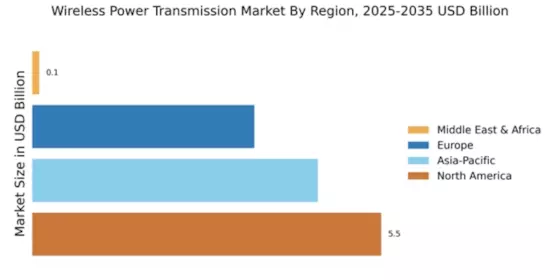
North America is poised to dominate the Wireless Power Transmission Market, holding a market size of $5.5 billion in 2025. The region's growth is driven by increasing demand for efficient charging solutions in consumer electronics and electric vehicles. Regulatory support, including initiatives for smart grid technologies, further catalyzes market expansion. The presence of major tech companies accelerates innovation, making North America a hub for wireless power advancements. The competitive landscape is robust, with key players like Qualcomm, WiTricity, and Energous leading the charge. The U.S. stands out as a primary market, supported by significant investments in R&D and infrastructure. Companies are focusing on partnerships and collaborations to enhance their product offerings. As the market matures, North America is expected to maintain its leadership position, driven by continuous technological advancements and consumer adoption.

Europe : Emerging Market with Strong Potential

Europe is witnessing a significant rise in the Wireless Power Transmission Market, projected to reach $3.5 billion by 2025. The region's growth is fueled by increasing adoption of electric vehicles and smart devices, alongside stringent regulations promoting energy efficiency. Countries like Germany and France are at the forefront, implementing policies that encourage innovation in wireless technologies, thus enhancing market dynamics. The competitive landscape features key players such as Samsung and Sony, who are investing heavily in R&D to capture market share. The European market is characterized by a mix of established companies and innovative startups, fostering a vibrant ecosystem. As the region embraces sustainable energy solutions, the demand for wireless power technologies is expected to grow, positioning Europe as a significant player in the global market.

Asia-Pacific : Rapid Growth and Adoption

Asia-Pacific is emerging as a powerhouse in the Wireless Power Transmission Market, with a projected size of $4.5 billion by 2025. The region's rapid urbanization and increasing smartphone penetration are key drivers of demand. Countries like Japan and South Korea are leading the charge, supported by government initiatives aimed at enhancing technological infrastructure and promoting clean energy solutions. The competitive landscape is vibrant, with major players like Nippon Telegraph and Samsung actively investing in wireless power technologies. The presence of a large consumer base and a growing middle class further fuels market growth. As companies innovate and expand their product lines, Asia-Pacific is set to become a critical region for wireless power advancements, attracting global investments and partnerships.

Middle East and Africa : Emerging Market with Challenges

The Middle East and Africa region is in the nascent stages of the Wireless Power Transmission Market, with a market size of $0.11 billion projected for 2025. The growth is hindered by infrastructural challenges and limited consumer awareness. However, increasing investments in renewable energy and smart technologies are beginning to create opportunities for wireless power solutions. Countries like South Africa are exploring innovative energy solutions to meet growing demands. The competitive landscape is still developing, with few key players present. Local startups are beginning to emerge, focusing on niche markets and tailored solutions. As the region's economies diversify and technological adoption increases, the Wireless Power Transmission Market is expected to gain traction, albeit at a slower pace compared to other regions. The potential for growth remains significant as awareness and infrastructure improve.

Key Players and Competitive Insights

The Wireless Power Transmission Market is currently characterized by a dynamic competitive landscape, driven by technological advancements and increasing demand for efficient energy solutions. Key players such as Qualcomm (US), Nippon Telegraph and Telephone Corporation (JP), and WiTricity Corporation (US) are at the forefront, each adopting distinct strategies to enhance their market positioning. Qualcomm (US) focuses on innovation in semiconductor technology, aiming to integrate wireless charging capabilities into a broader range of consumer electronics. Meanwhile, Nippon Telegraph and Telephone Corporation (JP) emphasizes partnerships with automotive manufacturers to develop wireless charging systems for electric vehicles, thereby expanding its operational focus into the burgeoning EV market. WiTricity Corporation (US) is leveraging its proprietary technology to establish strategic alliances with various tech firms, enhancing its competitive edge through collaborative innovation.

The business tactics employed by these companies reflect a concerted effort to optimize supply chains and localize manufacturing processes. The market structure appears moderately fragmented, with several players vying for dominance while also collaborating on technological advancements. This collective influence of key players fosters a competitive environment where innovation and strategic partnerships are paramount.

In November 2025, Qualcomm (US) announced a groundbreaking partnership with a leading smartphone manufacturer to integrate its latest wireless charging technology into upcoming flagship devices. This strategic move is likely to enhance Qualcomm's market share and solidify its reputation as a leader in wireless power solutions, particularly in the consumer electronics sector. The collaboration not only showcases Qualcomm's commitment to innovation but also highlights the growing trend of integrating wireless charging into everyday devices.

In October 2025, Nippon Telegraph and Telephone Corporation (JP) unveiled a new wireless charging system designed specifically for electric vehicles, in collaboration with a major automotive manufacturer. This initiative is significant as it positions NTT as a key player in the EV charging infrastructure, potentially transforming the way electric vehicles are powered. The strategic importance of this development lies in its alignment with global sustainability goals and the increasing adoption of electric vehicles.

In September 2025, WiTricity Corporation (US) secured a partnership with a prominent tech firm to co-develop next-generation wireless charging solutions for smart home devices. This collaboration is indicative of the growing trend towards smart home integration, where seamless energy transfer is becoming essential. The strategic implications of this partnership suggest a shift towards creating a more interconnected ecosystem of devices, enhancing user convenience and energy efficiency.

As of December 2025, the competitive trends in the Wireless Power Transmission Market are increasingly defined by digitalization, sustainability, and the integration of AI technologies. Strategic alliances are shaping the landscape, enabling companies to pool resources and expertise to drive innovation. Looking ahead, competitive differentiation is likely to evolve from traditional price-based competition to a focus on technological innovation, supply chain reliability, and sustainable practices. This shift underscores the importance of adaptability and forward-thinking strategies in maintaining a competitive edge in a rapidly changing market.

Key Companies in the Wireless Power Transmission Market market include

Industry Developments

In recent months, the Wireless Power Transmission Market has experienced significant developments with key players like Powercast, Freescale Semiconductor, and Samsung Electronics making strides in innovations. Powercast unveiled enhancements to its technology for charging electronics over distances in October 2023, while Freescale Semiconductor introduced a new wireless charging solution for electric vehicle applications in September 2023, highlighting increasing diversification in market applications. Additionally, Nippon Telegraph and Telephone Corporation and WiTricity have been collaborating on advanced charging technologies, aiming to enhance efficiency and reduce costs in the automotive sector.

In September 2023, Energous announced a strategic partnership with Lenovo to integrate wireless charging capabilities in their upcoming product lines. Notably, there have been public disclosures of acquisitions in the sector, including Qualcomm's acquisition of a smaller wireless tech firm in August 2023, which strengthens its portfolio in wireless charging technologies. Overall, the current market dynamics indicate robust growth potential, driven by technological advancements and expanding applications across various industries, such as consumer electronics and automotive, thereby enhancing the competitive landscape of the Wireless Power Transmission Market.


Future Outlook

Wireless Power Transmission Market Future Outlook

The Wireless Power Transmission Market is projected to grow at a 20.4% CAGR from 2024 to 2035, driven by advancements in technology, increasing demand for electric vehicles, and the proliferation of IoT devices.

New opportunities lie in:

  • Development of wireless charging infrastructure for electric vehicles in urban areas.
  • Integration of wireless power solutions in consumer electronics for enhanced user convenience.
  • Partnerships with renewable energy providers to create sustainable wireless charging networks.

By 2035, the Wireless Power Transmission Market is expected to be a pivotal sector, reflecting robust growth and innovation.

Market Segmentation

Wireless Power Transmission Market End Use Outlook

  • Residential
  • Commercial
  • Industrial
  • Healthcare
  • Transportation

Wireless Power Transmission Market Technology Outlook

  • Resonant Inductive Coupling
  • Magnetic Resonance Coupling
  • Capacitive Coupling
  • Laser Power Transmission
  • Microwave Power Transmission

Wireless Power Transmission Market Application Outlook

  • Consumer Electronics
  • Electric Vehicles
  • Industrial Equipment
  • Medical Devices
  • Telecommunications

Report Scope

MARKET SIZE 202413.61(USD Billion)
MARKET SIZE 202516.39(USD Billion)
MARKET SIZE 2035104.95(USD Billion)
COMPOUND ANNUAL GROWTH RATE (CAGR)20.4% (2024 - 2035)
REPORT COVERAGERevenue Forecast, Competitive Landscape, Growth Factors, and Trends
BASE YEAR2024
Market Forecast Period2025 - 2035
Historical Data2019 - 2024
Market Forecast UnitsUSD Billion
Key Companies ProfiledQualcomm (US), Nippon Telegraph and Telephone Corporation (JP), WiTricity Corporation (US), Energous Corporation (US), Powercast Corporation (US), Samsung Electronics (KR), Sony Corporation (JP), Ossia Inc. (US)
Segments CoveredApplication, Technology, End Use
Key Market OpportunitiesIntegration of Wireless Power Transmission in electric vehicle charging infrastructure presents substantial growth potential.
Key Market DynamicsTechnological advancements and regulatory support drive the expansion of the Wireless Power Transmission Market.
Countries CoveredNorth America, Europe, APAC, South America, MEA

Market Highlights

Author
Aarti Dhapte
Team Lead - Research

She holds an experience of about 6+ years in Market Research and Business Consulting, working under the spectrum of Information Communication Technology, Telecommunications and Semiconductor domains. Aarti conceptualizes and implements a scalable business strategy and provides strategic leadership to the clients. Her expertise lies in market estimation, competitive intelligence, pipeline analysis, customer assessment, etc.

Leave a Comment

FAQs

What was the expected market size of the Wireless Power Transmission Market in 2024?

The Wireless Power Transmission Market reached a valuation of 7.33 billion USD in 2024.

What will be the market size by 2035?

By 2035, the market is projected to grow to 25.0 billion USD.

What is the expected CAGR for the Wireless Power Transmission Market from 2025 to 2035?

The market is anticipated to register a CAGR of 20.40% from 2025 to 2035.

Which region is expected to dominate the Wireless Power Transmission Market?

North America is expected to hold a significant market share, with a valuation of 7.5 billion USD by 2035.

What market size is projected for Asia Pacific in 2035?

The Asia Pacific region is expected to reach a market size of 9.5 billion USD by 2035.

How is the Magnetic Resonant Coupling technology expected to grow in the market?

Magnetic Resonant Coupling is projected to expand from 1.83 billion USD in 2024 to 6.25 billion USD in 2035.

Who are the key players in the Wireless Power Transmission Market?

Major players include Powercast, Samsung Electronics, Sony, and Qualcomm, among others.

What was the market value of Inductive Coupling technology in 2024?

Inductive Coupling technology was valued at 2.2 billion USD in 2024.

What will be the market value for Capacitive Coupling by 2035?

The market value for Capacitive Coupling is expected to reach 3.81 billion USD by 2035.

What are the expected challenges in the Wireless Power Transmission Market?

Challenges include market competition and technological advancements that may impact growth opportunities.

Download Free Sample

Kindly complete the form below to receive a free sample of this Report

Compare Licence

×
Features License Type
Single User Multiuser License Enterprise User
Price $4,950 $5,950 $7,250
Maximum User Access Limit 1 User Upto 10 Users Unrestricted Access Throughout the Organization
Free Customization
Direct Access to Analyst
Deliverable Format
Platform Access
Discount on Next Purchase 10% 15% 15%
Printable Versions