×
Request Free Sample ×

Kindly complete the form below to receive a free sample of this Report

* Please use a valid business email

Leading companies partner with us for data-driven Insights

clients tt-cursor
Hero Background

Womens Health Devices Market

ID: MRFR/HC/9744-HCR
128 Pages
Rahul Gotadki
October 2025

Women’s Health Devices Market Research Report Information By Application (General Health and wellness, Cancers and Other Chronic Diseases, Reproductive Health, Pregnancy and Nursing Care, Pelvic and Uterine Healthcare, and Others), By End-user (Hospitals and Clinics, Home Healthcare, and Others), And By Region (North America, Europe, Asia-Pacific, And Rest of The World) –Market Forecast Till 2035

Share:
Download PDF ×

We do not share your information with anyone. However, we may send you emails based on your report interest from time to time. You may contact us at any time to opt-out.

Womens Health Devices Market Infographic
Purchase Options

Womens Health Devices Market Summary

As per MRFR analysis, the Womens Health Devices Market was estimated at 63.03 USD Billion in 2024. The Womens Health Devices industry is projected to grow from 68.26 USD Billion in 2025 to 151.55 USD Billion by 2035, exhibiting a compound annual growth rate (CAGR) of 8.3 during the forecast period 2025 - 2035.

Key Market Trends & Highlights

The Womens Health Devices Market is experiencing a dynamic evolution driven by technological advancements and increasing awareness of women's health issues.

  • The market is witnessing a shift towards personalized health solutions that cater to individual needs.
  • Integration of telehealth services is becoming increasingly prevalent, enhancing accessibility to women's health devices.
  • Fertility monitoring remains the largest segment, while menopause management is emerging as the fastest-growing area in the market.
  • Rising awareness of women's health issues and technological advancements in health devices are key drivers propelling market growth.

Market Size & Forecast

2024 Market Size 63.03 (USD Billion)
2035 Market Size 151.55 (USD Billion)
CAGR (2025 - 2035) 8.3%

Major Players

Abbott (US), Bayer (DE), Medtronic (US), Hologic (US), Philips (NL), GE Healthcare (US), Johnson & Johnson (US), Stryker (US), Siemens Healthineers (DE)

Womens Health Devices Market Trends

The Womens Health Devices Market is currently experiencing a transformative phase, characterized by a growing emphasis on personalized healthcare solutions. This shift is largely driven by advancements in technology, which enable the development of innovative devices tailored to meet the unique needs of women. As awareness regarding women's health issues continues to rise, there is an increasing demand for devices that not only address reproductive health but also encompass broader aspects such as mental well-being and chronic disease management. Furthermore, the integration of telehealth services is reshaping how women access healthcare, allowing for more convenient and efficient consultations. In addition, the market is witnessing a surge in investment from both public and private sectors, aimed at fostering research and development in this field. This influx of funding is likely to accelerate the introduction of cutting-edge products, enhancing the overall quality of care available to women. Moreover, collaborations between technology firms and healthcare providers appear to be on the rise, suggesting a trend towards more holistic approaches in women's health. As the landscape evolves, it is essential for stakeholders to remain agile and responsive to the changing needs of consumers, ensuring that the Womens Health Devices Market continues to thrive and innovate.

Personalized Health Solutions

The Womens Health Devices Market is increasingly focusing on personalized health solutions, which cater to the specific needs of women. This trend reflects a broader shift towards individualized care, where devices are designed to address unique health concerns, enhancing user experience and outcomes.

Integration of Telehealth

The integration of telehealth services into the Womens Health Devices Market is transforming how women access healthcare. This trend facilitates remote consultations and monitoring, making healthcare more accessible and convenient, particularly for those in underserved areas.

Collaborative Innovations

Collaborative innovations between technology companies and healthcare providers are becoming more prevalent in the Womens Health Devices Market. These partnerships aim to develop comprehensive solutions that address various aspects of women's health, promoting a more integrated approach to care.

Womens Health Devices Market Drivers

Rising Awareness of Women's Health Issues

The increasing awareness surrounding women's health issues is a notable driver in the Global Women’s Health Devices Market Industry. As educational initiatives and health campaigns proliferate, women are becoming more informed about their health needs, leading to a higher demand for specialized health devices. This trend is reflected in the market's projected growth, with an estimated value of 63.0 USD Billion in 2024. The emphasis on preventive care and early diagnosis is likely to further stimulate the adoption of devices such as fertility monitors and menstrual health trackers, thereby enhancing overall health outcomes for women globally.

Market Segment Insights

By Application: Fertility Monitoring (Largest) vs. Menopause Management (Fastest-Growing)

In the Women's Health Devices Market, the application segments showcase varied dominance. Fertility Monitoring holds the largest share among these segments, attributed to the increasing focus on reproductive health and family planning. This segment's prominence is further supported by technological advancements in fertility tracking, allowing women to understand their cycles better. On the other hand, Menopause Management is emerging swiftly as a notable segment, reflecting a growing awareness of menopausal health and the introduction of innovative products designed to ease symptoms associated with menopause. As the market evolves, several factors are driving growth within these segments. The surge in fertility awareness, coupled with rising disposable incomes, has amplified interest in Fertility Monitoring devices. Meanwhile, demographic shifts, including an aging population, are propelling the demand for Menopause Management solutions. Furthermore, educational campaigns and healthcare provider initiatives enhance accessibility and acceptance, positioning these segments for significant growth in the coming years.

Fertility Monitoring: Dominant vs. Menopause Management: Emerging

Fertility Monitoring is characterized by its advanced technological offerings, providing women with tools that range from ovulation detectors to hormone level analyzers. As the dominant application in the Women’s Health Devices Market, it empowers women by facilitating data-driven insights into their reproductive health. The implications of such technologies extend beyond simple monitoring; they play a crucial role in family planning and enhancing fertility awareness. Conversely, Menopause Management is rapidly becoming an emerging segment, largely due to the introduction of innovative relief solutions such as smart wearables and hormone therapy devices. This growing segment caters specifically to the needs of women experiencing menopausal transitions, bringing comfort and improved quality of life, and it is supported by increasing investment in research and relevant healthcare initiatives.

By Device Type: Wearable Devices (Largest) vs. Diagnostic Devices (Fastest-Growing)

In the Women's Health Devices Market, the segment of wearable devices leads the way, capturing significant market share due to the growing emphasis on personal health monitoring and fitness among women. These devices have become essential tools for tracking health metrics, which contributes to their dominant position in the market. Following closely is the diagnostic devices segment, which, while not the largest, is witnessing rapid growth as more women seek preventive healthcare options and early disease detection, boosting its market presence.

Wearable Devices (Dominant) vs. Diagnostic Devices (Emerging)

Wearable devices have established themselves as the dominant force in the Women's Health Devices Market, characterized by their ability to provide real-time health data and personalized health insights. This segment ranges from fitness trackers to advanced monitoring devices tailored specifically for women's health needs. In contrast, diagnostic devices are emerging, enhancing the healthcare landscape with innovations that allow for faster and more accurate health assessments. The growing awareness of women's health issues propels this segment, paving the way for future advancements in diagnostic technology that cater specifically to women's unique health profiles.

By End User: Healthcare Providers (Largest) vs. Hospitals (Fastest-Growing)

In the Women's Health Devices Market, the segmentation by end users reveals that healthcare providers represent the largest share of market demand, reflecting the critical role they play in delivering women's health services. Clinics and research institutions also contribute significantly, albeit to a lesser extent, while hospitals are emerging as a key factor in market dynamics. This structure indicates that healthcare providers and hospitals are at the forefront of shaping market trends, driving adoption, and influencing purchasing decisions.

Healthcare Providers (Dominant) vs. Hospitals (Emerging)

Healthcare providers are the dominant end users in the Women's Health Devices Market, as they not only facilitate access to essential health technology but also guide treatment protocols and innovations. Their established relationships with manufacturers enable streamlined procurement and adoption of new devices. Hospitals, on the other hand, are categorized as emerging players in this space, increasingly investing in advanced women's health solutions. This growth is driven by heightened awareness of women's health issues and the integration of technology to enhance patient care. The collaboration between hospitals and healthcare providers further strengthens the market landscape.

Get more detailed insights about Womens Health Devices Market

Regional Insights

North America : Market Leader in Innovation

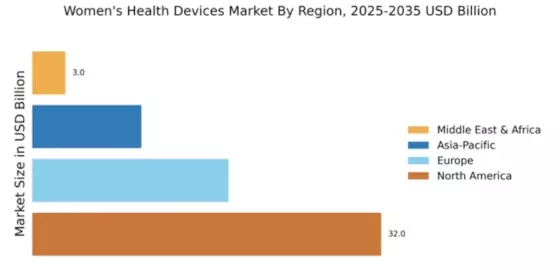
North America holds a commanding market share of 32.0 in the Women's Health Devices sector, driven by advanced healthcare infrastructure, increasing awareness of women's health issues, and supportive regulatory frameworks. The demand for innovative devices is further fueled by rising healthcare expenditures and a growing focus on preventive care. Regulatory bodies are actively promoting initiatives to enhance women's health, contributing to market growth. The competitive landscape in North America is robust, featuring key players such as Abbott, Medtronic, and Hologic. The U.S. stands out as a leader in technological advancements and product development, with significant investments in research and development. The presence of established companies and a strong distribution network enhances market accessibility, ensuring that women have access to essential health devices. The region's commitment to improving women's health outcomes is evident in its ongoing innovations and market strategies.

Europe : Emerging Market with Potential

Europe's Women's Health Devices market is valued at 18.0, reflecting a growing recognition of women's health needs. Factors such as increasing life expectancy, rising awareness of health issues, and supportive government policies are driving demand. The European market is characterized by stringent regulations that ensure product safety and efficacy, fostering consumer trust and encouraging market growth. The focus on preventive healthcare and early diagnosis is also a significant catalyst for the sector. Leading countries in Europe include Germany, France, and the UK, where key players like Bayer and Siemens Healthineers are making substantial contributions. The competitive landscape is marked by innovation and collaboration among companies, healthcare providers, and regulatory bodies. The European market is witnessing a surge in new product launches and partnerships aimed at enhancing women's health, positioning the region as a vital player in the global market.

Asia-Pacific : Rapidly Growing Market

The Asia-Pacific region, with a market size of 10.0, is experiencing rapid growth in the Women's Health Devices sector. This growth is driven by increasing healthcare access, rising disposable incomes, and a growing awareness of women's health issues. Governments in the region are implementing policies to improve healthcare infrastructure and promote women's health initiatives, which are crucial for market expansion. The demand for advanced health devices is also being fueled by a shift towards preventive healthcare and early diagnosis. Countries like China, India, and Japan are leading the charge in this market, with significant investments from key players such as Philips and GE Healthcare. The competitive landscape is evolving, with both multinational corporations and local companies striving to capture market share. The region's diverse population and varying healthcare needs present unique opportunities for innovation and tailored solutions in women's health devices, making it a focal point for future growth.

Middle East and Africa : Emerging Market Opportunities

The Middle East and Africa region, with a market size of 3.03, is gradually emerging as a significant player in the Women's Health Devices market. Factors such as increasing healthcare investments, rising awareness of women's health issues, and government initiatives aimed at improving healthcare access are driving growth. The region is witnessing a shift towards modern healthcare solutions, with a focus on enhancing women's health outcomes through innovative devices and technologies. Leading countries in this region include South Africa and the UAE, where key players are beginning to establish a presence. The competitive landscape is characterized by a mix of local and international companies striving to meet the growing demand for women's health devices. As healthcare infrastructure improves and awareness increases, the Middle East and Africa are poised for substantial growth in this sector, presenting opportunities for investment and innovation.

Key Players and Competitive Insights

The Womens Health Devices Market is currently characterized by a dynamic competitive landscape, driven by innovation, technological advancements, and an increasing focus on personalized healthcare solutions. Key players such as Abbott (US), Bayer (DE), and Hologic (US) are strategically positioning themselves through a combination of product innovation and strategic partnerships. Abbott (US) has been particularly focused on expanding its portfolio of diagnostic devices, which aligns with the growing demand for early detection and preventive healthcare. Meanwhile, Bayer (DE) emphasizes its commitment to women's health through targeted research and development initiatives, aiming to enhance its product offerings in hormonal therapies and reproductive health devices. Hologic (US) continues to lead in the field of breast health and gynecological devices, leveraging its expertise to drive market growth and improve patient outcomes.

The business tactics employed by these companies reflect a concerted effort to optimize supply chains and localize manufacturing processes. The market appears moderately fragmented, with several players vying for market share while also collaborating on various fronts. This competitive structure allows for a diverse range of products and services, catering to the unique needs of women’s health. The collective influence of these key players fosters an environment where innovation is paramount, and companies are incentivized to differentiate themselves through advanced technologies and improved patient care solutions.

In November 2025, Abbott (US) announced the launch of a new line of wearable health monitoring devices specifically designed for women. This strategic move is anticipated to enhance Abbott's presence in the women's health segment, particularly in areas such as fertility tracking and menstrual health management. The introduction of these devices is likely to resonate with consumers seeking more personalized health insights, thereby positioning Abbott as a leader in this niche market.

In October 2025, Bayer (DE) entered into a partnership with a leading tech firm to develop AI-driven solutions for reproductive health. This collaboration aims to integrate artificial intelligence into Bayer's existing product lines, potentially revolutionizing how women manage their reproductive health. The strategic importance of this partnership lies in its potential to enhance user experience and improve health outcomes through data-driven insights, thereby solidifying Bayer's competitive edge in the market.

In September 2025, Hologic (US) expanded its product offerings by acquiring a startup specializing in telehealth solutions for women's health. This acquisition is expected to bolster Hologic's capabilities in providing remote healthcare services, which have become increasingly relevant in today's healthcare landscape. The strategic importance of this move is underscored by the growing demand for accessible healthcare solutions, particularly in underserved regions, thus enhancing Hologic's market position.

As of December 2025, the competitive trends within the Womens Health Devices Market are increasingly defined by digitalization, sustainability, and the integration of AI technologies. Strategic alliances are playing a crucial role in shaping the current landscape, enabling companies to leverage each other's strengths and innovate more rapidly. Looking ahead, it is likely that competitive differentiation will evolve from traditional price-based strategies to a focus on innovation, technological advancements, and supply chain reliability. This shift underscores the importance of adaptability and forward-thinking in a market that is continuously evolving.

Key Companies in the Womens Health Devices Market market include

Industry Developments

  • Q2 2024: Maven Clinic raises $90M Series E to expand women’s and family health platform Maven Clinic, a digital health company focused on women’s and family health, secured $90 million in Series E funding to expand its virtual care offerings and global reach.
  • Q2 2024: Hologic receives FDA approval for new Genius Digital Diagnostics System Hologic announced it received FDA approval for its Genius Digital Diagnostics System, a new device designed to improve cervical cancer screening for women in the United States.
  • Q2 2024: Clue secures $20 million in funding to advance menstrual health tracking technology Berlin-based femtech company Clue raised $20 million in a new funding round to further develop its menstrual health tracking app and expand its product offerings.
  • Q2 2024: CooperSurgical acquires Ostro for undisclosed sum to bolster fertility solutions portfolio CooperSurgical announced the acquisition of Ostro, a digital health company specializing in fertility support tools, to enhance its suite of women’s health and fertility solutions.
  • Q2 2024: Elvie launches Elvie Stride Plus, a new wearable breast pump in the US Elvie, a leading femtech company, launched the Elvie Stride Plus, a wearable breast pump designed for hands-free, discreet pumping, expanding its product line in the US market.
  • Q3 2024: Theramex receives European Commission approval for Bijuva, a hormone therapy for menopause Theramex announced it received European Commission approval for Bijuva, an oral hormone therapy for the treatment of menopause symptoms in women.
  • Q3 2024: Flo Health appoints new CEO to drive next phase of growth Flo Health, the developer of a leading women’s health app, announced the appointment of a new CEO to lead the company’s global expansion and product innovation strategy.
  • Q3 2024: Natural Cycles partners with Oura to integrate temperature data for fertility tracking Natural Cycles, a digital birth control app, announced a partnership with Oura to integrate temperature data from the Oura Ring, enhancing the app’s fertility tracking capabilities.
  • Q3 2024: Kindbody opens new fertility clinic in Chicago Kindbody, a fertility and women’s health company, opened a new clinic in Chicago to expand access to fertility services and reproductive care.
  • Q4 2024: Ava Science receives FDA clearance for Ava Fertility Tracker 2.0 Ava Science announced it received FDA clearance for its updated Ava Fertility Tracker 2.0, a wearable device designed to help women track ovulation and improve chances of conception.
  • Q1 2025: FemTec Health raises $50 million in Series B funding to expand personalized women’s health platform FemTec Health, a digital health startup focused on personalized women’s health solutions, raised $50 million in Series B funding to accelerate product development and market expansion.
  • Q2 2025: Roche launches new HPV self-sampling solution for cervical cancer screening Roche announced the launch of a new HPV self-sampling solution, enabling women to collect samples at home for cervical cancer screening, aiming to increase screening rates and early detection.

Future Outlook

Womens Health Devices Market Future Outlook

The Womens Health Devices Market is projected to grow at an 8.3% CAGR from 2024 to 2035, driven by technological advancements, increasing awareness, and rising healthcare expenditures.

New opportunities lie in:

  • Development of telehealth platforms for remote monitoring of women's health
  • Integration of AI-driven analytics in diagnostic devices
  • Expansion of subscription-based models for health monitoring devices

By 2035, the market is expected to be robust, reflecting substantial growth and innovation.

Market Segmentation

Womens Health Devices Market End User Outlook

  • Individuals
  • Healthcare Providers
  • Clinics
  • Hospitals
  • Research Institutions

Womens Health Devices Market Application Outlook

  • Fertility Monitoring
  • Menstrual Health
  • Pregnancy Care
  • Menopause Management
  • Sexual Health

Womens Health Devices Market Device Type Outlook

  • Wearable Devices
  • Diagnostic Devices
  • Therapeutic Devices
  • Monitoring Devices
  • Surgical Devices

Report Scope

MARKET SIZE 202463.03(USD Billion)
MARKET SIZE 202568.26(USD Billion)
MARKET SIZE 2035151.55(USD Billion)
COMPOUND ANNUAL GROWTH RATE (CAGR)8.3% (2024 - 2035)
REPORT COVERAGERevenue Forecast, Competitive Landscape, Growth Factors, and Trends
BASE YEAR2024
Market Forecast Period2025 - 2035
Historical Data2019 - 2024
Market Forecast UnitsUSD Billion
Key Companies ProfiledAbbott (US), Bayer (DE), Medtronic (US), Hologic (US), Philips (NL), GE Healthcare (US), Johnson & Johnson (US), Stryker (US), Siemens Healthineers (DE)
Segments CoveredApplication, Device Type, End User
Key Market OpportunitiesIntegration of telehealth solutions enhances accessibility in the Womens Health Devices Market.
Key Market DynamicsRising consumer awareness drives demand for innovative women's health devices amid evolving regulatory and technological landscapes.
Countries CoveredNorth America, Europe, APAC, South America, MEA

Leave a Comment

FAQs

What is the projected growth of the Women’s Health Devices market?

The Women’s Health Devices market is the expected increase in total market value of 151.55 USD billion over a defined forecast period 2025–2035. It is driven by factors such as demand trends, technological advances, regulatory changes, and geographic expansion.

What is the size of the Women’s Health Devices market?

Women’s Health Devices market size was valued at approximately 63.03 billion USD in 2024. This figure will reach 151.55 billion USD covering all regions (America, Europe, Asia, MEA and ROW), focusing its segments / services / distribution channels till 2035.

What is the CAGR of the Women’s Health Devices market?

Women’s Health Devices market is expected to grow at a CAGR of 8.3% between 2025 and 2035.

How much will the Women’s Health Devices market be worth by 2035?

Women’s Health Devices market is expected to be worth of 151.55 billion USD, reflecting growth driven by usage, technology and global demands by the end of 2035.

How will the Women’s Health Devices market perform over the next 10 years?

Over the next 10 years the Women’s Health Devices market is expected to shift from usd billion 63.03 to 151.55 billion USD, led by adoption of advanced tech, demographic trends, regulatory approvals, with potential headwinds from 2025 to 2035.

Which region held the largest market share in the Women’s Health Devices Market?

North America had the largest share of the global market

Download Free Sample

Kindly complete the form below to receive a free sample of this Report

Compare Licence

×
Features License Type
Single User Multiuser License Enterprise User
Price $4,950 $5,950 $7,250
Maximum User Access Limit 1 User Upto 10 Users Unrestricted Access Throughout the Organization
Free Customization
Direct Access to Analyst
Deliverable Format
Platform Access
Discount on Next Purchase 10% 15% 15%
Printable Versions