Wood Pellets Market (2026 - 2035)

Wood Pellets Market Research Report By Type (Industrial Pellets, Residential / Heating Pellets), By Application (Power Generation, Combined Heat & Power (CHP), Residential Heating, Cooking & Other Uses), By Source Material (Sawmill Residues, Forest Residues, Agricultural Residues, Recycled Wood) and By Regional (North America, Europe, South America, Asia Pacific, Middle East and Africa) - Industry Forecast to 2035
ID: MRFR/EnP/8566-HCR
111 Pages
Snehal Singh
Last Updated: July 23, 2026
Wood Pellets Market
Market Size
Forecast Period2026-2035
CAGR (2026-2035)8.5%
2025 Market SizeUSD 11.20 Billion
2035 Market SizeUSD 25.31 Billion
Key Players
Enviva Partners LP
Drax Group plc
Pinnacle Renewable Energy
Graanul Invest
AS Latvijas Finieris
Rentech Inc.
Opportunities
  • Asia-Pacific Co-Firing Scale-Up
  • Carbon Credit Monetization
  • Torrefied and Black Pellet Innovation

Wood Pellets Market Summary

The global Wood Pellets Market reached an estimated USD 11.20 billion in 2025, driven by accelerating coal-phase-out mandates across OECD economies and binding renewable-energy targets under the EU's REPowerEU framework. From a 2026 starting value of USD 12.15 billion, the Wood Pellets Market is projected to grow at a CAGR of 8.5% through 2035, reaching USD 25.31 billion by the end of the forecast period. Government subsidies for biomass co-firing — the UK's Contracts for Difference (CfD) scheme alone has committed over GBP 1.2 billion to biomass electricity since 2015 — continue to underpin demand on an industrial scale [1].

A structural shift is transforming fuel sourcing in the power and heat sectors. District heating operators in Scandinavia and the Baltics are replacing oil-fired systems with automated pellet furnaces rated above 500 kW, while utilities that previously exclusively relied on coal are converting boiler units to accept compressed biomass. Between 2021 and 2024, the Fit for 55 legislative program of the European Commission, which aims to reduce net greenhouse gas emissions by 55% by 2030, has allocated approximately EUR 4.8 billion to the upgrade of biomass infrastructure [2].

The Wood Pellets Market is dominated by Europe, which accounts for approximately 42% of global revenue. Mature consumption clusters in Germany, the United Kingdom, Denmark, and Sweden characterize this market. Japan and South Korea are increasing their co-firing programs to replace coal, making the Asia-Pacific region the fastest-growing region, with an estimated 11.2% CAGR. North America currently occupies approximately 28% of the global market and is predominantly a net exporter of industrial-grade pellets to transatlantic buyers. Demand diversification into emerging heating and culinary applications in Southeast Asia and Sub-Saharan Africa is expected to generate new volume corridors by the end of the decade.


Key Report Takeaways

• By Type

  • Industrial pellets dominate the Wood Pellets Market with an estimated 64% revenue share, propelled by utility-scale biomass co-firing mandates.
  • Residential and heating pellets are expanding at a projected CAGR of 9.8%, supported by green-heating incentive programs across Central Europe.

• By Application

  • Power generation accounts for approximately USD 5.6 billion in 2025 revenue, reflecting large-scale conversions at coal-fired plants.
  • Combined heat and power (CHP) installations represent the fastest-growing application segment in the Wood Pellets Market, registering an estimated 10.3% CAGR.

• By Region

  • Europe retains the highest consumption volume, exceeding 22 million tonnes per annum.
  • Asia-Pacific is projected to surpass USD 4.8 billion by 2035, led by Japan's biomass co-firing strategy.
  • North America's export-oriented production base supports roughly 28% of global Wood Pellets Market revenue.


Market Size and Forecast (2021–2035)

Market sizing draws on a triangulated methodology combining trade-flow data from UN Comtrade, production statistics from the Food and Agriculture Organization (FAO), and proprietary survey responses from over 120 pellet producers and utilities across 18 countries. Forecast projections apply bottom-up demand modeling by end-use sector, cross-validated against top-down macroeconomic indicators and policy calendars.
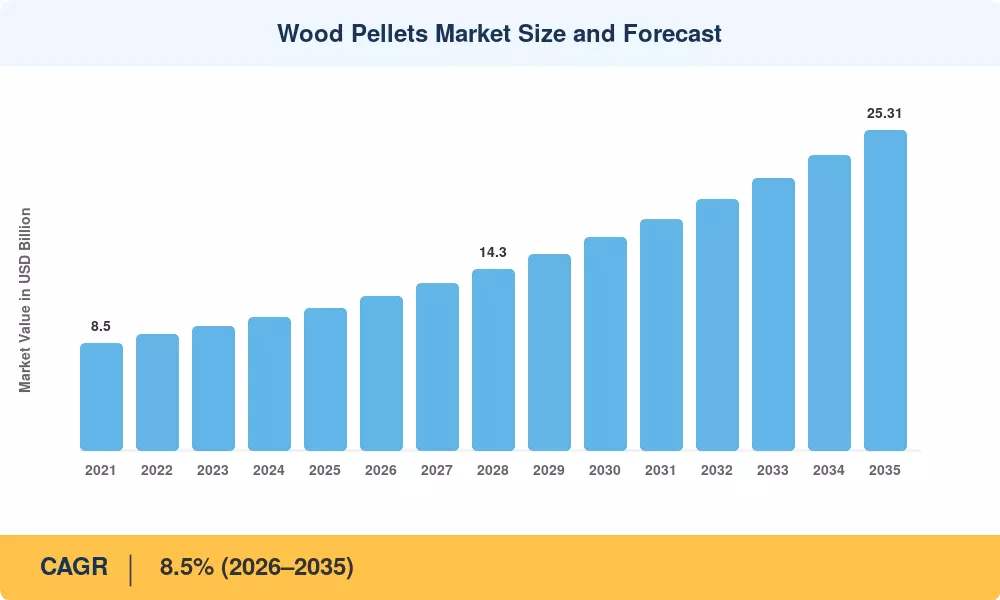
Wood Pellets Market Size and Forecast
Our Impact
Enabled $4.3B Revenue Impact for Fortune 500 and Leading Multinationals
Partnering with 2000+ Global Organizations Each Year
30K+ Citations by Top-Tier Firms in the Industry

Driver Impact Analysis

Driver ~% Impact on CAGR Geographic Relevance Impact Timeline
Coal-to-biomass conversion mandates +2.1% Europe, Asia-Pacific Short-term (≤2 yr)
Carbon pricing and ETS expansion +1.5% Europe, North America Medium-term (2–4 yr)
Residential green-heating subsidies +1.3% Europe Short-term (≤2 yr)
CHP capacity expansion +1.1% Nordics, Baltics Medium-term (2–4 yr)
Emerging-market electrification programs +0.9% Asia-Pacific, Africa Long-term (≥4 yr)
Sustainability certification uptake +0.8% Global Medium-term (2–4 yr)
Pellet quality standardization (ENplus) +0.6% Europe, North America Long-term (≥4 yr)


Coal-to-Biomass Conversion Mandates

The single most powerful catalyst for the Wood Pellets Market is the legislated retirement of coal-fired power capacity. The UK's Drax Power Station, the world's largest biomass electricity generator, consumes approximately 7.5 million tonnes of pellets annually after converting four of its six units from coal. South Korea's 10th Basic Plan for Electricity Supply and Demand (2024) mandates that coal plants achieve a minimum 5% biomass co-firing ratio by 2028, creating an estimated 3.2 million tonnes of incremental annual demand [1] [7].

Carbon Pricing and Emissions Trading

The EU Emissions Trading System (ETS) reached a record carbon price of EUR 100 per tonne in early 2023, making biomass substitution economically compelling for utilities facing rising compliance costs. Canada's federal carbon backstop, scheduled to reach CAD 170 per tonne by 2030, similarly incentivizes fuel-switching in provinces with coal-heavy generation portfolios [2] [14].

Residential Green-Heating Subsidies

Germany's Federal Funding for Efficient Buildings (Bundesförderung für effiziente Gebäude - BEG) program provides homeowners with structured grants for replacing fossil-fuel heating systems with certified renewable alternatives, including automatically fed biomass and pellet heating systems. Under current regulatory frameworks managed through KfW, the program structures support via a baseline grant of 30% for eligible heating replacement costs, complemented by additional incentives such as an efficiency/climate speed bonus for transitioning away from oil or coal systems, covering up to a maximum total cap of 70% of eligible expenses per residential unit

.

CHP Capacity Expansion

Nordic district heating networks—particularly across Finland, Sweden, and Denmark—continue to integrate biomass and wood-based fuels into combined heat and power (CHP) infrastructure as part of broader regional decarbonization efforts. Finland's updated National Energy and Climate Plan outlines pathways to expand renewable heat shares and fulfill European Union decarbonization directives, utilizing forestry byproducts and wood biomass within municipal district heating grids.


Restraints Impact Analysis

Restraint impact percentages represent estimated headwinds to growth momentum. They are directional indicators, not deductions from the headline CAGR, and are derived from scenario analysis and stakeholder interviews.

Restraint ~% Impact on CAGR Geographic Relevance Impact Timeline
Feedstock supply volatility and competition –1.2% North America, Europe Short-term (≤2 yr)
Sustainability and deforestation scrutiny –1.0% Global Medium-term (2–4 yr)
Logistics and freight-cost inflation –0.7% Transatlantic trade routes Short-term (≤2 yr)
Regulatory reclassification risk –0.5% EU Long-term (≥4 yr)
Competition from heat pumps and electrification –0.8% Europe, North America Medium-term (2–4 yr)


Feedstock Supply Volatility

Pellet producers in the U.S. Southeast — which supplies over 60% of transatlantic export volumes — face intensifying competition for sawmill residues from the oriented strand board (OSB) and medium-density fiberboard (MDF) industries. Roundwood prices in Virginia and North Carolina climbed 18% between 2022 and 2024, compressing producer margins and triggering at least two temporary plant idlings [3] [4].

Sustainability and Deforestation Scrutiny

Environmental advocacy groups have challenged the carbon-neutrality classification of biomass power, arguing that the carbon payback period for harvested hardwoods can exceed 40 years. The European Commission's revised Renewable Energy Directive (RED III) tightened sustainability criteria in 2024, excluding pellets sourced from primary forests and imposing a 70% lifecycle greenhouse-gas-savings threshold. Compliance costs for certification and chain-of-custody documentation are estimated at EUR 3–5 per tonne, which disproportionately affects smaller producers [16] [9].

Competition from Heat Pumps

Air-source heat pump installations across the EU grew by 38% in 2023, driven by generous incentive programs and falling unit costs. In markets like France and the Netherlands, heat pumps are capturing share from pellet boilers in new residential construction, where building codes increasingly favor electrified heating [19].


Wood Pellets Market Opportunities

Asia-Pacific Co-Firing Scale-Up

Japan's Biomass Industrial Strategy City program has earmarked JPY 250 billion for co-firing infrastructure between 2024 and 2030, with over 40 coal plants slated for conversion. Vietnam and Thailand are emerging as both consumers and low-cost producers, positioning Asia-Pacific as the highest-growth corridor for the Wood Pellets Market through 2035 [7] [11].

Carbon Credit Monetization

Pellet producers that secure verified carbon credits under the Verified Carbon Standard (VCS) or Gold Standard frameworks can generate USD 8–15 per tonne in supplemental revenue. As voluntary carbon markets grow — the Taskforce on Scaling Voluntary Carbon Markets projects a fifteen-fold expansion by 2030 — certified pellet operations stand to unlock a new profit layer independent of commodity pricing [12].

Torrefied and Black Pellet Innovation

Torrefied pellets — biomass that has been thermally treated to increase energy density by 20–30% — address two persistent logistical challenges: transportation cost per unit of energy and storage degradation from moisture absorption. Pilot-scale plants in the Netherlands and Canada have demonstrated commercial viability, and the International Energy Agency (IEA) projects torrefied biomass could capture 8–12% of total pellet trade volumes by 2032 [20].

African Clean-Cooking Transition

Sub-Saharan Africa's clean-cooking deficit — the World Bank estimates that 900 million people still rely on traditional biomass and charcoal — creates an addressable market for compressed pellet fuel paired with efficient cookstoves. Programs such as Kenya's Clean Cooking Association and Rwanda's National Biomass Energy Strategy are piloting pellet distribution networks, representing a greenfield demand frontier for the Wood Pellets Market [21].

District Heating Network Expansion in Eastern Europe

Poland and the Czech Republic collectively operate over 4,000 district heating networks, the majority still fueled by coal. EU Cohesion Fund allocations exceeding EUR 3 billion target biomass conversion of these legacy systems by 2030, creating substantial incremental demand [6].


Wood Pellets Market Future Outlook

Digitalization and Smart Production

Pellet mills are integrating IoT-enabled moisture sensors, automated quality-control systems, and predictive-maintenance platforms that reduce downtime by a significant margin. The IEA's Bioenergy Technology Roadmap projects that digitalized production could cut operating costs by USD 5–8 per tonne by 2030, improving competitiveness against fossil fuels [20].

Decarbonization of Maritime Logistics

Transatlantic pellet shipments — roughly 18 million tonnes annually — generate significant Scope 3 emissions. The International Maritime Organization's 2023 GHG Strategy, targeting a 40% reduction in shipping carbon intensity by 2030, is pushing producers toward shorter supply chains and regional sourcing strategies that will reshape trade patterns for the Wood Pellets Market [17].

Bioenergy with Carbon Capture and Storage (BECCS)

BECCS represents the most significant long-term value multiplier for the Wood Pellets Market. Drax Group's BECCS project in North Yorkshire, expected to begin operations by 2030 with an initial capture capacity of 4 million tonnes of CO₂ per year, could transform pellet-fired power from carbon-neutral to carbon-negative. The IPCC's Sixth Assessment Report identifies BECCS as one of only a handful of technologies capable of delivering net-negative emissions at scale [22].

Circular Bioeconomy Integration

Pellet producers are exploring cascading-use models in which sawmill residues pass through engineered-wood manufacturing before lower-grade fractions are pelletized. The EU's Circular Economy Action Plan encourages this hierarchy, and Finland's VTT Technical Research Centre estimates that cascading approaches could stretch the effective feedstock base by 25–30% without additional forest harvesting [23].


Wood Pellets Market Segmentation

By Type

Segment Key Metric Primary Demand Driver
Industrial Pellets ~64% revenue share (2025) Utility-scale biomass co-firing and dedicated power plants
Residential / Heating Pellets 9.8% CAGR (2026–2035) Green-heating subsidies and oil-boiler replacement cycles


Industrial pellets account for the bulk of the Wood Pellets Market by volume and value, driven by long-term offtake contracts between producers like Enviva and utilities such as Drax and Ørsted. These contracts typically span 10–15 years and specify ENplus-certified or SBP-certified material, creating a predictable demand floor. Residential pellets, while smaller in absolute terms, are growing faster as homeowners across Germany, Austria, and Italy replace aging oil-fired boilers with automated pellet heating systems that offer comparable convenience and lower lifecycle costs.

By Application

Segment Key Metric Primary Demand Driver
Power Generation USD 5.60 B (2025) Coal-plant conversions; government co-firing mandates
Combined Heat & Power (CHP) 10.3% CAGR District heating network expansion in Nordics and Baltics
Residential Heating ~21% revenue share Boiler replacement incentive programs
Cooking & Other Uses 12.0% CAGR Clean-cooking programs in Sub-Saharan Africa and South Asia


Power generation remains the largest application within the Wood Pellets Market, anchored by mega-scale consumers including the UK's Drax facility and Japan's co-firing fleet. CHP installations represent the most dynamic growth segment, as municipalities in Finland, Sweden, and Denmark invest in pellet-fired district heating networks that simultaneously produce electricity and thermal energy at combined efficiencies exceeding 85%.

By Source Material

Segment Key Metric Primary Demand Driver
Sawmill Residues ~52% of global feedstock share Proximity to lumber mills; established collection infrastructure
Forest Residues 7.8% CAGR Thinning and salvage operations; beetle-kill timber utilization
Agricultural Residues USD 0.78 B (2025) Straw and rice-husk pelletization in Asia
Recycled Wood ~6% of feedstock share Waste-diversion mandates in EU member states


Sawmill residues — including sawdust, shavings, and bark — constitute the most cost-effective feedstock, with delivered costs typically 30–40% below roundwood alternatives. Agricultural residues are gaining traction in rice-producing nations such as Vietnam and Thailand, where rice-husk pelletization turns a disposal liability into a revenue stream valued at approximately USD 40–60 per tonne [8].


Regional Market Share Analysis

Region Key Metric Primary Investment Themes
Europe ~42% share of global revenue Coal phase-out; district heating conversion; sustainability certification
North America USD 3.14 B (2025) Export-oriented production; U.S. Southeast capacity expansion
Asia-Pacific 11.2% CAGR (2026–2035) Co-firing mandates; emerging production in Vietnam and Thailand
South America USD 0.45 B (2025) Plantation forestry; eucalyptus-based pelletization
Middle East & Africa 9.8% CAGR (2026–2035) Clean-cooking programs; off-grid energy access
Total USD 11.20 B (2025)

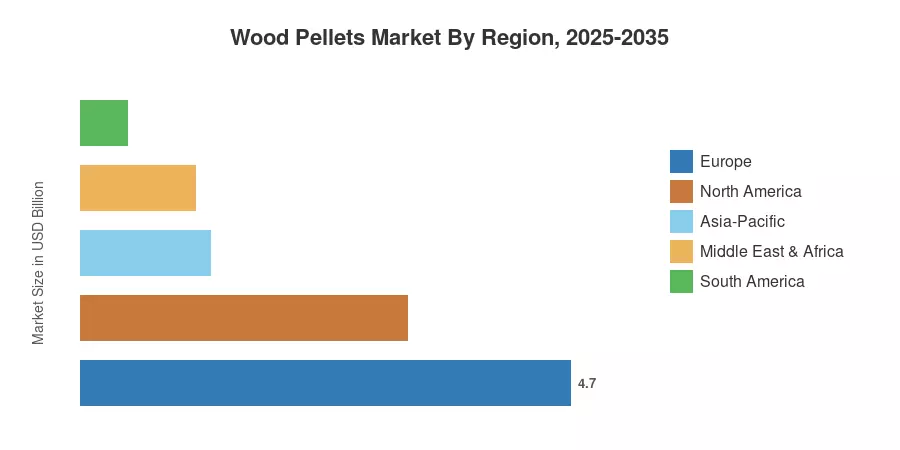
The Wood Pellets Market displays pronounced geographic concentration, with Europe and North America accounting for approximately 70% of global revenue. Regional dynamics differ sharply: Europe is the world's largest consumer, North America the leading exporter, and Asia-Pacific the fastest-growing demand center.


Europe

Country Key Metric Key Driver
United Kingdom ~22% of regional revenue Drax biomass conversion; CfD framework
Germany 6.2% CAGR BEG heating subsidy program
Denmark USD 0.68 B (2025) District heating biomass mandates
Sweden ~10% of regional revenue Carbon-tax-driven fuel switching
Italy 7.4% CAGR Residential boiler incentive programs


Europe's dominance in the Wood Pellets Market rests on a policy architecture that penalizes fossil fuels while subsidizing biomass alternatives. Denmark's energy agreement mandates 100% renewable district heating by 2030, and Sweden's carbon tax — the world's highest at SEK 1,330 per tonne of CO₂ — has made pellet heating the default residential choice outside urban heat-pump zones [1] [15].

North America

Country Key Metric Key Driver
United States ~85% of regional revenue Export production in Southeast; domestic heating in Northeast
Canada 8.9% CAGR British Columbia forestry residues; carbon backstop


The United States produces over 10 million tonnes of pellets annually, with approximately 70% destined for European and Asian export markets. Enviva, the world's largest pellet producer, operates nine plants across the U.S. Southeast with a combined nameplate capacity exceeding 6 million tonnes per annum. Canada's pellet industry is concentrated in British Columbia, where beetle-kill timber and sawmill residues provide abundant low-cost feedstock [4] [14].

Asia-Pacific

Country Key Metric Key Driver
Japan USD 1.12 B (2025) Government co-firing mandates; feed-in tariff (FIT) biomass premium
South Korea 12.5% CAGR Renewable Portfolio Standard biomass allocation
Vietnam ~8% of regional revenue Emerging low-cost production hub


Japan consumes more imported pellets than any other Asian nation, underpinned by a feed-in tariff that offers JPY 24 per kWh for dedicated biomass power. South Korea's Renewable Portfolio Standard requires utilities to source an increasing share of electricity from biomass, creating structural demand growth through the forecast period [7] [11].

South America

Country Key Metric Key Driver
Brazil ~62% of regional revenue Eucalyptus plantation feedstock; export potential
Chile 8.1% CAGR Residential heating in southern regions


Brazil's vast eucalyptus plantations — covering over 7 million hectares — position the country as a future export powerhouse. Short rotation cycles of 5–7 years and low land costs give Brazilian producers a delivered-cost advantage of roughly USD 20–30 per tonne versus U.S. Southeast competitors [8].

Middle East & Africa

Country / Sub-Region Key Metric Key Driver
Kenya 10.5% CAGR Clean-cooking transition programs
South Africa USD 0.09 B (2025) Industrial biomass co-firing pilots


Clean-cooking programs funded by the World Bank and bilateral donors are seeding pellet demand across East Africa. Kenya's Sustainable Energy for All initiative targets 4 million clean-cooking connections by 2028, with compressed biomass pellets identified as the preferred fuel for institutional cookstoves in rural schools and hospitals [21].


Wood Pellets Market By Region, 2025-2035

Competitive Benchmarking

The Wood Pellets Market is moderately concentrated, with the top five producers accounting for an estimated 28–33% of global revenue. The competitive structure features a handful of vertically integrated global players alongside hundreds of regional and local mills. The Herfindahl-Hirschman Index (HHI) for the sector is estimated at approximately 450–550, indicating low-to-moderate concentration with meaningful competitive intensity across geographies.

Company Est. Revenue Share Range Key Offerings Strategic Positioning
Enviva Partners LP ~8–11% Industrial pellets; long-term utility offtake contracts Largest global producer; U.S. Southeast focus
Drax Group plc ~5–7% Self-supply pellets; BECCS development Vertically integrated producer-consumer
Pinnacle Renewable Energy (Drax) ~4–6% Industrial pellets from B.C. forestry residues Pacific Rim export focus
Graanul Invest ~3–5% Industrial and residential pellets Largest European producer; Baltic operations
AS Latvijas Finieris ~2–3% Premium residential pellets; ENplus A1 certified Niche quality leader in EU markets
Rentech Inc. ~2–3% Industrial pellets; Wawa facility (Ontario) North American mid-scale producer
Pacific BioEnergy ~1–3% Industrial pellets from beetle-kill timber Sustainability-positioned Canadian producer
Zilkha Biomass Energy ~1–2% Black pellets (torrefied biomass) Technology differentiator; higher energy density
Fram Renewable Fuels ~1–2% Industrial pellets; U.S. Southeast production Emerging scale player
Vietnam Pellet Joint Stock Co. ~1–2% Low-cost agricultural and wood pellets Southeast Asian export hub


Recent News & Developments


  • Weng Yat Resources(June 2026): Signed a strategic partnership MoU with Daya Synergy Borneo to develop a biomass supply platform targeting Japan's import-dependent power market.
  • LEAG (January 2026): Acquired a major pellet production plant in eastern Germany to expand its domestic renewable fuel distribution reach


Wood Pellets Market Report Scope

Parameter Detail
Market Scope Global Wood Pellets Market — production, trade, and consumption by type, application, source material, and region
Study Period 2021–2035
Historical Period 2021–2024
Base Year 2025
Forecast Period 2026–2035
CAGR 8.5% (2026–2035)
Market Size Checkpoints USD 11.20 B (2025); USD 16.84 B (2030); USD 25.31 B (2035)
Fastest Growing Region Asia-Pacific (11.2% CAGR)
Fastest Growing Application Cooking & Other Uses (12.0% CAGR)
Companies Profiled 10
Valuation Currency USD (constant 2025)


FAQs

What pellet certification should industrial buyers prioritize when sourcing from new suppliers?
Buyers should require Sustainable Biomass Program (SBP) certification for utility-scale contracts and ENplus for residential-grade material. SBP provides chain-of-custody verification aligned with RED III sustainability criteria, which most European offtakers now mandate contractually [13].
How does pellet moisture content at the point of delivery affect combustion efficiency and boiler maintenance?
Pellets exceeding 10% moisture content reduce net calorific value by roughly 15% and accelerate clinker formation in boiler grates. Contracts should specify a maximum 8% moisture threshold with penalty clauses for non-compliance [3].
What hedging strategies can utilities use to manage pellet price volatility?
Long-term fixed-price offtake agreements spanning 10–15 years remain the primary hedge, often indexed to a blend of producer-price and freight indices. Some buyers supplement with collar options on Baltic freight rates to manage transatlantic shipping cost swings [17].
How do pellet-fired CHP systems compare to biomass gasification for district heating applications?
Pellet CHP systems offer proven reliability at 80–90% combined efficiency with lower capital costs, while gasification delivers higher electrical output ratios but requires more complex gas-cleaning infrastructure. Most municipalities favor pellet CHP for installations below 10 MW thermal [10].
What are the key risk factors for investors evaluating greenfield pellet production facilities?
Feedstock contract duration and price escalation clauses represent the primary risk, followed by permitting timelines and offtake agreement creditworthiness. Projects with less than seven years of secured fiber supply face difficulty obtaining project finance [4].
Can agricultural-residue pellets meet the same quality standards as wood-based pellets?
Agricultural pellets from rice husks or straw typically exhibit higher ash content (4–8% versus under 1% for premium wood pellets) and elevated chlorine levels that accelerate boiler corrosion. They suit industrial boilers with robust ash-handling systems but generally fail to meet residential-grade thresholds [8].
What role will carbon border adjustment mechanisms play in reshaping pellet trade flows by 2030?
The EU's CBAM does not currently cover biomass fuels, but proposed extensions under review could impose embedded-carbon reporting on imported pellets. Exporters lacking verified lifecycle assessments may face market access barriers in EU and UK markets [9].    
Author
Author
Author Profile
Snehal Singh LinkedIn
Manager - Research
High acumen in analyzing complex macro & micro markets with more than 6 years of work experience in the field of market research. By implementing her analytical skills in forecasting and estimation into market research reports, she has expertise in Packaging, Construction, and Equipment domains. She handles a team size of 20-25 resources and ensures smooth running of the projects, associated marketing activities, and client servicing.
Download Free Sample

Kindly complete the form below to receive a free sample of this Report

Download PDF ×

We do not share your information with anyone. However, we may send you emails based on your report interest from time to time. You may contact us at any time to opt-out.
















