×
Request Free Sample ×

Kindly complete the form below to receive a free sample of this Report

* Please use a valid business email

Leading companies partner with us for data-driven Insights

clients tt-cursor
Hero Background

Woodworking Tool Market

ID: MRFR/Equip/21974-HCR
128 Pages
Snehal Singh
October 2025

Woodworking Tool Market Research Report By Product Type (Hand-Held Power Tools, Stationary Power Tools, Accessories and Attachments), By Application (Home Improvement and DIY, Professional Construction, Industrial Manufacturing), By End User (Individual Consumers, Small Businesses and Contractors, Large Corporations and Institutions) and By Regional (North America, Europe, South America, Asia Pacific, Middle East and Africa) - Forecast to 2035

Share:
Download PDF ×

We do not share your information with anyone. However, we may send you emails based on your report interest from time to time. You may contact us at any time to opt-out.

Woodworking Tool Market Infographic
Purchase Options

Woodworking Tool Market Summary

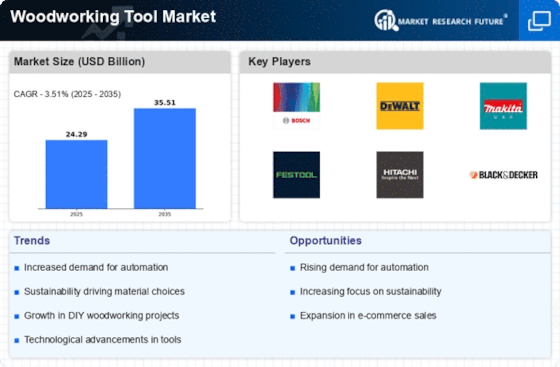
As per MRFR analysis, the Woodworking Tool Market Size was estimated at 24.29 USD Billion in 2024. The woodworking tool industry is projected to grow from 25.14 USD Billion in 2025 to 35.51 USD Billion by 2035, exhibiting a compound annual growth rate (CAGR) of 3.51 during the forecast period 2025 - 2035.

Key Market Trends & Highlights

The woodworking tool market is experiencing a dynamic shift driven by technological advancements and changing consumer preferences.

  • Technological advancements are reshaping the woodworking tool market, enhancing efficiency and user experience.
  • The sustainability focus is increasingly influencing product development and consumer purchasing decisions in North America.
  • Online retail growth is facilitating easier access to woodworking tools, particularly in the Asia-Pacific region.
  • The rise in DIY culture and home renovation projects is driving demand, particularly in the hand-held power tools segment.

Market Size & Forecast

2024 Market Size 24.29 (USD Billion)
2035 Market Size 35.51 (USD Billion)
CAGR (2025 - 2035) 3.51%

Major Players

Bosch (DE), DeWalt (US), Makita (JP), Festool (DE), Hitachi (JP), Black & Decker (US), Ryobi (JP), Milwaukee (US), Stanley (US)

Woodworking Tool Market Trends

The Woodworking Tool Market is currently experiencing a dynamic evolution, driven by a confluence of technological advancements and shifting consumer preferences. As artisans and hobbyists increasingly seek precision and efficiency, manufacturers are responding by innovating tools that enhance usability and performance. This trend appears to be fostering a more engaged community of woodworkers, who are eager to adopt new technologies that streamline their processes. Furthermore, the rise of online platforms for purchasing tools has transformed the way consumers access products, making it easier for them to find specialized equipment tailored to their needs. In addition to technological innovations, sustainability is becoming a pivotal consideration within the Woodworking Tool Market. Consumers are increasingly inclined to choose tools made from eco-friendly materials and those produced through sustainable practices. This shift suggests a growing awareness of environmental impacts, prompting manufacturers to adapt their offerings accordingly. As the market continues to evolve, it is likely that these trends will shape the future landscape of woodworking tools, influencing both production methods and consumer choices.

Technological Advancements

The Woodworking Tool Market is witnessing a surge in technological innovations, with manufacturers integrating smart features into their products. These advancements enhance precision, efficiency, and user experience, appealing to both professionals and hobbyists.

Sustainability Focus

There is a notable shift towards sustainability within the Woodworking Tool Market, as consumers increasingly prefer tools made from eco-friendly materials. This trend indicates a growing commitment to environmentally responsible practices among manufacturers.

Online Retail Growth

The rise of e-commerce is transforming the Woodworking Tool Market, providing consumers with greater access to a diverse range of products. This trend suggests that online platforms are becoming essential for both purchasing and discovering new tools.

Woodworking Tool Market Drivers

Increased DIY Culture

The rise of the do-it-yourself (DIY) culture appears to be a significant driver in the Woodworking Tool Market. As more individuals engage in home improvement projects, the demand for woodworking tools has surged. This trend is particularly evident among millennials and Gen Z, who are increasingly interested in crafting and personalizing their living spaces. According to recent data, the DIY home improvement market is projected to reach substantial figures, indicating a robust growth trajectory. This cultural shift not only enhances the appeal of woodworking tools but also encourages manufacturers to innovate and diversify their product offerings. Consequently, the Woodworking Tool Market is likely to benefit from this growing consumer interest, as more people seek to acquire tools that facilitate their creative endeavors.

Rise in Home Renovation Projects

The ongoing trend of home renovations is driving the Woodworking Tool Market. Homeowners are increasingly investing in renovations to enhance property value and improve living conditions. This trend has been bolstered by favorable economic conditions, including low interest rates and increased disposable income. Data suggests that the home renovation market is experiencing a compound annual growth rate that could exceed expectations in the coming years. As homeowners undertake various projects, the demand for high-quality woodworking tools is likely to rise. This presents an opportunity for manufacturers to cater to a diverse range of consumer needs, from basic hand tools to advanced power tools. The Woodworking Tool Market stands to gain significantly from this trend, as more individuals seek to undertake ambitious renovation projects.

Expansion of E-commerce Platforms

The expansion of e-commerce platforms is significantly impacting the Woodworking Tool Market. As consumers increasingly turn to online shopping for convenience and variety, the demand for woodworking tools through digital channels is rising. Data shows that e-commerce sales in the home improvement sector are experiencing robust growth, driven by the ease of access to a wide range of products. This shift is encouraging traditional retailers to enhance their online presence and adapt to changing consumer behaviors. The Woodworking Tool Market is likely to benefit from this trend, as more consumers discover and purchase tools online. Additionally, the rise of online reviews and tutorials is empowering consumers to make informed purchasing decisions, further driving sales in the woodworking tool segment.

Technological Innovations in Tool Design

Technological advancements are reshaping the Woodworking Tool Market. Innovations in tool design, such as the integration of smart technology and enhanced ergonomics, are attracting a new generation of woodworkers. Tools equipped with features like precision measurement and automated functions are becoming increasingly popular among both hobbyists and professionals. Market analysis indicates that the demand for technologically advanced tools is expected to grow, as consumers seek efficiency and ease of use. This trend is prompting manufacturers to invest in research and development, leading to the introduction of cutting-edge products. As technology continues to advance, the Woodworking Tool Market is likely to witness a transformation, with tools that not only meet but exceed consumer expectations.

Growing Interest in Sustainable Practices

The increasing emphasis on sustainability is influencing the Woodworking Tool Market. Consumers are becoming more conscious of the environmental impact of their purchases, leading to a preference for tools made from sustainable materials. This shift is prompting manufacturers to adopt eco-friendly practices, such as sourcing responsibly harvested wood and utilizing recyclable materials in tool production. Market data indicates that the demand for sustainable woodworking tools is on the rise, as consumers seek products that align with their values. This trend not only enhances brand loyalty but also encourages innovation within the industry. As sustainability becomes a core consideration for consumers, the Woodworking Tool Market is likely to evolve, with a growing number of companies prioritizing environmentally friendly practices.


Market Segment Insights

Woodworking Tool Market Product Type Insights

The Woodworking Tool Market is segmented by product type into hand-held power tools, stationary power tools, and accessories and attachments. The hand-held power tools segment is expected to account for the largest share of the market in 2023, with a valuation of 12.5 billion USD. This segment is expected to grow at a CAGR of 3.2% over the forecast period, reaching a valuation of 15.2 billion USD by 2032. The stationary power tools segment is expected to account for the second-largest share of the market in 2023, with a valuation of 8.3 billion USD.

This segment is expected to grow at a CAGR of 3.7% over the forecast period, reaching a valuation of 10.7 billion USD by 2032. The accessories and attachments segment are expected to account for the smallest share of the market in 2023, with a valuation of 1.9 billion USD. This segment is expected to grow at a CAGR of 4.1% over the forecast period, reaching a valuation of 2.6 billion USD by 2032. The growth of the hand-held power tools segment is attributed to the increasing popularity of DIY projects and the growing demand for cordless power tools.

The growth of the stationary power tools segment is attributed to the increasing demand for precision woodworking tools and the growing adoption of CNC machines. The growth of the accessories and attachments segment is attributed to the increasing demand for specialized woodworking tools and the growing popularity of online retailers.

Woodworking Tool Market Application Insights

The Woodworking Tool Market is segmented by application into Home Improvement and DIY, Professional Construction, and Industrial Manufacturing. The Home Improvement and DIY segment is expected to account for USD 12.67 billion in 2023 and is projected to grow at a CAGR of 4.0% from 2023 to 2032. This growth is attributed to the increasing popularity of home improvement projects and the growing trend of do-it-yourself (DIY) projects. 

The Professional Construction segment is expected to account for USD 8.25 billion in 2023 and is projected to grow at a CAGR of 3.2% from 2023 to 2032. This growth is driven by the increasing demand for woodworking tools in the construction industry. The Industrial Manufacturing segment is expected to account for USD 2.05 billion in 2023 and is projected to grow at a CAGR of 2.8% from 2023 to 2032. This growth is attributed to the increasing demand for woodworking tools in the manufacturing industry.

Woodworking Tool Market End User Insights

The end user segment of the Woodworking Tool Market is categorized into individual consumers, small businesses and contractors, and large corporations and institutions. Individual consumers accounted for the largest share of the market in 2023, with a significant portion of revenue generated from DIY enthusiasts and hobbyists. Small businesses and contractors represented the second-largest segment, driven by the growing demand for customized woodworking projects and renovations. 

Large corporations and institutions, including construction companies and manufacturing facilities, contributed a substantial share of the market revenue, primarily driven by investments in infrastructure development and industrial applications. The market growth for each segment is expected to vary based on factors such as consumer spending patterns, industry trends, and technological advancements.

Get more detailed insights about Woodworking Tool Market

Regional Insights

North America : Market Leader in Innovation

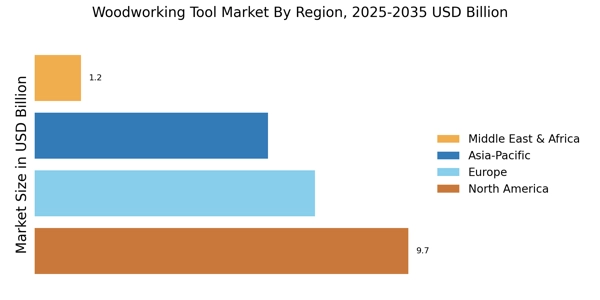
North America is the largest market for woodworking tools, holding approximately 40% of the global market share. The growth is driven by increasing DIY projects, home renovations, and a surge in woodworking hobbies. Regulatory support for manufacturing and safety standards further catalyzes market expansion. The U.S. leads this region, followed closely by Canada, which contributes around 15% to the market share. The competitive landscape is dominated by key players such as DeWalt, Bosch, and Milwaukee, which are known for their innovative products and strong distribution networks. The presence of established brands ensures a high level of competition, driving advancements in technology and product offerings. The market is characterized by a mix of large corporations and small manufacturers, catering to both professional and amateur woodworkers.

Europe : Emerging Market with Potential

Europe is witnessing a significant shift in the woodworking tool market, holding about 30% of the global share. The growth is fueled by increasing demand for sustainable and eco-friendly products, alongside a rise in home improvement projects. Regulatory frameworks promoting sustainability and energy efficiency are key drivers. Germany and the UK are the largest markets in this region, accounting for approximately 20% and 10% of the market share, respectively. Leading countries like Germany, France, and the UK are home to major players such as Bosch and Festool, which are known for their high-quality tools. The competitive landscape is marked by innovation and a focus on sustainability, with many companies investing in research and development. The presence of numerous small and medium enterprises also enriches the market, providing diverse options for consumers.

Asia-Pacific : Rapidly Growing Market

Asia-Pacific is emerging as a powerhouse in the woodworking tool market, holding around 25% of the global share. The region's growth is driven by rapid urbanization, increasing disposable incomes, and a growing interest in woodworking as a hobby. Countries like China and India are leading this growth, with China alone accounting for approximately 15% of the market share. Regulatory support for manufacturing and exports further enhances market potential. The competitive landscape is characterized by both local and international players, including Makita and Hitachi. The presence of a large manufacturing base in China provides a competitive edge, while the growing middle class in India is driving demand for quality tools. The market is expected to continue expanding as more consumers engage in DIY projects and home renovations, supported by a robust supply chain.

Middle East and Africa : Untapped Market Potential

The Middle East and Africa region is gradually emerging in the woodworking tool market, holding about 5% of the global share. The growth is primarily driven by increasing construction activities and a rising interest in woodworking as a craft. Countries like South Africa and the UAE are leading this market, with South Africa contributing approximately 3% to the overall share. Regulatory initiatives aimed at boosting local manufacturing are also contributing to market growth. The competitive landscape is still developing, with a mix of local and international brands. Key players are beginning to establish a presence, focusing on quality and affordability. The region's unique cultural aspects and growing interest in DIY projects are creating new opportunities for market entrants. As infrastructure projects expand, the demand for woodworking tools is expected to rise significantly, paving the way for future growth.

Woodworking Tool Market Regional Image

Key Players and Competitive Insights

Major players in the Woodworking Tool Market industry are constantly investing in research and development to create innovative products that meet the evolving needs of customers. Leading Woodworking Tool Market players are focusing on expanding their product portfolio by introducing new products and enhancing existing ones. The metalworking tools development is driven by the increasing adoption of power tools and the growing demand for DIY projects. The competitive landscape of the Woodworking Tool Market is expected to remain fragmented, with a large number of players competing for market share.

Stanley Black & Decker, a leading player in the Woodworking Tool Market, offers a wide range of power tools, hand tools, and accessories. The company has a strong presence in both the professional and consumer markets. Bosch, another major player, is known for its innovative power tools and accessories. The company has a strong focus on cordless technology and offers a wide range of cordless power tools. Makita, a Japanese company, is a leading manufacturer of power tools and accessories. 

The company has a strong presence in both the professional and consumer markets and is known for its high-quality products.TTI, a Hong Kong-based company, is a leading manufacturer of power tools and accessories. The company has a strong presence in the professional market and is known for its innovative products. Hilti, a Liechtenstein-based company, is a leading manufacturer of power tools, accessories, and fasteners. The company has a strong presence in the professional market and is known for its high-quality products.

Key Companies in the Woodworking Tool Market market include

Industry Developments

The global woodworking tool market is projected to reach $30.92 billion by 2032, exhibiting a CAGR of 3.51% during the forecast period (2025-2034). The market expansion is attributed to the rising demand for DIY projects, increasing construction activities, and growing popularity of woodworking as a hobby. 

Furthermore, technological advancements and the introduction of innovative tools, such as cordless power tools and laser-guided saws, are driving market growth. The Asia-Pacific region is expected to dominate the market due to the presence of a large woodworking industry and a growing consumer base.

Future Outlook

Woodworking Tool Market Future Outlook

The Woodworking Tool Market is projected to grow at a 3.51% CAGR from 2024 to 2035, driven by technological advancements, increasing DIY trends, and rising demand for sustainable materials.

New opportunities lie in:

  • Expansion of e-commerce platforms for woodworking tools.
  • Development of smart tools with IoT integration.
  • Introduction of eco-friendly tool lines targeting sustainability-conscious consumers.

By 2035, the market is expected to exhibit robust growth, reflecting evolving consumer preferences and technological innovations.

Market Segmentation

Woodworking Tool Market Type Outlook

  • Hand-Held Power Tools
  • Stationary Power Tools
  • Accessories and Attachments

Woodworking Tool Market End User Outlook

  • Individual Consumers
  • Small Businesses and Contractors
  • Large Corporations and Institutions

Woodworking Tool Market Application Outlook

  • Home Improvement and DIY
  • Professional Construction
  • Industrial Manufacturing

Report Scope

MARKET SIZE 202424.29(USD Billion)
MARKET SIZE 202525.14(USD Billion)
MARKET SIZE 203535.51(USD Billion)
COMPOUND ANNUAL GROWTH RATE (CAGR)3.51% (2024 - 2035)
REPORT COVERAGERevenue Forecast, Competitive Landscape, Growth Factors, and Trends
BASE YEAR2024
Market Forecast Period2025 - 2035
Historical Data2019 - 2024
Market Forecast UnitsUSD Billion
Key Companies ProfiledMarket analysis in progress
Segments CoveredMarket segmentation analysis in progress
Key Market OpportunitiesIntegration of smart technology in woodworking tools enhances precision and efficiency for modern craftsmen.
Key Market DynamicsTechnological advancements and consumer preferences drive innovation and competition in the woodworking tool market.
Countries CoveredNorth America, Europe, APAC, South America, MEA

Leave a Comment

FAQs

What is the current valuation of the Woodworking Tool Market as of 2024?

The Woodworking Tool Market was valued at 24.29 USD Billion in 2024.

What is the projected market size for the Woodworking Tool Market in 2035?

The market is projected to reach 35.51 USD Billion by 2035.

What is the expected CAGR for the Woodworking Tool Market during the forecast period 2025 - 2035?

The expected CAGR for the Woodworking Tool Market during 2025 - 2035 is 3.51%.

Which segment of the Woodworking Tool Market had the highest valuation in 2024?

In 2024, the Stationary Power Tools segment had the highest valuation at 10.0 USD Billion.

How much is the Hand-Held Power Tools segment projected to grow by 2035?

The Hand-Held Power Tools segment is projected to grow from 8.0 USD Billion in 2024 to 12.0 USD Billion by 2035.

What are the key applications driving the Woodworking Tool Market?

Key applications include Home Improvement and DIY, Professional Construction, and Industrial Manufacturing.

Which end-user segment is expected to see the most growth by 2035?

The Small Businesses and Contractors segment is expected to grow from 9.0 USD Billion in 2024 to 13.0 USD Billion by 2035.

Who are the leading players in the Woodworking Tool Market?

Key players include Bosch, DeWalt, Makita, Festool, Hitachi, Black & Decker, Ryobi, Milwaukee, and Stanley.

What was the valuation of the Accessories and Attachments segment in 2024?

The Accessories and Attachments segment was valued at 6.29 USD Billion in 2024.

How does the market size for Professional Construction compare to Industrial Manufacturing in 2024?

In 2024, the Professional Construction segment was valued at 9.0 USD Billion, whereas Industrial Manufacturing was valued at 7.29 USD Billion.

Download Free Sample

Kindly complete the form below to receive a free sample of this Report

Compare Licence

×
Features License Type
Single User Multiuser License Enterprise User
Price $4,950 $5,950 $7,250
Maximum User Access Limit 1 User Upto 10 Users Unrestricted Access Throughout the Organization
Free Customization
Direct Access to Analyst
Deliverable Format
Platform Access
Discount on Next Purchase 10% 15% 15%
Printable Versions