Author

Sakshi Gupta

Workwear Market Size, Share, Industry Trend & Analysis Research Report By Workwear Type (Protective Clothing, Uniforms, Flame-resistant Clothing, High-visibility Clothing, Footwear, Accessories), By End-Use Industry (Construction, Manufacturing, Transportation, Healthcare, Energy, Mining,Hospitality), By Distribution Channel (Online, Retail Stores, Wholesalers and Distributors, Direct Sales), By Material (Cotton, Polyester, Nylon, Kevlar, Nomex, Leather), By Safety Standard (ANSI, OSHA, NFPA, ASTM, EN, ISO) andBy Regional (North America, Europe, South America, Asia Pacific, Middle East and Africa)- Forecast to 2035.
As per Market Research Future analysis, the Workwear Market was estimated at 16.85 USD Billion in 2024. The Workwear industry is projected to grow from 17.54 USD Billion in 2025 to 26.35 USD Billion by 2035, exhibiting a compound annual growth rate (CAGR) of 4.15% during the forecast period 2025 - 2035
The Workwear Market is experiencing a transformative shift towards sustainability and technological integration.
| 2024 Market Size | 16.85 (USD Billion) |
| 2035 Market Size | 26.35 (USD Billion) |
| CAGR (2025 - 2035) | 4.15% |
Caterpillar (US), Carhartt (US), Dickies (US), Helly Hansen (NO), Red Kap (US), Workrite Uniform Company (US), Portwest (IE), Berne Apparel (US), Snickers Workwear (SE)
Our Impact
Enabled $4.3B Revenue Impact for Fortune 500 and Leading Multinationals
Partnering with 2000+ Global Organizations Each Year
30K+ Citations by Top-Tier Firms in the Industry
The Workwear Market is currently experiencing a dynamic evolution, driven by various factors that influence consumer preferences and industry standards. The increasing emphasis on safety regulations across multiple sectors, including construction, manufacturing, and healthcare, appears to be a primary catalyst for growth. Companies are investing in high-quality, durable materials that not only provide protection but also enhance comfort and functionality. This shift towards more specialized workwear indicates a broader trend where businesses prioritize employee well-being and productivity, reflecting a growing awareness of the importance of appropriate attire in hazardous environments. Moreover, the rise of sustainable practices within the Workwear Market is noteworthy. As environmental concerns gain traction, manufacturers are exploring eco-friendly materials and production methods. This trend suggests a potential shift in consumer expectations, where individuals increasingly seek products that align with their values regarding sustainability. The integration of technology into workwear, such as smart fabrics and wearable devices, also indicates a forward-thinking approach to design and functionality. Overall, the Workwear Market is poised for continued transformation, with innovation and sustainability at the forefront of its development.
The Workwear Market is witnessing a notable shift towards sustainable practices. Manufacturers are increasingly adopting eco-friendly materials and production techniques, responding to consumer demand for environmentally responsible products. This trend not only addresses ecological concerns but also aligns with the values of a growing segment of the workforce that prioritizes sustainability.
The incorporation of technology into workwear is becoming more prevalent. Innovations such as smart fabrics and wearable devices are enhancing functionality and safety. This trend indicates a movement towards more advanced workwear solutions that cater to the evolving needs of various industries, potentially improving overall efficiency and worker safety.
There is a growing emphasis on comfort and fit within the Workwear Market. As companies recognize the impact of employee satisfaction on productivity, they are investing in designs that prioritize ergonomic features. This trend suggests that workwear is evolving beyond mere functionality to include aspects that enhance the overall user experience.
The increasing emphasis on sustainability within the Workwear Market appears to be a pivotal driver. Companies are increasingly adopting eco-friendly materials and production processes to meet consumer demand for sustainable products. This shift is not merely a trend; it reflects a broader societal movement towards environmental responsibility. According to recent data, the sustainable workwear segment is projected to grow at a compound annual growth rate of approximately 8% over the next five years. This growth indicates a significant opportunity for brands that prioritize sustainability in their offerings, potentially leading to enhanced brand loyalty and market share.
Technological integration within the Workwear Market is transforming how workwear is designed and manufactured. Innovations such as smart textiles and wearable technology are becoming increasingly prevalent. These advancements not only enhance functionality but also improve worker safety and comfort. For instance, the incorporation of moisture-wicking fabrics and temperature-regulating materials is gaining traction. Market data suggests that the smart workwear segment could witness a growth rate of around 10% annually, driven by the demand for enhanced performance and safety features. This trend indicates a shift towards more sophisticated workwear solutions that cater to the evolving needs of various industries.
The complexities of The Workwear Industry. Fluctuations in raw material availability and transportation costs can affect production timelines and pricing strategies. Companies are increasingly seeking to optimize their supply chains to mitigate risks associated with these dynamics. This includes diversifying suppliers and investing in local production capabilities. Recent data suggests that companies that successfully navigate these supply chain challenges may experience a competitive advantage, potentially leading to a market share increase of up to 5% in the coming years. This underscores the importance of strategic supply chain management in the workwear sector.
The stringent health and safety regulations across various sectors are a crucial driver for the Workwear Market. Compliance with these regulations necessitates the use of specialized workwear designed to protect employees from workplace hazards. Industries such as construction, manufacturing, and healthcare are particularly affected by these regulations, which mandate specific safety standards. As a result, the demand for high-quality, compliant workwear is expected to rise. Recent statistics indicate that the market for safety workwear is projected to expand at a rate of 6% annually, reflecting the ongoing commitment to worker safety and regulatory compliance.
The changing demographics of the workforce are influencing the Workwear Market in notable ways. As younger generations enter the workforce, their preferences for style, comfort, and functionality are reshaping workwear design. This demographic shift is prompting brands to innovate and adapt their offerings to meet the expectations of a more diverse workforce. Additionally, the rise of remote and hybrid work models is leading to a demand for versatile workwear that can transition from office to home. Market analysis indicates that this trend could lead to a 7% increase in demand for adaptable workwear solutions over the next few years, highlighting the need for brands to remain agile in their product development.
The workwear market is experiencing a notable distribution among various applications, with construction dominating the landscape. This sector is propelled by the ongoing demand for safety and durability on job sites. Healthcare follows closely, as it increasingly necessitates specialized garments tailored to infection control and hygiene standards, reflecting a significant share in the market. Other sectors like manufacturing, hospitality, and transportation contribute to the breadth of the workwear landscape but do not match the prominence of these two segments. As industries adapt to new regulations and safety protocols, growth trends in the workwear market reflect a shift towards more innovative and functional designs. The construction sector is benefitting from advancements in material technology and increased safety awareness, while healthcare is rapidly expanding due to the rise in healthcare personnel needs and infection prevention priorities. This evolution is indicative of a broader trend towards functionality and comfort across work environments, fostering a dynamic market landscape.
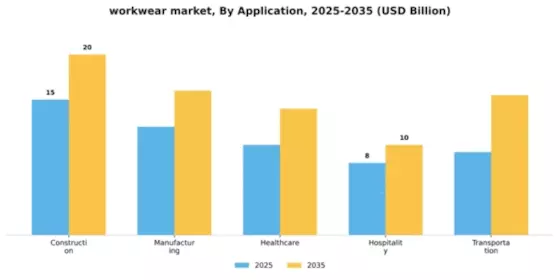
Construction: Dominant vs. Healthcare: Emerging
In the workwear market, the construction segment stands out as the dominant force, characterized by its robust demand for protective clothing that meets rigorous safety standards. Workers in construction require garments that offer durability, comfort, and essential features like high visibility and waterproofing. Meanwhile, the healthcare segment is emerging rapidly, driven by the increasing importance of hygiene and infection control in medical settings. Garments in this category need to be lightweight yet resilient, offering protection without compromising comfort during long shifts. As both segments evolve, construction remains a staple of workwear, while healthcare is quickly adapting to meet changing industry needs, positioning itself as an essential growth area.
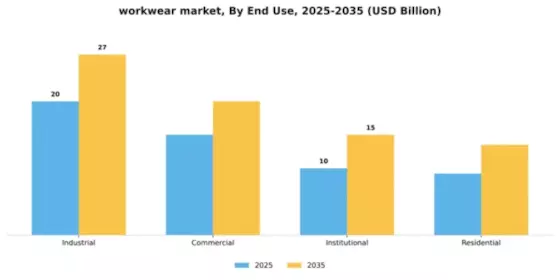
In the workwear market, the end-use segment is characterized by a diverse distribution among industrial, commercial, institutional, and residential sectors. The industrial segment holds the largest market share, fueled by significant demand in manufacturing, construction, and heavy industries where durable and protective clothing is crucial. On the other hand, the commercial segment is rapidly growing, driven by an increase in service-oriented businesses that require uniforms and protective gear for their employees, making it a key focus for manufacturers and retailers alike.
Industrial (Dominant) vs. Commercial (Emerging)
The industrial workwear segment is a dominant force in the market, characterized by robust demand for high-performance clothing suited for environments such as manufacturing and construction. This segment prioritizes durability, safety, and compliance with industry regulations, thus catering to a workforce that often faces demanding conditions. Meanwhile, the commercial segment is emerging as a significant player, reflecting an increasing emphasis on branding and employee image within service industries. This segment emphasizes aesthetic appeal while maintaining functionality, as businesses recognize that well-designed workwear can enhance customer perception and employee morale. As trends evolve, both segments will continue to adapt to meet the unique needs of their respective users.
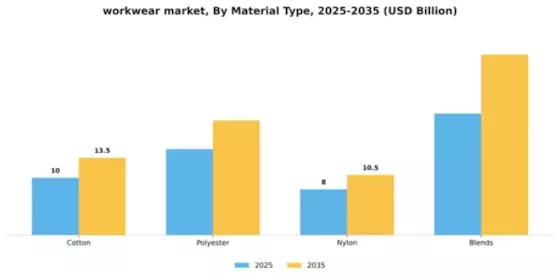
In the workwear market, material types significantly influence consumer choices and overall market dynamics. Cotton has established itself as the largest segment, appreciated for its comfort and breathability, making it the go-to choice for various work environments. Meanwhile, blends, composed of cotton combined with synthetic fibers, are rapidly gaining traction due to their enhanced durability and performance features, carving out a significant niche in the market.
Cotton (Dominant) vs. Blends (Emerging)
Cotton remains the dominant material in the workwear market thanks to its natural properties that offer comfort, moisture absorption, and softness against the skin. It is widely favored in industries such as healthcare, hospitality, and general labor, where comfort is paramount. On the other hand, blends are emerging as a competitive alternative, addressing the demand for workwear that can withstand harsher conditions while still providing comfort. Blends often combine cotton with polyester or nylon to enhance their strength, resistance to wrinkles, and ease of care, appealing to sectors that prioritize performance alongside comfort. This makes blends particularly attractive in construction and manufacturing, where durability is essential.
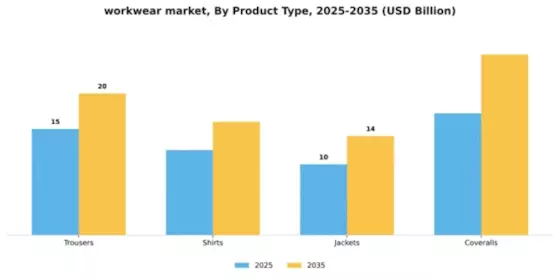
In the workwear market, the distribution of market share among product types reveals that trousers continue to dominate as the largest segment. This dominance is driven by their versatility and widespread applicability across various industries, making them a staple for workers. Shirts also hold a significant share, providing both comfort and functionality, while jackets and coveralls, though smaller in comparison, cater to specific needs like protection and warmth. As we look towards growth trends, jackets are emerging as the fastest-growing segment, largely fueled by an increasing focus on safety and weather-resistant options. The rising demand for protective workwear that combines functionality with comfort is driving innovation in this area. Coveralls, while traditionally considered a niche product, are experiencing renewed interest due to their all-in-one convenience, particularly in sectors where comprehensive safety attire is necessary.
Trousers (Dominant) vs. Coveralls (Emerging)
Trousers represent the dominant force in the workwear market, thanks to their widespread appeal across multiple sectors such as construction, manufacturing, and logistics. They are designed for durability and comfort, often featuring a variety of pockets and reinforced seams to meet the functional demands of workers. In contrast, coveralls are viewed as an emerging product, gaining traction in industries where full-body protection is essential. Innovations in fabric technology and design are enabling coveralls to transition from basic protective gear to more stylish and functional apparel, thus appealing to a broader audience. While trousers are favored for their practicality, coveralls are resonating more with companies focused on enhancing safety compliance and worker protection.
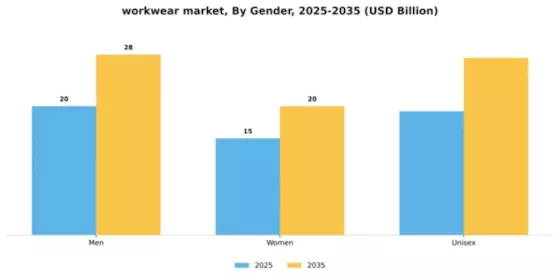
In the workwear market, the gender segment demonstrates a notable distribution, with men holding the largest share of the market. Traditionally, men's workwear has dominated due to a longstanding emphasis on manufacturing, construction, and other industries that have employed a predominantly male workforce. However, as industries have evolved, the female segment has also grown, reflecting a shift in workforce demographics and roles once predominantly occupied by men. The growth trends within this gender segment indicate a rapid increase in demand for women's workwear, driven by factors such as the rise of women in the workforce, changing societal norms, and a push for equality in various professions. Additionally, brands are enhancing their offerings in women's workwear to cater to this emerging market, focusing on designs that combine practicality with style, thus attracting a broader audience and contributing to its rapid growth.
Men (Dominant) vs. Women (Emerging)
Men's workwear remains dominant in the market, characterized by robust designs and functionality that have become essential for labor-intensive industries like construction and manufacturing. This segment has historically been the primary focus for many brands, leading to a well-established product line that includes rugged materials and utility-focused features. On the other hand, women’s workwear is viewed as an emerging segment, experiencing significant growth due to the increasing presence of women in various professional fields. Brands are investing more in this segment, creating clothing that offers both aesthetic appeal and functionality tailored to women's needs, thus challenging the traditional male-oriented market and diversifying options for female workers.
Get more detailed insights about Workwear Market Request Free Sample
North America is the largest market for workwear, accounting for approximately 40% of the global share. The growth is driven by increasing safety regulations and a rising demand for durable work clothing across various industries, including construction and manufacturing. The U.S. leads this market, followed closely by Canada, which holds about 15% of the market share. Regulatory frameworks emphasizing worker safety are significant catalysts for this growth. The competitive landscape in North America is robust, featuring key players such as Caterpillar, Carhartt, and Dickies. These companies dominate the market with their extensive product lines and strong brand recognition. The presence of established manufacturers and a growing trend towards sustainable workwear are shaping the competitive dynamics. The region's focus on innovation and quality further enhances its market position.
Europe is witnessing a significant shift towards sustainable workwear, holding approximately 30% of the global market share. The demand is driven by stringent environmental regulations and a growing awareness of sustainability among consumers. Germany and the UK are the largest markets in this region, collectively accounting for about 20% of the market. Regulatory initiatives aimed at reducing carbon footprints are propelling this trend forward. Leading countries in Europe include Germany, the UK, and France, with a competitive landscape featuring brands like Helly Hansen and Portwest. The market is characterized by innovation in materials and designs, focusing on functionality and eco-friendliness. The presence of numerous small and medium enterprises alongside established players fosters a dynamic market environment, enhancing competition and consumer choice.
Asia-Pacific is rapidly emerging as a significant player in the workwear market, holding around 25% of the global share. The growth is fueled by industrial expansion, urbanization, and increasing safety standards across countries like China and India. China is the largest market in the region, contributing approximately 15% to the global market, while India follows with a growing demand for workwear driven by its expanding manufacturing sector. The competitive landscape in Asia-Pacific is diverse, with both local and international brands vying for market share. Key players include Workrite Uniform Company and Snickers Workwear Market, which are gaining traction due to their innovative offerings. The region's focus on improving labor conditions and safety regulations is further driving the demand for high-quality workwear, making it a focal point for future growth.
The Middle East and Africa region is gradually emerging in the workwear market, currently holding about 5% of the global share. The growth is primarily driven by increasing industrial activities and a rising focus on worker safety regulations. Countries like South Africa and the UAE are leading this market, with South Africa accounting for approximately 3% of the global share. The region's regulatory frameworks are evolving to enhance workplace safety, which is expected to boost demand for workwear. The competitive landscape is still developing, with a mix of local and international brands. Key players are beginning to establish a foothold, focusing on quality and compliance with safety standards. The presence of emerging economies and a growing workforce are creating opportunities for market expansion, making this region a potential hotspot for future investments in workwear.

Major players in the Workwear Market are constantly striving to gain a competitive edge through strategic initiatives such as product innovation, market expansion, and acquisitions. Leading Workwear Market players like VF Corporation, Honeywell International Inc., and DuPont de Nemours, Inc. are focusing on developing technologically advanced and sustainable workwear solutions to meet evolving customer demands. These companies are also expanding their presence through partnerships and collaborations to cater to diverse regional markets. The Workwear Market development is influenced by factors such as advancements in materials and manufacturing techniques, increasing awareness of workplace safety, and growing demand for specialized workwear across various industries. Among the leading players in the Workwear Market, VF Corporation holds a significant market share and is known for its diverse portfolio of workwear brands such as Dickies, Red Kap, and Workrite. The company has a strong presence in North America, Europe, and Asia and is committed to providing durable, comfortable, and functional workwear solutions to its customers. VF Corporation emphasizes product innovation and invests in research and development to enhance the performance and safety features of its workwear offerings. The company also focuses on sustainability and ethical sourcing, aligning with the growing demand for eco-friendly and responsible workwear products. A notable competitor in the Workwear Market is Honeywell International Inc., which offers a wide range of protective and performance workwear solutions. The company's workwear products are designed to meet specific industry requirements, including chemical protection, flame resistance, and high-visibility applications. Honeywell leverages its expertise in advanced materials and technologies to develop innovative workwear that enhances safety, comfort, and productivity. The company has a presence and serves customers across various industries, including manufacturing, oil and gas, construction, and healthcare. Honeywell's commitment to research and development enables it to adapt to changing market trends and provide cutting-edge workwear solutions.


Key factors driving this growth include increasing demand for protective and functional workwear in industries such as construction, manufacturing, and healthcare. Additionally, rising awareness about workplace safety regulations and the growing popularity of workwear as a fashion statement are contributing to market expansion.
Recent developments include the adoption of sustainable and eco-friendly materials in workwear production, as well as the integration of technology such as wearable sensors and GPS tracking devices to enhance worker safety and productivity.
The Workwear Market is projected to grow at a 4.15% CAGR from 2025 to 2035, driven by increasing safety regulations, technological advancements, and rising demand for durable work apparel.
New opportunities lie in:
By 2035, the Workwear Market is expected to be robust, reflecting significant growth and innovation.
| MARKET SIZE 2024 | 16.85(USD Billion) |
| MARKET SIZE 2025 | 17.54(USD Billion) |
| MARKET SIZE 2035 | 26.35(USD Billion) |
| COMPOUND ANNUAL GROWTH RATE (CAGR) | 4.15% (2025 - 2035) |
| REPORT COVERAGE | Revenue Forecast, Competitive Landscape, Growth Factors, and Trends |
| BASE YEAR | 2024 |
| Market Forecast Period | 2025 - 2035 |
| Historical Data | 2019 - 2024 |
| Market Forecast Units | USD Billion |
| Key Companies Profiled | Caterpillar (US), Carhartt (US), Dickies (US), Helly Hansen (NO), Red Kap (US), Workrite Uniform Company (US), Portwest (IE), Berne Apparel (US), Snickers Workwear (SE) |
| Segments Covered | Workwear Type, End-Use Industry, Distribution Channel, Material, Safety Standard, Regional |
| Key Market Opportunities | Integration of sustainable materials and smart technology in the Workwear Market presents a compelling growth opportunity. |
| Key Market Dynamics | Rising demand for sustainable materials drives innovation and competition in the workwear market. |
| Countries Covered | North America, Europe, APAC, South America, MEA |
The workwear market was valued at 54.2 USD Billion in 2024.
The workwear market is projected to reach 75.5 USD Billion by 2035.
The expected CAGR for the workwear market during the forecast period 2025 - 2035 is 3.06%.
The 'By Application' segment, particularly Construction and Manufacturing, shows substantial growth potential.
Key players in the workwear market include Carhartt, Dickies, Caterpillar, and Helly Hansen.
The market for men's workwear was valued at 20.0 to 28.0 USD Billion, while women's workwear ranged from 15.0 to 20.0 USD Billion.
Polyester and blends are projected to dominate the workwear market, with valuations of 15.0 to 20.0 USD Billion and 21.2 to 31.5 USD Billion, respectively.
Trousers and coveralls are among the most prevalent product types, valued at 15.0 to 20.0 USD Billion and 17.2 to 25.5 USD Billion, respectively.
The healthcare segment of the workwear market was valued at 10.0 to 14.0 USD Billion, indicating a robust demand.
The transportation segment is valued between 9.2 and 15.5 USD Billion, suggesting a notable contribution to overall market growth.


The secondary research process involved comprehensive analysis of regulatory databases, industry trade publications, occupational safety standards repositories, and authoritative labor statistics organizations. Key sources included the US Occupational Safety and Health Administration (OSHA), National Institute for Occupational Safety and Health (NIOSH), American National Standards Institute (ANSI), National Fire Protection Association (NFPA), ASTM International, European Committee for Standardization (CEN/EN Standards), International Organization for Standardization (ISO), US Bureau of Labor Statistics (BLS), Eurostat Labour Market Statistics, International Labour Organization (ILO), World Health Organization (WHO) Occupational Health Data, US Census Bureau Construction Spending Reports, National Safety Council (NSC) Injury Statistics, EU-OSHA European Agency for Safety and Health at Work, Health and Safety Executive (HSE UK), National Institute of Standards and Technology (NIST), American Apparel & Footwear Association (AAFA), Industrial Fabrics Association International (IFAI), National Retail Federation (NRF), and textile industry databases from the International Textile Manufacturers Federation (ITMF). These sources were used to collect workplace safety incident statistics, regulatory compliance requirements, material innovation data, industry employment trends, and certification standards for cotton, polyester, nylon, Kevlar, Nomex, and leather workwear products.
Qualitative and quantitative insights were obtained by interviewing supply-side and demand-side stakeholders during the primary research process. The supply-side sources consisted of CEOs, VPs of Manufacturing, leaders of Product Innovation, sustainability officers, and commercial directors from workwear manufacturers, textile suppliers, and protective equipment OEMs. Demand-side sources included procurement directors from construction and manufacturing firms, safety managers from energy and mining operations, healthcare facility administrators, hospitality operations directors, uniform rental service providers, and industrial distributors. Primary research verified market segmentation in protective garments and high-visibility categories, verified the timelines for the adoption of sustainable materials, and collected information on bulk procurement patterns, rental versus purchase dynamics, and compliance-driven purchasing decisions.
Primary Respondent Breakdown:
By Designation: C-level Primaries (28%), Director Level (35%), Others (37%)
By Region: North America (32%), Europe (30%), Asia-Pacific (28%), Rest of World (10%)
Global market valuation was derived through revenue mapping and shipment volume analysis across workwear types and end-use industries. The methodology included:
Identification of 50+ key manufacturers across North America, Europe, Asia-Pacific, and Latin America specializing in protective clothing, uniforms, flame-resistant apparel, and safety footwear
Product mapping across cotton, polyester, nylon, Kevlar, Nomex, and leather material categories with analysis of ANSI, OSHA, NFPA, ASTM, EN, and ISO safety standard compliance
Analysis of reported and modeled annual revenues specific to workwear portfolios including direct sales, rental services, and distributor channels
Coverage of manufacturers representing 75-80% of global market share in 2024
Extrapolation using bottom-up (industry employment figures × penetration rate × average selling price by country) and top-down (manufacturer revenue validation) approaches to derive segment-specific valuations for construction, manufacturing, transportation, healthcare, energy, mining, and hospitality end-use sectors
Kindly complete the form below to receive a free sample of this Report

“This is really good guys. Excellent work on a tight deadline. I will continue to use you going forward and recommend you to others. Nice job”


“Thanks. It’s been a pleasure working with you, please use me as reference with any other Intel employees.”


“Thanks for sending the report it gives us a good global view of the Betaïne market.”


“Thank you, this will be very helpful for OQS.”


“We found the report very insightful! we found your research firm very helpful. I'm sending this email to secure our future business.”


“I am very pleased with how market segments have been defined in a relevant way for my purposes (such as "Portable Freezers & refrigerators" and "last-mile"). In general the report is well structured. Thanks very much for your efforts.”


“I have been reading the first document or the study, ,the Global HVAC and FP market report 2021 till 2026. Must say, good info! I have not gone in depth at all parts, but got a good indication of the data inside!”


“We got the report in time, we really thank you for your support in this process. I also thank to all of your team as they did a great job.”


“The Automotive 48V ECU Components Procurement Intelligence Study” was a complex project, but the Market Research Future (MRFR) team handled it with quality, agility, and customer-centricity. They delivered all requested data on time and within the agreed scope. The team, including Shubhendra Anand and Rahul Gotadki, was always readily available to clarify questions and swiftly implement necessary adjustments, driving the project to a successful conclusion within a very demanding timeframe.
I would also like to specifically commend Akshay Agarwal for his responsiveness and support at every stage—from our initial inquiry on May 6th through to final delivery on June 18th. His dedication made the entire process seamless.”


.png?v=1778851901)
