×
Request Free Sample ×

Kindly complete the form below to receive a free sample of this Report

* Please use a valid business email

Leading companies partner with us for data-driven Insights

clients tt-cursor
Hero Background

Zirconia Ceramic Ball Market

ID: MRFR/CnM/22806-HCR
100 Pages
Chitranshi Jaiswal
October 2025

Zirconia Ceramic Ball Market Research Report By Grade (Purity) (5YPS (5% Yttria Partially Stabilized Zirconia), 3YPS (3% Yttria Partially Stabilized Zirconia)), By Size (0.5-1 mm, 1-1.5 mm, 1.5-2 mm), By Application (Grinding Media (Wet/Dry Grinding), Pumps and Valves, Prosthetic Implants), By End-Use Industry (Chemical Processing, Pharmaceuticals, Automotive) and By Regional (North America, Europe, South America, Asia Pacific, Middle East and Africa) - Forecast to 2035

Share:
Download PDF ×

We do not share your information with anyone. However, we may send you emails based on your report interest from time to time. You may contact us at any time to opt-out.

Zirconia Ceramic Ball Market Infographic
Purchase Options

Zirconia Ceramic Ball Market Summary

As per MRFR analysis, the Zirconia Ceramic Ball Market Size was estimated at 38.89 USD Billion in 2024. The Zirconia Ceramic Ball industry is projected to grow from 41.26 USD Billion in 2025 to 74.46 USD Billion by 2035, exhibiting a compound annual growth rate (CAGR) of 6.08 during the forecast period 2025 - 2035.

Key Market Trends & Highlights

The Zirconia Ceramic Ball Market is poised for robust growth driven by technological advancements and increasing demand across various sectors.

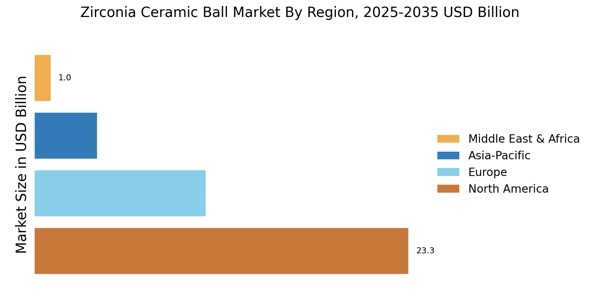
  • North America remains the largest market for zirconia ceramic balls, driven by its established automotive and aerospace industries.
  • Asia-Pacific is the fastest-growing region, reflecting a surge in manufacturing and industrial applications.
  • The 5YPS segment dominates the market, while the 3YPS segment is experiencing rapid growth due to customization trends.
  • Rising demand in automotive applications and advancements in manufacturing technologies are key drivers propelling market expansion.

Market Size & Forecast

2024 Market Size 38.89 (USD Billion)
2035 Market Size 74.46 (USD Billion)
CAGR (2025 - 2035) 6.08%

Major Players

CeramTec GmbH (DE), Saint-Gobain (FR), Zircoa Inc. (US), MHI (JP), Tosoh Corporation (JP), Matsui (JP), KCM (KR), YTZ (CN)

Zirconia Ceramic Ball Market Trends

The Zirconia Ceramic Ball Market is currently experiencing a notable evolution, driven by advancements in material science and increasing demand across various industries. These ceramic balls, known for their exceptional hardness and wear resistance, are finding applications in sectors such as automotive, aerospace, and medical devices. The growing emphasis on lightweight and durable materials is propelling manufacturers to explore innovative uses for zirconia ceramic balls, which may enhance product performance and longevity. Furthermore, the market appears to be influenced by a shift towards sustainable manufacturing practices, as companies seek to reduce their environmental footprint while maintaining high-quality standards. In addition, the Zirconia Ceramic Ball Market is likely to witness a surge in research and development activities aimed at improving the properties of these materials. This could lead to the introduction of new variants that cater to specific industry needs, thereby expanding the market's scope. As industries increasingly prioritize efficiency and reliability, the demand for zirconia ceramic balls may continue to grow, suggesting a promising outlook for stakeholders involved in this sector. Overall, the market's trajectory seems to be shaped by a combination of technological advancements and evolving consumer preferences, indicating a dynamic landscape ahead.

Sustainability Initiatives

The Zirconia Ceramic Ball Market is increasingly influenced by sustainability initiatives, as manufacturers strive to adopt eco-friendly practices. This trend reflects a broader commitment to reducing environmental impact while maintaining product quality. Companies are exploring ways to minimize waste and enhance recyclability, which may resonate with environmentally conscious consumers.

Technological Advancements

Technological advancements are playing a crucial role in the evolution of the Zirconia Ceramic Ball Market. Innovations in material processing and production techniques are enabling the creation of higher-quality ceramic balls with improved performance characteristics. This trend suggests that ongoing research may lead to enhanced durability and functionality, appealing to a wider range of applications.

Customization and Specialization

Customization and specialization are emerging trends within the Zirconia Ceramic Ball Market, as clients seek tailored solutions to meet specific operational requirements. This shift indicates a growing recognition of the diverse applications of zirconia ceramic balls, prompting manufacturers to develop specialized products that cater to unique industry needs.

Zirconia Ceramic Ball Market Drivers

Growth in Aerospace Sector

The aerospace industry is a significant driver for the Zirconia Ceramic Ball Market, as the demand for high-performance materials continues to rise. Zirconia ceramic balls are favored for their exceptional strength-to-weight ratio and resistance to wear, making them ideal for critical applications in aircraft engines and landing gear systems. The aerospace sector is projected to grow at a CAGR of 4.5% through 2027, which could lead to increased adoption of advanced materials like zirconia. Furthermore, the stringent safety and performance standards in aerospace applications necessitate the use of reliable components, thereby enhancing the market potential for zirconia ceramic balls. This growth in the aerospace sector is likely to have a cascading effect on the Zirconia Ceramic Ball Market.

Increasing Focus on Energy Efficiency

The growing emphasis on energy efficiency across multiple sectors is contributing to the expansion of the Zirconia Ceramic Ball Market. Industries are increasingly adopting materials that reduce friction and wear, thereby enhancing the overall efficiency of machinery and equipment. Zirconia ceramic balls, known for their low friction properties, are being integrated into various applications, including pumps and compressors, to optimize energy consumption. The global push towards sustainability and reduced carbon footprints is likely to bolster the demand for energy-efficient solutions, positioning zirconia ceramic balls as a preferred choice. This trend is expected to drive the Zirconia Ceramic Ball Market as companies seek to comply with environmental regulations and improve operational efficiency.

Emerging Applications in Medical Devices

The Zirconia Ceramic Ball Market is witnessing emerging opportunities in the medical devices sector. Zirconia's biocompatibility and mechanical strength make it an ideal material for various medical applications, including dental implants and orthopedic devices. The global market for medical ceramics is projected to grow significantly, with zirconia ceramics expected to capture a larger share due to their favorable properties. As healthcare providers increasingly prioritize patient safety and device longevity, the demand for high-quality materials like zirconia is likely to rise. This trend indicates a promising future for the Zirconia Ceramic Ball Market, as it expands into new and innovative applications within the medical field.

Rising Demand in Automotive Applications

The Zirconia Ceramic Ball Market is experiencing a notable increase in demand driven by the automotive sector. As manufacturers seek to enhance the performance and durability of components, zirconia ceramic balls are increasingly utilized in applications such as bearings and valve systems. The market for automotive bearings alone is projected to reach USD 20 billion by 2026, indicating a robust growth trajectory. This trend is further supported by the automotive industry's shift towards lightweight materials, where zirconia's properties offer a compelling advantage. The ability of zirconia ceramic balls to withstand high temperatures and corrosive environments makes them particularly appealing for automotive applications, thereby propelling the Zirconia Ceramic Ball Market forward.

Advancements in Manufacturing Technologies

Technological advancements in manufacturing processes are significantly influencing the Zirconia Ceramic Ball Market. Innovations such as precision grinding and advanced sintering techniques have improved the quality and consistency of zirconia ceramic balls, making them more attractive to various industries. The introduction of automated production lines has also reduced manufacturing costs, thereby increasing accessibility for smaller enterprises. As a result, the market is expected to witness a compound annual growth rate of approximately 6% over the next five years. These advancements not only enhance product performance but also expand the application range of zirconia ceramic balls, further driving the growth of the Zirconia Ceramic Ball Market.
Market Segment Insights

By Grade (Purity): 5YPS (Largest) vs. 3YPS (Fastest-Growing)

In the Zirconia Ceramic Ball Market, the distribution of market share between different grades of purity reveals critical insights into their respective positions. The 5YPS segment, characterized by its high level of yttria stabilization, holds the largest share of the market. This is primarily due to its superior mechanical properties and wear resistance, which make it preferable for use in demanding applications. On the other hand, the 3YPS segment, while currently smaller in terms of market share, is gaining traction as industries seek more cost-effective options without significantly compromising quality.

5YPS (Dominant) vs. 3YPS (Emerging)

The 5YPS (5% Yttria Partially Stabilized Zirconia) is recognized as the dominant segment within the Zirconia Ceramic Ball Market due to its exceptional performance in high-temperature and high-friction conditions. Its robustness makes it a preferred choice for various applications including aerospace, automotive, and medical devices. Conversely, the 3YPS (3% Yttria Partially Stabilized Zirconia) is emerging as a competitive alternative, appealing to industries looking for affordability while still obtaining reliable performance. This segment is on a growth trajectory as innovations are made to enhance its properties, leading to increased adoption in sectors where cost and quality need to be balanced.

By Size: 1.5-2 mm (Largest) vs. 1-1.5 mm (Fastest-Growing)

The zirconia ceramic ball market is characterized by distinct size segments, with the 1.5-2 mm range holding the largest market share. This segment is favored for its versatile applications across various industries, including automotive and manufacturing, where its durability and resistance to wear are highly valued. Meanwhile, the 1-1.5 mm segment is emerging as the fastest-growing segment due to the increasing demand for precision components in advanced machinery and electronics. As industries seek better performance and reliability, the adoption of smaller sizes is gaining traction. Growth trends in the zirconia ceramic ball market are being driven primarily by advancements in technology and the demand for high-performance materials across sectors. The shift towards miniaturization in design and the need for lightweight yet robust solutions are pushing the market towards smaller size categories, particularly the 1-1.5 mm balls. This segment is likely to see increased investment in production capabilities and marketing efforts aimed at promoting their advantages. As more manufacturers recognize the benefits of zirconia ceramic balls, the overall market is expected to grow, with the smaller size segments playing a pivotal role in shaping the future landscape.

1.5-2 mm (Dominant) vs. 0.5-1 mm (Emerging)

The 1.5-2 mm zirconia ceramic balls dominate the market due to their established presence and wide acceptance in various applications, including grinding, polishing, and automotive industries. Their larger size provides robust performance, making them suitable for high-impact environments. In contrast, the 0.5-1 mm segment is emerging, driven by the rise in precision engineering and electronic applications where smaller components are essential. These smaller balls are increasingly recognized for their ability to enhance the performance of devices by reducing friction and wear, making them attractive to manufacturers looking for innovative solutions. As the market evolves, we may see greater integration of these two segments, with advancements that leverage the strengths of both size ranges.

By Application: Grinding Media (Largest) vs. Prosthetic Implants (Fastest-Growing)

In the Zirconia Ceramic Ball Market, the application segment reveals significant variations in market share distribution. Grinding Media is currently the largest segment, accounting for an extensive portion of the market due to its extensive use in various grinding processes for materials. In contrast, Prosthetic Implants are gaining momentum, representing a rapidly growing segment, attributed to increased demand in the medical field for durable, biocompatible materials designed for long-term use in surgeries.

Applications: Grinding Media (Dominant) vs. Prosthetic Implants (Emerging)

Grinding Media serves as the dominant application in the Zirconia Ceramic Ball Market, primarily used in wet and dry grinding processes across different industries, including manufacturing and mineral processing. Its resilience and wear resistance make it ideal for these applications, ensuring efficient performance. Conversely, Prosthetic Implants represent an emerging segment, driven by advancements in healthcare and a growing focus on improving patient outcomes. These implants leverage the superior strength and biocompatibility of zirconia ceramics, catering to the rising demand for innovative and long-lasting medical solutions.

By End-Use Industry: Chemical Processing (Largest) vs. Pharmaceuticals (Fastest-Growing)

In the Zirconia Ceramic Ball Market, the end-use industry segment is predominantly led by chemical processing, which holds a significant market share due to its extensive applications in various chemical processes. This sector capitalizes on the durability and chemical resistance of zirconia ceramic balls, which are crucial for enhancing operational efficiency in chemical plants. Following closely, the pharmaceutical segment is emerging rapidly, driven by the increasing need for precision in drug formulations and manufacturing processes that require high-quality materials.

Chemical Processing: Dominant vs. Pharmaceuticals: Emerging

The chemical processing industry represents the dominant segment in the Zirconia Ceramic Ball Market, leveraging the material's unique properties such as hardness and thermal stability. This sector benefits from the heightened demand for efficient grinding and milling applications, where zirconia ceramic balls contribute to improved product quality and reduced contamination risks. Conversely, the pharmaceuticals segment is regarded as the emerging player, fueled by the accelerated growth in the biopharmaceuticals sector and a greater emphasis on the development of advanced drug delivery systems. The need for stringent quality standards in pharmaceutical production drives the adoption of zirconia ceramic balls, which ensure that processes meet the highest regulatory requirements.

Get more detailed insights about Zirconia Ceramic Ball Market

Regional Insights

North America : Innovation and Demand Surge

North America is witnessing significant growth in the Zirconia Ceramic Ball Market, driven by advancements in manufacturing technologies and increasing demand from the aerospace and automotive sectors. The United States holds the largest market share at approximately 60%, followed by Canada at around 25%. Regulatory support for advanced materials is further propelling market expansion, with initiatives aimed at enhancing manufacturing capabilities. The competitive landscape in North America is robust, featuring key players such as Zircoa Inc. and CeramTec GmbH. These companies are focusing on innovation and product development to meet the rising demand for high-performance materials. The presence of established manufacturing facilities and a skilled workforce enhances the region's attractiveness for investment in Zirconia products, ensuring sustained growth in the coming years.

Europe : Regulatory Support and Innovation

Europe is emerging as a significant player in the Zirconia Ceramic Ball Market, driven by stringent regulations promoting the use of advanced materials in various industries. Germany and France are the largest markets, collectively holding about 55% of the regional share. The European Union's focus on sustainability and innovation is fostering demand for high-quality ceramic products, which are essential in sectors like healthcare and automotive. Leading countries in Europe, particularly Germany and France, are home to major manufacturers such as Saint-Gobain and CeramTec GmbH. The competitive landscape is characterized by a strong emphasis on research and development, with companies investing in innovative solutions to meet regulatory standards. This focus on quality and compliance is expected to drive further growth in the Zirconia market across the region.

Asia-Pacific : Emerging Markets and Growth Potential

The Asia-Pacific region is rapidly becoming a powerhouse in the Zirconia Ceramic Ball Market, fueled by industrial growth and increasing investments in manufacturing. China and Japan are the leading markets, accounting for approximately 70% of the regional share. The demand for Zirconia products is being driven by the booming automotive and electronics sectors, alongside supportive government policies aimed at enhancing manufacturing capabilities. China's dominance in the market is complemented by the presence of key players like YTZ and Tosoh Corporation, which are focusing on expanding their production capacities. Japan also plays a crucial role, with companies like MHI and Matsui leading in innovation and quality. The competitive landscape is marked by a mix of local and international players, all vying for market share in this dynamic region.

Middle East and Africa : Resource-Rich and Growing Demand

The Middle East and Africa region is witnessing a gradual increase in the Zirconia Ceramic Ball Market, driven by growing industrialization and demand for advanced materials. The United Arab Emirates and South Africa are the largest markets, holding approximately 50% of the regional share. The region's focus on diversifying its economy away from oil dependency is fostering investments in manufacturing sectors, including ceramics and advanced materials. In the competitive landscape, local manufacturers are beginning to emerge, although the market is still dominated by international players. Companies are increasingly looking to establish partnerships and collaborations to enhance their market presence. The growth potential in this region is significant, as industries seek to adopt high-performance materials to meet evolving demands.

Zirconia Ceramic Ball Market Regional Image

Key Players and Competitive Insights

Major players in the Zirconia Ceramic Ball Market industry focus on introducing technologically advanced products to cater to the evolving demands of various industries. The Leading Zirconia Ceramic Ball Market players strive to gain a competitive edge through strategic partnerships, acquisitions, and research and development initiatives. The Zirconia Ceramic Ball Market development involves collaborations with universities and research institutes to enhance the understanding of material properties and explore new applications. Key players invest in expanding their production capacities to meet the growing demand for zirconia ceramic balls.

Moreover, they actively participate in trade fairs and exhibitions to showcase their latest innovations and connect with potential customers.A prominent competitor in the Zirconia Ceramic Ball Market is Saint-Gobain Céramiques & Plastiques, a global leader in the field of advanced ceramics. The company offers a wide range of zirconia ceramic balls for various applications, including precision bearings, medical devices, and aerospace components. Saint-Gobain Céramiques & Plastiques emphasizes quality control and precision manufacturing techniques to ensure the highest standards of performance and reliability.

Additionally, the company maintains a strong focus on customer service and technical support, providing tailored solutions to meet specific requirements.Another notable competitor in the Zirconia Ceramic Ball Market is Kyocera Corporation, a leading Japanese manufacturer of advanced ceramic materials. Kyocera offers high-precision zirconia ceramic balls for demanding applications in industries such as semiconductors, electronics, and automotive. The company's commitment to innovation drives its research and development efforts, resulting in the continuous improvement of its zirconia ceramic ball products.

Kyocera maintains a global network of production facilities and sales offices, enabling it to cater to customers worldwide with efficient delivery and technical support.

Key Companies in the Zirconia Ceramic Ball Market market include

Industry Developments

The Zirconia Ceramic Ball Market is projected to reach USD 58.8 billion by 2032, exhibiting a CAGR of 6.08% during the forecast period (2024-2032). The increasing demand for zirconia ceramic balls in various industrial applications, such as grinding, milling, and polishing, is a major growth driver for the market. The rising adoption of zirconia ceramic balls in the aerospace, automotive, and medical industries is further contributing to market growth. Additionally, the growing awareness of the benefits of zirconia ceramic balls, such as their high strength, wear resistance, and corrosion resistance, is fueling market expansion.

Recent developments in the market include the introduction of new zirconia ceramic ball grades with improved properties and the development of advanced manufacturing technologies for producing high-quality zirconia ceramic balls.

Future Outlook

Zirconia Ceramic Ball Market Future Outlook

The Zirconia Ceramic Ball Market is projected to grow at a 6.08% CAGR from 2024 to 2035, driven by advancements in manufacturing technologies and increasing demand in various industries.

New opportunities lie in:

  • Development of customized zirconia ceramic balls for specific industrial applications.
  • Expansion into emerging markets with tailored marketing strategies.
  • Investment in R&D for innovative zirconia formulations to enhance performance.

By 2035, the market is expected to solidify its position as a leader in advanced materials.

Market Segmentation

Zirconia Ceramic Ball Market Size Outlook

  • 0.5-1 mm
  • 1-1.5 mm
  • 1.5-2 mm

Zirconia Ceramic Ball Market Application Outlook

  • Grinding Media (Wet/Dry Grinding)
  • Pumps and Valves
  • Prosthetic Implants

Zirconia Ceramic Ball Market Grade (Purity) Outlook

  • 5YPS (5% Yttria Partially Stabilized Zirconia)
  • 3YPS (3% Yttria Partially Stabilized Zirconia)

Zirconia Ceramic Ball Market End-Use Industry Outlook

  • Chemical Processing
  • Pharmaceuticals
  • Automotive

Report Scope

MARKET SIZE 202438.89(USD Billion)
MARKET SIZE 202541.26(USD Billion)
MARKET SIZE 203574.46(USD Billion)
COMPOUND ANNUAL GROWTH RATE (CAGR)6.08% (2024 - 2035)
REPORT COVERAGERevenue Forecast, Competitive Landscape, Growth Factors, and Trends
BASE YEAR2024
Market Forecast Period2025 - 2035
Historical Data2019 - 2024
Market Forecast UnitsUSD Billion
Key Companies ProfiledMarket analysis in progress
Segments CoveredMarket segmentation analysis in progress
Key Market OpportunitiesGrowing demand for high-performance materials in automotive and aerospace sectors drives Zirconia Ceramic Ball Market expansion.
Key Market DynamicsRising demand for high-performance materials drives innovation and competition in the Zirconia Ceramic Ball market.
Countries CoveredNorth America, Europe, APAC, South America, MEA

Leave a Comment

FAQs

What is the current valuation of the Zirconia Ceramic Ball Market?

The market valuation reached 38.89 USD Billion in 2024.

What is the projected market size for the Zirconia Ceramic Ball Market by 2035?

The market is expected to grow to 74.46 USD Billion by 2035.

What is the expected CAGR for the Zirconia Ceramic Ball Market during the forecast period?

The anticipated CAGR for the market from 2025 to 2035 is 6.08%.

Which companies are considered key players in the Zirconia Ceramic Ball Market?

Key players include CeramTec GmbH, Saint-Gobain, Zircoa Inc., MHI, Tosoh Corporation, Matsui, KCM, and YTZ.

What are the primary applications of Zirconia Ceramic Balls?

Primary applications include grinding media, pumps and valves, and prosthetic implants.

How does the market segment by size for Zirconia Ceramic Balls?

The market segments by size include 0.5-1 mm, 1-1.5 mm, and 1.5-2 mm, with respective valuations of 10.0, 15.0, and 13.89 USD Billion.

What are the end-use industries for Zirconia Ceramic Balls?

End-use industries encompass chemical processing, pharmaceuticals, and automotive, with valuations of 12.0, 10.0, and 16.89 USD Billion respectively.

What is the market performance of 5YPS and 3YPS Zirconia Ceramic Balls?

The 5YPS segment is valued at 15.0 to 28.0 USD Billion, while the 3YPS segment ranges from 23.89 to 46.46 USD Billion.

What trends are influencing the growth of the Zirconia Ceramic Ball Market?

Trends include increasing demand in various industries and advancements in material technology.

How does the market for Zirconia Ceramic Balls compare across different grades?

The market segments by grade indicate varying valuations, with 5YPS and 3YPS showing substantial growth potential.

Download Free Sample

Kindly complete the form below to receive a free sample of this Report

Compare Licence

×
Features License Type
Single User Multiuser License Enterprise User
Price $4,950 $5,950 $7,250
Maximum User Access Limit 1 User Upto 10 Users Unrestricted Access Throughout the Organization
Free Customization
Direct Access to Analyst
Deliverable Format
Platform Access
Discount on Next Purchase 10% 15% 15%
Printable Versions