×
Request Free Sample ×

Kindly complete the form below to receive a free sample of this Report

* Please use a valid business email

Leading companies partner with us for data-driven Insights

clients tt-cursor
Hero Background

Automotive Active Rear Axle Steering Market

ID: MRFR/AT/29385-HCR
128 Pages
Sejal Akre
October 2025

Automotive Active Rear Axle Steering Market Research Report By System Type (Mechanical Active Rear Axle Steering, Electronic Active Rear Axle Steering), By Vehicle Segment (Passenger Vehicles, Commercial Vehicles, Luxury Vehicles, Sport Utility Vehicles (SUVs)), By Functionality (Low-Speed Maneuverability, High-Speed Stability, Dynamic Driving Assistance), By Market Application (Urban Driving, Off-Road Driving, Highway Driving) and By Regional (North America, Europe, South America, Asia Pacific, Middle East and Africa) - Forecast to 2035

分享
Download PDF ×

We do not share your information with anyone. However, we may send you emails based on your report interest from time to time. You may contact us at any time to opt-out.

Automotive Active Rear Axle Steering Market Infographic
Purchase Options

Automotive Active Rear Axle Steering Market 摘要

根据MRFR分析,汽车主动后轴转向市场规模在2024年估计为26.63亿美元。汽车主动后轴转向行业预计将从2025年的28.42亿美元增长到2035年的54.52亿美元,预计在2025年至2035年的预测期内,年均增长率(CAGR)为6.73。

主要市场趋势和亮点

汽车主动后轴转向市场因技术进步和消费者偏好的变化而有望实现显著增长。

  • 技术进步正在重塑汽车主动后轴转向市场,特别是在北美地区。

市场规模与预测

2024 Market Size 26.63(十亿美元)
2035 Market Size 54.52 (亿美元)
CAGR (2025 - 2035) 6.73%

主要参与者

博世(德国),ZF弗里德里希哈芬(德国),大陆集团(德国),JTEKT公司(日本),Mando公司(韩国),蒂森克虏伯(德国),日立Astemo(日本),Nexteer汽车(美国)

Automotive Active Rear Axle Steering Market 趋势

The Automotive Active Rear Axle Steering Market is currently experiencing a transformative phase, driven by advancements in vehicle technology and increasing consumer demand for enhanced driving dynamics. This system, which allows the rear wheels to turn in conjunction with the front wheels, offers improved maneuverability and stability, particularly in tight spaces and during high-speed cornering. As manufacturers focus on integrating this technology into a broader range of vehicles, the market is likely to expand, appealing to both luxury and mainstream segments. Furthermore, the growing emphasis on safety features and automated driving systems suggests that active rear axle steering could become a standard offering in future vehicle designs. In addition to technological advancements, environmental considerations are influencing the Automotive Active Rear Axle Steering Market. As automakers strive to meet stringent emissions regulations, the incorporation of this steering technology may contribute to improved fuel efficiency and reduced carbon footprints. The potential for enhanced vehicle performance, coupled with sustainability goals, positions active rear axle steering as a pivotal component in the evolution of modern automobiles. Overall, the market appears poised for growth, with innovations and regulatory pressures shaping its trajectory in the coming years.

Technological Advancements

Recent innovations in automotive technology are significantly enhancing the capabilities of active rear axle steering systems. These advancements include improved sensors and control algorithms that allow for more precise steering adjustments, thereby increasing vehicle stability and responsiveness.

Consumer Demand for Enhanced Performance

There is a growing consumer preference for vehicles that offer superior handling and driving experiences. This trend is driving manufacturers to incorporate active rear axle steering into a wider array of models, appealing to performance-oriented buyers.

Sustainability and Regulatory Pressures

As environmental regulations become more stringent, automakers are increasingly focusing on technologies that improve fuel efficiency. Active rear axle steering may play a crucial role in achieving these goals, as it can enhance vehicle dynamics and reduce energy consumption.

Automotive Active Rear Axle Steering Market Drivers

更加关注燃油效率

Fuel efficiency remains a critical concern for consumers and manufacturers alike, shaping the Automotive Active Rear Axle Steering Market. Active rear axle steering systems contribute to improved fuel economy by optimizing vehicle dynamics and reducing tire wear. As automakers seek to enhance the efficiency of their vehicles, the integration of these systems becomes more appealing. Market Research Future indicates that vehicles equipped with advanced steering technologies can achieve up to 10% better fuel efficiency compared to traditional systems. This potential for reduced fuel consumption aligns with consumer preferences for environmentally friendly vehicles, further driving the adoption of active rear axle steering.

监管合规与安全标准

The Automotive Active Rear Axle Steering Market is influenced by stringent regulatory compliance and safety standards. Governments worldwide are implementing regulations aimed at enhancing vehicle safety, which includes the adoption of advanced steering technologies. These regulations often mandate features that improve vehicle stability and control, thereby driving the demand for active rear axle steering systems. As manufacturers strive to meet these requirements, the market is likely to witness an uptick in the integration of such technologies. Data indicates that compliance with safety standards can lead to a competitive advantage, as consumers increasingly favor vehicles that meet or exceed regulatory expectations.

转向系统中的技术创新

The Automotive Active Rear Axle Steering Market is experiencing a surge in technological innovations that enhance vehicle maneuverability and stability. Advanced steering systems, including electronic control units and sensor integration, are becoming increasingly prevalent. These innovations allow for real-time adjustments to steering angles, improving vehicle handling during various driving conditions. According to recent data, the market for active steering systems is projected to grow at a compound annual growth rate of approximately 8% over the next five years. This growth is driven by the demand for improved safety features and enhanced driving experiences, indicating a strong correlation between technological advancements and market expansion.

电动和自动驾驶汽车的增长

The rise of electric and autonomous vehicles is significantly impacting the Automotive Active Rear Axle Steering Market. As the automotive landscape shifts towards electrification and automation, the demand for advanced steering technologies that enhance vehicle control and maneuverability is increasing. Active rear axle steering systems are particularly beneficial for electric vehicles, as they can improve handling while compensating for the weight distribution of batteries. Furthermore, autonomous vehicles require precise steering capabilities to navigate complex environments. Market forecasts suggest that the integration of active steering systems in electric and autonomous vehicles will drive substantial growth in the coming years, reflecting a transformative shift in the industry.

消费者对车辆性能的期望不断提高

Consumer expectations for vehicle performance are evolving, significantly impacting the Automotive Active Rear Axle Steering Market. As consumers increasingly prioritize driving dynamics, manufacturers are compelled to integrate advanced steering technologies that offer superior handling and responsiveness. The demand for vehicles that provide a sportier driving experience is evident, with a notable increase in sales of performance-oriented models. Market analysis suggests that vehicles equipped with active rear axle steering systems are perceived as more desirable, leading to a potential increase in market share for manufacturers who adopt these technologies. This trend underscores the importance of aligning product offerings with consumer preferences.

市场细分洞察

By System Type: Electronic Active Rear Axle Steering (Largest) vs. Mechanical Active Rear Axle Steering (Fastest-Growing)

The Automotive Active Rear Axle Steering Market is predominantly characterized by the increasing dominance of Electronic Active Rear Axle Steering systems. This segment holds a substantial share of the market due to advancements in electronic technologies that provide better integration with modern vehicle systems, enhancing maneuverability and safety. Conversely, Mechanical Active Rear Axle Steering is witnessing rapid adoption, particularly as manufacturers look for cost-effective and reliable options that offer improved handling without the complexity of electronic components.

System Type: Electronic Active Rear Axle Steering (Dominant) vs. Mechanical Active Rear Axle Steering (Emerging)

Electronic Active Rear Axle Steering has established itself as the dominant player in the Automotive Active Rear Axle Steering Market sector, benefiting from ongoing technological innovations that improve steering precision and response. Its ability to adapt to various driving conditions makes it highly favored among premium automotive brands. In contrast, Mechanical Active Rear Axle Steering is emerging as a practical alternative, especially for mid-range vehicles that prioritize functionality and affordability. It delivers solid performance improvements in handling dynamics without the high costs associated with electronic systems, positioning it as an attractive option for manufacturers targeting value-conscious consumers.

By Vehicle Segment: Passenger Vehicles (Largest) vs. Commercial Vehicles (Fastest-Growing)

In the Automotive Active Rear Axle Steering Market, the passenger vehicle segment holds the largest share, driven by increasing consumer demand for enhanced maneuverability and improved driving experience. This segment encompasses a wide range of models, from economy cars to premium sedans, which are increasingly being equipped with advanced steering technologies to enhance vehicle dynamics and safety. Meanwhile, commercial vehicles, though smaller in share, are witnessing rapid adoption of active rear axle steering systems, fueled by the need for better handling and load management in urban logistics and transportation. The growth trends in the passenger vehicle segment are propelled by technological advancements and consumer preferences for agile, responsive vehicles. In contrast, the commercial vehicle segment is growing at a faster rate due to rising needs for fleet efficiency and operational agility, especially in delivery and transport scenarios. The increasing regulations around fleet emissions and safety are also pushing commercial vehicle manufacturers toward more sophisticated steering solutions.

乘用车(主导)与商用车(新兴)

The passenger vehicle segment dominates the Automotive Active Rear Axle Steering Market by incorporating innovative technologies that enhance driver comfort and vehicle control. This segment includes various car types that prioritize performance and user experience, thus adopting rear axle steering systems to improve handling and stability at high speeds or during maneuvering in tight spaces. Meanwhile, the emerging commercial vehicle segment is adapting to dynamic logistical needs, integrating advanced steering solutions to cater to operational efficiency. These vehicles need to handle heavier loads and navigate urban environments effectively, creating a demand for better steering responsiveness and agility. As regulations tighten around emissions and safety in transportation, both segments are evolving, but the commercial vehicles are particularly notable for rapidly adopting such technologies for competitive advantages.

By Functionality: Low-Speed Maneuverability (Largest) vs. High-Speed Stability (Fastest-Growing)

In the Automotive Active Rear Axle Steering Market, the functionality segment is marked by varied value distributions. Low-Speed Maneuverability stands out as the largest segment, appealing primarily to urban drivers seeking enhanced maneuverability in tight spaces. High-Speed Stability, meanwhile, is rapidly gaining traction, especially among performance vehicle manufacturers looking to improve handling at high speeds. Dynamic Driving Assistance is also notable, catering to a growing demand for automated driving technologies, although it currently holds a smaller share compared to the leading applications.

Low-Speed Maneuverability (Dominant) vs. High-Speed Stability (Emerging)

低速机动性以其在城市驾驶环境中的显著优势而闻名,显著增强了车辆的灵活性,使在拥挤区域的停车和导航变得更加可控。这在城市汽车和紧凑型车辆中被广泛采用,这些特性对消费者满意度至关重要。另一方面,高速稳定性正在成为运动轿车和SUV的游戏规则改变者,在高速机动中精确的转向响应至关重要。转向技术的创新正在推动其快速增长,迎合消费者对性能增强驾驶体验的兴趣,表明市场动态将发生未来的转变。

按市场应用:城市驾驶(最大)与越野驾驶(增长最快)

在汽车主动后轴转向市场中,城市驾驶占据了最大的市场份额,这得益于对拥挤城市环境中增强机动性和安全特性的日益需求。该细分市场主要面向寻求在紧急转弯和平行停车场景中改善车辆操控的城市居民。尽管越野驾驶目前的市场份额较小,但被认为是增长最快的细分市场,因为冒险和越野车辆的日益普及推动了对先进转向技术的需求,这些技术增强了在崎岖地形中的控制和稳定性。

城市驾驶(主导)与越野驾驶(新兴)

城市驾驶是汽车主动后轴转向市场的主导细分市场,其特点是专注于适应城市驾驶条件的灵活性和响应性操控等属性。配备先进转向系统的车辆旨在为驾驶者在狭窄街道上提供更好的控制,这项技术在城市通勤者中变得至关重要。另一方面,越野驾驶正在迅速崛起,越来越多的制造商开发出适合寻求强悍性能的爱好者的车辆。该细分市场需要创新的转向解决方案,使车辆能够高效地在具有挑战性的地形中导航,从而在重视多功能性和耐用性的冒险驾驶体验市场中获得了市场份额。

获取关于Automotive Active Rear Axle Steering Market的更多详细见解

区域洞察

北美:创新与技术领导者

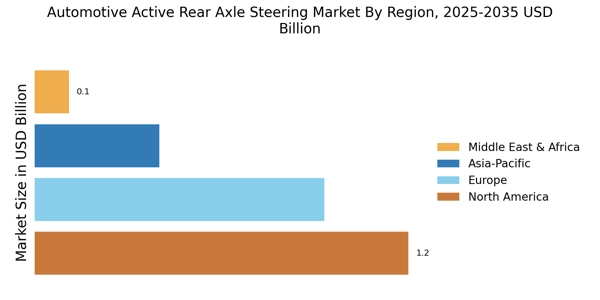
北美有望主导汽车主动后轴转向市场,这得益于技术进步和消费者对提升车辆性能的需求不断增加。该地区约占全球市场份额的45%,美国是最大的贡献者,其次是加拿大。对先进汽车技术的监管支持进一步推动了这一增长,因为制造商寻求遵守严格的安全和排放标准。

北美的竞争格局强劲,主要参与者包括博世、ZF弗里德里希哈芬和Nexteer汽车。这些公司在研发方面投入巨资,以创新和改善转向技术。主要汽车制造商的存在以及对电动车辆日益增长的趋势也是推动市场扩张的重要因素。随着该地区继续拥抱智能出行解决方案,对主动后轴转向系统的需求预计将上升。

欧洲:监管驱动的市场增长

欧洲在汽车主动后轴转向市场中占据重要地位,约占全球市场份额的35%。该地区的增长受到旨在提高车辆安全性和环境可持续性的严格法规的推动。德国和法国等国处于前沿,拥有强大的汽车工业,优先考虑创新和遵守欧盟法规。欧洲市场的特点是向电动和混合动力车辆的转变,这进一步推动了对先进转向技术的需求。

欧洲的主要国家包括德国、法国和英国,主要汽车制造商正在投资于主动转向系统。大陆和蒂森克虏伯等主要参与者专注于开发尖端技术,以增强车辆动态性能。竞争格局以合作和伙伴关系为特征,旨在将先进的转向解决方案整合到新车型中,确保欧洲在汽车创新方面保持领先地位。

亚太地区:新兴市场潜力

亚太地区迅速崛起为汽车主动后轴转向市场的关键市场,约占全球市场份额的15%。该地区的增长受到汽车生产增加、可支配收入上升和对先进汽车技术日益偏好的推动。中国和日本等国正在引领潮流,在汽车研发和制造能力方面进行重大投资。政府推动电动车辆的举措也在催化该地区的市场增长。

中国作为亚太地区最大的市场,汽车行业蓬勃发展,越来越多地采用先进的转向技术。JTEKT公司和日立Astemo等主要参与者积极参与开发针对当地市场需求的创新解决方案。竞争格局正在演变,国内外公司争相抢占市场份额,使亚太地区成为一个充满活力和竞争的主动转向系统市场。

中东和非洲:未开发的市场机会

中东和非洲地区在汽车主动后轴转向市场中逐渐崭露头角,约占全球市场份额的5%。增长主要受到城市化加速、车辆拥有量上升和对先进汽车技术日益关注的推动。南非和阿联酋等国正在见证对创新车辆功能的需求激增,得益于政府增强道路安全和车辆性能的举措。

在该地区,竞争格局仍在发展中,许多本地和国际参与者进入市场。公司专注于调整其产品以满足该地区独特的需求,包括气候考虑和道路条件。随着汽车行业的持续增长,对主动后轴转向系统的需求预计将增加,为市场参与者提供了重要机会。

Automotive Active Rear Axle Steering Market Regional Image

主要参与者和竞争洞察

汽车主动后轴转向市场目前的特点是动态竞争格局,受到技术进步和消费者对增强车辆机动性和安全性需求增加的驱动。博世(德国)、ZF弗里德里希哈芬(德国)和大陆(德国)等主要参与者处于前沿,各自采取不同的战略来巩固其市场地位。博世(德国)强调转向技术的创新,专注于整合先进的传感器和软件,以增强车辆的响应能力。ZF弗里德里希哈芬(德国)正在与汽车制造商建立战略合作伙伴关系,共同开发下一代转向系统,从而扩大其市场覆盖范围。与此同时,大陆(德国)在数字化转型方面进行了大量投资,旨在利用数据分析改善产品供应和客户参与。总体而言,这些战略促成了一个日益关注技术差异化和协作创新的竞争环境。

在商业战术方面,公司正在本地化制造,以降低成本并提高供应链效率。这种方法在汽车市场蓬勃发展的地区尤为明显,当地生产可以减轻关税和物流挑战。市场结构似乎适度分散,多个参与者争夺市场份额,但主要公司的影响力仍然相当大。他们的集体行动塑造了行业标准并推动了技术进步,创造了一个鼓励持续改进和创新的竞争氛围。

2025年8月,博世(德国)宣布推出其最新的主动后轴转向系统,该系统结合了基于人工智能的算法,以根据实时驾驶条件优化转向响应。这一战略举措不仅强化了博世对创新的承诺,还将其定位为汽车系统中人工智能整合的领导者。此类先进技术的引入可能会增强车辆的安全性和性能,吸引寻求在竞争激烈的市场中区分其产品的制造商。

2025年9月,ZF弗里德里希哈芬(德国)与一家领先的电动汽车制造商达成合作,开发一款专为电动汽车量身定制的后轴转向系统。这一合作凸显了ZF对日益增长的电动汽车细分市场的战略关注,使其能够利用在转向技术方面的专业知识,同时满足电动驱动系统的独特需求。这种合作表明了一个更广泛的趋势,即传统汽车供应商正在与新兴市场领导者对接,以保持在快速发展的市场中的相关性。

2025年7月,大陆(德国)推出了一种新的数字平台,旨在增强其主动后轴转向系统的连接性。该平台旨在为汽车制造商提供实时数据分析,使他们能够优化性能和维护计划。通过投资数字解决方案,大陆不仅提升了其产品供应,还将自己定位为汽车行业数字化转型的关键参与者,该行业越来越依赖数据驱动的洞察。

截至2025年10月,汽车主动后轴转向市场的竞争趋势受到数字化、可持续性和人工智能整合的强烈影响。战略联盟变得越来越普遍,因为公司认识到需要汇集资源和专业知识,以应对现代汽车工程的复杂性。展望未来,预计竞争差异化将越来越多地从传统的基于价格的战略转向关注创新、技术进步和供应链可靠性,因为公司努力满足消费者和监管标准不断变化的需求。
Automotive Active Rear Axle Steering Market市场的主要公司包括

行业发展

汽车主动后轴转向市场的最新发展表明,越来越重视提升车辆的机动性和安全性,促使制造商在应对日益增长的消费者需求方面进行创新。主要汽车公司正在大力投资于研发,以将先进的后轴转向系统集成到他们的车辆中,特别是在电动和自动驾驶汽车逐渐普及的情况下。监管趋势也在影响市场动态,各国政府提倡改善车辆稳定性和碰撞避免技术。

此外,汽车原始设备制造商与科技公司之间的合作变得越来越普遍,旨在利用人工智能和机器学习来增强转向算法。这些合作预计将加速主动后轴转向系统在各类车辆中的采用,从而吸引更多希望获得先进操控能力的消费者的关注。随着市场参与者适应不断变化的环境,关注可持续性和效率变得越来越重要,许多公司正在探索环保的制造工艺和材料。

这种转变不仅反映了当前消费者的价值观,还使组织能够在竞争激烈的市场中蓬勃发展,同时应对快速技术进步带来的挑战。

未来展望

Automotive Active Rear Axle Steering Market 未来展望

The Automotive Active Rear Axle Steering Market is projected to grow at a 6.73% CAGR from 2024 to 2035, driven by advancements in vehicle dynamics and increasing demand for enhanced maneuverability.

新机遇在于:

  • Integration of active rear axle steering in electric vehicles
  • Development of advanced steering control algorithms
  • Partnerships with automotive OEMs for customized steering solutions

到2035年,市场预计将实现显著增长,反映出汽车技术的不断发展。

报告范围

MARKET SIZE 20242.663(USD Billion)
MARKET SIZE 20252.842(USD Billion)
MARKET SIZE 20355.452(USD Billion)
COMPOUND ANNUAL GROWTH RATE (CAGR)6.73% (2024 - 2035)
REPORT COVERAGERevenue Forecast, Competitive Landscape, Growth Factors, and Trends
BASE YEAR2024
Market Forecast Period2025 - 2035
Historical Data2019 - 2024
Market Forecast UnitsUSD Billion
Key Companies ProfiledMarket analysis in progress
Segments CoveredMarket segmentation analysis in progress
Key Market OpportunitiesIntegration of advanced sensor technologies enhances maneuverability in the Automotive Active Rear Axle Steering Market.
Key Market DynamicsRising demand for enhanced vehicle maneuverability drives innovation in Automotive Active Rear Axle Steering technologies.
Countries CoveredNorth America, Europe, APAC, South America, MEA

发表评论

FAQs

2035年汽车主动后轴转向市场的预计市场估值是多少?

预计到2035年,汽车主动后轴转向市场的市场估值为54.52亿美元。

2024年汽车主动后轴转向市场的市场估值是多少?

2024年汽车主动后轴转向市场的市场估值为26.63亿美元。

在2025年至2035年的预测期内,汽车主动后轴转向市场的预期CAGR是多少?

预计2025年至2035年期间,汽车主动后轴转向市场的年均增长率(CAGR)为6.73%。

在汽车主动后轴转向市场中,哪些公司被视为关键参与者?

汽车主动后轴转向市场的主要参与者包括博世、ZF弗里德里希哈芬、大陆、JTEKT公司、万都公司、蒂森克虏伯、日立Astemo和Nexteer汽车。

到2035年,机械和电子主动后轴转向的预计估值是多少?

到2035年,机械主动后轴转向预计将达到16亿美元,而电子主动后轴转向预计将达到38.52亿美元。

在汽车主动后轴转向市场中,乘用车和商用车的估值如何比较?

到2035年,乘用车预计将达到22.26亿美元,而商用车预计将达到11.34亿美元。

汽车主动后轴转向市场预计将增长哪些功能细分?

低速机动性、高速稳定性和动态驾驶辅助的功能细分预计将增长,估值到2035年分别达到16.75亿美元、16.75亿美元和11.02亿美元。

到2035年,城市驾驶的预期市场应用增长是多少?

预计到2035年,城市驾驶的市场应用增长将达到16.74亿美元。

到2035年,运动型多功能车(SUV)市场与豪华车市场相比如何?

到2035年,运动型多用途汽车(SUV)的市场预计将达到9.58亿美元,而豪华汽车预计将达到11.34亿美元。

汽车主动后轴转向市场的未来趋势有哪些?

趋势表明对先进转向技术的需求不断增长,各个细分市场的市场估值显著增加,特别是在电子主动后轴转向方面。

下载免费样本

请填写以下表格以获取本报告的免费样本

Compare Licence

×
Features License Type
Single User Multiuser License Enterprise User
Price $4,950 $5,950 $7,250
Maximum User Access Limit 1 User Upto 10 Users Unrestricted Access Throughout the Organization
Free Customization
Direct Access to Analyst
Deliverable Format
Platform Access
Discount on Next Purchase 10% 15% 15%
Printable Versions