Prefabricated Buildings Market

预制建筑市场研究报告信息按产品(骨架系统、面板系统、单元系统和组合系统)、按模块类型(浴室舱、厨房小间和其他)、按应用(工业、商业和住宅)以及按地区(北美、欧洲、亚太和其他地区)- 市场预测至2035年。
ID: MRFR/PCM/3733-CR
132 Pages
Varsha More
Last Updated: July 22, 2026
Prefabricated Buildings Market
Market Size
Forecast Period2025 - 2035
CAGR (2025 - 2035)6.85%
2024 Market Size$ 166.52 Billion
2025 Market Size$ 177.92 Billion
2035 Market Size$ 345.12 Billion
Key Players
Lendlease
Skanska
Kiewit Corporation
Modular Building Institute
Red Sea Housing Services
Bouygues Construction
Opportunities
  • Cost Efficiency
  • Urbanization Trends
  • Sustainability Initiatives

Prefabricated Buildings Market 摘要

根据市场研究未来的分析,全球预制建筑市场规模在2024年预计为1665.2亿美元。预制建筑行业预计将从2025年的1779.2亿美元增长到2035年的3451.2亿美元,在2025年至2035年的预测期内,复合年增长率(CAGR)为6.85%。

主要市场趋势和亮点

全球预制建筑市场因技术进步和可持续发展倡议而准备实现显著增长。

  • 技术整合正在重塑预制建筑的格局,提高效率和定制化。
  • 对可持续性的强烈关注正在影响行业内的设计选择和材料选择。
  • 北美仍然是最大的市场,而亚太地区正在成为预制建筑增长最快的地区。
  • 对成本效率的需求和政府对可持续实践的支持是推动市场扩张的关键驱动因素。

市场规模与预测

2024市场规模 166.52(美元十亿)
2035市场规模 345.12(美元十亿)
年均增长率(2025 - 2035) 6.85%

主要参与者

Lendlease(澳大利亚),Skanska(瑞典),Kiewit Corporation(美国),Modular Building Institute(美国),Red Sea Housing Services(沙特阿拉伯),Bouygues Construction(法国),Algeco(德国),Guerdon Enterprises(美国),Z Modular(美国)

Prefabricated Buildings Market Drivers

成本效率

成本效率仍然是预制建筑市场的一个关键驱动因素。能够在保持质量的同时降低整体建筑成本,是预制结构的一个引人注目的优势。通过减少人工成本和施工时间,这些建筑可以更快、更经济地交付市场。最近的分析表明,与传统建筑方法相比,预制建筑可以节省高达20%的施工成本。这一经济利益对希望最大化投资回报的开发商和投资者尤其具有吸引力。随着经济压力继续影响建筑行业,对成本效益解决方案的需求可能会促进预制建筑市场的增长。

城市化趋势

快速的城市化步伐是预制建筑市场的一个重要驱动因素。随着城市地区人口的不断增加,对经济适用房和商业空间的需求也在上升。预计到2030年,全球近60%的人口将居住在城市地区,这对高效的建筑解决方案提出了迫切的需求。预制建筑提供了对这一挑战的可行回应,因为与传统方法相比,它们可以更快、更低成本地建造。这一趋势在发展中地区尤为明显,那里的住房需求非常迫切。因此,随着城市中心寻求创新解决方案以容纳不断扩大的居民,预制建筑市场有望实现增长。

可持续发展倡议

可持续发展倡议在塑造预制建筑市场方面变得越来越有影响力。对环保建筑实践和材料的日益重视正在推动对预制结构的需求,这些结构通常利用可持续资源并减少浪费。根据最近的研究,预制建筑可以减少高达90%的施工废料,使其成为环保开发商的一个有吸引力的选择。此外,这些建筑的能源效率,通常设计以满足严格的环境标准,也增加了它们的吸引力。随着全球各国政府和组织实施更严格的碳排放和可持续性法规,预制建筑市场可能会经历需求激增,与全球应对气候变化的努力相一致。

技术进步

在建筑过程中整合先进技术似乎是预制建筑市场的一个关键驱动因素。建筑信息建模(BIM)和模块化建筑技术等创新提高了效率和精确度,减少了施工时间和成本。预计市场将在2025年至2030年期间以约6.5%的复合年增长率(CAGR)增长,这得益于这些技术进步。此外,在制造预制组件中采用自动化和机器人技术可能会简化生产流程,从而提高产量和质量。因此,预制建筑市场的利益相关者正越来越多地投资于技术,以保持竞争力并满足对更快、更具成本效益的建筑解决方案的日益增长的需求。

政府支持和法规

政府支持和有利的法规正在越来越多地塑造预制建筑市场的格局。许多政府正在认识到预制建筑在解决住房短缺和促进可持续发展方面的潜力。为了鼓励采用预制建筑方法,正在推出税收减免、补助金和简化许可流程等激励措施。此外,强制可持续建筑实践的法规进一步推动了市场的发展。随着政策制定者继续倡导创新建筑解决方案,预制建筑市场预计将受益于增强的支持和更有利的监管环境,从而促进增长和创新。

市场细分洞察

按产品:骨架系统(最大)与面板系统(增长最快)

在全球预制建筑中,骨架系统因其在各种建筑项目中的广泛应用而占据最大的市场份额。该系统的受欢迎程度源于其坚固的结构支撑和设计灵活性,吸引了商业和住宅建筑商。相反,面板系统作为增长最快的细分市场,正因对节能和经济高效建筑解决方案的需求上升而获得关注。

骨架系统(主导)与面板系统(新兴)

骨架系统以其承重框架为特征,是市场上的主导者。它提供卓越的耐用性和设计灵活性,使其非常适合大型结构和多种应用。同时,面板系统因其高效性和快速组装而迅速崛起,特别是在住宅和低层商业建筑中。其预制面板允许更快的完成时间,这对寻求经济高效解决方案的开发商尤其具有吸引力。

按模块类型:浴室舱(最大)与小厨房(增长最快)

在全球预制建筑中,模块类型细分显示出其关键价值的多样分布。浴室舱占据最大的市场份额,主要得益于其在住宅和商业项目中的广泛采用,尤其是由于其高效的组装和降低的现场人工成本。同时,小厨房在酒店和学生住宿等行业中变得越来越受欢迎,这促进了其快速增长。

浴室舱(主导)与小厨房(新兴)

浴室舱因其预制特性主导模块类型市场,显著减少了施工时间和成本。它们广泛应用于酒店、宿舍和模块化住宅等多种场合,增强了其在质量和卫生方面的吸引力。相反,小厨房作为重要组成部分正在迅速崛起,特别是在针对灵活居住安排的项目中,如共享居住空间和模块化住房。它们的多功能性和满足对紧凑、实用居住区域日益增长的需求,使其在行业中成为一个蓬勃发展的力量,反映了消费者偏好的变化。

按应用:住宅(最大)与工业(增长最快)

全球预制建筑在应用细分中显示出多样的分布,住宅部门占据最大的市场份额。该细分市场受到对经济适用房需求增加和快速城市化的推动,导致对住宅预制单元的重大投资。相反,工业应用作为增长最快的细分市场,受益于寻求更高效和可持续部署结构的制造设施的增加。随着企业适应不断变化的经济环境,对模块化和灵活建筑解决方案的需求使工业预制建筑蓬勃发展。建筑技术的创新,加上对减少交货时间的关注,进一步引发了对工业预制建筑的高度兴趣。对可持续性和提高运营效率的推动进一步促进了该细分市场的增长,使其成为未来投资的关键关注领域。

住宅:主导与工业:新兴

预制建筑市场的住宅细分以其对经济效益和快速施工时间的重视为特征,吸引了开发商和购房者。该细分市场成功地将现代设计与耐用材料相结合,以满足不断增长的人口和变化的住房需求。相比之下,工业应用因其快速扩展而被标记为新兴,推动其发展的因素包括新技术和对定制解决方案的需求增加。工业预制建筑在设计灵活性、施工速度和可扩展性方面提供支持,服务于物流和制造等行业。随着企业努力实现运营效率和可持续性,工业细分市场呈现出重要的增长机会,进一步重塑全球市场的动态。

获取关于Prefabricated Buildings Market的更多详细见解

区域洞察

北美:创新市场的领导者

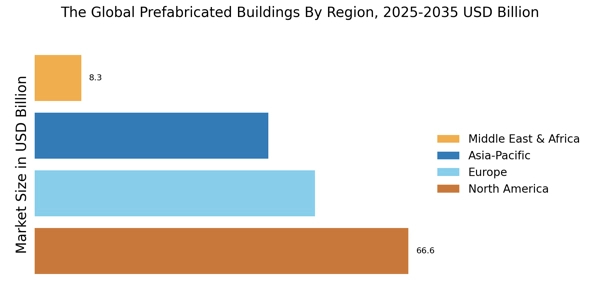
北美是预制建筑的最大市场,占全球市场份额的约40%。该地区的增长受到对可持续建筑实践的需求增加、快速城市化和政府激励措施促进模块化建筑技术的推动。监管框架正在不断演变,以支持预制化,提高效率并缩短施工时间。美国和加拿大是该行业的领先国家,Kiewit Corporation和Modular Building Institute等关键参与者做出了重要贡献。竞争格局以创新和行业领导者之间的合作为特征,专注于先进技术和可持续实践,以满足对预制解决方案日益增长的需求。

欧洲:可持续建筑实践

欧洲的预制建筑市场正在经历强劲增长,占全球市场份额的约30%。该地区对可持续性、能源效率和严格建筑法规的关注是这一趋势的主要驱动因素。各国正越来越多地采用预制化,以满足环境目标并减少建筑废物,得到了欧盟政策的支持,促进绿色建筑实践。领先国家包括德国、法国和英国,Bouygues Construction和Algeco等公司正在取得显著进展。竞争格局以公司之间的创新和合作为特征,越来越多的合作伙伴关系旨在提高预制建筑的效率和可持续性。

亚太地区:新兴市场潜力

亚太地区正在成为预制建筑市场的重要参与者,占全球市场份额的约25%。该地区的快速城市化、人口密度增加以及政府促进经济适用房的举措正在推动对预制解决方案的需求。各国正在实施政策,以简化建筑流程并降低成本,进一步推动市场增长。中国、日本和澳大利亚处于这一趋势的前沿,Lendlease和Guerdon Enterprises等关键参与者正在引领潮流。竞争格局正在演变,地方和国际公司混合竞争市场份额,专注于创新和效率,以满足该地区日益增长的人口的多样化需求。

中东和非洲:资源丰富的机会

中东和非洲地区的预制建筑市场正在逐渐增加,占全球市场份额的约5%。增长受到基础设施发展、城市化和对经济适用建筑解决方案需求上升的推动。各国政府正在投资大型项目,这些项目越来越多地利用预制技术,以提高效率并缩短施工时间。沙特阿拉伯和南非等国正在引领这一趋势,Red Sea Housing Services等公司做出了重要贡献。竞争格局以地方和国际参与者的混合为特征,专注于创新解决方案,以应对该地区建筑行业的独特挑战。

Prefabricated Buildings Market Regional Image

主要参与者和竞争洞察

主要市场参与者在研发方面投入大量资金,以扩大其产品供应,这将进一步推动预制建筑市场的扩展。随着新产品发布、合同协议、并购、投资增加以及与其他组织的合作等重大市场发展,市场参与者还在进行各种战略活动以扩大其市场份额。如果竞争者希望在日益竞争的行业中发展和繁荣,预制建筑市场需要提供具有成本效益的产品。
根据市场竞争格局,预制建筑行业的参与者必须提供具有成本效益的产品,以便在日益竞争和增长的市场环境中扩展和生存。
在全球预制建筑行业中,制造商使用的主要商业策略之一是本地生产以降低运营成本,从而使客户受益并增加市场份额。预制建筑市场的主要参与者如Welspun公司,EPACK集团Astron Buildings等正在通过投资研发活动来扩大预制建筑行业的需求。
Welspun公司是印度增长最快的国际企业之一。
他们在管道、家用纺织品、基础设施、仓储、石油和天然气、钢铁、先进纺织品和地板解决方案等多个行业运营。
在4月,作为Sintex集团公司正在进行的破产程序的一部分,Welspun Corp,一家Welspun集团公司,向国家公司法法庭(NCLT)提交了收购Sintex Prefab和Infra Ltd的提议。
此外,EPACK集团是由一群企业主在世纪之交成立的。他们聚集了最佳的人力和技术资源,在德里郊区的大诺伊达建立了一个EPS(膨胀聚苯乙烯包装)制造设施。这个项目是多年来艰苦平衡工作和家庭责任的结果,取得了巨大的成功。
在2月,EPACK Prefab为阿曼纳特朝圣者提供了现代化设施的安全住宿,作为创新和有效建筑材料及包装解决方案的交钥匙解决方案提供商。
这个项目由G+2建筑和现代化设施组成,已经完成。

Prefabricated Buildings Market市场的主要公司包括

行业发展

  • 2024年第二季度:Algeco集团宣布收购Modular Space Holdings Algeco集团,一家领先的模块化和预制建筑解决方案提供商,宣布收购Modular Space Holdings,以扩大其在北美市场的影响力并增强其临时和永久模块化建筑的产品组合。
  • 2024年第二季度:Bouygues Construction在新加坡开设新的预制建筑设施 Bouygues Construction在新加坡揭幕了一座新的最先进的预制设施,旨在满足东南亚日益增长的模块化住房和商业项目的需求。
  • 2024年第三季度:ATCO获得1.2亿美元的加拿大模块化住房合同 ATCO宣布已获得一项价值1.2亿美元的合同,为加拿大北部的一项重大基础设施项目提供模块化住房单元,支持劳动力住宿和社区发展。
  • 2024年第三季度:CIMC Modular Building与英国开发商合作开展伦敦住宅项目 CIMC Modular Building与一家领先的英国开发商达成合作,为伦敦的新住房开发提供超过500个预制住宅单元,标志着其迄今为止最大的欧洲合同。
  • 2024年第四季度:Red Sea Housing Services赢得沙特阿拉伯预制工人营地的重大合同 Red Sea Housing Services获得一项多年合同,设计、制造和安装用于沙特阿拉伯大型基础设施项目的预制工人住宿营地。
  • 2024年第四季度:Berkeley Group推出模块化建筑部门 英国的Berkeley Group宣布成立专门的模块化建筑部门,以加速使用预制建筑技术交付可持续住房。
  • 2025年第一季度:ATCO在德克萨斯州开设新的模块化建筑制造厂 ATCO正式在德克萨斯州开设了一家新的制造设施,以增加预制建筑的生产能力,针对美国南部日益增长的需求。
  • 2025年第一季度:Bouygues International与日本预制领导者Sekisui House签署合作协议 Bouygues International与Sekisui House达成战略合作,共同开发和营销先进的预制建筑解决方案,覆盖欧洲和亚洲。
  • 2025年第二季度:Algeco Scotsman任命新首席执行官以推动模块化扩展 Algeco Scotsman宣布任命新首席执行官,负责领导公司在模块化和预制建筑市场的全球扩展。
  • 2025年第二季度:CIMC Modular Building获得8000万美元的澳大利亚医院扩建合同 CIMC Modular Building获得8000万美元的合同,为澳大利亚一项重大医院扩建项目提供预制模块,旨在减少施工时间和成本。
  • 2025年第二季度:Red Sea Housing Services在沙特证券交易所上市 Red Sea Housing Services在沙特证券交易所推出首次公开募股(IPO),旨在为在中东和非洲的进一步扩展筹集资金。
  • 2025年第三季度:Berkeley Group获得伦敦模块化住房项目的政府批准 Berkeley Group获得英国当局的监管批准,继续在伦敦进行大规模模块化住房开发,利用先进的预制建筑方法。

未来展望

Prefabricated Buildings Market 未来展望

预计全球预制建筑市场将在2025年至2035年期间以6.85%的年均增长率增长,受到城市化、可持续发展趋势和技术进步的推动。

到2035年,市场预计将强劲,反映出显著的增长和创新。

市场细分

预制建筑市场产品展望

  • 骨架系统
  • 面板系统
  • 单元系统
  • 组合系统

预制建筑市场应用展望

  • 工业
  • 商业
  • 住宅

预制建筑市场模块类型展望

  • 浴室模块
  • 小厨房
  • 其他

报告范围

FAQs

What is the projected market valuation of The Global Prefabricated Buildings by 2035?

The projected market valuation for The Global Prefabricated Buildings is 345.12 USD Billion by 2035.

What was the overall market valuation of The Global Prefabricated Buildings in 2024?

The overall market valuation of The Global Prefabricated Buildings was 166.52 USD Billion in 2024.

What is the expected CAGR for The Global Prefabricated Buildings during the forecast period 2025 - 2035?

The expected CAGR for The Global Prefabricated Buildings during the forecast period 2025 - 2035 is 6.85%.

Which product segment is projected to have the highest valuation by 2035?

The combined system product segment is projected to reach 140.12 USD Billion by 2035.

What are the key players in The Global Prefabricated Buildings?

Key players in The Global Prefabricated Buildings include Lendlease, Skanska, Kiewit Corporation, and Bouygues Construction.

How does the valuation of the residential application segment compare to others by 2035?

The residential application segment is projected to reach 145.12 USD Billion by 2035, surpassing both industrial and commercial segments.

What is the projected valuation for bathroom pods in the module type segment by 2035?

The projected valuation for bathroom pods in the module type segment is 60.0 USD Billion by 2035.

Which company is known for its leadership in the prefabricated buildings market?

Lendlease is recognized for its leadership in the prefabricated buildings market.

What is the expected growth trend for the panel system product segment by 2035?

The panel system product segment is expected to grow to 85.0 USD Billion by 2035.

How does the valuation of the 'Others' module type segment compare to bathroom pods and kitchenettes by 2035?

The 'Others' module type segment is projected to reach 235.12 USD Billion by 2035, significantly exceeding both bathroom pods and kitchenettes.

作者
Author
Author Profile
Varsha More LinkedIn
Senior Research Analyst
Experienced business professional with a demonstrated history of working in the CFnB industry. Skilled in market research, and market estimation. Strong professional with a Masters focused in marketing management.

Research Approach

Research Methodology on the Prefabricated Buildings Market

Introduction

Prefabricated buildings are becoming increasingly popular due to their convenience, cost-effective design and wide range of available configurations. Prefabricated buildings are quick to assemble due to their industrialized production process and have been used in a variety of fields from housing to business offices, warehouses and agricultural buildings. The global prefabricated building market is expected to witness significant growth in the next five years as a result of the cost-effectiveness and convenience offered by these structures. This research report provides an analysis of the global prefabricated buildings market and its expected growth in the near future.

Research Objectives

  • To understand the market size and the market trends of the global prefabricated buildings market.
  • To analyze the major drivers, opportunities and challenges associated with the global prefabricated buildings market.
  • To identify the key market segmentation, industry players, and key strategies adopted by the major players in the global prefabricated buildings market.
  • To identify the differences in the regional market potential for the global prefabricated buildings market.

Research Methodology

This research report is constructed on a combination of primary and secondary research. The primary research is conducted through interviews with industry experts, a market analysis of industry reports, surveys, and an analysis of the published material. The secondary research involves sources such as press releases, news articles, industry journals and periodicals.

Research Design

The research report is designed using an integrated approach of a qualitative methodology and a quantitative method. The qualitative research includes a gathering of unstructured data to review and evaluate the industry context, providing an understanding of the market structure and other characteristics of various participants within the industry. The survey approach used in the research report enables the researchers to gain an experience-based understanding of the industry dynamics, while the quantitative method is used to analyze and forecast the market size and market trends.

Sample Selection

The sample selection for the survey consists of the major stakeholders within the industry, such as the market players, industry experts and other key players. The interviews and surveys conducted covered the areas of market analysis and evaluation, company size and structure, forecasting, market analysis and market trends analysis.

Data Collection

The data for the research report is collected from both primary and secondary sources. Primary data is collected from surveys, interviews, research reports and industry journals. The secondary data is collected from the reports issued by market players, existing literature and industry associations. The data collected from both sources is validated through cross-checking with other reliable sources and industry experts.

Data Analysis

The data analysis for the research report includes market analysis, industry analysis, industry trends, market drivers and restraints and segmentation. The analysis of the various data gathered from primary and secondary sources is used to project the expected market size and growth in the near future. The analysis was based on the variables such as market size, market trends, market drivers, market restraints and market dynamics. The data was analysed using analytical tools such as time series analysis, forecasting models and regression analysis.

Conclusion

This research report provides an analysis of the global prefabricated buildings market and its expected growth in the near future. The analysis of the data gathered from primary and secondary sources is used to project the market size and growth in the near future. The research report also provides a deep understanding of the market structure, key strategies, drivers, opportunities and challenges associated with the global prefabricated buildings market. The research report provides useful insights into the expected market dynamics of the global prefabricated buildings market and the industry players.
下载免费样本

请填写以下表格以获取本报告的免费样本

Download PDF ×

We do not share your information with anyone. However, we may send you emails based on your report interest from time to time. You may contact us at any time to opt-out.