3D-Display-Marktforschungsbericht Informationen nach Produkt (Volumetrisches Display, Stereoskopisches Display und Head-Mounted Display), nach Technologie (Plasma-Display-Panel (PDP), Digital Light Processing (DLP), Organische Leuchtdiode (OLED) und Leuchtdiode), nach Anwendung (Fernseher, Smartphones, Monitor, Projektorgeräte und Virtual-Reality-Headset) und nach Region (Nordamerika, Europa, Asien-Pazifik und Rest der Welt) – Branchenprognose bis 2035
Forecast Period
2025 - 2035
CAGR
16.27%
2024 Market Size
$ 78.05 Billion
2035 Market Size
$ 409.83 Billion
Camera, Display and Lighting● Updated August 24, 2026Report ID: MRFR/SEM/0631-HCR|Pages: 200|Author: Aarti Dhapte, Shubham Munde
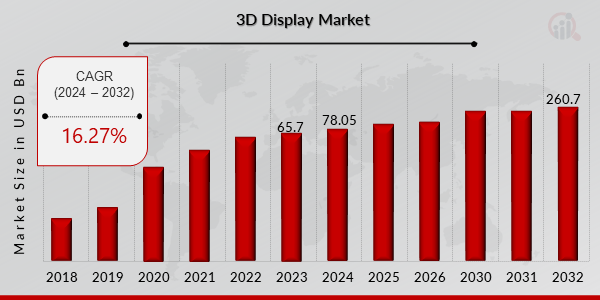
Der Markt für 3D-Displays wurde 2023 mit 65,7 Milliarden USD bewertet. Die Anwendung des 3D-Displays wird voraussichtlich von 78,05 Milliarden USD im Jahr 2024 auf 260,7 Milliarden USD bis 2032 wachsen, was einer jährlichen Wachstumsrate (CAGR) von 16,27 % während des Prognosezeitraums (2024 - 2032) entspricht. Die zunehmende Nutzung der 3D-Technologie im Gaming- und Heimunterhaltungsbereich, die sinkenden Preise für Geräte und der steigende Lebensstandard weltweit sind die Haupttreiber des Marktes, die das Wachstum fördern.
Quelle: Sekundärforschung, Primärforschung, MRFR-Datenbank und Analystenbewertung
Trends im 3D-Display-Markt
Die steigende Nachfrage nach Gaming-Industrien und Heimunterhaltung treibt das Marktwachstum an
Die steigende Nachfrage nach 3D-Technologien, die für die Gaming- und Heimunterhaltungsindustrie entwickelt wurden, ist einer der Hauptfaktoren, die das Wachstum des 3D-Display-Marktes fördern. Aufgrund der sinkenden Preise für elektronische Geräte und steigender verfügbaren Einkommen weltweit wird geschätzt, dass der Markt für 3D-Displays im prognostizierten Zeitraum erheblich wachsen wird. Das Spielerlebnis, die Technologie und die Grafiken haben sich in den letzten Jahren erheblich verändert. Die Branche arbeitet daran, das gesamte Spielerlebnis durch die Nutzung von 3D-Technologie zu verbessern, was das Wachstum des Marktes für 3D-Displays vorantreibt.
Das wachsende Interesse an LED- und OLED-Technologien, die eine überlegene Leistung und Bildqualität im Vergleich zu herkömmlichen Display-Technologien bieten, ist ein weiterer Faktor, von dem der Markt voraussichtlich profitieren wird.
Um im Markt Fuß zu fassen, entwickeln Unternehmen im 3D-Display-Sektor neue Technologien zur Kundenbindung. Beispielsweise werden die Sony Corporation und Theta Labs, Inc., ein Softwareunternehmen mit Sitz in den USA, im Mai 2022 3D-NFTs herausbringen. Die Designs dieser NFTs werden mit der Spatial Reality Device (SRD)-Technologie der Sony Corporation kompatibel sein. Das Hauptverkaufsmerkmal des Produkts ist die Fähigkeit, 3D-Effekte zu erzeugen, indem ein Bild mit der Augenbewegung des Benutzers synchronisiert wird.
Der Markt für 3D-Displays wird voraussichtlich schnell wachsen, da diese Displays in einer Vielzahl von Produkten wie Smartphones, Monitoren, Notebooks, Fernsehern und digitalen Bilderrahmen zunehmend verwendet werden.
Die Nachfrage nach Mobiltelefonen, Fernsehern und anderen nicht wesentlichen Verbraucherelektronikgeräten ging während der ersten Phase von COVID-19 zurück. Der Rückgang, der den Markt für 3D-Bildschirme beeinflusste, wurde auf die Verzögerung von Käufen durch die Kunden zurückgeführt. Allerdings gab es nach der Aufhebung der Beschränkungen einen Anstieg der Nachfrage nach Verbraucherelektronikprodukten aufgrund von Online-Lernen und Telearbeit. Im prognostizierten Jahrzehnt wird ein starkes Wachstum in den aufstrebenden Volkswirtschaften Chinas und Indiens aufgrund steigender Lebensstandards und einer erweiterten Mittelschicht erwartet.
Projektoren und Monitore, zwei der Hauptanwendungen für 3D-Displays, werden voraussichtlich in naher Zukunft einen plötzlichen Anstieg der Verkaufszahlen erleben, da sich die Verbraucherpräferenzen ändern und die Nachfrage nach hochauflösenden Grafiken steigt. Die hohen Kosten für 3D-Displays, der Mangel an 3D-Inhalten und gesundheitliche Probleme wie Reisekrankheit, Kopfschmerzen, Augenprobleme und Übelkeit werden voraussichtlich das Wachstum des 3D-Display-Marktes behindern.
Der Marktanteil für 3D-Displays wird voraussichtlich im Verlauf des Prognosezeitraums erheblich wachsen, da 3D-Displays in der Unterhaltungs- und Gaming-Industrie weit verbreitet sind. Das Interesse an 3D-Display-Technologien im Unterhaltungssektor hat das Wachstum des Marktes gefördert. Darüber hinaus wird geschätzt, dass das Gefühl von Tiefe das Wachstum des 3D-Display-Marktes im Laufe des prognostizierten Jahrzehnts ankurbeln wird. Die zunehmende Nutzung von Augmented Reality in verschiedenen medizinischen Verfahren und Anwendungen ist vorteilhaft für den 3D-Display-Markt.
Der Einsatz von Technologie reduziert die Dauer von Verfahren und die präoperative Planung, während die Sehfähigkeiten von Chirurgen verbessert werden. Es gibt jedoch mehrere Hindernisse, die das Wachstum des Marktes behindern könnten, darunter die hohen Kosten der 3D-Display-Technologie, die Unverfügbarkeit von 3D-Inhalten und das Fehlen von Interoperabilität zwischen den Akteuren des Marktes. Dies treibt die Einnahmen des 3D-Display-Marktes an.
Einblicke in die 3D-Display-Industrie:
Einblicke in 3D-Display-Produkte
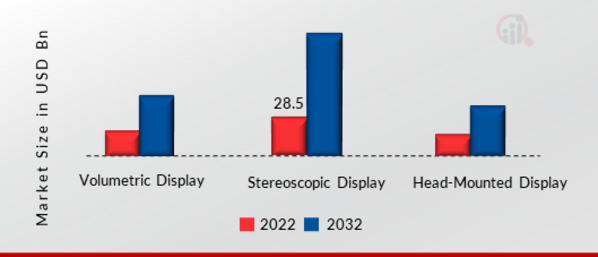
Die Segmentierung des 3D-Display-Marktes nach Produkt umfasst Volumetrische Displays, Stereoskopische Displays und Head-Mounted Displays. Das Segment der stereoskopischen Displays dominierte den globalen Markt im Jahr 2022. Das Wachstum des Segments kann auf die hohe Akzeptanz von Anwendungen in der Gaming- und Unterhaltungsindustrie zurückgeführt werden, darunter unter anderem Lehrmaterialien, Filme, Animationen und Videospiele. Entwicklungen in der autostereoskopischen Technologie und sinkende Preise für stereoskopische Produkte haben ebenfalls zur Entwicklung beigetragen.
Abbildung 1: 3D-Display-Markt, nach Produkt, 2022 & 2032 (USD Milliarden)
Quelle: Sekundärforschung, Primärforschung, MRFR-Datenbank und Analystenbewertung
Einblicke in 3D-Display-Technologie
Die Segmentierung des 3D-Display-Marktes nach Technologie umfasst Plasma-Display-Panel (PDP), Digital Light Processing (DLP), Organic Light Emitting Diode (OLED) und Light Emitting Diode. Das Segment der lichtemittierenden Dioden dominierte den globalen Markt im Jahr 2022. Um die Bildqualität zu verbessern und eine schnellere Reaktion zu bieten, verwenden Hintergrundbeleuchtungssysteme häufig LED-Panels. Verschiedene Unternehmen im 3D-Display-Markt konzentrieren sich auf die Entwicklung von LED-basierten Displays für verschiedene Anwendungen, darunter Fernseher, Monitore, Smartphones und Head-Mounted Displays (HMDs).
Einblicke in 3D-Display-Anwendungen
Die Segmentierung des 3D-Display-Marktes nach Anwendung umfasst Fernseher, Smartphones, Monitore, Projektorgeräte und Virtual-Reality-Headsets. Das Segment der Fernseher dominierte den 3D-Display-Markt im Jahr 2022. Ein erheblicher Teil des Wachstums der TV-Industrie kann nach der COVID-19-Pandemie mit einem Wechsel der Verbraucherpräferenzen von Kinobesuchen hin zu Unterhaltung zu Hause auf Fernsehern oder Computern in Verbindung gebracht werden.
Einblicke in die regionalen Märkte für 3D-Displays
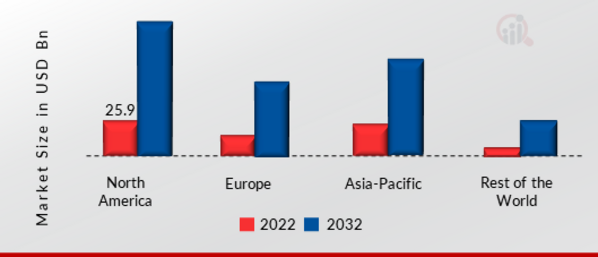
Die Studie bietet nach Region Einblicke in den Markt in Nordamerika, Europa, Asien-Pazifik und dem Rest der Welt. Der nordamerikanische 3D-Display-Markt dominierte diesen Markt im Jahr 2022 (45,80 %). Die Hauptfaktoren, die das Wachstum des regionalen Marktes beeinflussen, sind technologische Fortschritte, ein Anstieg der Smartphone-Durchdringung und eine hohe Akzeptanzrate digitaler Dienste. Darüber hinaus hielt der US-3D-Display-Markt den größten Marktanteil, und der kanadische 3D-Display-Markt war der am schnellsten wachsende Markt in der nordamerikanischen Region.
Darüber hinaus sind die wichtigsten Länder, die in dem Marktbericht untersucht wurden, die USA, Kanada, Deutschland, Frankreich, das Vereinigte Königreich, Italien, Spanien, China, Japan, Indien, Australien, Südkorea und Brasilien.
Abbildung 2: 3D-Display-Marktanteil nach Region 2022 (USD Milliarden)
Quelle: Sekundärforschung, Primärforschung, MRFR-Datenbank und Analystenbewertung
Der europäische 3D-Display-Markt hatte 2022 einen gesunden Marktanteil. Stereoskopische Displays werden aufgrund der wachsenden globalen Nachfrage nach Videospielen zunehmend eingesetzt. Im Verlauf der Prognose wird der regionale Markt auch durch die zunehmende Nutzung der 3D-Display-Technologie in der Unterhaltung, im Gaming, in militärischen Simulationen und im Ingenieurwesen gestärkt. Darüber hinaus hielt der deutsche 3D-Display-Markt den größten Marktanteil, und der britische 3D-Display-Markt war der am schnellsten wachsende Markt in der europäischen Region.
Der 3D-Display-Markt im asiatisch-pazifischen Raum wird von 2023 bis 2032 voraussichtlich ein signifikantes Wachstum verzeichnen. Dies ist auf sich ändernde Verbraucherpräferenzen und steigende verfügbare Haushaltseinkommen zurückzuführen. Das Wachstum des asiatisch-pazifischen Raums im 3D-Display-Markt wird zudem durch die Präsenz großer Technologieunternehmen wie LG, Samsung Electronics, Sony, Panasonic und Fujifilm Holdings Corporation unterstützt. Darüber hinaus hielt der 3D-Display-Markt in China den größten Marktanteil, und der indische 3D-Display-Markt war der am schnellsten wachsende Markt in der asiatisch-pazifischen Region.
Wichtige Akteure und Wettbewerbsanalysen im 3D-Display-Markt
Führende Marktteilnehmer investieren stark in Forschung und Entwicklung, um ihre Produktlinien zu erweitern, was dem 3D-Display-Markt weiteres Wachstum verleihen wird. Marktteilnehmer unternehmen auch eine Vielzahl strategischer Aktivitäten, um ihre globale Präsenz auszubauen, wobei wichtige Marktentwicklungen neue Produkteinführungen, vertragliche Vereinbarungen, Fusionen und Übernahmen, höhere Investitionen und Kooperationen mit anderen Organisationen umfassen. Um in einem wettbewerbsintensiven und wachsenden Marktumfeld zu expandieren und zu überleben, muss die 3D-Display-Anwendung kosteneffektive Produkte anbieten.
Die lokale Produktion zur Minimierung der Betriebskosten ist eine der wichtigsten Geschäftstaktiken, die von Herstellern im globalen 3D-Display-Anwendungsmarkt genutzt werden, um den Kunden zu nutzen und den Marktsektor zu erhöhen. In den letzten Jahren hat die 3D-Display-Anwendung einige der bedeutendsten Vorteile für die Medizin geboten. Wichtige Akteure im 3D-Display-Markt, darunter Panasonic Corporation, Samsung Electronics, Toshiba Corporation, LG Electronics Inc., Sharp Corporation, Sony Corporation, 3D Combination, Mitsubishi Electric Corporation, 3DIcon und Fujifilm Corporation, versuchen, die Marktnachfrage durch Investitionen in Forschung und Entwicklung von Produkten zu steigern.
Tragbare Technologien, Smartphones, Tablets und Personal Computer werden alle von Apple Inc. (Apple) hergestellt, verkauft und entwickelt. Das Unternehmen bietet zudem Zubehör, Software, verbundene Dienste und digitale Inhalte von Drittanbietern an. Zu den Produktlinien von Apple gehören das iPhone, iPad, Mac, iPod, Apple Watch und Apple TV. iCloud, AppleCare, Apple Pay, iOS, macOS, iPadOS und watchOS sind nur einige der Verbraucher- und Geschäftsanwendungen, die es anbietet. Apple bietet und vertreibt digitale Inhalte und Programme über den App Store, Apple Arcade, Apple News+, Apple Fitness+, Apple Card, Apple TV+ und Apple Music.
Cloud-Dienste, Finanzdienstleistungen und Werbedienste werden ebenfalls von dem Unternehmen angeboten. Das Unternehmen hat eine kommerzielle Präsenz in den Amerikas, Europa, dem Nahen Osten, Afrika und Asien-Pazifik. Apple hat seinen Sitz in Cupertino, Kalifornien, einer Stadt in den Vereinigten Staaten. Apple Inc. gab im April 2022 bekannt, dass es beginnen wird, MR-Geräte mit Micro OLED- und OLED-Bildschirmen zu verkaufen. Solche HMD-F&E werden das Wachstum des HMD-Segments des Marktes für 3D-Displays im Laufe des prognostizierten Zeitraums ankurbeln.
Die Sony Group Corp. (Sony) stellt eine Vielzahl von Produkten her, darunter Geräte, Werkzeuge, medizinische Ausrüstung, Halbleiter und Elektronik. Zu den Produkten des Unternehmens gehören Batterien, Software, Fernseher, Mobiltelefone, Kameras, Musiksysteme, Spielkonsolen und andere elektrische Geräte. Sony produziert, kauft und vertreibt außerdem Kinofilme, Fernsehsendungen und aufgezeichnete Musik und betreibt Fernsehsender und digitale Netzwerke. Das Unternehmen vermarktet seine Produkte über Distributoren, Verkaufsabteilungen und Online-Direktverkäufe. Unter den Namen Airpeak, Sony, PlayStation, Walkman, Blu-ray, Cyber-shot, Bravia, Exmor und Experia bietet es Produkte zum Verkauf an.
Das Unternehmen ist in Afrika, dem Nahen Osten, Asien-Pazifik und den Amerikas tätig. Der Hauptsitz von Sony befindet sich in Minato-Ku, Tokio, Japan. Im August 2022 stellte Sony den neuen A95K OLED-Fernseher vor, der über die Cognitive Processor XR-Technologie für ein immersives Seherlebnis und die Bereitstellung des ursprünglichen Inhalts des Erstellers verfügt.
Q2 2024: Sony stellt neues Spatial Reality Display für professionelle 3D-Inhaltserstellung vor Sony kündigte die Einführung seines neuesten Spatial Reality Displays an, das für Kreative in den Bereichen Unterhaltung, Automobil und Medizin konzipiert ist und eine brillenfreie 3D-Visualisierung für professionelle Anwendungen bietet.
Q2 2024: Samsung präsentiert Next-Generation 3D OLED-Display auf der SID Display Week 2024 Samsung Electronics stellte seine neue 3D OLED-Display-Technologie auf der SID Display Week 2024 vor und hob Fortschritte in der brillenfreien 3D-Anzeige für Unterhaltungselektronik und Armaturenbretter im Automobilbereich hervor.
Q3 2024: LG bringt 3D transparentes OLED-Display für Einzelhandel und Ausstellungsmarkt auf den Markt LG Electronics brachte ein neues 3D transparentes OLED-Display auf den Markt, das auf den Einzelhandels- und Ausstellungssektor abzielt und immersive Produktpräsentationen und interaktive Kundenerlebnisse ermöglicht.
Q3 2024: Panasonic stellt 3D-Head-Up-Display für Automobilanwendungen vor Panasonic stellte ein 3D-Head-Up-Display-System für Fahrzeuge vor, das Echtzeit-Navigation und Sicherheitsinformationen in stereoskopischem Format bereitstellt, um das Bewusstsein des Fahrers zu erhöhen.
Q4 2024: Sharp kündigt Massenproduktion von brillenfreien 3D-Displays für medizinische Bildgebung an Sharp begann mit der Massenproduktion seiner neuesten brillenfreien 3D-Display-Panels, die auf den Markt für medizinische Bildgebung abzielen, um die Visualisierung in der Diagnostik und Chirurgie zu verbessern.
Q1 2025: Looking Glass Factory sichert sich 50 Millionen USD in Serie-B-Finanzierung zur Skalierung der holografischen 3D-Display-Produktion Looking Glass Factory, ein Start-up, das sich auf holografische 3D-Displays spezialisiert hat, sicherte sich 50 Millionen USD in Serie-B-Finanzierung, um die Produktion zu erweitern und die Produktentwicklung für Unternehmens- und Kreativmärkte zu beschleunigen.
Q1 2025: Apple erwirbt 3D-Display-Startup LightField Lab zur Verbesserung der AR/VR-Hardware Apple erwarb LightField Lab, ein Unternehmen, das für seine fortschrittliche 3D-Display-Technologie bekannt ist, um seine Fähigkeiten in der Augmented- und Virtual-Reality-Hardware zu verbessern.
Q2 2025: BOE Technology eröffnet neues 3D-Display-Fertigungswerk in Chengdu BOE Technology eröffnete ein neues Fertigungswerk in Chengdu, das der Produktion von 3D-Display-Panels der nächsten Generation für Unterhaltungselektronik und Automobilanwendungen gewidmet ist.
Q2 2025: Realfiction und TCL kündigen strategische Partnerschaft zur Entwicklung von Großformat-3D-Displays an Realfiction und TCL gingen eine strategische Partnerschaft ein, um gemeinsam Großformat-3D-Displays für digitale Beschilderung und Unterhaltungsorte zu entwickeln und zu vermarkten.
Q2 2025: VividQ sichert sich 20 Millionen USD in Serie-A-Finanzierung zur Förderung der holografischen 3D-Display-Technologie VividQ, ein in Großbritannien ansässiges Deep-Tech-Unternehmen, sammelte 20 Millionen USD in Serie-A-Finanzierung, um die Entwicklung und Kommerzialisierung seiner holografischen 3D-Display-Lösungen zu beschleunigen.
Q3 2025: Panasonic und Unity Technologies arbeiten zusammen, um Echtzeit-3D-Inhalte in Displays zu integrieren Panasonic kündigte eine Partnerschaft mit Unity Technologies an, um die Integration von Echtzeit-3D-Inhalten in seine nächsten Display-Produkte für Gaming- und Simulationsmärkte zu ermöglichen.
Q3 2025: Sony ernennt neuen Leiter der 3D-Display-Geschäftseinheit im Zuge der globalen Expansion Sony ernannte einen neuen Geschäftsführer, um seine 3D-Display-Geschäftseinheit zu leiten, was auf einen strategischen Fokus auf die Expansion seiner Präsenz im globalen 3D-Visualisierungsmarkt hinweist.
Segmentierung des 3D-Display-Marktes:
Ausblick auf 3D-Display-Produkte
Volumetrisches Display
Stereoskopisches Display
Head-Mounted Display
Ausblick auf 3D-Display-Technologie
Plasma-Display-Panel (PDP)
Digital Light Processing (DLP)
Organic Light Emitting Diode (OLED)
Light Emitting Diode
Ausblick auf 3D-Display-Anwendungen
Fernsehen
Smartphones
Monitor
Projektorgeräte
Virtual-Reality-Headset
Ausblick auf regionale 3D-Displays
Nordamerika
USA
Kanada
Europa
Deutschland
Frankreich
Vereinigtes Königreich
Italien
Spanien
Rest von Europa
Asien-Pazifik
China
Japan
Indien
Australien
Südkorea
Rest von Asien-Pazifik
Rest der Welt
Naher Osten
Afrika
Lateinamerika
Global 3D Display Market Overview:
3D Display Market Size was valued at USD 65.7 Billion in 2023. The 3D Display market Application is projected to grow from USD 78.05 Billion in 2024 to USD 260.7 Billion by 2032, exhibiting a compound annual growth rate (CAGR) of 16.27% during the forecast period (2024 - 2032). The expanding use of 3D technology in gaming and home entertainment, the decreasing price of devices, and the growing standard of living globally, are the key market drivers enhancing the market growth.
3D Display Market Trends
Increasing demand for gaming industries and home entertainment is driving the market growth
The increasing demand for 3D technologies developed for the gaming and home entertainment industries is one of the main factors boosting the growth of the 3D display market. As a result of declining prices for electronic devices and increasing disposable incomes among people all over the world, it is estimated that the market for 3D displays would expand significantly over the projected period. The gaming experience, technology, and graphics have all changed significantly in recent years. The industry is working to improve the entire gaming experience by utilising 3D technology, which is causing the market for 3D displays to grow.
Growing interest in LED and OLED technologies, which offer superior performance and picture quality than traditional display technologies, is another factor that the market is predicted to profit from.
To assist them gain traction in the market, businesses in the 3D display sector are inventing new customer-drawing technologies. For instance, Sony Corporation and Theta Labs, Inc., a software firm with headquarters in the United States, will release 3D NFTs in May 2022. These NFTs' designs will be compatible with Sony Corporation's Spatial Reality Device (SRD) technology. The product's key selling feature is its ability to create 3D effects by synchronising an image with the user's eye movement.
The market for 3D displays is expected to increase rapidly as a result of the rising use of these displays in a number of goods, including smartphones, monitors, notebook PCs, TVs, and digital photo frames.
Demand for cellphones, televisions, and other non-essential consumer devices decreased during the first stage of COVID-19. Customers delaying purchases was blamed for the downturn, which affected the market for 3D screens. However, as a result of online learning and telecommuting, there was an increase in demand for consumer electronics products after the restrictions were removed. The forecast decade is expected to see strong growth in the growing economies of China and India as a result of rising living standards and an enlarged middle-class demographic base.
Projectors and monitors, two of the primary uses for 3D displays, are anticipated to see an abrupt increase in sales in the near future due to shifting consumer preferences and rising demand for high-definition graphics. The expensive cost of 3D displays, the scarcity of 3D content, and health issues including motion sickness, headaches, eye difficulties, and nausea are all expected to hinder the growth of the 3D display market.
The market share for 3D displays is expected to grow significantly over the course of the forecast period as a result of the extensive use of 3D displays in the entertainment and gaming industries. The market has expanded as a result of the rise in interest in 3D display technologies throughout the entertainment sector. Additionally, it is estimated that the feeling of depth will fuel the growth of the 3D display market during the course of the projected decade. The increasing use of augmented reality in various medical procedures and applications is advantageous for the 3D display market.
The use of technology reduces the duration of procedures and preoperative planning while enhancing the vision abilities of surgeons. However, there are several obstacles that could hinder the market's growth, including the high cost of 3D display technology, the unavailability of 3D content, and the lack of interoperability among the market's stakeholders. Thus, driving the 3D Display market revenue.
3D Display Market Industry Insights:
3D Display Product Insights
The 3D Display Market segmentation, based on Product, includes Volumetric Display, Stereoscopic Display, and Head-Mounted Display. Stereoscopic display segment dominated the global market in 2022. The segment's growth can be attributed to the high adoption of apps in the gaming and entertainment industries, including, among others, instructional materials, movies, animations, and video games. Autostereoscopic technology developments and lower stereoscopic product pricing have also contributed to the development.
Figure 1: 3D Display Market, by Product, 2022 & 2032 (USD Billion)
3D Display Technology Insights
The 3D Display Market segmentation, based on Technology, includes Plasma Display Panel (PDP), Digital Light Processing (DLP), Organic Light Emitting Diode (OLED), and Light Emitting Diode. Light emitting diode segment dominated the global market in 2022. To improve image quality and provide a quicker reaction, backlighting systems frequently use LED panels. For various applications, including TVs, monitors, smartphones, and head-mounted displays (HMDs), several businesses in the 3D display market are concentrating on developing LED-based displays.
3D Display Application Insights
The 3D Display Market segmentation, based on Application, includes Television, Smartphones, Monitor, Projector Devices, and Virtual Reality Headset. Television segment dominated the 3D Display Market in 2022. Following the COVID-19 pandemic, a significant portion of the expansion of the TV industry can be linked to a change in consumer choice from travelling to movie theatres to being entertained at home on TVs or computers.
3D Display Regional Insights
By region, the study provides the market insights into North America, Europe, Asia-Pacific and Rest of the World. The North America 3D Display Market dominated this market in 2022 (45.80%). The main factors influencing the growth of the regional market are technological improvements, an increase in smartphone penetration, and a high adoption rate of digital services. Further, the U.S. 3D Display market held the largest market share, and the Canada 3D Display market was the fastest growing market in the North America region.
Further, the major countries studied in the market report are The US, Canada, German, France, the UK, Italy, Spain, China, Japan, India, Australia, South Korea, and Brazil.
Figure 2: 3D Display Market SHARE BY REGION 2022 (USD Billion)
Europe 3D Display market accounted for the healthy market share in 2022. Stereoscopic displays are being used more frequently as a result of the growing global demand for video games. Through the course of the forecast, the regional market will also be strengthened by the expanding usage of 3D display technology in entertainment, gaming, simulations for the military, and engineering. Further, the German 3D Display market held the largest market share, and the U.K 3D Display market was the fastest growing market in the European region.
The Asia Pacific 3D Display market is expected to register significant growth from 2023 to 2032. This is due to changing consumer choices and rising household disposable income. The expansion of the Asia Pacific area in the 3D display market is further aided by the presence of major technology companies like LG, Samsung Electronics, Sony, Panasonic, and Fujifilm Holdings Corporation. Moreover, China’s 3D Display market held the largest market share and the Indian 3D Display market was the fastest growing market in the Asia-Pacific region.
3D Display Key Market Players & Competitive Insights
Leading market players are investing heavily in research and development in order to expand their product lines, which will help the 3D Display market, grow even more. Market participants are also undertaking a variety of strategic activities to expand their global footprint, with important market developments including new product launches, contractual agreements, mergers and acquisitions, higher investments, and collaboration with other organizations. To expand and survive in a more competitive and rising market climate, 3D Display Application must offer cost-effective items.
Manufacturing locally to minimize operational costs is one of the key business tactics used by manufacturers in the global 3D Display Application to benefit clients and increase the market sector. In recent years, the 3D Display Application has offered some of the most significant advantages to medicine. Major players in the 3D Display market, including Panasonic Corporation, Samsung Electronics, Corporation Toshiba Corporation, LG Electronics Inc., Sharp Corporation, Sony Corporation, 3D combination, Mitsubishi Electric Corporation, 3DIcon, and Fujifilm Corporation, are attempting to increase market demand by investing in research and development Products.
Wearable technology, smartphones, tablets, and personal computers are all produced, sold, and created by Apple Inc. (Apple). The company additionally offers accessories, software, connected services, and digital content from third parties. Among Apple's product lines are the iPhone, iPad, Mac, iPod, Apple Watch, and Apple TV. iCloud, AppleCare, Apple Pay, iOS, macOS, iPadOS, and watchOS are just a few of the consumer and commercial software applications it offers. Apple offers and distributes digital material and programmes via the App Store, Apple Arcade, Apple News+, Apple Fitness+, Apple Card, Apple TV+, and Apple Music.
Cloud services, financial services, and advertising services are also provided by the company. The corporation has a commercial presence throughout the Americas, Europe, the Middle East, Africa, and Asia-Pacific. Apple is based in Cupertino, California, a city in the United States. Apple Inc. said in April 2022 that it would begin selling MR devices with Micro OLED and OLED screens. Such HMD R&D will fuel the market for 3D displays' HMD segment growth throughout the course of the projected period.
Sony Group Corp. (Sony) manufactures a variety of products, including devices, tools, medical equipment, semiconductors, and electronics. The company's products include batteries, software, televisions, cell phones, cameras, music systems, game consoles, and other electrical equipment. Sony produces, buys, and distributes motion films, television programmes, and recorded music in addition to operating television and digital networks. Through distributors, sales divisions, and online direct sales, the company promotes its products. Under the names Airpeak, Sony, PlayStation, Walkman, Blu-ray, Cyber-shot, Bravia, Exmor, and Experia, it offers products for sale.
Africa, the Middle East, Asia-Pacific, and the Americas are all where the company has activities. Sony's corporate headquarters are in Minato-Ku, Tokyo, Japan. In August 2022, Sony introduced the new A95K OLED TV, which features cognitive processor XR technology for an immersive viewing experience and delivery of the creator's original content.
Q2 2024: Sony Unveils New Spatial Reality Display for Professional 3D Content Creation Sony announced the launch of its latest Spatial Reality Display, designed for creators in the entertainment, automotive, and medical industries, offering glasses-free 3D visualization for professional applications.
Q2 2024: Samsung Introduces Next-Generation 3D OLED Display at SID Display Week 2024 Samsung Electronics showcased its new 3D OLED display technology at SID Display Week 2024, highlighting advancements in glasses-free 3D viewing for consumer electronics and automotive dashboards.
Q3 2024: LG Launches 3D Transparent OLED Display for Retail and Exhibition Markets LG Electronics launched a new 3D transparent OLED display aimed at retail and exhibition sectors, enabling immersive product presentations and interactive customer experiences.
Q3 2024: Panasonic Debuts 3D Head-Up Display for Automotive Applications Panasonic introduced a 3D head-up display system for vehicles, providing real-time navigation and safety information in a stereoscopic format to enhance driver awareness.
Q4 2024: Sharp Announces Mass Production of Glasses-Free 3D Displays for Medical Imaging Sharp began mass production of its latest glasses-free 3D display panels, targeting the medical imaging market to improve visualization in diagnostics and surgery.
Q1 2025: Looking Glass Factory raises $50M Series B to scale holographic 3D display production Looking Glass Factory, a startup specializing in holographic 3D displays, secured $50 million in Series B funding to expand manufacturing and accelerate product development for enterprise and creative markets.
Q1 2025: Apple acquires 3D display startup LightField Lab to boost AR/VR hardware Apple acquired LightField Lab, a company known for its advanced 3D display technology, to enhance its augmented and virtual reality hardware capabilities.
Q2 2025: BOE Technology opens new 3D display manufacturing facility in Chengdu BOE Technology inaugurated a new manufacturing facility in Chengdu dedicated to the production of next-generation 3D display panels for consumer electronics and automotive applications.
Q2 2025: Realfiction and TCL Announce Strategic Partnership to Develop Large-Format 3D Displays Realfiction and TCL entered a strategic partnership to co-develop and commercialize large-format 3D displays for digital signage and entertainment venues.
Q2 2025: VividQ Secures $20M Series A Funding to Advance Holographic 3D Display Technology VividQ, a UK-based deep tech company, raised $20 million in Series A funding to accelerate the development and commercialization of its holographic 3D display solutions.
Q3 2025: Panasonic and Unity Technologies Partner to Integrate Real-Time 3D Content in Displays Panasonic announced a partnership with Unity Technologies to enable real-time 3D content integration in its next-generation display products for gaming and simulation markets.
Q3 2025: Sony appoints new head of 3D display business unit amid global expansion Sony named a new executive to lead its 3D display business unit, signaling a strategic focus on expanding its presence in the global 3D visualization market.
3D Display Market Segmentation:
3D Display Product Outlook
Volumetric Display
Stereoscopic Display
Head-Mounted Display
3D Display Technology Outlook
Plasma Display Panel (PDP)
Digital Light Processing (DLP)
Organic Light Emitting Diode (OLED)
Light Emitting Diode
3D Display Application Outlook
Television
Smartphones
Monitor
Projector Devices
Virtual Reality Headset
3D Display Regional Outlook
North America
U.S.
Canada
Europe
Germany
France
UK
Italy
Spain
Rest of Europe
Asia-Pacific
China
Japan
India
Australia
South Korea
Australia
Rest of Asia-Pacific
Rest of the World
Middle East
Africa
Latin America
3-D Display Markt Market Report Scope
MARKTGRÖSSE 2024
78,05 (Milliarden USD)
MARKTGRÖSSE 2025
90,75 (Milliarden USD)
MARKTGRÖSSE 2035
409,83 (Milliarden USD)
Durchschnittliche jährliche Wachstumsrate (CAGR)
16,27 % (2024 - 2035)
BERICHTSABDECKUNG
Umsatzprognose, Wettbewerbslandschaft, Wachstumsfaktoren und Trends
GRUNDJAHR
2024
Marktprognosezeitraum
2025 - 2035
Historische Daten
2019 - 2024
Marktprognoseeinheiten
Milliarden USD
Profilierte Schlüsselunternehmen
Marktanalyse in Bearbeitung
Abgedeckte Segmente
Marktsegmentierungsanalyse in Bearbeitung
Schlüsselmarktchancen
Die Integration von Augmented Reality in Unterhaltungselektronik erhöht das Engagement im 3D-Display-Markt.
Schlüsselmarktdynamiken
Technologische Fortschritte treiben die Wettbewerbsfaktoren voran, erhöhen das Engagement der Verbraucher und gestalten die Landschaft des 3D-Display-Marktes neu.
Abgedeckte Länder
Nordamerika, Europa, APAC, Südamerika, MEA
FAQs
Was ist die prognostizierte Marktbewertung des 3D-Display-Marktes bis 2035?
Die prognostizierte Marktbewertung des 3D-Display-Marktes wird voraussichtlich 409,83 Milliarden USD bis 2035 erreichen.
Wie hoch war die Gesamtmarktbewertung des 3D-Display-Marktes im Jahr 2024?
Die Gesamtmarktbewertung des 3D-Display-Marktes betrug 78,05 Milliarden USD im Jahr 2024.
Wie hoch ist die erwartete CAGR für den 3D-Display-Markt während des Prognosezeitraums 2025 - 2035?
Die erwartete CAGR für den 3D-Display-Markt während des Prognosezeitraums 2025 - 2035 beträgt 16,27 %.
Welche Unternehmen gelten als Schlüsselakteure im 3D-Display-Markt?
Zu den Schlüsselakteuren im 3D-Display-Markt gehören Samsung Electronics, LG Display, Sony Corporation, Panasonic Corporation, Sharp Corporation, Intel Corporation, NVIDIA Corporation, Qualcomm Incorporated und JVC Kenwood Corporation.
Was sind die wichtigsten Produktsegmente im 3D-Display-Markt?
Die wichtigsten Produktsegmente im 3D-Display-Markt sind Volumetrisches Display, Stereoskopisches Display und Head-Mounted Display.
Wie hat sich die Bewertung von Head-Mounted Displays von 2024 bis 2035 verändert?
Die Bewertung von Head-Mounted Displays wird voraussichtlich von 38,05 Milliarden USD im Jahr 2024 auf 209,83 Milliarden USD bis 2035 steigen.
Welche Technologiebereiche sind im 3D-Display-Markt enthalten?
Technologiebereiche im 3D-Display-Markt umfassen Plasma Display Panel (PDP), Digital Light Processing (DLP), Organic Light Emitting Diode (OLED) und Light Emitting Diode.
Wie hoch wird die prognostizierte Bewertung für OLED-Technologie bis 2035 sein?
Die prognostizierte Bewertung für OLED-Technologie im 3D-Display-Markt wird voraussichtlich 150,0 Milliarden USD bis 2035 erreichen.
Welche Anwendungssegmente treiben das Wachstum im 3D-Display-Markt voran?
Anwendungssegmente, die das Wachstum im 3D-Display-Markt vorantreiben, sind Fernsehen, Smartphones, Monitore, Projektorgeräte und Virtual-Reality-Headsets.
Wie hoch wird die erwartete Bewertung für Virtual-Reality-Headsets bis 2035 sein?
Die erwartete Bewertung für Virtual-Reality-Headsets im 3D-Display-Markt wird voraussichtlich 139,83 Milliarden USD bis 2035 betragen.
A consulting professional focused on helping businesses navigate complex markets through structured research and strategic insights.
I partner with clients to solve high-impact business problems across market entry strategy, competitive intelligence, and opportunity assessment. Over the course of my experience, I have led and contributed to 100+ market research and consulting engagements, delivering insights across multiple industries and geographies, and supporting strategic decisions linked to $500M+ market opportunities.
My core expertise lies in building robust market sizing, forecasting, and commercial models (top-down and bottom-up), alongside deep-dive competitive and industry analysis. I have played a key role in shaping go-to-market strategies, investment cases, and growth roadmaps, enabling clients to make confident, data-backed decisions in dynamic markets.
read more
Ko-Autor
Shubham Munde
Team Lead - Research
Shubham brings over 7 years of expertise in Market Intelligence and Strategic Consulting, with a strong focus on the Automotive, Aerospace, and Defense sectors. Backed by a solid foundation in semiconductors, electronics, and software, he has successfully delivered high-impact syndicated and custom research on a global scale. His core strengths include market sizing, forecasting, competitive intelligence, consumer insights, and supply chain mapping. Widely recognized for developing scalable growth strategies, Shubham empowers clients to navigate complex markets and achieve a lasting competitive edge. Trusted by start-ups and Fortune 500 companies alike, he consistently converts challenges into strategic opportunities that drive sustainable growth.
The secondary research process involved comprehensive analysis of regulatory databases, industry standards, technical publications, and authoritative technology organizations. Key sources included the US Federal Communications Commission (FCC), National Institute of Standards and Technology (NIST), US Department of Energy (DOE) Office of Energy Efficiency & Renewable Energy, European Telecommunications Standards Institute (ETSI), International Electrotechnical Commission (IEC), Society for Information Display (SID), Consumer Technology Association (CTA), IEEE Xplore Digital Library, US Patent and Trademark Office (USPTO), European Patent Office (EPO), Japan Patent Office (JPO), Organization for Economic Co-operation and Development (OECD) Digital Economy Outlook, International Data Corporation (IDC), National Science Foundation (NSF) Technology Statistics, and national technology ministry reports from key markets including China's Ministry of Industry and Information Technology (MIIT), Japan's Ministry of Economy, Trade and Industry (METI), and South Korea's Ministry of Science and ICT. These sources were used to collect technology standards, patent landscapes, regulatory compliance data, shipment statistics, adoption trends, and competitive landscape analysis for volumetric displays, stereoscopic displays, head-mounted displays, and underlying technologies including OLED, DLP, PDP, and LED.
Primary Research
To gather both qualitative and quantitative information, the primary research process involved interviewing players from both the supply and demand sides. Executives from semiconductor firms, original equipment manufacturers (OEMs), display panel makers, and heads of display technology research and development were among the supply-side sources. Enterprise virtual reality and augmented reality solution architects, healthcare imaging experts, chief technology officers, and procurement leads from consumer electronics firms were among the demand-side sources. Market segmentation, product development roadmaps, pricing tactics, supply chain dynamics, and patterns of technology adoption were all confirmed through primary research.
Primary Respondent Breakdown:
By Designation: C-level Primaries (32%), Director Level (30%), Others (38%)
By Region: North America (32%), Europe (30%), Asia-Pacific (33%), Rest of World (5%)
Market Size Estimation
Global market valuation was derived through revenue mapping and unit shipment analysis. The methodology included:
Identification of 50+ key manufacturers and technology providers across North America, Europe, Asia-Pacific, and Latin America
Product mapping across volumetric displays, stereoscopic displays, head-mounted displays, and underlying display technologies (OLED, DLP, PDP, LED)
Analysis of reported and modeled annual revenues specific to 3D display portfolios
Coverage of manufacturers representing 75-80% of global market share in 2024
Extrapolation using bottom-up (unit shipments × ASP by country/region) and top-down (manufacturer revenue validation) approaches to derive segment-specific valuations for television, smartphones, monitors, projector devices, and virtual reality headset applications
“This is really good guys. Excellent work on a tight deadline. I will continue to use you going forward and recommend you to others. Nice job”
Noah MalgeriCo-Founder
“Thanks. It’s been a pleasure working with you, please use me as reference with any other Intel employees.”
Joseph AguayoSales Operations & Pricing Manager
“Thanks for sending the report it gives us a good global view of the Betaïne market.”
Peter Groot koerkampAccount and Business Manager
“Thank you, this will be very helpful for OQS.”
La Terria DoddProgram Support Specialist
“We found the report very insightful! we found your research firm very helpful. I'm sending this email to secure our future business.”
Younghwan ChoiSenior Retail Manager
“I am very pleased with how market segments have been defined in a relevant way for my purposes (such as "Portable Freezers & refrigerators" and "last-mile").
In general the report is well structured. Thanks very much for your efforts.”
Mark IrwinManagement Consultant
“I have been reading the first document or the study, ,the Global HVAC and FP market report 2021 till 2026. Must say, good info! I have not gone in depth at all parts, but got a good indication of the data inside!”
Rob KooikerGroup Product Manager HVAC & Fire Protection GMA
“We got the report in time, we really thank you for your support in this process. I also thank to all of your team as they did a great job.”
Akif MorogluStrategy & Business Development Director
“The Automotive 48V ECU Components Procurement Intelligence Study” was a complex project, but the Market Research Future (MRFR) team handled it with quality, agility, and customer-centricity. They delivered all requested data on time and within the agreed scope. The team, including Shubhendra Anand and Rahul Gotadki, was always readily available to clarify questions and swiftly implement necessary adjustments, driving the project to a successful conclusion within a very demanding timeframe.
I would also like to specifically commend Akshay Agarwal for his responsiveness and support at every stage—from our initial inquiry on May 6th through to final delivery on June 18th. His dedication made the entire process seamless.”
Guilherme Gomes MartinsProduct Management Director