Kostenloses Muster herunterladen
Bitte füllen Sie das folgende Formular aus, um ein kostenloses Muster dieses Berichts zu erhalten
Marktforschungsbericht über fortgeschrittenen Basalzellkarzinom nach Behandlungsart (Chirurgische Exzision, Mohs-Chirurgie, Kryotherapie, Topische Chemotherapie, Strahlentherapie), nach Krankheitsstadium (Lokalisiert, Regional, Fern), nach Diagnosemethode (Hautbiopsie, Dermatoskopie, Histopathologie, Molekulare Tests), nach Patientendemografie (Erwachsene, Pädiatrie), nach Behandlungsumgebung (Krankenhaus, Ambulante Klinik, Dermatologiepraxis) und nach Region (Nordamerika, Europa, Südamerika, Asien-Pazifik, Naher Osten und Afrika) - Prognose bis 2035
| CAGR (2025 - 2035) | 7.47% |
The Advanced Basal Cell Carcinoma Market is currently experiencing notable developments, driven by a combination of increasing awareness regarding skin cancer and advancements in treatment modalities. As healthcare professionals and patients alike become more informed about the implications of advanced basal cell carcinoma, there is a growing demand for innovative therapies and diagnostic tools. This heightened awareness is likely to foster a more proactive approach to treatment, potentially leading to earlier interventions and improved patient outcomes. Furthermore, the integration of technology in healthcare, such as telemedicineand digital health platforms, appears to enhance access to specialized care, thereby influencing the market dynamics positively. In addition, the Advanced Basal Cell Carcinoma Market is witnessing a shift towards personalized medicine, where treatments are tailored to individual patient profiles. This trend suggests a move away from one-size-fits-all approaches, as healthcare providers increasingly recognize the importance of genetic and molecular factors in treatment efficacy. The collaboration between pharmaceutical companies and research institutions is likely to accelerate the development of targeted therapies, which may offer more effective solutions for patients suffering from advanced stages of this skin cancer. Overall, the market landscape is evolving, with a focus on innovation and patient-centered care, which could redefine treatment paradigms in the near future.
There is a growing emphasis on educating both healthcare providers and the public about advanced basal cell carcinoma. This trend is likely to lead to increased early detection and treatment, as more individuals recognize the symptoms and seek medical advice.
Innovations in treatment options, including targeted therapies and immunotherapies, are becoming more prevalent. These advancements may provide more effective solutions for patients, potentially improving survival rates and quality of life.
The market is gradually moving towards personalized treatment approaches, where therapies are tailored to the genetic makeup of individual patients. This trend suggests a more effective management of advanced basal cell carcinoma, as treatments become increasingly specific.
Die Entwicklung diagnostischer Techniken spielt eine entscheidende Rolle bei der Gestaltung des Marktes für fortgeschrittenes Basalzellkarzinom. Verbesserte Bildgebungstechnologien wie Dermatoskopie und reflektierende konfokale Mikroskopie haben die Genauigkeit der Diagnosen von Basalzellkarzinomen erheblich verbessert. Diese Fortschritte ermöglichen eine frühere Erkennung fortgeschrittener Fälle, die für eine effektive Behandlung unerlässlich ist. Darüber hinaus wird die Integration von künstlicher Intelligenz in diagnostische Prozesse zunehmend relevant, was möglicherweise die Identifizierung von Hautläsionen optimiert. Da Gesundheitsfachkräfte diese ausgeklügelten diagnostischen Werkzeuge zunehmend übernehmen, wird der Markt für fortgeschrittene Behandlungen des Basalzellkarzinoms voraussichtlich wachsen, angetrieben durch die Notwendigkeit zeitgerechter und präziser Interventionen.
Der Anstieg der Investitionen in die Onkologie-Forschung ist ein bemerkenswerter Treiber für den Markt für fortgeschrittenes Basalzellkarzinom. Pharmaunternehmen und Forschungseinrichtungen weisen erhebliche Ressourcen zu, um neuartige Therapien und Behandlungsmodalitäten für fortgeschrittenes Basalzellkarzinom zu entwickeln. Dieser Trend wird durch die zunehmende Anzahl klinischer Studien unterstrichen, die darauf abzielen, neue Arzneimittelkandidaten und Kombinationstherapien zu evaluieren. In den letzten Jahren hat der Onkologiesektor einen signifikanten Zufluss an Finanzmitteln erlebt, wobei jährlich Milliarden von USD investiert werden. Ein solches finanzielles Engagement beschleunigt nicht nur das Tempo der Innovation, sondern verbessert auch die Verfügbarkeit fortgeschrittener Behandlungsoptionen, wodurch das Wachstum im Markt für fortgeschrittenes Basalzellkarzinom gefördert wird.
Die wachsende Präferenz für minimalinvasive Behandlungen beeinflusst den Markt für fortgeschrittenes Basalzellkarzinom erheblich. Patienten suchen zunehmend nach Optionen, die kürzere Erholungszeiten und geringere Komplikationsrisiken bieten. Techniken wie die Mohs-Mikrographie und topische Therapien gewinnen an Bedeutung aufgrund ihrer Wirksamkeit und patientenfreundlichen Natur. Dieser Wandel in den Patientenpräferenzen zwingt die Gesundheitsdienstleister dazu, ihre Behandlungsprotokolle anzupassen, wodurch der Markt für fortgeschrittene Basalzellkarzinomtherapien erweitert wird. Da die Nachfrage nach weniger invasiven Optionen weiter steigt, ist der Markt für fortgeschrittenes Basalzellkarzinom auf ein erhebliches Wachstum vorbereitet.
Regulierungsbehörden unterstützen zunehmend innovative Therapien, was als wesentlicher Treiber für den Markt für fortgeschrittenes Basalzellkarzinom dient. Die beschleunigten Genehmigungsverfahren für bahnbrechende Therapien und Waisenarzneimittel haben Pharmaunternehmen ermutigt, in die Entwicklung fortschrittlicher Behandlungen zu investieren. Dieses regulatorische Umfeld fördert eine Landschaft, in der neuartige Therapien schneller auf den Markt kommen können, um die dringenden Bedürfnisse von Patienten mit fortgeschrittenem Basalzellkarzinom zu adressieren. Infolgedessen wird die Verfügbarkeit von hochmodernen Behandlungsoptionen voraussichtlich zunehmen, was das Wachstum des Marktes für fortgeschrittenes Basalzellkarzinom weiter ankurbeln wird.
Die steigende Inzidenz von fortgeschrittenem Basalzellkarzinom ist ein entscheidender Treiber für den Markt für fortgeschrittenes Basalzellkarzinom. Daten zeigen, dass die Prävalenz von Hautkrebs, insbesondere von Basalzellkarzinom, zunimmt, wobei Schätzungen darauf hindeuten, dass jährlich über 4 Millionen Fälle allein in den Vereinigten Staaten diagnostiziert werden. Dieser Anstieg kann auf Faktoren wie längere Sonnenexposition, die Nutzung von Sonnenbänken und eine alternde Bevölkerung zurückgeführt werden. Da immer mehr Personen mit fortgeschrittenen Stadien dieses Krebses diagnostiziert werden, steigt die Nachfrage nach effektiven Behandlungsoptionen. Folglich sind Pharmaunternehmen und Gesundheitsdienstleister gezwungen, zu innovieren und ihr Angebot zu erweitern, was das Wachstum des Marktes für fortgeschrittenes Basalzellkarzinom vorantreibt.
Der Markt für fortgeschrittenes Basalzellkarzinom zeigt eine vielfältige Verteilung der Behandlungstypen, wobei die chirurgische Exzision den größten Marktanteil hält, aufgrund ihrer etablierten Effektivität und Zuverlässigkeit. Die Mohs-Chirurgie gewinnt schnell an Bedeutung und erfreut sich bei Ärzten aufgrund ihrer Präzision und niedrigeren Rückfallraten zunehmender Beliebtheit, was sie zu einer überzeugenden Wahl im sich entwickelnden Behandlungsumfeld macht. Andere Behandlungen wie Kryotherapie und topische Chemotherapie, obwohl effektiv, nehmen kleinere Marktanteile ein, da sie spezifischere Patientenbedürfnisse ansprechen.
Chirurgische Exzision (Dominant) vs. Mohs-Chirurgie (Aufkommend)
Die chirurgische Exzision ist die dominierende Behandlungsoption für fortgeschrittenes Basalzellkarzinom, die aufgrund ihres umfassenden Ansatzes zur Entfernung von Tumoren und umgebendem erkranktem Gewebe bevorzugt wird, was oft zu erfolgreichen Ergebnissen führt. Diese Methode wird besonders für ihr unkompliziertes Verfahren und minimale Komplikationen geschätzt. Im Gegensatz dazu entwickelt sich die Mohs-Chirurgie als innovative Alternative, die durch ihre einzigartige Technik, krebsartiges Hautgewebe schichtweise zu entfernen, gekennzeichnet ist, was die Erhaltung von gesundem Gewebe maximiert und gleichzeitig eine vollständige Tumorentfernung gewährleistet. Die zunehmende Präferenz für die Mohs-Chirurgie wird durch ihre hohen Wirksamkeitsraten und die Zufriedenheit der Patienten gefördert, was auf einen Wandel in den Behandlungsparadigmen innerhalb der dermatologischen Onkologie hinweist.
Der Markt für fortgeschrittenes Basalzellkarzinom ist in drei verschiedene Krankheitsstadien unterteilt: Lokalisiert, Regional und Distant. Unter diesen macht das Lokalisiert-Stadium den größten Marktanteil aus, was auf eine höhere Prävalenz von Patienten hinweist, die in diesem frühen Stadium diagnostiziert werden. Das Regional-Stadium, obwohl kleiner im Vergleich, entwickelt sich aufgrund zunehmender Sensibilisierung und Strategien zur frühzeitigen Erkennung zu einem bedeutenden Fokus und erfasst einen wachsenden Marktanteil.
Lokalisierte (dominante) vs. regionale (aufstrebende)
Die lokalisierten Stadien des fortgeschrittenen Basalzellkarzinoms sind durch Tumoren gekennzeichnet, die auf den ursprünglichen Standort beschränkt sind, was es zu einem dominierenden Segment macht, aufgrund effektiver Behandlungsoptionen und hoher Überlebensraten. Patienten, bei denen in diesem Stadium eine Diagnose gestellt wird, profitieren oft von chirurgischen Eingriffen wie der Mohs-Chirurgie, was zu niedrigeren Rückfallraten führt. Im Gegensatz dazu wird das regionale Stadium, das durch die Ausbreitung des Krebses auf nahegelegene Lymphknoten gekennzeichnet ist, als aufstrebendes Segment betrachtet. Die zunehmende Aufmerksamkeit für dieses Stadium resultiert aus dem Bedarf an fortschrittlichen therapeutischen Ansätzen, die durch verbesserte diagnostische Fähigkeiten und ein erhöhtes Bewusstsein für die Krankheit gefördert werden, wodurch die Behandlungsergebnisse verbessert werden.
Im Markt für fortgeschrittenes Basalzellkarzinom zeigt das Segment der Diagnosemethoden unterschiedliche Methoden, jede mit ihren eigenen Marktanteilsdynamiken. Die Hautbiopsie sticht als das größte Segment hervor, da sie sich durch ihre etablierte Zuverlässigkeit und Genauigkeit bei der Erkennung von Basalzellkarzinomen auszeichnet. Dicht gefolgt sind Methoden wie Dermatoskopie und Histopathologie, die aufgrund ihrer Wirksamkeit bei visuellen und mikroskopischen Bewertungen jeweils signifikante Anteile halten. Molekulare Tests, obwohl derzeit kleiner im Anteil, gewinnen schnell an Bedeutung und spiegeln einen Wandel hin zu innovativeren Diagnosen wider.
Hautbiopsie (dominant) vs. Molekulare Tests (aufkommend)
Die Hautbiopsie ist die dominierende Methode zur Diagnose von fortgeschrittenem Basalzellkarzinom, gekennzeichnet durch ihren invasiven, aber definitiven Ansatz zur Entnahme von Gewebeproben für histologische Untersuchungen. Ihre langjährige Präsenz auf diesem Gebiet macht sie zu einer vertrauenswürdigen Wahl unter Klinikern. Im Gegensatz dazu entwickelt sich die molekulare Testung zu einem Game Changer, indem sie Fortschritte in der genomischen Analyse nutzt, um Krebsbiomarker zu identifizieren. Diese Methode, die sich noch in der Entwicklung befindet, spricht die wachsende Nachfrage nach präziser Medizin und personalisierten Behandlungsstrategien an und zieht damit zunehmende Investitionen und Forschungsaufmerksamkeit an.
Im Markt für fortgeschrittenes Basalzellkarzinom zeigt die Verteilung der Patienten nach Demografie eine signifikante Präferenz für das Segment der Erwachsenen, das den Markt aufgrund der höheren Prävalenz von Basalzellkarzinom-Fällen dominiert. Erwachsene stellen einen größeren Anteil der diagnostizierten Patienten dar, was die Korrelation zwischen Alter und Inzidenz von Hautkrebs widerspiegelt. Das pädiatrische Segment, obwohl kleiner, gewinnt an Bedeutung, was darauf hindeutet, dass das Bewusstsein und die frühzeitige Diagnose unter jüngeren Bevölkerungsgruppen zunehmen. Mit den Fortschritten im Gesundheitswesen entwickelt sich das pädiatrische Segment zum am schnellsten wachsenden demografischen Bereich innerhalb des Marktes. Ein erhöhtes Bewusstsein für Hautgesundheit und eine Zunahme von Aufklärungskampagnen, die sich auf Hautkrebs im Kindesalter konzentrieren, tragen zu diesem Wachstum bei. Darüber hinaus treiben Fortschritte bei Behandlungsoptionen, die speziell für jüngere Patienten entwickelt wurden, die Nachfrage voran und fördern einen Wandel hin zu frühzeitigen Interventionsstrategien im pädiatrischen Bereich.
Patientendemografie: Erwachsener (dominant) vs. Pädiatrisch (aufstrebend)
Das Segment der Erwachsenen bleibt im Markt für fortgeschrittenes Basalzellkarzinom dominant, gekennzeichnet durch eine höhere Inzidenz von Hautkrebs, die auf Faktoren wie langanhaltende UV-Exposition und alternde Haut zurückzuführen ist. Erwachsene präsentieren oft komplexere Fälle, was eine Vielzahl von Behandlungsoptionen erforderlich macht, die auf unterschiedliche Krankheitsstadien abgestimmt sind. Im Gegensatz dazu hat das pädiatrische Segment, obwohl es sich entwickelt, begonnen, seine Nische zu finden, was hauptsächlich durch die wachsende Anerkennung von Krebs bei Kindern vorangetrieben wird. Pädiatrische Patienten benötigen typischerweise maßgeschneiderte Ansätze, die auf ihre einzigartigen physiologischen Bedürfnisse eingehen, was die Bedeutung der Entwicklung spezialisierter Therapien unterstreicht. Zusammen deuten diese demografischen Daten auf ein sich veränderndes Landschaftsbild in den Behandlungsüberlegungen hin, das sowohl die Notwendigkeit für erwachsenenorientierte Lösungen betont als auch das signifikante Potenzial im pädiatrischen Markt anspricht.
Im Markt für fortgeschrittenes Basalzellkarzinom wird das Segment der Behandlungseinrichtungen hauptsächlich von Krankenhäusern dominiert, die aufgrund ihrer fortschrittlichen Einrichtungen und umfassenden Pflegefähigkeiten einen erheblichen Marktanteil halten. Auch ambulante Kliniken und dermatologische Praxen spielen eine entscheidende Rolle, jedoch sind ihre Anteile vergleichsweise kleiner. Die vielfältigen Behandlungsoptionen und die Zugänglichkeit, die von Krankenhäusern angeboten werden, bedienen eine große Patientendemografie und stärken ihre führende Position in diesem Sektor.
Behandlungssettings: Krankenhaus (dominant) vs. Ambulante Klinik (emerging)
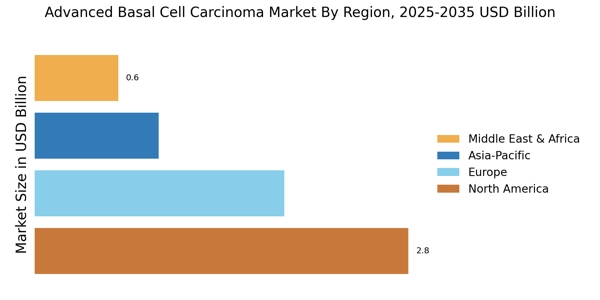
North America is the largest market for advanced basal cell carcinoma treatments, holding approximately 45% of the global market share. The region benefits from a robust healthcare infrastructure, high R&D investments, and increasing awareness of skin cancer. Regulatory support from agencies like the FDA accelerates the approval of innovative therapies, driving demand for advanced treatment options. The United States is the primary contributor, with significant market players such as Roche, Bristol-Myers Squibb, and Merck & Co. leading the competitive landscape. The presence of advanced healthcare facilities and a growing patient population further enhance market growth. Canada also plays a vital role, contributing to the overall market dynamics with its supportive healthcare policies and increasing incidence rates of skin cancer.
Europe is the second-largest market for advanced basal cell carcinoma treatments, accounting for approximately 30% of the global market share. The region is witnessing a surge in demand due to increasing skin cancer prevalence and supportive regulatory frameworks. The European Medicines Agency (EMA) plays a crucial role in expediting the approval of innovative therapies, which is vital for market expansion. Leading countries include Germany, France, and the UK, where key players like Novartis and Sanofi are actively involved. The competitive landscape is characterized by a mix of established pharmaceutical companies and emerging biotech firms. The growing focus on personalized medicine and targeted therapies is expected to further enhance market dynamics in Europe.
Asia-Pacific is an emerging powerhouse in the advanced basal cell carcinoma market, holding about 15% of the global market share. The region is experiencing rapid growth driven by increasing awareness of skin cancer, rising disposable incomes, and improving healthcare infrastructure. Countries like China and India are witnessing a significant rise in skin cancer cases, prompting a demand for advanced treatment options. China is the largest market in the region, with a growing number of local and international players entering the market. The competitive landscape is evolving, with companies like Amgen and Eli Lilly expanding their presence. The increasing focus on research and development, along with government initiatives to improve healthcare access, is expected to propel market growth in the coming years.
The Middle East and Africa represent a nascent market for advanced basal cell carcinoma treatments, holding approximately 10% of the global market share. The region faces challenges such as limited healthcare access and varying regulatory environments. However, increasing awareness of skin cancer and rising healthcare investments are driving demand for advanced therapies, presenting significant growth potential. Countries like South Africa and the UAE are leading the market, with a growing number of healthcare facilities and initiatives aimed at improving cancer care. The competitive landscape is still developing, with both local and international players exploring opportunities. The presence of key players like AstraZeneca is expected to enhance market dynamics as they introduce innovative treatment options.
The Advanced Basal Cell Carcinoma Market is characterized by a dynamic competitive landscape, driven by increasing incidences of skin cancer and a growing demand for innovative treatment options. Key players such as Roche (CH), Bristol-Myers Squibb (US), and Novartis (CH) are strategically positioned to leverage their extensive research capabilities and established market presence. Roche (CH) focuses on developing targeted therapies, while Bristol-Myers Squibb (US) emphasizes immunotherapy advancements. Novartis (CH) is actively pursuing partnerships to enhance its product pipeline, collectively shaping a competitive environment that prioritizes innovation and patient-centric solutions.In terms of business tactics, companies are increasingly localizing manufacturing to reduce costs and optimize supply chains. The market appears moderately fragmented, with several players vying for market share. However, the collective influence of major companies like Amgen (US) and Merck & Co. (US) is notable, as they continue to expand their therapeutic offerings and enhance their market positions through strategic collaborations and acquisitions.
In August Roche (CH) announced the initiation of a pivotal clinical trial for its novel BCC treatment, which aims to provide a more effective option for patients with advanced basal cell carcinoma. This strategic move underscores Roche's commitment to innovation and its focus on addressing unmet medical needs in oncology. The trial's outcomes could significantly impact the company's market share and reinforce its leadership in the sector.
In September Bristol-Myers Squibb (US) revealed a partnership with a leading biotechnology firm to co-develop a combination therapy targeting advanced basal cell carcinoma. This collaboration is expected to enhance the therapeutic landscape by integrating complementary technologies, thereby potentially improving patient outcomes. Such strategic alliances are indicative of a broader trend towards collaborative innovation in the market.
In July Novartis (CH) expanded its global footprint by entering into a licensing agreement with a regional player in Asia, aimed at distributing its advanced BCC therapies. This move not only enhances Novartis's market access but also reflects a strategic focus on emerging markets, where the incidence of skin cancer is rising. By localizing its operations, Novartis is likely to improve its supply chain efficiency and responsiveness to regional healthcare needs.
As of October the Advanced Basal Cell Carcinoma Market is witnessing trends such as digitalization and AI integration, which are reshaping competitive dynamics. Companies are increasingly leveraging technology to enhance drug development processes and patient engagement. Strategic alliances are becoming pivotal in driving innovation, as firms collaborate to share resources and expertise. Looking ahead, competitive differentiation is expected to evolve, with a shift from price-based competition to a focus on innovation, technological advancements, and supply chain reliability, ultimately benefiting patients and healthcare providers alike.

Recent developments in the Advance Basal Cell Carcinoma Market indicate a growing focus on novel therapeutics and increased investment in research and development. With the market projected to reach a valuation of approximately 10.2 billion USD by 2032, stakeholders are increasingly interested in targeted therapies and immunotherapy options, reflecting a shift toward personalized medicine. Regulatory bodies are also expediting the approval processes for innovative treatments, further enhancing market dynamics. Additionally, awareness campaigns aimed at early detection and prevention are expanding, contributing to increased patient outreach and treatment demand.
Partnerships between pharmaceutical companies and research institutions are becoming more prevalent, facilitating the development of new treatment models and approaches. Technological advancements in diagnostic tools are improving the accuracy of basal cell carcinoma detection, which is expected to drive market growth.
As the healthcare landscape evolves, the focus on patient-centric care and advancements in therapeutic alternatives remains pivotal for stakeholders navigating this dynamic market environment.
Der Markt für fortgeschrittenes Basalzellkarzinom wird voraussichtlich von 2024 bis 2035 mit einer durchschnittlichen jährlichen Wachstumsrate (CAGR) von 7,47 % wachsen, angetrieben durch steigende Inzidenzraten, Fortschritte bei den Behandlungsoptionen und zunehmendes Bewusstsein.
Neue Möglichkeiten liegen in:
Bis 2035 wird erwartet, dass der Markt ein erhebliches Wachstum erzielt, was sich in sich entwickelnden Behandlungsparadigmen und einer erhöhten Patientenbeteiligung widerspiegelt.
| MARKET SIZE 2024 | 6.169(USD Billion) |
| MARKET SIZE 2025 | 6.63(USD Billion) |
| MARKET SIZE 2035 | 13.63(USD Billion) |
| COMPOUND ANNUAL GROWTH RATE (CAGR) | 7.47% (2025 - 2035) |
| REPORT COVERAGE | Revenue Forecast, Competitive Landscape, Growth Factors, and Trends |
| BASE YEAR | 2024 |
| Market Forecast Period | 2025 - 2035 |
| Historical Data | 2019 - 2024 |
| Market Forecast Units | USD Billion |
| Key Companies Profiled | Roche (CH), Bristol-Myers Squibb (US), Novartis (CH), Amgen (US), Merck & Co. (US), Regeneron Pharmaceuticals (US), Eli Lilly and Company (US), Sanofi (FR), AstraZeneca (GB) |
| Segments Covered | Treatment Type, Stage of Disease, Diagnosis Method, Patient Demographics, Treatment Setting, Regional |
| Key Market Opportunities | Emergence of novel therapies and personalized medicine in the Advanced Basal Cell Carcinoma Market. |
| Key Market Dynamics | Rising demand for targeted therapies drives innovation and competition in the Advanced Basal Cell Carcinoma treatment landscape. |
| Countries Covered | North America, Europe, APAC, South America, MEA |


Bitte füllen Sie das folgende Formular aus, um ein kostenloses Muster dieses Berichts zu erhalten

“This is really good guys. Excellent work on a tight deadline. I will continue to use you going forward and recommend you to others. Nice job”


“Thanks. It’s been a pleasure working with you, please use me as reference with any other Intel employees.”


“Thanks for sending the report it gives us a good global view of the Betaïne market.”


“Thank you, this will be very helpful for OQS.”


“We found the report very insightful! we found your research firm very helpful. I'm sending this email to secure our future business.”


“I am very pleased with how market segments have been defined in a relevant way for my purposes (such as "Portable Freezers & refrigerators" and "last-mile"). In general the report is well structured. Thanks very much for your efforts.”


“I have been reading the first document or the study, ,the Global HVAC and FP market report 2021 till 2026. Must say, good info! I have not gone in depth at all parts, but got a good indication of the data inside!”


“We got the report in time, we really thank you for your support in this process. I also thank to all of your team as they did a great job.”


“The Automotive 48V ECU Components Procurement Intelligence Study” was a complex project, but the Market Research Future (MRFR) team handled it with quality, agility, and customer-centricity. They delivered all requested data on time and within the agreed scope. The team, including Shubhendra Anand and Rahul Gotadki, was always readily available to clarify questions and swiftly implement necessary adjustments, driving the project to a successful conclusion within a very demanding timeframe.
I would also like to specifically commend Akshay Agarwal for his responsiveness and support at every stage—from our initial inquiry on May 6th through to final delivery on June 18th. His dedication made the entire process seamless.”



