Material Handling Equipment Market
Marktinformationsbericht für Flurförderzeuge nach Betrieb (Montage, Transport, Verpackung, Vertrieb, andere), nach Systemtyp (Stückladungsmaterialtransportsystem, Schüttguttransportsystem), nach Anwendung (E-Commerce, Automobilindustrie, Lebensmittel und Getränke, Metall und Schwermaschinen, Andere ) und nach Regionen - Globale Prognose bis 2030
Globaler Marktüberblick für Materialtransportgeräte
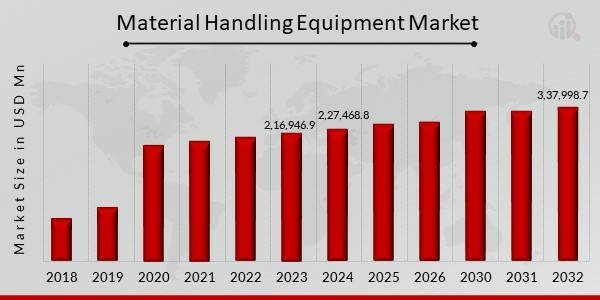
pDer Markt für Materialtransportgeräte hatte im Jahr 2023 ein Volumen von 216.946,9 Millionen USD. Es wird erwartet, dass die Materialtransportgerätebranche von 227.468,8 Millionen USD im Jahr 2024 auf 337.998,7 Millionen USD bis 2032 wächst und im Prognosezeitraum (2024–2032) eine durchschnittliche jährliche Wachstumsrate (CAGR) von 5,07 % aufweist. Dieser Markt hat einen technologischen Boom erlebt, von Förderbändern bis hin zu selbstfahrenden Gabelstaplern. Mit der zunehmenden Nutzung von Robotern wird die Automatisierung entlang der gesamten Lieferkette stärker voranschreiten. Diese Automatisierung wird viele Teile der Lieferkette erheblich beeinflussen, darunter Personal- und Lagerverwaltungsstrategien sowie eine schnelle Abwicklung. Daher trägt die zunehmende Prozessautomatisierung weiter zum Wachstum des Marktes für Materialtransportgeräte bei.
Quelle: Sekundärforschung, Primärforschung, MRFR-Datenbank und AnalystenbewertungMarkttrends für Materialhandhabungsgeräte
ul-
Wachsender E-Commerce und die Logistikbranche stärken den Markt.
Darüber hinaus floriert die E-Commerce-Branche weltweit, was einen hohen Automatisierungsgrad erfordert. Amazon, Walmart und andere große Einzelhändler führen schrittweise automatisierte Technologien in ihre Abläufe ein, um diese präziser, effizienter, sicherer und kostengünstiger zu gestalten. Darüber hinaus ist die Verbesserung der Fertigungsindustrie ein wichtiger Faktor für die Entwicklung des Marktes für Materialtransportgeräte.
Marktsegmente für Materialtransportgeräte
h3Typen von Materialtransportgeräten pDie Marktsegmentierung für Materialtransportgeräte, basierend auf dem Typ, umfasst Transportgeräte, Positionierungsgeräte, Lagergeräte und andere (Geräte zur Ladungsbildung, Identifikations- und Steuerungsgeräte). Das Segment Transportgeräte wird im Prognosezeitraum voraussichtlich die höchste jährliche Wachstumsrate aufweisen. Dies ist auf die Nutzung zum Transport von Material von einem Ort zum anderen zurückzuführen (z. B. von einer Laderampe zu einem Lager). Diese Art von Geräten wird verwendet, um Material an einem einzigen Ort zu handhaben. Förderbänder, Kräne, Flurförderzeuge und andere (Trichter, Rücklader) sind einige der wichtigsten Geräte, die in verschiedenen Bereichen weit verbreitet sind. Branchen.Einblicke in die Materialtransportausrüstung
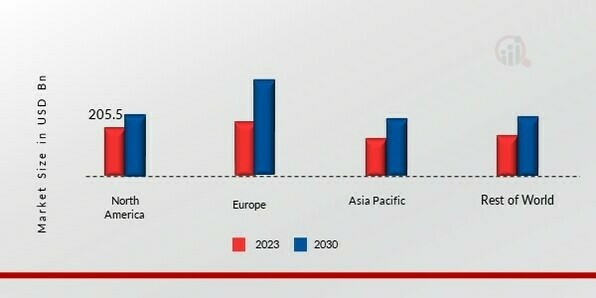
pDer Markt für Materialtransportausrüstung umfasst nach Branchen die Automobilindustrie, Konsumgüter und Elektronik, Pharmazeutika, Lebensmittel und Getränke, Bergbau, Bauwesen, Halbleiter und weitere. Die Bauwirtschaft boomt dank umfangreicher Bau- und Umstrukturierungsinitiativen in Industrie- und Schwellenländern. Darüber hinaus tragen staatliche Initiativen zum Ausbau der Infrastruktur und enorme Investitionen in die Immobilienbranche zum Marktwachstum bei. Abbildung 2: Markt für Materialtransportausrüstung nach Typ, 2023 und 2030 (Mrd. USD)
strongQuelle: Sekundärforschung, Primärforschung, MRFR-Datenbank und Analystenbewertung
h3Regionale Einblicke in Materialtransportgeräte pDie Studie bietet regionale Markteinblicke für Nordamerika, Europa, den asiatisch-pazifischen Raum und den Rest der Welt. Es wird erwartet, dass der asiatisch-pazifische Raum das Gesamtwachstum der Materialtransportgerätebranche mit einer soliden jährlichen Wachstumsrate (CAGR) von 9,7 % im Prognosezeitraum dominieren wird. Dies ist auf die steigende Nachfrage in der Automobilindustrie, der Fertigungsindustrie und anderen wichtigen Endverbraucherbranchen zurückzuführen. Länder wie Südkorea, China und Taiwan setzen in den letzten Jahren zunehmend auf moderne Materialtransportmethoden, um dem wachsenden Bedarf an Produktionsdienstleistungen gerecht zu werden. Abbildung 3: MARKTANTEIL VON MATERIALTRANSPORTGERÄTEN NACH REGIONEN 2023 (%)
strongQuelle: Sekundärforschung, Primärforschung, MRFR-Datenbank und Analystenbewertung
pAuch in Nordamerika wird ein deutliches Wachstum im Bereich der Materialhandhabungsausrüstung erwartet, was auf die steigenden Umsätze in der gesamten Region aufgrund der E-Commerce-Branche zurückzuführen ist. Das zunehmende Wachstum bei langlebigen und nicht langlebigen Gütern treibt das Gesamtwachstum der Materialhandhabungsausrüstungsbranche voran. Darüber hinaus fördert die Einführung automatisierter Lagerpraktiken in Nordamerika das Gesamtwachstum der Materialhandhabungsausrüstungsbranche.Schlüssel zur Materialhandhabungsausrüstung Marktteilnehmer Wettbewerbseinblicke
pWichtige Marktteilnehmer investieren viel Geld in Forschung und Entwicklung, um ihre Produktlinien zu erweitern und so das Marktwachstum für Materialtransportgeräte weiter zu steigern. Marktteilnehmer ergreifen zudem eine Reihe strategischer Initiativen, um ihre weltweite Präsenz auszubauen. Zu den wichtigsten Marktentwicklungen zählen Produktneuheiten, vertragliche Vereinbarungen, Fusionen und Übernahmen, erhöhte Investitionen sowie die Zusammenarbeit mit anderen Unternehmen. Wettbewerber in der Materialtransportbranche müssen kostengünstige Produkte anbieten, um in einem zunehmend wettbewerbsintensiven und wachsenden Marktumfeld zu expandieren und zu bestehen.Die wichtigsten Marktteilnehmer investieren viel Geld in Forschung und Entwicklung, um ihre Produktlinien zu erweitern und so das Marktwachstum für Materialtransportgeräte weiter anzukurbeln. Mit bedeutenden Marktentwicklungen wie Produktneuheiten, vertraglichen Vereinbarungen, Fusionen und Übernahmen, erhöhten Investitionen sowie der Zusammenarbeit mit anderen Unternehmen ergreifen Marktteilnehmer zudem verschiedene strategische Maßnahmen, um ihre Präsenz auszubauen. Um in einem zunehmend wettbewerbsintensiven und wachsenden Marktumfeld zu wachsen und zu florieren, müssen Wettbewerber in der Materialtransportbranche erschwingliche Produkte anbieten.
Lokale Produktion zur Reduzierung Die Senkung der Betriebskosten ist eine der wichtigsten Geschäftsstrategien der Hersteller in der Materialtransportbranche, um Kunden zu profitieren und den Marktsektor zu erweitern. Der Markt für Materialtransport hat der Medizin in letzter Zeit einige der wichtigsten Vorteile beschert. Wichtige Akteure im Materialtransportmarkt, darunter die Liebherr-Gruppe (Schweiz), die KION Group AG (Deutschland), die Jungheinrich AG (Deutschland) und andere, versuchen, die Marktnachfrage durch die Finanzierung von Forschungs- und Entwicklungsinitiativen zu steigern.
Die Liebherr-Gruppe (auch bekannt als Liebherr-International Deutschland) ist ein Unternehmen, das Bau- und Bergbaumaschinen herstellt. Sie bietet Erdbewegungsmaschinen und Materialumschlagmaschinen, Kräne, Luft- und Raumfahrt- und Transportsysteme, Werkzeugmaschinen, Automatisierungssysteme und andere Maschinen an. Das Unternehmen bietet außerdem die Vermietung von Baumaschinen, Flottenmanagementsysteme sowie Beschaffungs- und Logistikdienstleistungen an.
Die KION Group ist ebenfalls ein Unternehmen, das Materialtransportmaschinen herstellt. Ihre Produkte Dazu gehören Flurförderzeuge, Gabelstapler, Zugmaschinen, Förderbänder, Sortieranlagen, Palettierer usw. Das Unternehmen bietet Wartungs- und Lieferkettenlösungen für E-Commerce, Logistikdienstleister und Supermärkte an.
Zu den wichtigsten Unternehmen im Markt für Materialtransportgeräte gehören:
ul-
Liebherr Group (Schweiz)
-
KION Group AG (Deutschland)
-
Jungheinrich AG (Deutschland)
-
Viastore Systems GmbH (Deutschland)
-
Eisenmann AG (Deutschland)
-
Columbus McKinnon Corporation (USA)
-
Crown Equipment Corporation (USA)
-
Hytrol Conveyor Co., Inc. (USA)
-
Xuzhou Heavy Machinery Co., Ltd. (China)
-
Toyota Industries Corporation (Japan).
Marktsegmentierung für Materialtransportgeräte
h3Ausblick auf Materialtransportgerätetypen ul-
Transportgeräte
-
Positionierungsgeräte
-
Lagergeräte
-
Sonstige
-
Konsumgüter Elektronik
-
Automobil
-
Lebensmittel Getränke
-
Pharma
-
Bauwesen
-
Bergbau
-
Halbleiter
-
Sonstige
- Norden Amerika
- USA
- Kanada
- Europa
- Deutschland
- Frankreich
- Großbritannien
- Italien
- Spanien
- Restliches Europa
- Asien-Pazifik
- China
- Japan
- Indien
- Australien
- Südkorea
- Australien
- Rest von Asien-Pazifik
- Rest der Welt
- Naher Osten
- Afrika
- Lateinamerika
FAQs
How big is the Material Handling Equipment market?
The Material Handling Equipment market size was valued at USD 227468.80 Million in 2024
What is the growth rate of the Material Handling Equipment market?
Material Handling Equipment Market is projected to grow at a CAGR of 5.07% during the forecast period, 2025-2035
Which region held the largest market share in the Material Handling Equipment market?
Asia Pacific had the largest share of the Material Handling Equipment market
Who are the key players in the Material Handling Equipment market?
The key players in the market are Liebherr Group (Switzerland), KION Group AG (Germany), Jungheinrich AG (Germany), Viastore Systems GmbH (Germany), Eisenmann AG (Germany), Columbus McKinnon Corporation (U.S.), Crown Equipment Corporation (U.S.), Hytrol Conveyor Co., Inc. (U.S.), Xuzhou Heavy Machinery Co., Ltd. (China) and Toyota Industries Corporation (Japan)
Which Type led the Material Handling Equipment market?
The Transport categories dominated the market in 2024.
Which Industry led the Material Handling Equipment market?
The construction had the largest share in the market for Material Handling Equipment.
Research Approach
Research Methodology on Material Handling Equipment Market
Abstract
This research aims to review the Material Handling Equipment (MHE) market in terms of the global market, market structure, market share, market trends and potential growth opportunities, key players and their overall market contribution. The research report outlines the scope of the Material Handling Equipment market, its current market size and growth potential and projected growth rate, and recent market trends, including historical and current baseline data, growth rates and other related data.
Introduction
Material Handling equipment solutions enable efficient, safe and reliable movement of materials, goods, people and equipment. The need for MHE solutions is increasing in the production and distribution of goods, as well as in the shipping, loading, and unloading of goods. MHE solutions are used in various end-user industries including automotive, manufacturing, FMCG, healthcare, aerospace, and construction. One of the key factors driving the market for MHEs is the rising demand from production and distribution processes, where efficient and safe handling of goods helps minimise losses and injuries.
Research Methodology
The research for this report is conducted using a combination of both primary and secondary sources of information. Primary sources include interviews and surveys of industry experts, companies and other stakeholders. Interviews and surveys of industry experts focus on business models, drivers, constraints and trends in the MHE market. Secondary sources include books, industry reports, white papers, company websites, etc.
The research methodology used to collect and analyse data is comprehensive and consisted of four distinct steps: identification of key players, their product offerings, their market share and competitive landscape; analysis of industry trends and competitive landscape; customer needs assessment and customer segmentation; and finally, assessments of market size projections and competitive strategies.
Identifying the Key Players
The key players in the Material Handling Equipment (MHE) market are identified and evaluated based on their product offering, size, share, and competitive information. The key players evaluated are identified through primary and secondary sources. Primary sources include direct contact with manufacturers and smaller companies in the industry. Secondary sources include published articles, industry reports, white papers, books, and company websites.
Analysis of Industry Trends & Competitive Landscape
The next step involves studying the industry trends and competitive landscape to assess the prevailing conditions in the material handling equipment market. This step involves studying various aspects such as the macroeconomic environment, government policies, technological advancements, market drivers and restraints. The analysis of the competitive landscape is done by studying the current market share, industry players, and strategies.
Customer Needs Assessment & Segmentation
The next step in the methodology is to assess the customer needs and segmentation. This step involves understanding the different segments in the material handling equipment market. The customers are segmented based on the end-use industry and their requirements concerning product features, price, etc. The segmentation of the customers is done based on the analysis of the customer needs and is used to assess the potential of each segment in terms of growth rate and profitability.
Assessment of Market Size and Competitive Strategies
The last step in the research methodology is assessing the market size and competitive strategies. The market size is determined based on the current market size and projected growth rate. This is done by studying the historical market data, current market trends, and projected growth rate of the market. The assessment of the competitive strategies is done by studying the current strategies adopted by the various industry players and their product positioning.
Conclusion
The research methodology outlined in this report is comprehensive and allows for a thorough investigation of the Material Handling Equipment market. It enables a detailed assessment of the key players, their product offerings, market share, and competitive landscape. In addition, it also enables an assessment of customer needs, segmentation, and market size projections. Overall, this research methodology provides a comprehensive yet succinct approach to analyzing the market.
Bitte füllen Sie das folgende Formular aus, um ein kostenloses Muster dieses Berichts zu erhalten
Customer Stories
“This is really good guys. Excellent work on a tight deadline. I will continue to use you going forward and recommend you to others. Nice job”
“Thanks. It’s been a pleasure working with you, please use me as reference with any other Intel employees.”
“Thanks for sending the report it gives us a good global view of the Betaïne market.”
“Thank you, this will be very helpful for OQS.”
“We found the report very insightful! we found your research firm very helpful. I'm sending this email to secure our future business.”
“I am very pleased with how market segments have been defined in a relevant way for my purposes (such as "Portable Freezers & refrigerators" and "last-mile"). In general the report is well structured. Thanks very much for your efforts.”
“I have been reading the first document or the study, ,the Global HVAC and FP market report 2021 till 2026. Must say, good info! I have not gone in depth at all parts, but got a good indication of the data inside!”
“We got the report in time, we really thank you for your support in this process. I also thank to all of your team as they did a great job.”