×
Request Free Sample ×

Kindly complete the form below to receive a free sample of this Report

* Please use a valid business email

Leading companies partner with us for data-driven Insights

clients tt-cursor
Hero Background

Material Handling Equipment Market

ID: MRFR/PCM/2323-HCR
111 Pages
Snehal Singh
October 2025

Material Handling Equipment Market Research Report Information By Equipment Type (Transport Equipment, Positioning Equipment, Storage Equipment, Others (Unit Load Formation Equipment, Identification, and Control Equipment), By Industry (Consumer Goods & Electronics, Automotive, Food & Beverages, Pharmaceutical, Construction, Mining, Semiconductors, Others (Aviation, Chemicals), And By Region (North America, Europe, Asia-Pacific, And Rest Of The World) – Market Forecast Till 2035

Share:
Download PDF ×

We do not share your information with anyone. However, we may send you emails based on your report interest from time to time. You may contact us at any time to opt-out.

Material Handling Equipment Market Infographic
Purchase Options

Material Handling Equipment Market Summary

As per MRFR analysis, the Material Handling Equipment Market Size was estimated at 227468.8 USD Million in 2024. The Material Handling Equipment industry is projected to grow from 239006.07 in 2025 to 391994.46 by 2035, exhibiting a compound annual growth rate (CAGR) of 5.07 during the forecast period 2025 - 2035.

Key Market Trends & Highlights

The Material Handling Equipment Market is poised for substantial growth driven by technological advancements and evolving consumer demands.

  • Automation and robotics integration is transforming operational efficiencies across various sectors.
  • Sustainability initiatives are increasingly influencing equipment design and manufacturing processes.
  • The adoption of IoT and data analytics is enhancing inventory management and operational visibility.
  • Increased demand for e-commerce fulfillment and technological advancements in equipment are key drivers propelling market growth.

Market Size & Forecast

2024 Market Size 227468.8 (USD Million)
2035 Market Size 391994.46 (USD Million)
CAGR (2025 - 2035) 5.07%

Major Players

Toyota Industries (JP), Kion Group (DE), Crown Equipment Corporation (US), Jungheinrich AG (DE), Hyster-Yale Materials Handling (US), Mitsubishi Logisnext (JP), Daifuku Co., Ltd. (JP), SSI Schaefer (DE), Honeywell Intelligrated (US)

Material Handling Equipment Market Trends

The Material Handling Equipment Market is currently experiencing a dynamic evolution, driven by advancements in technology and increasing demand for efficient logistics solutions. Companies are increasingly adopting automation and robotics to enhance productivity and reduce operational costs. This shift towards automated systems appears to be reshaping traditional practices, as organizations seek to streamline their supply chains and improve overall efficiency. Furthermore, the growing emphasis on sustainability is influencing the design and manufacturing of material handling equipment, with a focus on eco-friendly materials and energy-efficient technologies. In addition, the Material Handling Equipment Market is witnessing a rise in the integration of Internet of Things (IoT) technologies. This integration facilitates real-time monitoring and data analytics, enabling businesses to optimize their operations and make informed decisions. As industries continue to evolve, the demand for innovative solutions that enhance safety, reduce labor costs, and improve inventory management is likely to grow. Overall, the Material Handling Equipment Market is poised for significant transformation, reflecting broader trends in automation, sustainability, and digitalization.

Automation and Robotics Integration

The integration of automation and robotics in the Material Handling Equipment Market is reshaping operational frameworks. Companies are increasingly utilizing automated systems to enhance efficiency, reduce labor costs, and improve safety. This trend indicates a shift towards more sophisticated solutions that streamline processes and minimize human intervention.

Sustainability Initiatives

Sustainability initiatives are becoming a focal point within the Material Handling Equipment Market. Manufacturers are prioritizing eco-friendly materials and energy-efficient technologies in their product designs. This trend suggests a growing awareness of environmental impact and a commitment to reducing carbon footprints across the industry.

IoT and Data Analytics Adoption

The adoption of Internet of Things (IoT) technologies and data analytics is gaining traction in the Material Handling Equipment Market. This trend allows for real-time monitoring and optimization of operations, enabling businesses to enhance decision-making processes. The potential for improved inventory management and operational efficiency is driving this technological shift.

Material Handling Equipment Market Drivers

Labor Shortages

Labor shortages are becoming a pressing issue in various industries, directly impacting the Global Material Handling Equipment Market Industry. As the workforce diminishes, companies are compelled to invest in automated solutions to maintain productivity levels. This trend is particularly evident in sectors such as manufacturing and logistics, where the need for efficient material handling equipment is paramount. The market's growth is likely to be fueled by this necessity, as businesses seek to mitigate the effects of labor shortages through automation and advanced handling technologies.

E-commerce Growth

The rapid expansion of the e-commerce sector is significantly influencing the Global Material Handling Equipment Market Industry. As online retail continues to flourish, the demand for efficient material handling solutions rises. Companies are investing in advanced equipment to manage increased order volumes and ensure timely deliveries. This trend is evident as the market is expected to grow to 392.1 USD Billion by 2035. The need for automated sorting systems and high-density storage solutions is becoming paramount, suggesting that the e-commerce boom is a critical driver for the Global Material Handling Equipment Market.

Global Trade Dynamics

Global trade dynamics are significantly influencing the Global Material Handling Equipment Market Industry. As international trade continues to expand, the demand for efficient logistics and supply chain solutions increases. This trend is reflected in the projected compound annual growth rate of 5.07% for the period from 2025 to 2035. Companies are investing in advanced material handling equipment to navigate complex supply chains and meet global demands. The interplay between trade policies and material handling solutions suggests a robust growth potential for the Global Material Handling Equipment Market.

Market Growth Projections

The Global Material Handling Equipment Market Industry is poised for substantial growth, with projections indicating a market size of 227.5 USD Billion in 2024 and an anticipated increase to 392.1 USD Billion by 2035. This growth trajectory is supported by a compound annual growth rate of 5.07% from 2025 to 2035. The increasing demand for efficient material handling solutions across various sectors, including manufacturing, logistics, and retail, underscores the market's potential. As businesses continue to invest in advanced technologies and automation, the Global Material Handling Equipment Market is likely to thrive.

Sustainability Initiatives

Sustainability initiatives are increasingly shaping the Global Material Handling Equipment Market Industry. Companies are adopting eco-friendly practices, leading to a demand for energy-efficient equipment and sustainable materials. This shift is not only beneficial for the environment but also aligns with regulatory requirements and consumer preferences. As organizations strive to reduce their carbon footprints, the market for green material handling solutions is likely to expand. This trend indicates a potential growth trajectory for the Global Material Handling Equipment Market, as businesses prioritize sustainability in their operations.

Technological Advancements

The Global Material Handling Equipment Market Industry is experiencing a surge in technological advancements, particularly with automation and robotics. Innovations such as automated guided vehicles and smart warehouse systems enhance operational efficiency and reduce labor costs. For instance, companies are increasingly adopting Internet of Things (IoT) technologies to streamline inventory management. This trend is likely to contribute to the market's growth, as it is projected to reach 227.5 USD Billion in 2024. As businesses seek to optimize their supply chains, the integration of advanced technologies appears to be a driving force in the Global Material Handling Equipment Market.

Market Segment Insights

By Application: Warehouse Management (Largest) vs. Transportation (Fastest-Growing)

In the Material Handling Equipment Market, 'Warehouse Management' takes the lead as the largest application segment, driven by the increasing demand for efficient inventory control and order fulfillment processes. This segment benefits significantly from advancements in automation technology, which enhance operational efficiency and reduce labor costs. Conversely, 'Transportation' is emerging as the fastest-growing segment, reflecting the heightened focus on logistics optimization and supply chain efficiency across various industries.

Warehouse Management (Dominant) vs. Transportation (Emerging)

'Warehouse Management' is characterized by its extensive use of automated storage and retrieval systems, pallet racking systems, and warehouse management software, facilitating real-time tracking and enhanced accuracy in inventory management. As e-commerce continues to grow, the need for effective warehouse operations has become paramount. On the other hand, 'Transportation' involves an increasing reliance on material handling equipment such as conveyor belts, stackers, and automated guided vehicles to streamline the movement of goods. With the rise of just-in-time manufacturing and the expansion of global distribution networks, investments in transportation capabilities are rapidly increasing, positioning this segment as a critical area of growth within the market.

By Product Type: Forklifts (Largest) vs. Automated Guided Vehicles (Fastest-Growing)

In the Product Type segment of the Material Handling Equipment Market, Forklifts lead the market with significant share and widespread adoption across industries. Their versatility and ability to handle various loads make them a preferred choice for warehouses, construction sites, and manufacturing settings. In contrast, Automated Guided Vehicles (AGVs) are rapidly gaining traction, particularly in environments where automation is prioritized. Their ability to enhance efficiency and reduce labor costs positions them as a strong competitor in this evolving market.

Forklifts (Dominant) vs. Automated Guided Vehicles (Emerging)

Forklifts represent the dominant force in the Material Handling Equipment landscape, offering unmatched adaptability to various operational needs, from lifting heavy loads to navigating confined spaces. They are integral in sectors such as logistics and manufacturing, where high maneuverability is crucial. Automated Guided Vehicles, however, are emerging as a vital component, especially in automated warehouses. They utilize sophisticated navigation technologies, allowing them to transport materials with minimal human intervention. While Forklifts showcase traditional reliability and versatility, AGVs introduce innovative solutions that align with the growing trend towards automation and labor efficiency.

By End Use: Food and Beverage (Largest) vs. Pharmaceuticals (Fastest-Growing)

The Material Handling Equipment Market displays varied dynamics across its end-use segments. The Food and Beverage sector holds the largest market share, driven by ongoing demands for efficient storage and transportation solutions for perishable goods. Meanwhile, the Pharmaceuticals segment demonstrates a remarkable growth trajectory, increasingly relying on advanced material handling solutions to manage stringent regulations, safety protocols, and the complex nature of pharma product logistics. As industries evolve, swift expansion in the Pharmaceuticals sector is anticipated due to rising healthcare demands globally. Innovations in automated material handling equipment are more frequently adopted, significantly enhancing productivity and accuracy in pharmaceutical supply chains. Concurrently, the Food and Beverage sector is evolving, focusing on sustainability and compliance with safety standards, indicating both stability and innovation within this segment as it grapples with market challenges.

Food and Beverage (Dominant) vs. Pharmaceuticals (Emerging)

The Food and Beverage sector is characterized by its robust demand for material handling equipment, which is essential for the storage, processing, and transportation of food products. This segment emphasizes the need for equipment that can handle high volumes while ensuring compliance with health regulations and maintaining product integrity. The integration of automation and technology in sorting, packaging, and inventory management continues to enhance efficiency in this sector. In contrast, the Pharmaceuticals segment is emerging rapidly, driven by the increasing need for effective handling of sensitive and high-value products. This segment requires specialized equipment that can maintain strict temperature control and ensure safety during material handling processes. The growth in this area is fueled by a heightened focus on supply chain efficiency, accuracy in order fulfillment, and compliance with strict regulatory requirements, making it a focal point for investment and innovation within the Material Handling Equipment Market.

Get more detailed insights about Material Handling Equipment Market

Regional Insights

North America : Market Leader in Equipment

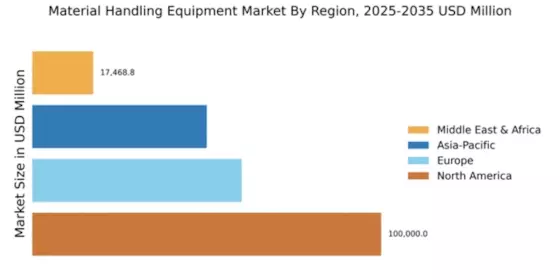
North America continues to lead the Material Handling Equipment market, holding a significant share of 100000.0 in 2024. The region's growth is driven by advancements in automation, increased e-commerce activities, and a focus on supply chain efficiency. Regulatory support for infrastructure development and safety standards further catalyzes demand for innovative material handling solutions. The competitive landscape is robust, with key players like Crown Equipment Corporation, Hyster-Yale Materials Handling, and Toyota Industries dominating the market. The U.S. stands out as a major contributor, supported by a strong manufacturing base and technological innovations. The presence of established companies fosters a dynamic environment, ensuring continuous growth and adaptation to market needs.

Europe : Emerging Market Dynamics

Europe's Material Handling Equipment market is valued at 60000.0, reflecting a growing demand for automation and efficiency in logistics. The region is witnessing a shift towards smart technologies, driven by sustainability initiatives and regulatory frameworks aimed at reducing carbon footprints. The European Union's commitment to enhancing supply chain resilience is a key catalyst for market growth. Leading countries such as Germany and France are at the forefront, with companies like Kion Group and Jungheinrich AG leading the charge. The competitive landscape is characterized by innovation and strategic partnerships, enabling firms to enhance their product offerings. The presence of advanced manufacturing capabilities further strengthens Europe's position in the global market.

Asia-Pacific : Rapid Growth and Innovation

The Asia-Pacific region, with a market size of 55000.0, is rapidly emerging as a powerhouse in the Material Handling Equipment sector. The growth is fueled by increasing industrialization, urbanization, and a surge in e-commerce activities. Governments are investing in infrastructure development, which is expected to further boost demand for efficient material handling solutions across various industries. Countries like Japan and China are leading the charge, with key players such as Mitsubishi Logisnext and Daifuku Co., Ltd. making significant contributions. The competitive landscape is marked by innovation and a focus on technology integration, allowing companies to meet the evolving needs of the market. This dynamic environment positions Asia-Pacific as a critical player in the global material handling landscape.

Middle East and Africa : Untapped Market Potential

The Middle East and Africa region, with a market size of 17468.8, presents untapped potential in the Material Handling Equipment market. The growth is driven by increasing investments in infrastructure and logistics, particularly in the Gulf Cooperation Council (GCC) countries. Regulatory initiatives aimed at enhancing supply chain efficiency are also contributing to market expansion. Countries like the UAE and South Africa are emerging as key players, with a growing number of local and international companies entering the market. The competitive landscape is evolving, with firms focusing on innovative solutions to meet the demands of various sectors. This region's unique challenges and opportunities make it a focal point for future growth in material handling.

Key Players and Competitive Insights

The Material Handling Equipment Market is currently characterized by a dynamic competitive landscape, driven by technological advancements and increasing demand for automation in logistics and warehousing. Key players such as Toyota Industries (Japan), Kion Group (Germany), and Crown Equipment Corporation (US) are strategically positioned to leverage innovation and operational efficiency. Toyota Industries (Japan) focuses on integrating advanced robotics into their product lines, enhancing their competitive edge in automated solutions. Meanwhile, Kion Group (Germany) emphasizes digital transformation, investing heavily in software solutions that optimize supply chain management. Crown Equipment Corporation (US) is also making strides in this area, with a strong focus on sustainability and energy-efficient equipment, which aligns with the growing environmental consciousness among consumers.

The business tactics employed by these companies reflect a trend towards localizing manufacturing and optimizing supply chains to enhance responsiveness to market demands. The competitive structure of the market appears moderately fragmented, with several key players exerting influence while also facing competition from emerging firms. This fragmentation allows for a diverse range of products and services, catering to various customer needs and preferences.

In November 2025, Kion Group (Germany) announced a strategic partnership with a leading software firm to develop AI-driven warehouse management systems. This collaboration is poised to enhance Kion's offerings, enabling clients to achieve greater operational efficiency and accuracy in inventory management. The integration of AI technology is likely to position Kion as a frontrunner in the digital transformation of material handling.

In October 2025, Crown Equipment Corporation (US) launched a new line of electric forklifts designed to reduce energy consumption by 30%. This initiative not only underscores Crown's commitment to sustainability but also addresses the increasing regulatory pressures for greener operations. The introduction of these energy-efficient models may attract environmentally conscious customers, thereby expanding Crown's market share.

In September 2025, Toyota Industries (Japan) unveiled a new autonomous mobile robot (AMR) designed for warehouse operations. This innovation is expected to streamline logistics processes and reduce labor costs significantly. By investing in AMRs, Toyota Industries is likely to enhance its competitive positioning in the automation segment of the market, appealing to businesses seeking to modernize their operations.

As of December 2025, the Material Handling Equipment Market is witnessing trends such as digitalization, sustainability, and AI integration, which are reshaping competitive dynamics. Strategic alliances among key players are becoming increasingly common, fostering innovation and enhancing product offerings. The shift from price-based competition to a focus on technological advancement and supply chain reliability is evident, suggesting that future differentiation will hinge on the ability to innovate and adapt to evolving market demands.

Key Companies in the Material Handling Equipment Market market include

Industry Developments

  • Q2 2024: DHL Express Expands Hong Kong Hub to Meet Growing Asia Pacific Demand DHL Express announced the expansion of its Hong Kong hub, enhancing operational capabilities and processing efficiency to accommodate increased demand for express logistics services in the Asia Pacific region.

Future Outlook

Material Handling Equipment Market Future Outlook

The Material Handling Equipment Market is projected to grow at a 5.07% CAGR from 2024 to 2035, driven by automation, e-commerce expansion, and sustainability initiatives.

New opportunities lie in:

  • Integration of IoT for real-time inventory management
  • Development of autonomous material handling systems
  • Expansion into emerging markets with tailored solutions

By 2035, the market is expected to be robust, driven by innovation and strategic investments.

Market Segmentation

Material Handling Equipment Market End Use Outlook

  • Food and Beverage
  • Pharmaceuticals
  • Automotive
  • Electronics
  • Aerospace

Material Handling Equipment Market Application Outlook

  • Warehouse Management
  • Manufacturing
  • Construction
  • Retail
  • Transportation

Material Handling Equipment Market Product Type Outlook

  • Forklifts
  • Conveyors
  • Pallet Jacks
  • Automated Guided Vehicles
  • Cranes

Report Scope

MARKET SIZE 2024227468.8(USD Million)
MARKET SIZE 2025239006.07(USD Million)
MARKET SIZE 2035391994.46(USD Million)
COMPOUND ANNUAL GROWTH RATE (CAGR)5.07% (2024 - 2035)
REPORT COVERAGERevenue Forecast, Competitive Landscape, Growth Factors, and Trends
BASE YEAR2024
Market Forecast Period2025 - 2035
Historical Data2019 - 2024
Market Forecast UnitsUSD Million
Key Companies ProfiledToyota Industries (JP), Kion Group (DE), Crown Equipment Corporation (US), Jungheinrich AG (DE), Hyster-Yale Materials Handling (US), Mitsubishi Logisnext (JP), Daifuku Co., Ltd. (JP), SSI Schaefer (DE), Honeywell Intelligrated (US)
Segments CoveredApplication, Product Type, End Use
Key Market OpportunitiesIntegration of automation and robotics enhances efficiency in the Material Handling Equipment Market.
Key Market DynamicsTechnological advancements and automation drive efficiency and reshape competitive dynamics in the Material Handling Equipment Market.
Countries CoveredNorth America, Europe, APAC, South America, MEA

Market Highlights

Author
Snehal Singh
Assistant Manager - Research

High acumen in analyzing complex macro & micro markets with more than 6 years of work experience in the field of market research. By implementing her analytical skills in forecasting and estimation into market research reports, she has expertise in Packaging, Construction, and Equipment domains. She handles a team size of 20-25 resources and ensures smooth running of the projects, associated marketing activities, and client servicing.

Leave a Comment

FAQs

How big is the Material Handling Equipment market?

The Material Handling Equipment market size was valued at USD 227468.80 Million in 2024

What is the growth rate of the Material Handling Equipment market?

Material Handling Equipment Market is projected to grow at a CAGR of 5.07% during the forecast period, 2025-2035

Which region held the largest market share in the Material Handling Equipment market?

Asia Pacific had the largest share of the Material Handling Equipment market

Who are the key players in the Material Handling Equipment market?

The key players in the market are Liebherr Group (Switzerland), KION Group AG (Germany), Jungheinrich AG (Germany), Viastore Systems GmbH (Germany), Eisenmann AG (Germany), Columbus McKinnon Corporation (U.S.), Crown Equipment Corporation (U.S.), Hytrol Conveyor Co., Inc. (U.S.), Xuzhou Heavy Machinery Co., Ltd. (China) and Toyota Industries Corporation (Japan)

Which Type led the Material Handling Equipment market?

The Transport categories dominated the market in 2024.

Which Industry led the Material Handling Equipment market?

The construction had the largest share in the market for Material Handling Equipment.

Download Free Sample

Kindly complete the form below to receive a free sample of this Report

Compare Licence

×
Features License Type
Single User Multiuser License Enterprise User
Price $4,950 $5,950 $7,250
Maximum User Access Limit 1 User Upto 10 Users Unrestricted Access Throughout the Organization
Free Customization
Direct Access to Analyst
Deliverable Format
Platform Access
Discount on Next Purchase 10% 15% 15%
Printable Versions