Quantencomputing-Markt

Marktforschungsbericht über Quantencomputing nach Anwendung (Kryptographie, Arzneimittelentdeckung, Optimierungsprobleme, Finanzmodellierung, Maschinelles Lernen), nach Komponenten (Hardware, Software, Dienstleistungen), nach Endnutzung (Akademische Einrichtungen, Regierung, Unternehmen), nach Technologie (Supraleitende Qubits, Eingefangene Ionen, Topologische Qubits, Photonic Quantum Computing) und nach Region (Nordamerika, Europa, Südamerika, Asien-Pazifik, Naher Osten und Afrika) - Prognose bis 2035
ID: MRFR/ICT/1943-CR
200 Pages
Aarti Dhapte
Last Updated: July 31, 2026
Quantum Computing Market
Market Size
Forecast Period2025 - 2035
CAGR (2025 - 2035)27.04%
2024 Market Size$ 1.02 Billion
2025 Market Size$ 1.3 Billion
2035 Market Size$ 14.19 Billion
Key Players
Google
Honeywell/Quantinuum
Alibaba
Microsoft
D-Wave Systems
Rigetti Computing
Opportunities
  • Advancements in Quantum Hardware
  • Government Initiatives and Funding
  • Emergence of Quantum-as-a-Service Models

Quantencomputing-Markt Zusammenfassung

Laut der Analyse von MRFR wurde die Größe des Marktes für Quantencomputing im Jahr 2024 auf 1,02 Milliarden USD geschätzt. Die Quantencomputing-Branche wird voraussichtlich von 1,296 Milliarden USD im Jahr 2025 auf 14,19 Milliarden USD bis 2035 wachsen, was einer durchschnittlichen jährlichen Wachstumsrate (CAGR) von 27,04 während des Prognosezeitraums 2025 - 2035 entspricht.

Wichtige Markttrends & Highlights

Der Markt für Quantencomputing steht vor einem erheblichen Wachstum, das durch technologische Fortschritte und zunehmende Anwendungen in verschiedenen Sektoren vorangetrieben wird.

  • Nordamerika bleibt der größte Markt für Quantencomputing und zeigt robuste Investitionen in Forschung und Entwicklung.

Marktgröße & Prognose

2024 Market Value $1.02B
2035 Market Value $14.19B
CAGR (2025 - 2035) 27.04%

Hauptakteure

IBM (US), Google (US), Microsoft (US), D-Wave Systems (CA), Rigetti Computing (US), IonQ (US), Honeywell (US), Alibaba (CN), Xanadu (CA)

Quantencomputing-Markt Treiber

Advancements in Quantum Hardware

Advancements in quantum hardware are a pivotal driver for the Quantum Computing Market. Innovations in qubit design, error correction techniques, and cooling technologies are enhancing the performance and scalability of quantum systems. Companies are actively developing superconducting qubits, trapped ions, and topological qubits, each offering unique advantages for different applications. The race to build more stable and reliable quantum computers is intensifying, with several firms reporting breakthroughs in qubit coherence times and gate fidelities. As hardware capabilities improve, the potential applications of quantum computing expand, attracting interest from various sectors. This ongoing evolution in quantum hardware is likely to catalyze further investment and research, solidifying the industry's growth.

Government Initiatives and Funding

Government initiatives play a crucial role in propelling the Quantum Computing Market forward. Various nations are investing heavily in quantum research and development, recognizing its potential to revolutionize technology and maintain competitive advantages. For instance, funding programs aimed at fostering public-private partnerships are becoming increasingly common. These initiatives not only provide financial support but also facilitate collaboration among academia, industry, and government entities. In recent years, several countries have announced multi-billion dollar investments in quantum technology, which are expected to accelerate advancements and commercialization efforts. Such government backing is likely to enhance the overall ecosystem, driving innovation and attracting talent to the quantum computing sector.

Emergence of Quantum-as-a-Service Models

The emergence of Quantum-as-a-Service (QaaS) models is transforming the Quantum Computing Market by making quantum technologies more accessible. These models allow businesses to leverage quantum computing resources without the need for substantial upfront investments in hardware. Cloud-based quantum computing platforms are being developed by leading technology firms, enabling organizations to experiment with quantum algorithms and applications on a pay-per-use basis. This democratization of quantum computing is expected to accelerate adoption across various industries, including healthcare, finance, and logistics. As more companies recognize the potential of quantum solutions, the QaaS model is likely to drive significant growth in the market, fostering innovation and collaboration.

Growing Interest in Quantum Cryptography

The Quantum Computing Market is witnessing a growing interest in quantum cryptography, which offers unprecedented security features. As cyber threats become more sophisticated, organizations are seeking robust solutions to protect sensitive data. Quantum cryptography leverages the principles of quantum mechanics to create secure communication channels that are theoretically immune to eavesdropping. This has led to increased investments in quantum key distribution technologies, which are gaining traction among financial institutions and government agencies. The market for quantum cryptography is expected to expand significantly, with projections indicating a potential market size of over 1 billion dollars by 2027. This trend underscores the importance of quantum technologies in enhancing cybersecurity measures.

Rising Demand for Advanced Computing Solutions

The Quantum Computing Market is experiencing a notable surge in demand for advanced computing solutions. As traditional computing systems struggle to handle complex problems, industries such as finance, pharmaceuticals, and logistics are increasingly turning to quantum computing for its unparalleled processing capabilities. This shift is driven by the need for faster data analysis and optimization, which quantum computers can provide. According to recent estimates, the quantum computing market is projected to reach a valuation of approximately 65 billion dollars by 2030, indicating a robust growth trajectory. The ability of quantum systems to solve problems that are currently intractable for classical computers positions them as a vital tool for innovation across various sectors.

Einblicke in Marktsegmente

By Application: Cryptography (Largest) vs. Drug Discovery (Fastest-Growing)

In the Quantum Computing Market, Cryptography is currently the largest segment, capturing significant market share through its application in enhancing security measures. This segment's development leverages the unique attributes of quantum mechanics to create cryptographic systems that are nearly unbreakable. Following closely, Drug Discovery is emerging as a fast-growing segment due to its potential in revolutionizing the pharmaceutical industry by enabling the simulation of molecular interactions and significantly accelerating the drug development process.

Cryptography: Dominant vs. Drug Discovery: Emerging

Cryptography stands out as the dominant application in the Quantum Computing Market, thanks to its critical capacity to secure digital information against evolving cyber threats. Utilizing quantum algorithms, this segment offers unparalleled opportunities for creating advanced cryptographic protocols that institutional and governmental entities seek. In contrast, Drug Discovery represents an emerging frontier, capturing attention for its capability to drastically shorten the timeline from initial drug research to market-ready products. By harnessing quantum simulations, pharmaceutical companies can optimize molecular designs and predict interactions more precisely, leading to a prospective breakthrough in treating complex diseases. Together, these segments illustrate the transformative power of quantum technology.

By Component: Hardware (Largest) vs. Software (Fastest-Growing)

In the Quantum Computing Market, the component segment showcases a diverse range of offerings, primarily divided into hardware, software, and services. Hardware, encompassing quantum processors and quantum chips, holds the largest market share due to the critical role it plays in quantum computing infrastructure. In contrast, software solutions, which include programming languages and quantum algorithms, represent the fastest-growing segment, driven by the increasing demand for efficient quantum applications.

Hardware (Dominant) vs. Software (Emerging)

Hardware remains the dominant force in the Quantum Computing Market, representing a substantial portion of the segment with its advanced quantum processors and related technologies. These components are essential for the execution of quantum algorithms, making them indispensable in building quantum computers. Meanwhile, software is swiftly emerging as a vital component, fueled by a growing ecosystem of developers and researchers focused on optimizing quantum applications. This emerging software landscape is characterized by innovative tools and frameworks that enable efficient programming for quantum systems, enhancing the overall capacity and functionality of quantum computers.

By End Use: Academic (Largest) vs. Enterprise (Fastest-Growing)

The Quantum Computing Market is seeing a diverse distribution of market share among its end-use segments. The academic sector currently holds the largest share, leveraging its extensive research initiatives and collaborations with technology firms. Educational institutions are investing in quantum technologies for research and development, thus driving innovations and applications in the field. In contrast, enterprises are rapidly catching up, capitalizing on quantum computing's potential to transform operations across various industries, including finance and healthcare.

End Use: Academic (Dominant) vs. Enterprise (Emerging)

The academic segment in the Quantum Computing Market is characterized by its extensive research programs and collaborations with industry players, leading to groundbreaking advancements. Universities and research institutions are at the forefront of exploring quantum algorithms and computing capabilities, making significant contributions to both theoretical and applied research. Meanwhile, the enterprise segment is emerging as a significant player, with businesses actively exploring quantum solutions for optimization, security, and data analysis. Enterprises are drawn to the technology for its potential to solve complex problems that traditional computing cannot handle, thereby positioning themselves as future leaders in innovation.

By Technology: Superconducting Qubits (Largest) vs. Trapped Ions (Fastest-Growing)

In the quantum computing market, superconducting qubits dominate, representing the largest share, largely due to their robustness and existing technological infrastructure. In contrast, trapped ions are gaining traction, rapidly increasing their market share as advancements in their associated technologies improve their performance and scalability. Both technologies are essential to the evolution of quantum computing, yet they cater to different applications and research focuses, highlighting a dynamic competitive landscape. The growth trends in the quantum computing segment are primarily driven by increased research funding, demand for advanced computational power, and the advancement of algorithms that utilize qubits efficiently. Superconducting qubits benefit from established industry players and significant investments, while trapped ions are experiencing faster growth due to their scalability and precision. As both segments evolve, they represent unique opportunities and challenges in the quest for practical, deployed quantum systems.

Technology: Superconducting Qubits (Dominant) vs. Trapped Ions (Emerging)

Superconducting qubits are at the forefront of quantum technology, leveraging the principles of superconductivity to achieve qubit operations at ultra-low temperatures. Their dominance in the market is driven by significant investment from leading tech companies, as well as their successful integration into existing quantum architectures. They are known for their relatively low error rates and compatibility with standard semiconductor fabrication techniques. Conversely, trapped ions represent an emerging technology characterized by their use of individual ions confined using electromagnetic fields. This technology offers impressive coherence times and high-fidelity gates, making it a strong contender for specific quantum computing tasks. As research progresses, trapped ions are poised to capitalize on their growing applications in areas such as quantum simulations and secure communication.

Erhalten Sie detailliertere Einblicke zu Quantencomputing-Markt

Regionale Einblicke

Nordamerika: Innovationszentrum für Quanten-Technologie

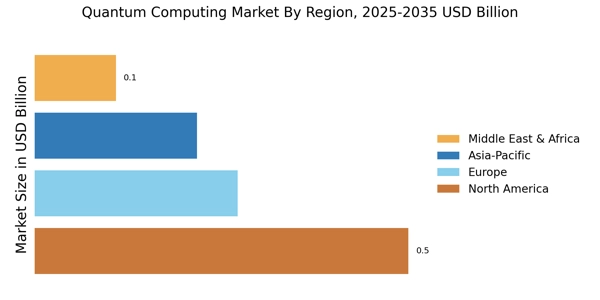
Nordamerika ist der größte Markt für Quantencomputing und hält etwa 45 % des globalen Anteils. Die Region profitiert von erheblichen Investitionen in Forschung und Entwicklung, die durch staatliche Initiativen und Innovationen des privaten Sektors vorangetrieben werden. Die US-Regierung hat verschiedene Programme ins Leben gerufen, um die Quanten-Technologie zu unterstützen, was die Nachfrage und die regulatorische Unterstützung für Fortschritte in diesem Bereich erhöht. Die Wettbewerbslandschaft wird von Schlüsselakteuren wie IBM, Google und Microsoft dominiert, die alle in den USA ansässig sind. Kanada spielt ebenfalls eine entscheidende Rolle mit Unternehmen wie D-Wave Systems und Xanadu. Die Präsenz dieser Branchenführer fördert ein robustes Ökosystem, das Zusammenarbeit und Innovation anregt, was das Marktwachstum weiter vorantreibt.

Europa: Aufstrebende Macht im Bereich Quanten

Europa entwickelt sich schnell zu einem bedeutenden Akteur im Markt für Quantencomputing und hält rund 25 % des globalen Anteils. Die Europäische Union hat Initiativen wie das Quantum Flagship-Programm ins Leben gerufen, das darauf abzielt, Forschung und Innovation in Quanten-Technologien zu fördern. Diese regulatorische Unterstützung ist entscheidend, um die Zusammenarbeit zwischen den Mitgliedstaaten zu fördern und die Wettbewerbsfähigkeit der Region auf dem globalen Markt zu stärken. Führende Länder sind Deutschland, Frankreich und die Niederlande, die mehrere Forschungseinrichtungen und Start-ups beherbergen, die sich auf Quanten-Technologien konzentrieren. Die Präsenz von Unternehmen wie IBM und D-Wave Systems in Europa bereichert die Wettbewerbslandschaft weiter, treibt Innovationen voran und zieht Investitionen in das Quantencomputing an.

Asien-Pazifik: Schnelles Wachstum und Investitionen

Asien-Pazifik verzeichnet ein rapides Wachstum im Markt für Quantencomputing und macht etwa 20 % des globalen Anteils aus. Länder wie China und Japan führen den Vorstoß an, mit erheblichen staatlichen Mitteln und Initiativen, die darauf abzielen, die Quantenforschung voranzutreiben. Chinas Fokus darauf, ein globaler Führer in der Quanten-Technologie zu werden, ist ein wesentlicher Treiber der Nachfrage in der Region, unterstützt durch verschiedene regulatorische Rahmenbedingungen, die Innovationen fördern. China beherbergt große Akteure wie Alibaba und mehrere Forschungseinrichtungen, die sich dem Quantencomputing widmen. Japan trägt ebenfalls mit seiner starken technologischen Basis und Unternehmen wie Fujitsu bei. Die Wettbewerbslandschaft ist durch eine Mischung aus etablierten Firmen und aufstrebenden Start-ups gekennzeichnet, die ein dynamisches Umfeld für Wachstum und Zusammenarbeit fördern.

Naher Osten und Afrika: Aufstrebende Grenze für Quanten-Technologie

Die Region Naher Osten und Afrika befindet sich in den Anfängen der Entwicklung ihres Marktes für Quantencomputing und hält derzeit etwa 10 % des globalen Anteils. Länder wie die VAE investieren in Technologie und Innovation, mit Initiativen, die darauf abzielen, die Forschung im Bereich Quantencomputing zu fördern. Regulatorische Rahmenbedingungen werden geschaffen, um diesen aufstrebenden Sektor zu unterstützen, der voraussichtlich in den kommenden Jahren erheblich wachsen wird, da das Bewusstsein und die Investitionen zunehmen. Führende Länder in dieser Region sind die VAE und Südafrika, wo staatlich geförderte Initiativen die Forschung und Entwicklung in Quanten-Technologien vorantreiben. Die Wettbewerbslandschaft entwickelt sich noch, mit einem Fokus auf den Aufbau von Partnerschaften zwischen Wissenschaft und Industrie, um Innovation und Wachstum im Quanten-Sektor voranzutreiben.

Quantencomputing-Markt Regional Image

Hauptakteure und Wettbewerbseinblicke

Der Markt für Quantencomputing ist derzeit durch eine dynamische Wettbewerbslandschaft gekennzeichnet, die von raschen technologischen Fortschritten und zunehmenden Investitionen in Forschung und Entwicklung angetrieben wird. Führende Unternehmen wie IBM (USA), Google (USA) und Microsoft (USA) stehen an der Spitze und verfolgen jeweils unterschiedliche Strategien zur Verbesserung ihrer Marktpositionierung. IBM (USA) betont Innovation durch sein Quantum System One und konzentriert sich auf hybride Quanten-klassische Computing-Lösungen, während Google (USA) seine Expertise in künstlicher Intelligenz nutzt, um Quantenalgorithmen zu optimieren. Microsoft (USA) verfolgt einen einzigartigen Ansatz, indem es Quantencomputing mit seiner Azure-Cloud-Plattform integriert, wodurch eine breitere Zugänglichkeit und Anwendung von Quanten-Technologien ermöglicht wird. Gemeinsam verbessern diese Strategien nicht nur ihre Wettbewerbsfähigkeit, sondern tragen auch zu einem robusteren und vernetzten Marktumfeld bei.

In Bezug auf Geschäftstaktiken lokalisieren Unternehmen zunehmend die Fertigung und optimieren die Lieferketten, um die betriebliche Effizienz zu steigern. Der Markt für Quantencomputing erscheint moderat fragmentiert, mit einer Mischung aus etablierten Akteuren und aufstrebenden Startups. Diese Struktur ermöglicht vielfältige Innovationswege, da kleinere Unternehmen oft Nischen-Technologien einführen, die den Status quo herausfordern. Der kollektive Einfluss der Hauptakteure bleibt jedoch erheblich, da sie Branchenstandards setzen und kollaborative Initiativen vorantreiben, die die Marktdynamik prägen.

Im September 2025 gab IBM (USA) eine strategische Partnerschaft mit einem führenden Automobilhersteller bekannt, um Quantenalgorithmen zu entwickeln, die darauf abzielen, die Logistik in der Lieferkette zu optimieren. Diese Zusammenarbeit unterstreicht IBMs Engagement, Quantencomputing-Lösungen in realen Szenarien anzuwenden, was potenziell revolutionieren könnte, wie Industrien komplexe logistische Herausforderungen bewältigen. Die Partnerschaft verbessert nicht nur IBMs Marktpräsenz, sondern veranschaulicht auch den wachsenden Trend zu branchenübergreifenden Kooperationen im Quantenbereich.

Im August 2025 stellte Google (USA) seinen neuesten Quantenprozessor vor, der Berichten zufolge beispiellose Kohärenzzeiten für Qubits erreicht. Dieser Fortschritt ist entscheidend, da er die Leistung von Quantenalgorithmen erheblich verbessern könnte, wodurch die praktischen Anwendungen des Quantencomputings beschleunigt werden. Indem Google die Grenzen der Quantenhardware verschiebt, positioniert sich das Unternehmen als führend im Wettlauf um die Quantenüberlegenheit und könnte potenziell weitere Investitionen und Partnerschaften anziehen.

Im Juli 2025 erweiterte Microsoft (USA) seine Azure Quantum-Plattform, indem es neue Werkzeuge für Entwickler integrierte, die darauf abzielen, den Prozess der Erstellung von Quantenanwendungen zu vereinfachen. Dieser Schritt spiegelt Microsofts Strategie wider, den Zugang zu Quantencomputing zu demokratisieren und ein breiteres Ökosystem von Entwicklern und Forschern zu fördern. Durch die Senkung der Eintrittsbarrieren verbessert Microsoft nicht nur seine Wettbewerbsposition, sondern regt auch Innovationen in verschiedenen Sektoren an.

Stand Oktober 2025 sind die Wettbewerbstrends im Markt für Quantencomputing zunehmend durch Digitalisierung, Nachhaltigkeit und die Integration von künstlicher Intelligenz geprägt. Strategische Allianzen werden immer häufiger, da Unternehmen den Wert der Zusammenarbeit erkennen, um die Komplexität der Quanten-Technologie zu bewältigen. In Zukunft wird sich die wettbewerbliche Differenzierung voraussichtlich weiterentwickeln und von traditioneller preisbasierter Konkurrenz hin zu einem Fokus auf Innovation, technologische Fortschritte und Zuverlässigkeit der Lieferkette verschieben. Dieser Übergang könnte neu definieren, wie Unternehmen mit dem Markt interagieren, und die Bedeutung strategischer Voraussicht und Anpassungsfähigkeit in einer sich schnell verändernden Landschaft betonen.

Zu den wichtigsten Unternehmen im Quantencomputing-Markt-Markt gehören

Branchenentwicklungen

Es gab in letzter Zeit einige große Veränderungen auf dem Markt für Quantencomputing unter den größten Unternehmen. Im August 2023 sagte Google, dass die Kohärenz von Qubits und die Fehlerkorrektur sich erheblich verbessert hätten, um Quanten Systeme zu entwickeln, die mit Fehlern umgehen können. IBM richtete am 22. September 2023 ein Quantum System One auf seinem Campus in Bromont, Quebec, ein. Seit Juni 2022 hat Microsoft die gefangenen Ionen Systeme von IonQ zu Azure Quantum hinzugefügt, was seine Hardware Sammlung vergrößert hat.

Anstatt sich mit einem Analyseunternehmen zusammenzuschließen, hat D-Wave sich auf die Unternehmensresilienz konzentriert, indem es Geld durch Eigenkapital beschafft und sein erstes Advantage-Quanten System vor Ort installiert hat.

Verschiedene Schätzungen beziffern den Markt für Quantencomputing bis 2027 auf 65 Milliarden USD, während andere Schätzungen, die Quanten-Sensing und -Kommunikation einbeziehen, ihn bis 2035 auf 97 Milliarden USD schätzen. Insgesamt wächst die Branche schnell, dank Durchbrüchen in der Fehlerkorrektur, Hardware-Implementierungen und dem zunehmenden Engagement von Unternehmen. Dies ist eine transformative Zeit für die Quanten Technologie.

Zukunftsaussichten

Quantencomputing-Markt Zukunftsaussichten

Der Markt für Quantencomputing wird voraussichtlich von 2024 bis 2035 mit einer durchschnittlichen jährlichen Wachstumsrate (CAGR) von 27,04 % wachsen, angetrieben durch Fortschritte in Algorithmen, Hardware und die steigende Nachfrage nach komplexen Problemlösungsfähigkeiten.

Neue Möglichkeiten liegen in:

  • Entwicklung von Quantum-as-a-Service-Plattformen für Unternehmen

Bis 2035 wird der Markt für Quantencomputing voraussichtlich eine entscheidende Branche sein, die Innovation und wirtschaftliches Wachstum vorantreibt.

Marktsegmentierung

Quantum Computing Market End Use Outlook

  • Academic
  • Government
  • Enterprise

Quantum Computing Market Component Outlook

  • Hardware
  • Software
  • Services

Quantum Computing Market Technology Outlook

  • Superconducting Qubits
  • Trapped Ions
  • Topological Qubits
  • Photonic Quantum Computing

Quantum Computing Market Application Outlook

  • Cryptography
  • Drug Discovery
  • Optimization Problems
  • Financial Modeling
  • Machine Learning

Berichtsumfang

MARKTGRÖSSE 2024 1,02 (Milliarden USD)
MARKTGRÖSSE 2025 1,296 (Milliarden USD)
MARKTGRÖSSE 2035 14,19 (Milliarden USD)
DURCHSCHNITTLICHE JÄHRLICHE WACHSTUMSRATE (CAGR) 27,04 % (2024 - 2035)
BERICHTDECKUNG Umsatzprognose, Wettbewerbslandschaft, Wachstumsfaktoren und Trends
GRUNDJAHR 2024
Marktprognosezeitraum 2025 - 2035
Historische Daten 2019 - 2024
Marktprognoseeinheiten Milliarden USD
Profilierte Schlüsselunternehmen Marktanalyse in Bearbeitung
Abgedeckte Segmente Marktsegmentierungsanalyse in Bearbeitung
Schlüsselmarktchancen Fortschritte bei Quantenalgorithmen treiben die Nachfrage nach innovativen Anwendungen im Quantencomputermarkt.
Schlüsselmarktdynamiken Intensivierter Wettbewerb treibt rasche technologische Fortschritte und strategische Partnerschaften im Quantencomputermarkt voran.
Abgedeckte Länder Nordamerika, Europa, APAC, Südamerika, MEA

FAQs

What is the projected market valuation of the Quantum Computing Market by 2035?
The Quantum Computing Market is projected to reach a valuation of 14.19 USD Billion by 2035.
What was the market valuation of the Quantum Computing Market in 2024?
In 2024, the Quantum Computing Market had a valuation of 1.02 USD Billion.
What is the expected CAGR for the Quantum Computing Market from 2025 to 2035?
The expected CAGR for the Quantum Computing Market during the forecast period 2025 - 2035 is 27.04%.
Which application segment is anticipated to have the highest valuation by 2035?
By 2035, the Machine Learning application segment is anticipated to reach a valuation of 4.39 USD Billion.
What are the key components driving the Quantum Computing Market?
The key components driving the market include Hardware, Software, and Services, with Hardware projected to reach 5.5 USD Billion by 2035.
Which end-use segment is expected to dominate the Quantum Computing Market?
The Enterprise end-use segment is expected to dominate, with a projected valuation of 7.69 USD Billion by 2035.
What technologies are being utilized in the Quantum Computing Market?
Technologies such as Superconducting Qubits and Trapped Ions are being utilized, with Superconducting Qubits projected to reach 5.5 USD Billion by 2035.
Who are the leading players in the Quantum Computing Market?
Leading players in the Quantum Computing Market include IBM, Google, Microsoft, and D-Wave Systems, among others.
What is the projected growth of the Drug Discovery segment by 2035?
The Drug Discovery segment is projected to grow to 2.8 USD Billion by 2035.
How does the Quantum Computing Market's growth compare to other technology sectors?
The Quantum Computing Market's growth, with a projected CAGR of 27.04%, suggests a robust expansion compared to many other technology sectors.
Autor
Author
Author Profile
Aarti Dhapte LinkedIn
AVP - Research
A consulting professional focused on helping businesses navigate complex markets through structured research and strategic insights. I partner with clients to solve high-impact business problems across market entry strategy, competitive intelligence, and opportunity assessment. Over the course of my experience, I have led and contributed to 100+ market research and consulting engagements, delivering insights across multiple industries and geographies, and supporting strategic decisions linked to $500M+ market opportunities. My core expertise lies in building robust market sizing, forecasting, and commercial models (top-down and bottom-up), alongside deep-dive competitive and industry analysis. I have played a key role in shaping go-to-market strategies, investment cases, and growth roadmaps, enabling clients to make confident, data-backed decisions in dynamic markets.

Research Approach


Secondary Research

The secondary research process involved comprehensive analysis of regulatory databases, peer-reviewed scientific journals, technical publications, and authoritative technology organizations. Key sources included the US National Institute of Standards and Technology (NIST), Department of Energy (DOE) Office of Science, National Science Foundation (NSF), European Commission Quantum Flagship Initiative, European Space Agency (ESA) Quantum Technologies, UK National Quantum Programme, National Institute of Information and Communications Technology (NICT) Japan, Chinese Academy of Sciences (CAS), Defence Research and Development Organisation (DRDO) India, International Telecommunication Union (ITU), Institute of Electrical and Electronics Engineers (IEEE) Quantum Initiative, American Physical Society (APS), Nature Publishing Group, Science Magazine, arXiv.org quantum physics repository, QED-C (Quantum Economic Development Consortium), Quantum World Association, McKinsey Global Institute, and national technology ministry reports from key markets.

Quantum computing investment statistics, regulatory policy frameworks, hardware development milestones, patent filings, talent pipeline data, and competitive landscape analysis for superconducting qubits, trapped ion systems, photonic quantum computing, and other quantum technology platforms were gathered using these sources.


Primary Research

Qualitative and quantitative insights were obtained by interviewing supply-side and demand-side stakeholders during the primary research process. The supply-side sources comprised CEOs, CTOs, VPs of Quantum Engineering, heads of quantum research laboratories, and commercial directors from quantum computing hardware manufacturers, software developers, and cloud service providers. Demand-side sources included chief information officers, the heads of advanced computing, research directors from pharmaceutical companies, financial institutions, logistics enterprises, defense contractors, and technology procurement leaders at government agencies. Primary research verified market segmentation, verified quantum roadmap timelines, and collected information on cloud access dynamics, software licensing models, and hardware adoption patterns.

Primary Respondent Breakdown:

By Designation: C-level Primaries (32%), Director Level (31%), Others (37%)

By Region: North America (38%), Europe (25%), Asia-Pacific (28%), Rest of World (9%)


Market Size Estimation

Revenue mapping and deployment volume analysis were implemented to determine global market valuation. The methodology comprised the following:

Identification of over 50 significant quantum computing entities in North America, Europe, Asia-Pacific, and Latin America

Product mapping encompasses quantum software/services, topological qubits, photonic quantum computing, trapped ion systems, and superconducting qubits.

Examination of annual revenues that are specific to quantum computing portfolios, including hardware sales, cloud access fees, software licenses, and consulting services, as reported and modeled.

Entities that account for 65-70% of the global market share in 2024 are included in the coverage.

Segment-specific valuations are derived through extrapolation using bottom-up (quantum processing hours × pricing by deployment model) and top-down (venture funding + government investment validation) approaches.

Kostenloses Muster herunterladen

Bitte füllen Sie das folgende Formular aus, um ein kostenloses Muster dieses Berichts zu erhalten

Download PDF ×

We do not share your information with anyone. However, we may send you emails based on your report interest from time to time. You may contact us at any time to opt-out.