量子コンピューティング市場

量子コンピューティング市場調査報告書 アプリケーション別(暗号学、薬剤発見、最適化問題、金融モデリング、機械学習)、コンポーネント別(ハードウェア、ソフトウェア、サービス)、エンドユーザー別(学術、政府、企業)、技術別(超伝導キュービット、トラップイオン、トポロジカルキュービット、フォトニック量子コンピューティング)、地域別(北米、ヨーロッパ、南米、アジア太平洋、中東およびアフリカ) - 2035年までの予測
ID: MRFR/ICT/1943-CR
200 Pages
Aarti Dhapte
Last Updated: July 31, 2026
Quantum Computing Market
Market Size
Forecast Period2025 - 2035
CAGR (2025 - 2035)27.04%
2024 Market Size$ 1.02 Billion
2025 Market Size$ 1.3 Billion
2035 Market Size$ 14.19 Billion
Key Players
Google
Honeywell/Quantinuum
Alibaba
Microsoft
D-Wave Systems
Rigetti Computing
Opportunities
  • Advancements in Quantum Hardware
  • Government Initiatives and Funding
  • Emergence of Quantum-as-a-Service Models

量子コンピューティング市場 概要

MRFRの分析によると、量子コンピューティング市場の規模は2024年に10.2億米ドルと推定されています。量子コンピューティング業界は、2025年に12.96億米ドルから2035年には141.9億米ドルに成長すると予測されており、2025年から2035年の予測期間中に27.04の年平均成長率(CAGR)を示すとされています。

主要な市場動向とハイライト

量子コンピューティング市場は、技術の進歩とさまざまな分野での応用の増加により、 substantial growth の準備が整っています。

  • "北米は量子コンピューティングの最大市場であり、研究開発への堅実な投資を示しています。","アジア太平洋地域は、量子スタートアップや教育イニシアチブの急増により、最も成長が早い地域として浮上しています。","暗号化セグメントが市場をリードしており、薬剤発見が重要なアプリケーション分野として急速に注目を集めています。","高度なコンピューティングソリューションへの需要の高まりと政府のイニシアチブが、市場拡大を促進する重要な要因です。"

市場規模と予測

2024 Market Value $1.02B
2035 Market Value $14.19B
CAGR (2025 - 2035) 27.04%

主要なプレーヤー

IBM(米国)、Google(米国)、Microsoft(米国)、D-Wave Systems(カナダ)、Rigetti Computing(米国)、IonQ(米国)、Honeywell(米国)、Alibaba(中国)、Xanadu(カナダ)

量子コンピューティング市場 運転手

Advancements in Quantum Hardware

Advancements in quantum hardware are a pivotal driver for the Quantum Computing Market. Innovations in qubit design, error correction techniques, and cooling technologies are enhancing the performance and scalability of quantum systems. Companies are actively developing superconducting qubits, trapped ions, and topological qubits, each offering unique advantages for different applications. The race to build more stable and reliable quantum computers is intensifying, with several firms reporting breakthroughs in qubit coherence times and gate fidelities. As hardware capabilities improve, the potential applications of quantum computing expand, attracting interest from various sectors. This ongoing evolution in quantum hardware is likely to catalyze further investment and research, solidifying the industry's growth.

Government Initiatives and Funding

Government initiatives play a crucial role in propelling the Quantum Computing Market forward. Various nations are investing heavily in quantum research and development, recognizing its potential to revolutionize technology and maintain competitive advantages. For instance, funding programs aimed at fostering public-private partnerships are becoming increasingly common. These initiatives not only provide financial support but also facilitate collaboration among academia, industry, and government entities. In recent years, several countries have announced multi-billion dollar investments in quantum technology, which are expected to accelerate advancements and commercialization efforts. Such government backing is likely to enhance the overall ecosystem, driving innovation and attracting talent to the quantum computing sector.

Emergence of Quantum-as-a-Service Models

The emergence of Quantum-as-a-Service (QaaS) models is transforming the Quantum Computing Market by making quantum technologies more accessible. These models allow businesses to leverage quantum computing resources without the need for substantial upfront investments in hardware. Cloud-based quantum computing platforms are being developed by leading technology firms, enabling organizations to experiment with quantum algorithms and applications on a pay-per-use basis. This democratization of quantum computing is expected to accelerate adoption across various industries, including healthcare, finance, and logistics. As more companies recognize the potential of quantum solutions, the QaaS model is likely to drive significant growth in the market, fostering innovation and collaboration.

Growing Interest in Quantum Cryptography

The Quantum Computing Market is witnessing a growing interest in quantum cryptography, which offers unprecedented security features. As cyber threats become more sophisticated, organizations are seeking robust solutions to protect sensitive data. Quantum cryptography leverages the principles of quantum mechanics to create secure communication channels that are theoretically immune to eavesdropping. This has led to increased investments in quantum key distribution technologies, which are gaining traction among financial institutions and government agencies. The market for quantum cryptography is expected to expand significantly, with projections indicating a potential market size of over 1 billion dollars by 2027. This trend underscores the importance of quantum technologies in enhancing cybersecurity measures.

Rising Demand for Advanced Computing Solutions

The Quantum Computing Market is experiencing a notable surge in demand for advanced computing solutions. As traditional computing systems struggle to handle complex problems, industries such as finance, pharmaceuticals, and logistics are increasingly turning to quantum computing for its unparalleled processing capabilities. This shift is driven by the need for faster data analysis and optimization, which quantum computers can provide. According to recent estimates, the quantum computing market is projected to reach a valuation of approximately 65 billion dollars by 2030, indicating a robust growth trajectory. The ability of quantum systems to solve problems that are currently intractable for classical computers positions them as a vital tool for innovation across various sectors.

市場セグメントの洞察

By Application: Cryptography (Largest) vs. Drug Discovery (Fastest-Growing)

In the Quantum Computing Market, Cryptography is currently the largest segment, capturing significant market share through its application in enhancing security measures. This segment's development leverages the unique attributes of quantum mechanics to create cryptographic systems that are nearly unbreakable. Following closely, Drug Discovery is emerging as a fast-growing segment due to its potential in revolutionizing the pharmaceutical industry by enabling the simulation of molecular interactions and significantly accelerating the drug development process.

Cryptography: Dominant vs. Drug Discovery: Emerging

Cryptography stands out as the dominant application in the Quantum Computing Market, thanks to its critical capacity to secure digital information against evolving cyber threats. Utilizing quantum algorithms, this segment offers unparalleled opportunities for creating advanced cryptographic protocols that institutional and governmental entities seek. In contrast, Drug Discovery represents an emerging frontier, capturing attention for its capability to drastically shorten the timeline from initial drug research to market-ready products. By harnessing quantum simulations, pharmaceutical companies can optimize molecular designs and predict interactions more precisely, leading to a prospective breakthrough in treating complex diseases. Together, these segments illustrate the transformative power of quantum technology.

By Component: Hardware (Largest) vs. Software (Fastest-Growing)

In the Quantum Computing Market, the component segment showcases a diverse range of offerings, primarily divided into hardware, software, and services. Hardware, encompassing quantum processors and quantum chips, holds the largest market share due to the critical role it plays in quantum computing infrastructure. In contrast, software solutions, which include programming languages and quantum algorithms, represent the fastest-growing segment, driven by the increasing demand for efficient quantum applications.

Hardware (Dominant) vs. Software (Emerging)

Hardware remains the dominant force in the Quantum Computing Market, representing a substantial portion of the segment with its advanced quantum processors and related technologies. These components are essential for the execution of quantum algorithms, making them indispensable in building quantum computers. Meanwhile, software is swiftly emerging as a vital component, fueled by a growing ecosystem of developers and researchers focused on optimizing quantum applications. This emerging software landscape is characterized by innovative tools and frameworks that enable efficient programming for quantum systems, enhancing the overall capacity and functionality of quantum computers.

By End Use: Academic (Largest) vs. Enterprise (Fastest-Growing)

The Quantum Computing Market is seeing a diverse distribution of market share among its end-use segments. The academic sector currently holds the largest share, leveraging its extensive research initiatives and collaborations with technology firms. Educational institutions are investing in quantum technologies for research and development, thus driving innovations and applications in the field. In contrast, enterprises are rapidly catching up, capitalizing on quantum computing's potential to transform operations across various industries, including finance and healthcare.

End Use: Academic (Dominant) vs. Enterprise (Emerging)

The academic segment in the Quantum Computing Market is characterized by its extensive research programs and collaborations with industry players, leading to groundbreaking advancements. Universities and research institutions are at the forefront of exploring quantum algorithms and computing capabilities, making significant contributions to both theoretical and applied research. Meanwhile, the enterprise segment is emerging as a significant player, with businesses actively exploring quantum solutions for optimization, security, and data analysis. Enterprises are drawn to the technology for its potential to solve complex problems that traditional computing cannot handle, thereby positioning themselves as future leaders in innovation.

By Technology: Superconducting Qubits (Largest) vs. Trapped Ions (Fastest-Growing)

In the quantum computing market, superconducting qubits dominate, representing the largest share, largely due to their robustness and existing technological infrastructure. In contrast, trapped ions are gaining traction, rapidly increasing their market share as advancements in their associated technologies improve their performance and scalability. Both technologies are essential to the evolution of quantum computing, yet they cater to different applications and research focuses, highlighting a dynamic competitive landscape. The growth trends in the quantum computing segment are primarily driven by increased research funding, demand for advanced computational power, and the advancement of algorithms that utilize qubits efficiently. Superconducting qubits benefit from established industry players and significant investments, while trapped ions are experiencing faster growth due to their scalability and precision. As both segments evolve, they represent unique opportunities and challenges in the quest for practical, deployed quantum systems.

Technology: Superconducting Qubits (Dominant) vs. Trapped Ions (Emerging)

Superconducting qubits are at the forefront of quantum technology, leveraging the principles of superconductivity to achieve qubit operations at ultra-low temperatures. Their dominance in the market is driven by significant investment from leading tech companies, as well as their successful integration into existing quantum architectures. They are known for their relatively low error rates and compatibility with standard semiconductor fabrication techniques. Conversely, trapped ions represent an emerging technology characterized by their use of individual ions confined using electromagnetic fields. This technology offers impressive coherence times and high-fidelity gates, making it a strong contender for specific quantum computing tasks. As research progresses, trapped ions are poised to capitalize on their growing applications in areas such as quantum simulations and secure communication.

量子コンピューティング市場に関する詳細な洞察を得る

地域の洞察

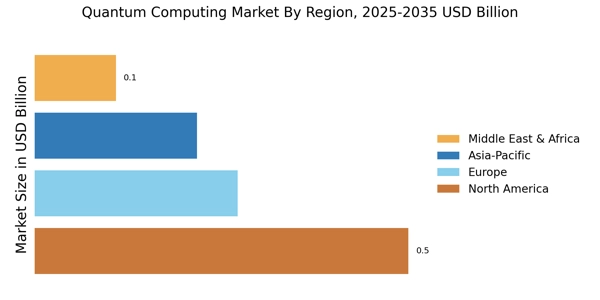
北米:量子技術のイノベーションハブ

北米は量子コンピューティングの最大市場であり、世界のシェアの約45%を占めています。この地域は、政府のイニシアティブと民間部門のイノベーションによって推進される研究開発への大規模な投資の恩恵を受けています。米国政府は、量子技術を支援するためのさまざまなプログラムを立ち上げており、この分野の進展に対する需要と規制のサポートを強化しています。 競争環境は、米国に拠点を置くIBM、Google、Microsoftなどの主要プレーヤーによって支配されています。カナダもD-Wave SystemsやXanaduなどの企業を通じて重要な役割を果たしています。これらの業界リーダーの存在は、強力なエコシステムを育成し、コラボレーションとイノベーションを促進し、市場の成長をさらに推進しています。

ヨーロッパ:量子の新興大国

ヨーロッパは、量子コンピューティング市場で急速に重要なプレーヤーとして台頭しており、世界のシェアの約25%を占めています。欧州連合は、量子技術の研究とイノベーションを促進することを目的とした量子フラグシッププログラムなどのイニシアティブを立ち上げました。この規制のサポートは、加盟国間のコラボレーションを促進し、世界市場における地域の競争力を高めるために重要です。 主要な国には、ドイツ、フランス、オランダが含まれ、これらの国には量子技術に焦点を当てた研究機関やスタートアップが多数存在します。IBMやD-Wave Systemsなどの企業がヨーロッパに存在することで、競争環境がさらに豊かになり、イノベーションを推進し、量子コンピューティングへの投資を引き寄せています。

アジア太平洋:急成長と投資

アジア太平洋地域は、量子コンピューティング市場で急成長を遂げており、世界のシェアの約20%を占めています。中国や日本などの国々が先頭に立ち、量子研究を進めるための大規模な政府資金とイニシアティブを展開しています。中国の量子技術のグローバルリーダーになるという焦点は、この地域の需要の重要な推進力であり、イノベーションを促進するさまざまな規制枠組みに支えられています。 中国には、Alibabaや量子コンピューティングに特化したいくつかの研究機関などの主要プレーヤーが存在します。日本も、強力な技術基盤とFujitsuなどの企業を通じて貢献しています。競争環境は、確立された企業と新興スタートアップの混在によって特徴づけられ、成長とコラボレーションのためのダイナミックな環境を育成しています。

中東およびアフリカ:量子技術の新興フロンティア

中東およびアフリカ地域は、量子コンピューティング市場の発展の初期段階にあり、現在、世界のシェアの約10%を占めています。UAEなどの国々は、量子コンピューティングの研究を促進することを目的とした技術とイノベーションへの投資を行っています。この新興セクターを支援するための規制枠組みが確立されつつあり、認知度と投資が増加するにつれて、今後数年間で大きな成長が期待されています。 この地域の主要国には、UAEや南アフリカが含まれ、政府支援のイニシアティブが量子技術の研究と開発を促進しています。競争環境はまだ発展途上であり、イノベーションと量子セクターの成長を推進するために、学界と産業間のパートナーシップを構築することに焦点を当てています。

量子コンピューティング市場 Regional Image

主要企業と競争の洞察

量子コンピューティング市場は、急速な技術革新と研究開発への投資の増加によって推進される動的な競争環境が特徴です。IBM(米国)、Google(米国)、Microsoft(米国)などの主要プレーヤーが最前線に立ち、それぞれが市場ポジションを強化するための独自の戦略を採用しています。IBM(米国)は、ハイブリッド量子古典コンピューティングソリューションに焦点を当てたQuantum System Oneを通じて革新を強調し、Google(米国)は人工知能の専門知識を活用して量子アルゴリズムを最適化しています。Microsoft(米国)は、Azureクラウドプラットフォームと量子コンピューティングを統合する独自のアプローチを追求し、量子技術のより広範なアクセスと応用を促進しています。これらの戦略は、競争力を高めるだけでなく、より強固で相互接続された市場環境に寄与しています。

ビジネス戦略に関しては、企業は製造のローカライズとサプライチェーンの最適化を進め、運営効率を向上させています。量子コンピューティング市場は、確立されたプレーヤーと新興スタートアップの混在により、適度に分散しているようです。この構造は、多様な革新の道を可能にし、小規模な企業がしばしばニッチな技術を導入して現状に挑戦します。しかし、主要プレーヤーの集団的影響力は依然として重要であり、業界標準を設定し、市場のダイナミクスを形成する共同イニシアチブを推進しています。

2025年9月、IBM(米国)は、サプライチェーンの物流最適化を目的とした量子アルゴリズムを開発するために、主要な自動車メーカーとの戦略的パートナーシップを発表しました。このコラボレーションは、現実のシナリオに量子コンピューティングソリューションを適用するというIBMのコミットメントを強調し、業界が複雑な物流の課題を管理する方法を革命的に変える可能性があります。このパートナーシップは、IBMの市場での存在感を高めるだけでなく、量子分野における業界横断的なコラボレーションの増加傾向を示しています。

2025年8月、Google(米国)は、前例のないキュービットコヒーレンスタイムを達成した最新の量子プロセッサを発表しました。この進展は重要であり、量子アルゴリズムの性能を大幅に向上させ、量子コンピューティングの実用的な応用を加速させる可能性があります。量子ハードウェアの限界を押し広げることで、Googleは量子優位性の競争においてリーダーとしての地位を確立し、さらなる投資やパートナーシップを引き寄せる可能性があります。

2025年7月、Microsoft(米国)は、量子アプリケーションの構築プロセスを簡素化するための新しいツールを統合してAzure Quantumプラットフォームを拡張しました。この動きは、量子コンピューティングへのアクセスを民主化し、開発者や研究者のより広範なエコシステムを育成するというMicrosoftの戦略を反映しています。参入障壁を下げることで、Microsoftは競争力を高めるだけでなく、さまざまな分野での革新を刺激しています。

2025年10月現在、量子コンピューティング市場の競争トレンドは、デジタル化、持続可能性、人工知能の統合によってますます定義されています。戦略的アライアンスがますます普及しており、企業は量子技術の複雑さをナビゲートする上でのコラボレーションの価値を認識しています。今後、競争の差別化は進化し、従来の価格ベースの競争から、革新、技術の進歩、サプライチェーンの信頼性に焦点を当てる方向にシフトする可能性があります。この移行は、企業が市場と関わる方法を再定義し、急速に変化する環境における戦略的先見性と適応力の重要性を強調するかもしれません。

量子コンピューティング市場市場の主要企業には以下が含まれます

業界の動向

最近、主要企業の間で量子コンピューティング市場に大きな変化がありました。2023年8月、Googleは、量子システムが故障を処理できるようになる過程で、キュービットのコヒーレンスとエラー訂正が大幅に改善されたと発表しました。IBMは2023年9月22日に、ケベック州ブロモンのキャンパスに量子システム「Quantum System One」を設置しました。2022年6月以来、MicrosoftはAzure QuantumにIonQのトラップイオンシステムを追加し、ハードウェアコレクションを拡大しました。

D-Waveは分析会社との合併を避け、資金を調達し、初のAdvantage量子システムを現地に設置することで企業のレジリエンスに注力しています。

異なる推定によれば、量子コンピューティング市場は2027年までに650億米ドルに達するとされていますが、量子センシングや通信を含む他の推定では、2035年までに970億米ドルに達するとされています。全体として、エラー訂正、ハードウェアの展開、そしてより多くの企業の参入により、業界は急速に成長しています。これは量子技術にとって変革の時代です。

今後の見通し

量子コンピューティング市場 今後の見通し

量子コンピューティング市場は、2024年から2035年にかけて年平均成長率27.04%で成長すると予測されており、アルゴリズム、ハードウェアの進歩、複雑な問題解決能力に対する需要の増加がその推進要因となっています。

新しい機会は以下にあります:

  • 企業向けの量子サービスプラットフォームの開発

2035年までに、量子コンピューティング市場は革新と経済成長を推進する重要な産業になると予想されています。

市場セグメンテーション

Quantum Computing Market End Use Outlook

  • Academic
  • Government
  • Enterprise

Quantum Computing Market Component Outlook

  • Hardware
  • Software
  • Services

Quantum Computing Market Technology Outlook

  • Superconducting Qubits
  • Trapped Ions
  • Topological Qubits
  • Photonic Quantum Computing

Quantum Computing Market Application Outlook

  • Cryptography
  • Drug Discovery
  • Optimization Problems
  • Financial Modeling
  • Machine Learning

レポートの範囲

市場規模 2024 1.02(億米ドル)
市場規模 2025 1.296(億米ドル)
市場規模 2035 14.19(億米ドル)
年平均成長率 (CAGR) 27.04% (2024 - 2035)
レポートの範囲 収益予測、競争環境、成長要因、トレンド
基準年 2024
市場予測期間 2025 - 2035
過去データ 2019 - 2024
市場予測単位 億米ドル
主要企業のプロファイル 市場分析進行中
カバーされるセグメント 市場セグメンテーション分析進行中
主要市場機会 量子アルゴリズムの進展が量子コンピューティング市場における革新的なアプリケーションの需要を促進します。
主要市場ダイナミクス 競争の激化が量子コンピューティング市場における急速な技術革新と戦略的パートナーシップを促進します。
カバーされる国 北米、ヨーロッパ、APAC、南米、中東・アフリカ

FAQs

What is the projected market valuation of the Quantum Computing Market by 2035?
The Quantum Computing Market is projected to reach a valuation of 14.19 USD Billion by 2035.
What was the market valuation of the Quantum Computing Market in 2024?
In 2024, the Quantum Computing Market had a valuation of 1.02 USD Billion.
What is the expected CAGR for the Quantum Computing Market from 2025 to 2035?
The expected CAGR for the Quantum Computing Market during the forecast period 2025 - 2035 is 27.04%.
Which application segment is anticipated to have the highest valuation by 2035?
By 2035, the Machine Learning application segment is anticipated to reach a valuation of 4.39 USD Billion.
What are the key components driving the Quantum Computing Market?
The key components driving the market include Hardware, Software, and Services, with Hardware projected to reach 5.5 USD Billion by 2035.
Which end-use segment is expected to dominate the Quantum Computing Market?
The Enterprise end-use segment is expected to dominate, with a projected valuation of 7.69 USD Billion by 2035.
What technologies are being utilized in the Quantum Computing Market?
Technologies such as Superconducting Qubits and Trapped Ions are being utilized, with Superconducting Qubits projected to reach 5.5 USD Billion by 2035.
Who are the leading players in the Quantum Computing Market?
Leading players in the Quantum Computing Market include IBM, Google, Microsoft, and D-Wave Systems, among others.
What is the projected growth of the Drug Discovery segment by 2035?
The Drug Discovery segment is projected to grow to 2.8 USD Billion by 2035.
How does the Quantum Computing Market's growth compare to other technology sectors?
The Quantum Computing Market's growth, with a projected CAGR of 27.04%, suggests a robust expansion compared to many other technology sectors.
著者
Author
Author Profile
Aarti Dhapte LinkedIn
AVP - Research
A consulting professional focused on helping businesses navigate complex markets through structured research and strategic insights. I partner with clients to solve high-impact business problems across market entry strategy, competitive intelligence, and opportunity assessment. Over the course of my experience, I have led and contributed to 100+ market research and consulting engagements, delivering insights across multiple industries and geographies, and supporting strategic decisions linked to $500M+ market opportunities. My core expertise lies in building robust market sizing, forecasting, and commercial models (top-down and bottom-up), alongside deep-dive competitive and industry analysis. I have played a key role in shaping go-to-market strategies, investment cases, and growth roadmaps, enabling clients to make confident, data-backed decisions in dynamic markets.

Research Approach


Secondary Research

The secondary research process involved comprehensive analysis of regulatory databases, peer-reviewed scientific journals, technical publications, and authoritative technology organizations. Key sources included the US National Institute of Standards and Technology (NIST), Department of Energy (DOE) Office of Science, National Science Foundation (NSF), European Commission Quantum Flagship Initiative, European Space Agency (ESA) Quantum Technologies, UK National Quantum Programme, National Institute of Information and Communications Technology (NICT) Japan, Chinese Academy of Sciences (CAS), Defence Research and Development Organisation (DRDO) India, International Telecommunication Union (ITU), Institute of Electrical and Electronics Engineers (IEEE) Quantum Initiative, American Physical Society (APS), Nature Publishing Group, Science Magazine, arXiv.org quantum physics repository, QED-C (Quantum Economic Development Consortium), Quantum World Association, McKinsey Global Institute, and national technology ministry reports from key markets.

Quantum computing investment statistics, regulatory policy frameworks, hardware development milestones, patent filings, talent pipeline data, and competitive landscape analysis for superconducting qubits, trapped ion systems, photonic quantum computing, and other quantum technology platforms were gathered using these sources.


Primary Research

Qualitative and quantitative insights were obtained by interviewing supply-side and demand-side stakeholders during the primary research process. The supply-side sources comprised CEOs, CTOs, VPs of Quantum Engineering, heads of quantum research laboratories, and commercial directors from quantum computing hardware manufacturers, software developers, and cloud service providers. Demand-side sources included chief information officers, the heads of advanced computing, research directors from pharmaceutical companies, financial institutions, logistics enterprises, defense contractors, and technology procurement leaders at government agencies. Primary research verified market segmentation, verified quantum roadmap timelines, and collected information on cloud access dynamics, software licensing models, and hardware adoption patterns.

Primary Respondent Breakdown:

By Designation: C-level Primaries (32%), Director Level (31%), Others (37%)

By Region: North America (38%), Europe (25%), Asia-Pacific (28%), Rest of World (9%)


Market Size Estimation

Revenue mapping and deployment volume analysis were implemented to determine global market valuation. The methodology comprised the following:

Identification of over 50 significant quantum computing entities in North America, Europe, Asia-Pacific, and Latin America

Product mapping encompasses quantum software/services, topological qubits, photonic quantum computing, trapped ion systems, and superconducting qubits.

Examination of annual revenues that are specific to quantum computing portfolios, including hardware sales, cloud access fees, software licenses, and consulting services, as reported and modeled.

Entities that account for 65-70% of the global market share in 2024 are included in the coverage.

Segment-specific valuations are derived through extrapolation using bottom-up (quantum processing hours × pricing by deployment model) and top-down (venture funding + government investment validation) approaches.

無料サンプルをダウンロード

このレポートの無料サンプルを受け取るには、以下のフォームにご記入ください

Download PDF ×

We do not share your information with anyone. However, we may send you emails based on your report interest from time to time. You may contact us at any time to opt-out.