Marché de l'informatique quantique

Rapport d'étude de marché sur l'informatique quantique par application (Cryptographie, Découverte de médicaments, Problèmes d'optimisation, Modélisation financière, Apprentissage automatique), par composant (Matériel, Logiciel, Services), par utilisation finale (Académique, Gouvernement, Entreprise), par technologie (Qubits supraconducteurs, Ions piégés, Qubits topologiques, Informatique quantique photonique) et par région (Amérique du Nord, Europe, Amérique du Sud, Asie-Pacifique, Moyen-Orient et Afrique) - Prévisions jusqu'en 2035.
ID: MRFR/ICT/1943-CR
200 Pages
Aarti Dhapte
Last Updated: July 31, 2026
Quantum Computing Market
Market Size
Forecast Period2025 - 2035
CAGR (2025 - 2035)27.04%
2024 Market Size$ 1.02 Billion
2025 Market Size$ 1.3 Billion
2035 Market Size$ 14.19 Billion
Key Players
Google
Honeywell/Quantinuum
Alibaba
Microsoft
D-Wave Systems
Rigetti Computing
Opportunities
  • Advancements in Quantum Hardware
  • Government Initiatives and Funding
  • Emergence of Quantum-as-a-Service Models

Marché de l'informatique quantique Résumé

Selon l'analyse de MRFR, la taille du marché de l'informatique quantique était estimée à 1,02 milliard USD en 2024. L'industrie de l'informatique quantique devrait croître de 1,296 milliard USD en 2025 à 14,19 milliards USD d'ici 2035, affichant un taux de croissance annuel composé (CAGR) de 27,04 pendant la période de prévision 2025 - 2035.

Principales tendances et faits saillants du marché

Le marché de l'informatique quantique est prêt à connaître une croissance substantielle, soutenue par les avancées technologiques et l'augmentation des applications dans divers secteurs.

  • "L'Amérique du Nord reste le plus grand marché pour l'informatique quantique, montrant un investissement robuste dans la recherche et le développement.","L'Asie-Pacifique émerge comme la région à la croissance la plus rapide, avec une augmentation des startups quantiques et des initiatives éducatives.","Le segment de la cryptographie domine le marché, tandis que la découverte de médicaments gagne rapidement en traction en tant que domaine d'application clé.","La demande croissante pour des solutions informatiques avancées et les initiatives gouvernementales sont des moteurs significatifs propulsant l'expansion du marché."

Taille du marché et prévisions

2024 Market Value $1.02B
2035 Market Value $14.19B
CAGR (2025 - 2035) 27.04%

Principaux acteurs

IBM (US), Google (US), Microsoft (US), D-Wave Systems (CA), Rigetti Computing (US), IonQ (US), Honeywell (US), Alibaba (CN), Xanadu (CA)

Marché de l'informatique quantique conducteurs

Advancements in Quantum Hardware

Advancements in quantum hardware are a pivotal driver for the Quantum Computing Market. Innovations in qubit design, error correction techniques, and cooling technologies are enhancing the performance and scalability of quantum systems. Companies are actively developing superconducting qubits, trapped ions, and topological qubits, each offering unique advantages for different applications. The race to build more stable and reliable quantum computers is intensifying, with several firms reporting breakthroughs in qubit coherence times and gate fidelities. As hardware capabilities improve, the potential applications of quantum computing expand, attracting interest from various sectors. This ongoing evolution in quantum hardware is likely to catalyze further investment and research, solidifying the industry's growth.

Government Initiatives and Funding

Government initiatives play a crucial role in propelling the Quantum Computing Market forward. Various nations are investing heavily in quantum research and development, recognizing its potential to revolutionize technology and maintain competitive advantages. For instance, funding programs aimed at fostering public-private partnerships are becoming increasingly common. These initiatives not only provide financial support but also facilitate collaboration among academia, industry, and government entities. In recent years, several countries have announced multi-billion dollar investments in quantum technology, which are expected to accelerate advancements and commercialization efforts. Such government backing is likely to enhance the overall ecosystem, driving innovation and attracting talent to the quantum computing sector.

Emergence of Quantum-as-a-Service Models

The emergence of Quantum-as-a-Service (QaaS) models is transforming the Quantum Computing Market by making quantum technologies more accessible. These models allow businesses to leverage quantum computing resources without the need for substantial upfront investments in hardware. Cloud-based quantum computing platforms are being developed by leading technology firms, enabling organizations to experiment with quantum algorithms and applications on a pay-per-use basis. This democratization of quantum computing is expected to accelerate adoption across various industries, including healthcare, finance, and logistics. As more companies recognize the potential of quantum solutions, the QaaS model is likely to drive significant growth in the market, fostering innovation and collaboration.

Growing Interest in Quantum Cryptography

The Quantum Computing Market is witnessing a growing interest in quantum cryptography, which offers unprecedented security features. As cyber threats become more sophisticated, organizations are seeking robust solutions to protect sensitive data. Quantum cryptography leverages the principles of quantum mechanics to create secure communication channels that are theoretically immune to eavesdropping. This has led to increased investments in quantum key distribution technologies, which are gaining traction among financial institutions and government agencies. The market for quantum cryptography is expected to expand significantly, with projections indicating a potential market size of over 1 billion dollars by 2027. This trend underscores the importance of quantum technologies in enhancing cybersecurity measures.

Rising Demand for Advanced Computing Solutions

The Quantum Computing Market is experiencing a notable surge in demand for advanced computing solutions. As traditional computing systems struggle to handle complex problems, industries such as finance, pharmaceuticals, and logistics are increasingly turning to quantum computing for its unparalleled processing capabilities. This shift is driven by the need for faster data analysis and optimization, which quantum computers can provide. According to recent estimates, the quantum computing market is projected to reach a valuation of approximately 65 billion dollars by 2030, indicating a robust growth trajectory. The ability of quantum systems to solve problems that are currently intractable for classical computers positions them as a vital tool for innovation across various sectors.

Aperçu des segments de marché

By Application: Cryptography (Largest) vs. Drug Discovery (Fastest-Growing)

In the Quantum Computing Market, Cryptography is currently the largest segment, capturing significant market share through its application in enhancing security measures. This segment's development leverages the unique attributes of quantum mechanics to create cryptographic systems that are nearly unbreakable. Following closely, Drug Discovery is emerging as a fast-growing segment due to its potential in revolutionizing the pharmaceutical industry by enabling the simulation of molecular interactions and significantly accelerating the drug development process.

Cryptography: Dominant vs. Drug Discovery: Emerging

Cryptography stands out as the dominant application in the Quantum Computing Market, thanks to its critical capacity to secure digital information against evolving cyber threats. Utilizing quantum algorithms, this segment offers unparalleled opportunities for creating advanced cryptographic protocols that institutional and governmental entities seek. In contrast, Drug Discovery represents an emerging frontier, capturing attention for its capability to drastically shorten the timeline from initial drug research to market-ready products. By harnessing quantum simulations, pharmaceutical companies can optimize molecular designs and predict interactions more precisely, leading to a prospective breakthrough in treating complex diseases. Together, these segments illustrate the transformative power of quantum technology.

By Component: Hardware (Largest) vs. Software (Fastest-Growing)

In the Quantum Computing Market, the component segment showcases a diverse range of offerings, primarily divided into hardware, software, and services. Hardware, encompassing quantum processors and quantum chips, holds the largest market share due to the critical role it plays in quantum computing infrastructure. In contrast, software solutions, which include programming languages and quantum algorithms, represent the fastest-growing segment, driven by the increasing demand for efficient quantum applications.

Hardware (Dominant) vs. Software (Emerging)

Hardware remains the dominant force in the Quantum Computing Market, representing a substantial portion of the segment with its advanced quantum processors and related technologies. These components are essential for the execution of quantum algorithms, making them indispensable in building quantum computers. Meanwhile, software is swiftly emerging as a vital component, fueled by a growing ecosystem of developers and researchers focused on optimizing quantum applications. This emerging software landscape is characterized by innovative tools and frameworks that enable efficient programming for quantum systems, enhancing the overall capacity and functionality of quantum computers.

By End Use: Academic (Largest) vs. Enterprise (Fastest-Growing)

The Quantum Computing Market is seeing a diverse distribution of market share among its end-use segments. The academic sector currently holds the largest share, leveraging its extensive research initiatives and collaborations with technology firms. Educational institutions are investing in quantum technologies for research and development, thus driving innovations and applications in the field. In contrast, enterprises are rapidly catching up, capitalizing on quantum computing's potential to transform operations across various industries, including finance and healthcare.

End Use: Academic (Dominant) vs. Enterprise (Emerging)

The academic segment in the Quantum Computing Market is characterized by its extensive research programs and collaborations with industry players, leading to groundbreaking advancements. Universities and research institutions are at the forefront of exploring quantum algorithms and computing capabilities, making significant contributions to both theoretical and applied research. Meanwhile, the enterprise segment is emerging as a significant player, with businesses actively exploring quantum solutions for optimization, security, and data analysis. Enterprises are drawn to the technology for its potential to solve complex problems that traditional computing cannot handle, thereby positioning themselves as future leaders in innovation.

By Technology: Superconducting Qubits (Largest) vs. Trapped Ions (Fastest-Growing)

In the quantum computing market, superconducting qubits dominate, representing the largest share, largely due to their robustness and existing technological infrastructure. In contrast, trapped ions are gaining traction, rapidly increasing their market share as advancements in their associated technologies improve their performance and scalability. Both technologies are essential to the evolution of quantum computing, yet they cater to different applications and research focuses, highlighting a dynamic competitive landscape. The growth trends in the quantum computing segment are primarily driven by increased research funding, demand for advanced computational power, and the advancement of algorithms that utilize qubits efficiently. Superconducting qubits benefit from established industry players and significant investments, while trapped ions are experiencing faster growth due to their scalability and precision. As both segments evolve, they represent unique opportunities and challenges in the quest for practical, deployed quantum systems.

Technology: Superconducting Qubits (Dominant) vs. Trapped Ions (Emerging)

Superconducting qubits are at the forefront of quantum technology, leveraging the principles of superconductivity to achieve qubit operations at ultra-low temperatures. Their dominance in the market is driven by significant investment from leading tech companies, as well as their successful integration into existing quantum architectures. They are known for their relatively low error rates and compatibility with standard semiconductor fabrication techniques. Conversely, trapped ions represent an emerging technology characterized by their use of individual ions confined using electromagnetic fields. This technology offers impressive coherence times and high-fidelity gates, making it a strong contender for specific quantum computing tasks. As research progresses, trapped ions are poised to capitalize on their growing applications in areas such as quantum simulations and secure communication.

Obtenez des informations plus détaillées sur Marché de l'informatique quantique

Aperçu régional

Amérique du Nord : Pôle d'Innovation pour la Technologie Quantique

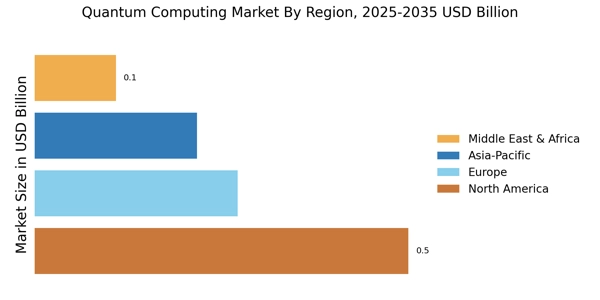
L'Amérique du Nord est le plus grand marché pour l'informatique quantique, détenant environ 45 % de la part mondiale. La région bénéficie d'investissements significatifs dans la recherche et le développement, soutenus par des initiatives gouvernementales et l'innovation du secteur privé. Le gouvernement américain a lancé divers programmes pour soutenir la technologie quantique, renforçant la demande et le soutien réglementaire pour les avancées dans ce domaine. Le paysage concurrentiel est dominé par des acteurs clés tels qu'IBM, Google et Microsoft, tous basés aux États-Unis. Le Canada joue également un rôle crucial avec des entreprises comme D-Wave Systems et Xanadu. La présence de ces leaders de l'industrie favorise un écosystème robuste, encourageant la collaboration et l'innovation, ce qui propulse davantage la croissance du marché.

Europe : Puissance Émergente dans le Quantique

L'Europe émerge rapidement comme un acteur significatif sur le marché de l'informatique quantique, détenant environ 25 % de la part mondiale. L'Union européenne a lancé des initiatives comme le programme Quantum Flagship, qui vise à stimuler la recherche et l'innovation dans les technologies quantiques. Ce soutien réglementaire est crucial pour favoriser la collaboration entre les États membres et améliorer l'avantage concurrentiel de la région sur le marché mondial. Les pays leaders incluent l'Allemagne, la France et les Pays-Bas, qui abritent plusieurs institutions de recherche et startups axées sur les technologies quantiques. La présence d'entreprises comme IBM et D-Wave Systems en Europe enrichit encore le paysage concurrentiel, stimulant l'innovation et attirant des investissements dans l'informatique quantique.

Asie-Pacifique : Croissance Rapide et Investissement

La région Asie-Pacifique connaît une croissance rapide sur le marché de l'informatique quantique, représentant environ 20 % de la part mondiale. Des pays comme la Chine et le Japon mènent la charge, avec un financement gouvernemental substantiel et des initiatives visant à faire progresser la recherche quantique. L'accent mis par la Chine sur son objectif de devenir un leader mondial en technologie quantique est un moteur significatif de la demande dans la région, soutenu par divers cadres réglementaires qui encouragent l'innovation. La Chine abrite des acteurs majeurs comme Alibaba et plusieurs institutions de recherche dédiées à l'informatique quantique. Le Japon contribue également avec sa solide base technologique et des entreprises comme Fujitsu. Le paysage concurrentiel est caractérisé par un mélange d'entreprises établies et de startups émergentes, favorisant un environnement dynamique pour la croissance et la collaboration.

Moyen-Orient et Afrique : Frontière Émergente pour la Technologie Quantique

La région du Moyen-Orient et de l'Afrique est à ses débuts dans le développement de son marché de l'informatique quantique, détenant actuellement environ 10 % de la part mondiale. Des pays comme les Émirats Arabes Unis investissent dans la technologie et l'innovation, avec des initiatives visant à favoriser la recherche en informatique quantique. Des cadres réglementaires sont en cours d'établissement pour soutenir ce secteur émergent, qui devrait connaître une croissance significative dans les années à venir à mesure que la sensibilisation et les investissements augmentent. Les pays leaders dans cette région incluent les Émirats Arabes Unis et l'Afrique du Sud, où des initiatives soutenues par le gouvernement promeuvent la recherche et le développement dans les technologies quantiques. Le paysage concurrentiel est encore en développement, avec un accent sur la création de partenariats entre le milieu académique et l'industrie pour stimuler l'innovation et la croissance dans le secteur quantique.

Marché de l'informatique quantique Regional Image

Acteurs clés et aperçu concurrentiel

Le marché de l'informatique quantique est actuellement caractérisé par un paysage concurrentiel dynamique, propulsé par des avancées technologiques rapides et des investissements croissants en recherche et développement. Des acteurs majeurs tels qu'IBM (États-Unis), Google (États-Unis) et Microsoft (États-Unis) sont à l'avant-garde, chacun adoptant des stratégies distinctes pour améliorer leur position sur le marché. IBM (États-Unis) met l'accent sur l'innovation grâce à son Quantum System One, se concentrant sur des solutions d'informatique quantique hybride-classique, tandis que Google (États-Unis) tire parti de son expertise en intelligence artificielle pour optimiser les algorithmes quantiques. Microsoft (États-Unis) adopte une approche unique en intégrant l'informatique quantique à sa plateforme cloud Azure, facilitant ainsi une accessibilité et une application plus larges des technologies quantiques. Collectivement, ces stratégies non seulement renforcent leur avantage concurrentiel, mais contribuent également à un environnement de marché plus robuste et interconnecté.

En termes de tactiques commerciales, les entreprises localisent de plus en plus la fabrication et optimisent les chaînes d'approvisionnement pour améliorer l'efficacité opérationnelle. Le marché de l'informatique quantique semble modérément fragmenté, avec un mélange d'acteurs établis et de startups émergentes. Cette structure permet des voies d'innovation diversifiées, car les petites entreprises introduisent souvent des technologies de niche qui remettent en question le statu quo. L'influence collective des acteurs clés, cependant, reste substantielle, car ils établissent des normes industrielles et mènent des initiatives collaboratives qui façonnent la dynamique du marché.

En septembre 2025, IBM (États-Unis) a annoncé un partenariat stratégique avec un fabricant automobile de premier plan pour développer des algorithmes quantiques visant à optimiser la logistique de la chaîne d'approvisionnement. Cette collaboration souligne l'engagement d'IBM à appliquer des solutions d'informatique quantique dans des scénarios réels, révolutionnant potentiellement la manière dont les industries gèrent des défis logistiques complexes. Le partenariat renforce non seulement la présence d'IBM sur le marché, mais illustre également la tendance croissante des collaborations intersectorielles dans le domaine quantique.

En août 2025, Google (États-Unis) a dévoilé son dernier processeur quantique, qui atteindrait des temps de cohérence de qubit sans précédent. Cette avancée est cruciale, car elle pourrait considérablement améliorer les performances des algorithmes quantiques, accélérant ainsi les applications pratiques de l'informatique quantique. En repoussant les limites du matériel quantique, Google se positionne comme un leader dans la course à la suprématie quantique, attirant potentiellement davantage d'investissements et de partenariats.

En juillet 2025, Microsoft (États-Unis) a élargi sa plateforme Azure Quantum en intégrant de nouveaux outils pour les développeurs, visant à simplifier le processus de création d'applications quantiques. Ce mouvement reflète la stratégie de Microsoft visant à démocratiser l'accès à l'informatique quantique, favorisant un écosystème plus large de développeurs et de chercheurs. En abaissant les barrières à l'entrée, Microsoft renforce non seulement sa position concurrentielle, mais stimule également l'innovation dans divers secteurs.
À partir d'octobre 2025, les tendances concurrentielles sur le marché de l'informatique quantique sont de plus en plus définies par la numérisation, la durabilité et l'intégration de l'intelligence artificielle. Les alliances stratégiques deviennent plus fréquentes, alors que les entreprises reconnaissent la valeur de la collaboration pour naviguer dans les complexités de la technologie quantique. À l'avenir, la différenciation concurrentielle est susceptible d'évoluer, passant d'une concurrence traditionnelle basée sur les prix à un accent sur l'innovation, les avancées technologiques et la fiabilité de la chaîne d'approvisionnement. Cette transition pourrait redéfinir la manière dont les entreprises interagissent avec le marché, soulignant l'importance de la prévoyance stratégique et de l'adaptabilité dans un paysage en rapide évolution.

Les principales entreprises du marché Marché de l'informatique quantique incluent

Développements de l'industrie

Il y a eu de grands changements récemment sur le marché de l'informatique quantique parmi les plus grandes entreprises. En août 2023, Google a déclaré que la cohérence des qubits et la correction d'erreurs s'étaient beaucoup améliorées en vue de créer des systèmes quantiques capables de gérer les pannes. IBM a installé un système quantique One sur son campus à Bromont, au Québec, le 22 septembre 2023. Depuis juin 2022, Microsoft a ajouté les systèmes à ions piégés d'IonQ à Azure Quantum, ce qui a élargi sa collection de matériel.

Au lieu de fusionner avec une entreprise d'analytique, D-Wave s'est concentré sur la résilience des entreprises en levant des fonds par le biais d'équité et en installant son premier système quantique Advantage sur site.

Différentes estimations placent le marché de l'informatique quantique à 65 milliards USD d'ici 2027, mais d'autres estimations, qui incluent la détection quantique et les communications, le placent à 97 milliards USD d'ici 2035. Dans l'ensemble, l'industrie connaît une croissance rapide, grâce aux percées en matière de correction d'erreurs, de déploiements matériels et à l'implication croissante des entreprises. C'est une période transformative pour la technologie quantique.

Perspectives d'avenir

Marché de l'informatique quantique Perspectives d'avenir

Le marché de l'informatique quantique devrait croître à un taux de croissance annuel composé (CAGR) de 27,04 % entre 2024 et 2035, soutenu par les avancées dans les algorithmes, le matériel et la demande croissante pour des capacités de résolution de problèmes complexes.

De nouvelles opportunités résident dans :

  • Développement de plateformes de quantum-as-a-service pour les entreprises

En 2035, le marché de l'informatique quantique devrait être une industrie clé, stimulant l'innovation et la croissance économique.

Segmentation du marché

Quantum Computing Market End Use Outlook

  • Academic
  • Government
  • Enterprise

Quantum Computing Market Component Outlook

  • Hardware
  • Software
  • Services

Quantum Computing Market Technology Outlook

  • Superconducting Qubits
  • Trapped Ions
  • Topological Qubits
  • Photonic Quantum Computing

Quantum Computing Market Application Outlook

  • Cryptography
  • Drug Discovery
  • Optimization Problems
  • Financial Modeling
  • Machine Learning

Portée du rapport

TAILLE DU MARCHÉ 2024 1,02 (milliards USD)
TAILLE DU MARCHÉ 2025 1,296 (milliards USD)
TAILLE DU MARCHÉ 2035 14,19 (milliards USD)
TAUX DE CROISSANCE ANNUEL COMPOSÉ (CAGR) 27,04 % (2024 - 2035)
COUVERTURE DU RAPPORT Prévisions de revenus, paysage concurrentiel, facteurs de croissance et tendances
ANNÉE DE BASE 2024
Période de prévision du marché 2025 - 2035
Données historiques 2019 - 2024
Unités de prévision du marché milliards USD
Profils des entreprises clés Analyse de marché en cours
Segments couverts Analyse de segmentation du marché en cours
Opportunités clés du marché Les avancées dans les algorithmes quantiques stimulent la demande d'applications innovantes sur le marché de l'informatique quantique.
Dynamique clé du marché La concurrence croissante stimule des avancées technologiques rapides et des partenariats stratégiques sur le marché de l'informatique quantique.
Pays couverts Amérique du Nord, Europe, APAC, Amérique du Sud, MEA

FAQs

What is the projected market valuation of the Quantum Computing Market by 2035?
The Quantum Computing Market is projected to reach a valuation of 14.19 USD Billion by 2035.
What was the market valuation of the Quantum Computing Market in 2024?
In 2024, the Quantum Computing Market had a valuation of 1.02 USD Billion.
What is the expected CAGR for the Quantum Computing Market from 2025 to 2035?
The expected CAGR for the Quantum Computing Market during the forecast period 2025 - 2035 is 27.04%.
Which application segment is anticipated to have the highest valuation by 2035?
By 2035, the Machine Learning application segment is anticipated to reach a valuation of 4.39 USD Billion.
What are the key components driving the Quantum Computing Market?
The key components driving the market include Hardware, Software, and Services, with Hardware projected to reach 5.5 USD Billion by 2035.
Which end-use segment is expected to dominate the Quantum Computing Market?
The Enterprise end-use segment is expected to dominate, with a projected valuation of 7.69 USD Billion by 2035.
What technologies are being utilized in the Quantum Computing Market?
Technologies such as Superconducting Qubits and Trapped Ions are being utilized, with Superconducting Qubits projected to reach 5.5 USD Billion by 2035.
Who are the leading players in the Quantum Computing Market?
Leading players in the Quantum Computing Market include IBM, Google, Microsoft, and D-Wave Systems, among others.
What is the projected growth of the Drug Discovery segment by 2035?
The Drug Discovery segment is projected to grow to 2.8 USD Billion by 2035.
How does the Quantum Computing Market's growth compare to other technology sectors?
The Quantum Computing Market's growth, with a projected CAGR of 27.04%, suggests a robust expansion compared to many other technology sectors.
Auteur
Author
Author Profile
Aarti Dhapte LinkedIn
AVP - Research
A consulting professional focused on helping businesses navigate complex markets through structured research and strategic insights. I partner with clients to solve high-impact business problems across market entry strategy, competitive intelligence, and opportunity assessment. Over the course of my experience, I have led and contributed to 100+ market research and consulting engagements, delivering insights across multiple industries and geographies, and supporting strategic decisions linked to $500M+ market opportunities. My core expertise lies in building robust market sizing, forecasting, and commercial models (top-down and bottom-up), alongside deep-dive competitive and industry analysis. I have played a key role in shaping go-to-market strategies, investment cases, and growth roadmaps, enabling clients to make confident, data-backed decisions in dynamic markets.

Research Approach


Secondary Research

The secondary research process involved comprehensive analysis of regulatory databases, peer-reviewed scientific journals, technical publications, and authoritative technology organizations. Key sources included the US National Institute of Standards and Technology (NIST), Department of Energy (DOE) Office of Science, National Science Foundation (NSF), European Commission Quantum Flagship Initiative, European Space Agency (ESA) Quantum Technologies, UK National Quantum Programme, National Institute of Information and Communications Technology (NICT) Japan, Chinese Academy of Sciences (CAS), Defence Research and Development Organisation (DRDO) India, International Telecommunication Union (ITU), Institute of Electrical and Electronics Engineers (IEEE) Quantum Initiative, American Physical Society (APS), Nature Publishing Group, Science Magazine, arXiv.org quantum physics repository, QED-C (Quantum Economic Development Consortium), Quantum World Association, McKinsey Global Institute, and national technology ministry reports from key markets.

Quantum computing investment statistics, regulatory policy frameworks, hardware development milestones, patent filings, talent pipeline data, and competitive landscape analysis for superconducting qubits, trapped ion systems, photonic quantum computing, and other quantum technology platforms were gathered using these sources.


Primary Research

Qualitative and quantitative insights were obtained by interviewing supply-side and demand-side stakeholders during the primary research process. The supply-side sources comprised CEOs, CTOs, VPs of Quantum Engineering, heads of quantum research laboratories, and commercial directors from quantum computing hardware manufacturers, software developers, and cloud service providers. Demand-side sources included chief information officers, the heads of advanced computing, research directors from pharmaceutical companies, financial institutions, logistics enterprises, defense contractors, and technology procurement leaders at government agencies. Primary research verified market segmentation, verified quantum roadmap timelines, and collected information on cloud access dynamics, software licensing models, and hardware adoption patterns.

Primary Respondent Breakdown:

By Designation: C-level Primaries (32%), Director Level (31%), Others (37%)

By Region: North America (38%), Europe (25%), Asia-Pacific (28%), Rest of World (9%)


Market Size Estimation

Revenue mapping and deployment volume analysis were implemented to determine global market valuation. The methodology comprised the following:

Identification of over 50 significant quantum computing entities in North America, Europe, Asia-Pacific, and Latin America

Product mapping encompasses quantum software/services, topological qubits, photonic quantum computing, trapped ion systems, and superconducting qubits.

Examination of annual revenues that are specific to quantum computing portfolios, including hardware sales, cloud access fees, software licenses, and consulting services, as reported and modeled.

Entities that account for 65-70% of the global market share in 2024 are included in the coverage.

Segment-specific valuations are derived through extrapolation using bottom-up (quantum processing hours × pricing by deployment model) and top-down (venture funding + government investment validation) approaches.

Télécharger l'échantillon gratuit

Veuillez remplir le formulaire ci-dessous pour recevoir un échantillon gratuit de ce rapport

Download PDF ×

We do not share your information with anyone. However, we may send you emails based on your report interest from time to time. You may contact us at any time to opt-out.