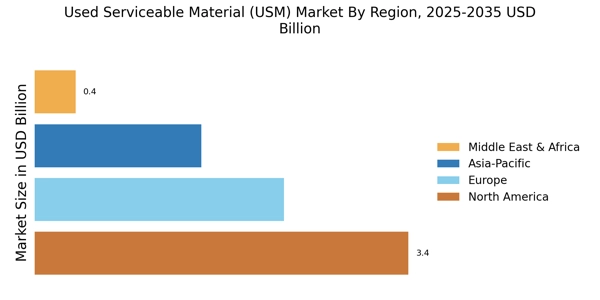
Used Serviceable Material Market
Research for the report “Used Serviceable Material Market” was carried out using a mix of primary and secondary research. Primary research involved interviews with Used Serviceable Material (USM) suppliers, Original Equipment Manufacturers (OEMs), Maintenance Repair and Overhaul (MRO) operators, associations, research organizations, and consultants. Secondary research included an exhaustive search of relevant publications like company annual reports, government documents, brochures, harvester transactions, and related articles.
The research gathered data from both the demand and supply side for the Used Serviceable Material market. The demand side data combines the production and consumption of Used Serviceable materials, as well as their share of the overall market. The supply side data consists of data on revenue generated from USM exports and imports. Factor analysis was employed to identify the most important factors affecting the growth of USM and the market in the coming years. Data from the demand side and supply side were triangulated to arrive at reasonable and accurate market volume estimates.
Time-series analysis was used to analyze historical Used Serviceable Material market data and identify trends. The analysis included both demand and supply-side analysis. An analysis was done to acquire the gap between current market trends and how the market is being perceived towards future periods.
The statistical information was collected from different reputable sources such as government websites, agencies, official associations, and organizations. The data gathering followed a standard protocol, which combines primary and secondary research, to ensure the accuracy and validity of the figures.
Primary Research:
The primary research involved interviews with Used Serviceable Material providers, Original Equipment Manufacturers, Maintenance Repair and Overhaul operators, associations, research organizations, and consultants. The primary research aimed to understand the current USM industry trends, past movements in the USM market, and the size and shape of the USM market.
Primary research is conducted using a variety of methods such as telephone interviews, email-based surveys, face-to-face interviews, and online surveys. This helps to collect data from numerous individuals to gain a better understanding of the market behaviour and dynamics. Responses to the questionnaire were analyzed to understand the behaviour and trend of the Used Serviceable Materials market.
Secondary Research:
Secondary research was employed to gather the data that was used to validate the primary research results. Source materials for the secondary research included company annual reports, market reports, government documents, industry reports, company documents, and financial reports. This data research was done using both online and offline sources.
Bottom-up Approach:
A bottom-up approach was used in this research. This approach starts with collecting data and information about the individual companies and then extrapolating this data to the overall USM market. An observation of the individual segments across geographies makes it possible to visualize the competitive advantages and weaknesses of the overall market.
Top-down Approach:
The top-down approach was used to ensure the accuracy of the data collected in the bottom-up approach. This approach starts with gathering and validating the data by analyzing the overall market and extrapolating this data to individual segments. This makes it possible to validate the market forecasts to ensure the accuracy of the market analysis.
Factor Analysis:
Factor analysis was used to identify the most important factors affecting the growth of the USM market from both the demand and supply sides. Factors that are related to the industry players such as OEMs, MRO operators, and suppliers, as well as factors that affect the use of the USM, were identified. The most important factors that are driving and restraining the growth of the market were identified.
Time-Series Analysis:
Time-series analysis was used to analyze the historical Used Serviceable Materials market data and identify trends. This analysis includes both demand-side and supply-side analysis. Historical market data helps to understand how the USM market has been performing in the past and assess future prospects.
Data Triangulation:
Data from the demand side and supply side were triangulated to arrive at reasonable and accurate market volume estimates. This makes it possible to eliminate outliers from the market forecasts that could otherwise distort the market estimates. The research also includes an in-depth analysis of the different factors and dynamics that can affect the USM market.
Conclusion:
This research involved a combination of primary and secondary research, as well as bottom-up and top-down approaches, factor analysis, time-series analysis and demand side and supply side data triangulation, to arrive at an in-depth market analysis. The data gathered was validated to ensure accuracy, and the results were triangulated to ensure the validity of the market estimates.