Request Free Sample ×

Kindly complete the form below to receive a free sample of this Report

* Please use a valid business email

Leading companies partner with us for data-driven Insights

clients tt-cursor
Hero Background

Heat Pump Market

ID: MRFR/EnP/5547-HCR
200 Pages
Chitranshi Jaiswal
Last Updated: May 27, 2026
Informe de investigación de mercado de bombas de calor por tipo (bombas de calor aerotérmicas, geotérmicas, hídricas, híbridas), aplicación (residencial, comercial, industrial), tipo de instalación (nueva instalación, modernización), uso final (calefacción, refrigeración, suministro de agua caliente) y región (Norteamérica, Europa, Sudamérica, Asia Pacífico, Oriente Medio y África): pronóstico hasta 2035
Download PDF ×

We do not share your information with anyone. However, we may send you emails based on your report interest from time to time. You may contact us at any time to opt-out.

⚠ STRAIT OF HORMUZ CRISIS ALERT
13 Million Barrels/Day at Risk | 31% of Global Seaborne Oil Flow | Qatar LNG Halted — Oil, Natural Gas, Power Generation & Energy Security Markets Disrupted, Insurance Withdrawn, $80–100+ Price Scenarios Active | Get Crisis-Adjusted Production, Pricing & Security Analysis

Heat Pump Market Resumen

Según el análisis de Market Research Future, el tamaño del mercado de bombas de calor se estimó en 101,38 mil millones de dólares en 2024. Se proyecta que la industria de bombas de calor crecerá de 110,23 mil millones de dólares en 2025 a 254,62 mil millones de dólares en 2035, exhibiendo una tasa de crecimiento anual compuesta (CAGR) del 8,73% durante el período previsto 2025-2035.

Tendencias clave del mercado y aspectos destacados

El mercado de bombas de calor está experimentando un sólido crecimiento impulsado por los avances tecnológicos y la creciente demanda de soluciones energéticamente eficientes.

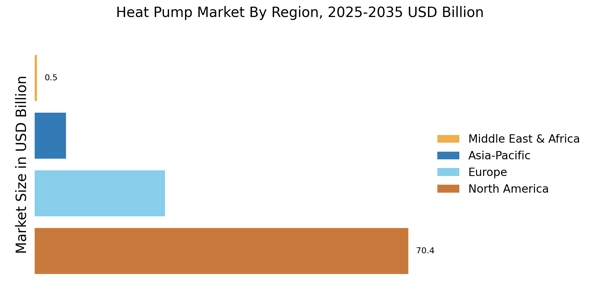
  • La región de América del Norte sigue siendo el mercado más grande para bombas de calor, impulsada por un fuerte enfoque en la eficiencia energética.
  • La región de Asia y el Pacífico está emergiendo como el mercado de más rápido crecimiento, impulsado por la rápida urbanización y el desarrollo de infraestructura.
  • Las bombas de calor de fuente de aire dominan el mercado, mientras que las bombas de calor de fuente de tierra están experimentando el crecimiento más rápido debido a su eficiencia.
  • El apoyo regulatorio a la eficiencia energética y el aumento de los costos de la energía son factores clave que impulsan la expansión del mercado.

Tamaño del mercado y previsión

Tamaño del mercado en 2024 101.38 (USD Billion)
Tamaño del mercado en 2035 254.62 (USD Billion)
CAGR (2025 - 2035) 8.73%
Mayor cuota de mercado regional en 2024 América del norte

Principales jugadores

Daikin(JP), Mitsubishi Electric (JP), Carrier (EE.UU.), Trane Technologies (IE), Bosch (DE), LG Electronics (KR), Fujitsu (JP), Hitachi (JP), Rheem (EE.UU.)

Our Impact
Enabled $4.3B Revenue Impact for Fortune 500 and Leading Multinationals
Partnering with 2000+ Global Organizations Each Year
30K+ Citations by Top-Tier Firms in the Industry

Las empresas clave en el mercado Heat Pump Market incluyen

Alcance del informe

MARKET SIZE 2024 101.38(USD Billion)
MARKET SIZE 2025 110.23(USD Billion)
MARKET SIZE 2035 254.62(USD Billion)
COMPOUND ANNUAL GROWTH RATE (CAGR) 8.73% (2025 - 2035)
REPORT COVERAGE Revenue Forecast, Competitive Landscape, Growth Factors, and Trends
BASE YEAR 2024
Market Forecast Period 2025 - 2035
Historical Data 2019 - 2024
Market Forecast Units USD Billion
Key Companies Profiled Daikin (JP), Mitsubishi Electric (JP), Carrier (US), Trane Technologies (IE), Bosch (DE), LG Electronics (KR), Fujitsu (JP), Hitachi (JP), Rheem (US)
Segments Covered Type, Application, Installation Type, End Use, Regional
Key Market Opportunities Growing demand for energy-efficient heating solutions drives innovation in the Heat Pump Market.
Key Market Dynamics Rising demand for energy-efficient heating solutions drives innovation and competition in the heat pump market.
Countries Covered North America, Europe, APAC, South America, MEA

FAQs

What is the current valuation of the Heat Pump Market as of 2024?

The Heat Pump Market was valued at 101.38 USD Billion in 2024.

What is the projected market valuation for the Heat Pump Market in 2035?

The market is projected to reach 254.62 USD Billion by 2035.

What is the expected CAGR for the Heat Pump Market during the forecast period 2025 - 2035?

The expected CAGR for the Heat Pump Market during 2025 - 2035 is 8.73%.

Which type of heat pump segment had the highest valuation in 2024?

In 2024, the Air Source Heat Pumps segment had the highest valuation at 40.55 USD Billion.

What are the projected valuations for Ground Source Heat Pumps by 2035?

Ground Source Heat Pumps are projected to reach between 30.0 and 70.0 USD Billion by 2035.

How does the residential application segment perform in the Heat Pump Market?

The Residential application segment was valued at 40.55 USD Billion in 2024 and is expected to grow significantly.

What is the market size for new installations of heat pumps in 2024?

The market size for new installations of heat pumps was 60.0 USD Billion in 2024.

Which key players are leading the Heat Pump Market?

Key players in the Heat Pump Market include Daikin, Mitsubishi Electric, Carrier, and Trane Technologies.

What is the valuation range for the retrofit installation type by 2035?

The retrofit installation type is projected to reach between 41.38 and 104.62 USD Billion by 2035.

What end-use segment is expected to see substantial growth in the Heat Pump Market?

The Heating end-use segment was valued at 40.55 USD Billion in 2024 and is likely to see substantial growth.

Autor
Author
Author Profile
Chitranshi Jaiswal LinkedIn
Team Lead - Research
Chitranshi is a Team Leader in the Chemicals & Materials (CnM) and Energy & Power (EnP) domains, with 6+ years of experience in market research. She leads and mentors teams to deliver cross-domain projects that equip clients with actionable insights and growth strategies. She is skilled in market estimation, forecasting, competitive benchmarking, and both primary & secondary research, enabling her to turn complex data into decision-ready insights. An engineer and MBA professional, she combines technical expertise with strategic acumen to solve dynamic market challenges. Chitranshi has successfully managed projects that support market entry, investment planning, and competitive positioning, while building strong client relationships. Certified in Advanced Excel & Power BI she leverages data-driven approaches to ensure accuracy, clarity, and impactful outcomes.
Deja un comentario

Research Approach


Secondary Research

The secondary research process involved comprehensive analysis of regulatory databases, energy efficiency standards, peer-reviewed engineering journals, and authoritative energy organizations. Key sources included the US Department of Energy (DOE), Environmental Protection Agency (EPA) ENERGY STAR program, International Energy Agency (IEA) Heat Pump Centre, European Heat Pump Association (EHPA), Air-Conditioning, Heating, and Refrigeration Institute (AHRI), European Committee of Air Handling and Refrigeration Equipment Manufacturers (Eurovent), ASHRAE (American Society of Heating, Refrigerating and Air-Conditioning Engineers), National Renewable Energy Laboratory (NREL), Lawrence Berkeley National Laboratory (LBNL) Building Technologies & Urban Systems Division, Oak Ridge National Laboratory (ORNL) Building Technologies Research & Integration Center, US Energy Information Administration (EIA), Eurostat Energy Database, International Renewable Energy Agency (IRENA), and national energy ministry reports from key markets including Germany's Federal Ministry for Economic Affairs and Climate Action (BMWK), Japan's Agency for Natural Resources and Energy (ANRE), and China's National Development and Reform Commission (NDRC). These sources were used to collect installation statistics, energy efficiency certification data, carbon emission reduction studies, regulatory incentive programs, and market penetration analysis for air source heat pumps (ASHP), ground source heat pumps (GSHP), water source heat pumps (WSHP), and hybrid heating technologies.


Primary Research

To gather both qualitative and quantitative information, the primary research process involved interviewing players from both the supply and demand sides. Participants from the supply side included chief executive officers, vice presidents of product development, sustainability department leaders, and commercial directors from original equipment manufacturers (OEMs) of heat pumps, compressors, and refrigerants. Commercial and industrial end-users' sustainability officers, building facility managers, mechanical engineers, HVAC contractors, procurement leads from construction and real estate development businesses, and energy auditors made up the demand-side sources. We acquired information on specification trends, distribution channel dynamics, and the effectiveness of the utility rebate program through primary research. The data also validated our product development roadmaps for low-GWP refrigerant transitions and market segmentation across installation types (new build vs. retrofit).

Primary Respondent Breakdown:

By Designation: C-level Primaries (40%), Director Level (32%), Others (28%)

By Region: North America (32%), Europe (30%), Asia-Pacific (28%), Rest of World (10%)


Market Size Estimation

Global market valuation was derived through revenue mapping and installation volume analysis. The methodology included:

Identification of 50+ key manufacturers across North America, Europe, Asia-Pacific, and Latin America spanning residential, commercial, and industrial heat pump systems

Product mapping across air source (ducted/ductless), ground source (vertical/horizontal loop), water source, and hybrid heat pump categories with segmentation by refrigerant type (R-410A, R-32, CO2, hydrocarbons)

Analysis of reported and modeled annual revenues specific to heat pump portfolios, excluding non-HVAC business units

Coverage of manufacturers representing 75-80% of global market share in 2024

Extrapolation using bottom-up (installation volume × ASP by country/region, adjusted for system size kW/ton) and top-down (manufacturer revenue validation against national import/export data) approaches to derive segment-specific valuations for heating, cooling, and hot water supply applications

Descargar muestra gratis

Complete el formulario a continuación para recibir una muestra gratuita de este informe