×
Request Free Sample ×

Kindly complete the form below to receive a free sample of this Report

* Please use a valid business email

Leading companies partner with us for data-driven Insights

clients tt-cursor
Hero Background

Plastic Recycling Equipment Market

ID: MRFR/PCM/38176-HCR
111 Pages
Snehal Singh
October 2025

Plastic Recycling Equipment Market Research Report By Equipment Type (Shredders, Granulators, Washers, Pelletizers), By Technology (Mechanical Recycling, Chemical Recycling, Energy Recovery), By Material Type (Polyethylene, Polypropylene, Polyvinyl Chloride, Polyethylene Terephthalate), By End Use Industry (Packaging, Automotive, Construction, Textiles) and By Regional (North America, Europe, South America, Asia Pacific, Middle East and Africa) - Forecast to 2035.

Compartir
Download PDF ×

We do not share your information with anyone. However, we may send you emails based on your report interest from time to time. You may contact us at any time to opt-out.

Plastic Recycling Equipment Market Infographic
Purchase Options

Plastic Recycling Equipment Market Resumen

As per MRFR analysis, the Plastic Recycling Equipment Market Size was estimated at 8.281 USD Billion in 2024. The Plastic Recycling Equipment industry is projected to grow from 8.762 USD Billion in 2025 to 15.42 USD Billion by 2035, exhibiting a compound annual growth rate (CAGR) of 5.81 during the forecast period 2025 - 2035.

Tendencias clave del mercado y aspectos destacados

The Plastic Recycling Equipment Market is poised for substantial growth driven by technological advancements and increasing environmental awareness.

  • América del Norte sigue siendo el mercado más grande para equipos de reciclaje de plásticos, impulsado por regulaciones estrictas y una infraestructura de reciclaje robusta.
  • Asia-Pacífico está emergiendo como la región de más rápido crecimiento, alimentada por la creciente demanda de prácticas sostenibles y la inversión en tecnologías de reciclaje.
  • Las trituradoras dominan el mercado como el segmento más grande, mientras que los granuladores están experimentando un rápido crecimiento debido a su eficiencia en el procesamiento de materiales.
  • Los principales impulsores del mercado incluyen una creciente conciencia ambiental y regulaciones gubernamentales que promueven iniciativas de reciclaje.

Tamaño del mercado y previsión

2024 Market Size 8.281 (USD Billion)
2035 Market Size 15.42 (mil millones de USD)
CAGR (2025 - 2035) 5.81%

Principales jugadores

Vecoplan AG (DE), Erema Engineering Recycling Maschinen und Anlagen Ges.m.b.H. (AT), BHS-Sonthofen GmbH (DE), NGR (Next Generation Recyclingmaschinen GmbH) (AT), Plastics Recycling Technology (US), Sorema S.r.l. (IT), KraussMaffei Group GmbH (DE), Herbold Meckesheim GmbH (DE), Coperion GmbH (DE)

Plastic Recycling Equipment Market Tendencias

The Plastic Recycling Equipment Market is currently experiencing a transformative phase, driven by increasing environmental awareness and stringent regulations aimed at reducing plastic waste. As societies globally grapple with the consequences of plastic pollution, there is a growing emphasis on sustainable practices. This shift is prompting manufacturers to innovate and enhance their recycling technologies, thereby improving efficiency and effectiveness in processing various types of plastics. Furthermore, advancements in automation and artificial intelligence are likely to play a pivotal role in optimizing operations within this sector, potentially leading to reduced operational costs and increased throughput. In addition to technological advancements, the market is also witnessing a surge in investments from both public and private sectors. Governments are implementing policies that encourage recycling initiatives, while private enterprises are recognizing the economic potential of recycled materials. This dual approach appears to be fostering a more robust ecosystem for plastic recycling, where collaboration between stakeholders is essential. As the Plastic Recycling Equipment Market evolves, it is poised to contribute significantly to the circular economy, promoting resource efficiency and sustainability in the long term.

Technological Advancements

The Plastic Recycling Equipment Market is seeing rapid technological innovations that enhance processing capabilities. New machinery is being developed to handle diverse plastic types more efficiently, which may lead to higher recovery rates and better quality of recycled materials.

Regulatory Support

Governments worldwide are increasingly enacting regulations that promote recycling and reduce plastic waste. This regulatory environment is likely to stimulate demand for advanced recycling equipment, as companies seek to comply with new standards and improve their sustainability practices.

Investment Growth

There is a noticeable increase in investments directed towards the Plastic Recycling Equipment Market. Both public and private sectors are recognizing the economic benefits of recycling, which could lead to enhanced research and development efforts, further driving market growth.

Plastic Recycling Equipment Market Treiber

Innovaciones Tecnológicas

Technological advancements are significantly influencing the Plastic Recycling Equipment Market. Innovations in recycling technologies, such as enhanced sorting systems and improved processing methods, are making recycling more efficient and cost-effective. For example, the introduction of AI-driven sorting technologies has the potential to increase the purity of recycled materials, thereby enhancing their market value. Furthermore, advancements in machinery design are enabling higher throughput rates, which is essential for meeting the growing demand for recycled plastics. As these technologies continue to evolve, they are expected to attract investments and drive growth within the market, as companies seek to upgrade their equipment to remain competitive.

Aumento de la Conciencia Ambiental

The rising awareness regarding environmental issues is a primary driver for the Plastic Recycling Equipment Market. As consumers and businesses alike become more conscious of their ecological footprint, the demand for effective recycling solutions intensifies. This trend is reflected in the increasing number of initiatives aimed at reducing plastic waste, which in turn propels the need for advanced recycling equipment. According to recent data, the plastic recycling rate has seen a gradual increase, suggesting a shift in public perception towards sustainability. Consequently, manufacturers of plastic recycling equipment are likely to benefit from this heightened focus on environmental responsibility, as they innovate and adapt their technologies to meet the evolving needs of the market.

Regulaciones y Políticas Gubernamentales

Government regulations play a crucial role in shaping the Plastic Recycling Equipment Market. Many countries are implementing stringent policies aimed at reducing plastic waste and promoting recycling. These regulations often mandate higher recycling rates and the use of recycled materials in production processes. For instance, some regions have set ambitious targets for plastic waste reduction, which necessitates the adoption of advanced recycling technologies. This regulatory landscape not only encourages investment in recycling infrastructure but also drives innovation in equipment design and efficiency. As a result, companies operating in the plastic recycling equipment sector are likely to experience increased demand for their products, aligning with governmental objectives for sustainability.

Inversión en Infraestructura de Reciclaje

Investment in recycling infrastructure is a pivotal driver for the Plastic Recycling Equipment Market. As awareness of plastic pollution grows, both public and private sectors are channeling funds into developing robust recycling systems. This influx of capital is aimed at enhancing the efficiency and capacity of recycling facilities, which directly impacts the demand for advanced recycling equipment. Recent reports suggest that investments in recycling technologies are expected to rise, driven by the need for sustainable waste management solutions. Consequently, this trend not only supports the growth of the plastic recycling equipment market but also fosters innovation as companies strive to develop cutting-edge solutions to meet the increasing demands of the industry.

Aumento de la demanda de plásticos reciclados

The increasing demand for recycled plastics is a significant driver for the Plastic Recycling Equipment Market. As industries seek to incorporate sustainable materials into their production processes, the need for high-quality recycled plastics is on the rise. This trend is particularly evident in sectors such as packaging, automotive, and construction, where companies are actively pursuing circular economy practices. Data indicates that the market for recycled plastics is projected to grow substantially, which in turn fuels the demand for efficient recycling equipment. Manufacturers of plastic recycling machinery are thus positioned to capitalize on this trend, as they provide the necessary tools to meet the burgeoning demand for recycled materials.

Perspectivas del segmento de mercado

By Type: Shredders (Largest) vs. Granulators (Fastest-Growing)

In the Plastic Recycling Equipment Market, shredders represent the largest segment, capturing significant market share due to their essential function in reducing waste material size for further processing. Granulators, while smaller in market share, are experiencing rapid growth as they serve a critical role in creating uniform plastic flakes necessary for recycling operations. The adaptability of these technologies to various types of plastic is enhancing their acceptance in the market.

Shredders (Dominant) vs. Pelletizers (Emerging)

Shredders are currently the dominant force in the plastic recycling equipment market, characterized by their robust design and adaptability for handling diverse plastic waste. They efficiently break down large plastic items into manageable sizes, which makes them invaluable in recycling operations. On the other hand, pelletizers are an emerging technology, increasingly recognized for their ability to transform recycled plastic into pellets that are suitable for manufacturing new products. With advancements in pelletizing technology, these machines are gaining traction, especially in processes that require high-quality end products. As the demand for recycled plastics grows, the competition between these two segments continues to intensify.

By Technology: Mechanical Recycling (Largest) vs. Chemical Recycling (Fastest-Growing)

The 'Technology' segment in the Plastic Recycling Equipment Market illustrates a diverse landscape, with Mechanical Recycling maintaining the largest market share. This traditional method involves physically breaking down plastics for reuse, appealing to many industries due to its simplicity and effectiveness. In contrast, Chemical Recycling is gaining momentum, offering innovative solutions that break plastics down to their molecular level, thereby allowing for the restoration of original properties. The distribution between these two methods reflects a growing variety of choices for manufacturers navigating the recycling landscape.

Technology: Mechanical Recycling (Dominant) vs. Chemical Recycling (Emerging)

Mechanical Recycling, as the dominant player, continues to be favored for its cost-effectiveness and well-established processes. This method typically involves shredding, washing, and re-molding plastics into new products, making it a reliable option for many businesses. On the other hand, Chemical Recycling is poised as an emerging technology, showcasing significant potential for enhanced efficiency and sustainability. It utilizes advanced chemical processes to decompose plastics, making it possible to recycle otherwise non-recyclable plastics. The adoption of Chemical Recycling is driven by regulatory pressures and the increasing demand for high-quality recycled materials. As such, both methods play vital roles in shaping a more sustainable plastic recycling ecosystem.

By Material Type: Polyethylene (Largest) vs. Polyvinyl Chloride (Fastest-Growing)

The Plastic Recycling Equipment Market is significantly influenced by the material types being recycled. Among these, polyethylene leads the market, owing to its extensive usage in packaging applications. Polypropylene and polyvinyl chloride follow, each having a distinct market share driven by their diverse applications, from construction to consumer products. Polyethylene terephthalate, while substantial, ranks lower in comparison given the specific industrial needs and recycling technologies available for these materials.

Polietileno (Dominante) vs. Polipropileno (Emergente)

Polyethylene is the dominant player in the plastic recycling equipment market, primarily due to its widespread consumption in various industries, particularly in packaging and containers. Its recyclability and the efficiency of recycling processes contribute to its strong market presence. On the other hand, polypropylene, while already significant, is emerging as a rapidly growing segment. Increasing awareness around sustainability and the growing demand for sustainable packaging solutions foster growth in polypropylene recycling. Its diverse applications and adaptability in the market are central to its rising profile. As the industry prioritizes eco-friendly materials, both segments are expected to evolve, showing increased investment in innovative recycling technologies.

Por Industria de Uso Final: Empaque (Más Grande) vs. Automotriz (De Más Rápido Crecimiento)

The Plastic Recycling Equipment Market is significantly influenced by its end use industries, with Packaging leading the way in market share. This dominance can be attributed to the increasing demand for sustainable packaging solutions driven by consumer preferences and regulatory pressures. The automotive segment, while smaller in comparison, is experiencing rapid growth as manufacturers seek to incorporate recycled plastics into their production processes, promoting eco-friendly vehicles.

Embalaje (Dominante) vs. Automotriz (Emergente)

Packaging remains the dominant force within the Plastic Recycling Equipment Market, characterized by substantial investments in technology aimed at enhancing the recycling process. This segment focuses on reducing waste through innovative packaging designs and the integration of recycled materials. In contrast, the automotive sector is emerging as a significant player, driven by stringent environmental regulations and the automotive industry's shift toward sustainability. This segment is witnessing increased adoption of recycled plastics in parts and components, facilitating a circular economy within vehicle manufacturing.

Obtenga información más detallada sobre Plastic Recycling Equipment Market

Perspectivas regionales

North America : Innovation and Sustainability Leader

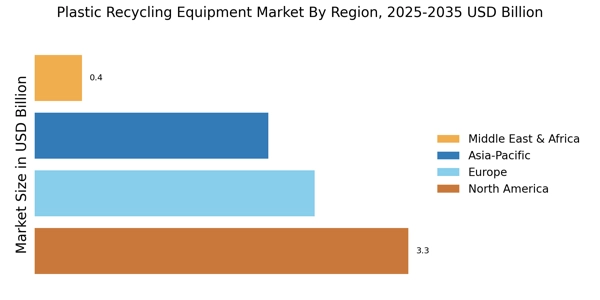
North America is witnessing significant growth in the plastic recycling equipment market, driven by stringent regulations and increasing consumer awareness about sustainability. The region holds approximately 40% of the global market share, making it the largest market. The demand for advanced recycling technologies is fueled by government initiatives aimed at reducing plastic waste and promoting circular economy practices. The United States and Canada are the leading countries in this region, with a robust presence of key players such as Plastics Recycling Technology and Vecoplan AG. The competitive landscape is characterized by continuous innovation and partnerships among manufacturers to enhance recycling efficiency. The focus on eco-friendly solutions is reshaping the market dynamics, positioning North America as a leader in recycling technology.

Europe : Regulatory-Driven Market Growth

Europe is emerging as a pivotal player in the plastic recycling equipment market, driven by comprehensive regulations and ambitious recycling targets. The region accounts for approximately 30% of the global market share, making it the second-largest market. The European Union's Circular Economy Action Plan and various national policies are catalyzing investments in recycling technologies, enhancing the demand for innovative equipment. Germany, Austria, and Italy are at the forefront of this market, with key players like Erema Engineering and KraussMaffei Group leading the charge. The competitive landscape is marked by a strong emphasis on sustainability and technological advancements. European manufacturers are increasingly focusing on developing efficient recycling solutions to meet regulatory requirements and consumer expectations, ensuring a robust market presence.

Asia-Pacific : Emerging Market Potential

Asia-Pacific is rapidly becoming a significant player in the plastic recycling equipment market, driven by increasing urbanization and rising plastic consumption. The region holds approximately 25% of the global market share, with countries like China and India leading the charge. Government initiatives aimed at reducing plastic waste and promoting recycling are further propelling market growth, creating a favorable environment for investment in recycling technologies. China is the largest market in this region, followed by India and Japan, with a growing number of local and international players entering the market. The competitive landscape is evolving, with companies focusing on innovative solutions to enhance recycling efficiency. The presence of key players such as NGR and BHS-Sonthofen is indicative of the region's commitment to advancing recycling technologies and addressing environmental challenges.

Middle East and Africa : Resource-Rich Recycling Opportunities

The Middle East and Africa region is gradually recognizing the importance of plastic recycling, driven by increasing environmental awareness and resource scarcity. This region holds approximately 5% of the global market share, with a growing focus on sustainable practices. Countries like South Africa and the UAE are leading efforts to enhance recycling capabilities, supported by government initiatives aimed at reducing plastic waste. South Africa is emerging as a key player in the market, with local companies investing in advanced recycling technologies. The competitive landscape is characterized by a mix of local and international players, with a focus on developing efficient recycling solutions. The presence of companies like Sorema S.r.l. highlights the region's potential for growth in the plastic recycling equipment market, as stakeholders seek to address environmental challenges and promote sustainability.

Plastic Recycling Equipment Market Regional Image

Jugadores clave y perspectivas competitivas

The Plastic Recycling Equipment Market is currently characterized by a dynamic competitive landscape, driven by increasing environmental regulations and a growing emphasis on sustainability. Key players are actively engaging in innovation and strategic partnerships to enhance their market positioning. For instance, Vecoplan AG (DE) has focused on developing advanced shredding technologies that improve efficiency in plastic waste processing. Similarly, Erema Engineering Recycling Maschinen und Anlagen Ges.m.b.H. (AT) has been at the forefront of integrating digital solutions into their recycling systems, thereby enhancing operational efficiency and product quality. These strategies collectively contribute to a competitive environment that prioritizes technological advancement and sustainability.

In terms of business tactics, companies are increasingly localizing manufacturing to reduce lead times and optimize supply chains. The market structure appears moderately fragmented, with several players vying for market share while also collaborating on joint ventures and partnerships. This collective influence of key players fosters a competitive atmosphere where innovation and operational excellence are paramount.

In August 2025, BHS-Sonthofen GmbH (DE) announced a strategic partnership with a leading waste management firm to enhance its recycling capabilities. This collaboration is expected to leverage BHS-Sonthofen's advanced technology in mechanical recycling, thereby expanding its market reach and reinforcing its commitment to sustainability. Such partnerships are indicative of a broader trend where companies seek to combine strengths to address the complexities of plastic waste management.

In September 2025, NGR (Next Generation Recyclingmaschinen GmbH) (AT) unveiled a new line of recycling machines designed specifically for high-quality PET recycling. This launch not only underscores NGR's commitment to innovation but also positions the company to capture a larger share of the growing PET recycling market. The introduction of these machines is likely to enhance operational efficiencies for recyclers, thereby solidifying NGR's competitive edge.

In October 2025, Plastics Recycling Technology (US) expanded its operations by acquiring a local recycling facility, which is anticipated to bolster its production capacity and streamline its supply chain. This strategic move reflects a growing trend among companies to vertically integrate their operations, thereby enhancing control over the recycling process and improving overall efficiency.

As of October 2025, the competitive trends in the Plastic Recycling Equipment Market are increasingly defined by digitalization, sustainability, and the integration of artificial intelligence. Strategic alliances are becoming more prevalent, as companies recognize the need to collaborate to tackle the challenges of plastic waste. Looking ahead, competitive differentiation is likely to evolve from traditional price-based competition to a focus on innovation, technological advancements, and supply chain reliability, thereby reshaping the market landscape.

Las empresas clave en el mercado Plastic Recycling Equipment Market incluyen

Desarrollos de la industria

The Plastic Recycling Equipment Market is witnessing significant developments, particularly through advancements in technology and increasing adoption of sustainable practices among industries. Companies like TOMRA and Erema are leading innovations in sorting and processing technology, which enhance recycling efficiency. In recent months, there has been a heightened focus on collaborative efforts to improve recycling infrastructure, with companies like Waste Management and SUEZ expanding their operational capabilities. The market is also closely watching the mergers and acquisitions landscape; for instance, Schneider Electric's acquisition activities aim to strengthen their foothold in sustainable technologies related to recycling.

Genan's growth has been driven by an increasing demand for tire recycling solutions, with strong financial backing enhancing their market position.

Additionally, a surge in valuation for companies like Krones and Machinex reflects evolving market dynamics, emphasizing competitive strategies that integrate advanced recycling technologies. Furthermore, the rising regulatory pressure on plastic waste management is prompting significant investments in recycling equipment, influencing market growth and driving companies to enhance their technological capabilities rapidly. This evolving landscape indicates a robust future for markets focused on sustainable solutions within the plastic recycling industry.

Perspectivas futuras

Plastic Recycling Equipment Market Perspectivas futuras

The Plastic Recycling Equipment Market is projected to grow at a 5.81% CAGR from 2024 to 2035, driven by increasing environmental regulations, technological advancements, and rising consumer awareness.

Nuevas oportunidades se encuentran en:

  • Integration of AI-driven sorting technologies for enhanced efficiency.
  • Development of modular recycling systems for small-scale operations.
  • Expansion into emerging markets with tailored recycling solutions.

Para 2035, se espera que el mercado sea robusto, impulsado por la innovación y las iniciativas de sostenibilidad.

Segmentación de mercado

Perspectiva del Tipo de Mercado de Equipos de Reciclaje de Plástico

  • Shredders
  • Granulators
  • Washers
  • Pelletizers

Perspectivas tecnológicas del mercado de equipos de reciclaje de plástico

  • Reciclaje Mecánico
  • Reciclaje Químico
  • Recuperación de Energía

Perspectiva del tipo de material del mercado de equipos de reciclaje de plástico

  • Polyethylene
  • Polypropylene
  • Polyvinyl Chloride
  • Polyethylene Terephthalate

Perspectiva de la Industria de Uso Final del Mercado de Equipos de Reciclaje de Plástico

  • Packaging
  • Automotive
  • Construction
  • Textiles

Alcance del informe

MARKET SIZE 20248.281(USD Billion)
MARKET SIZE 20258.762(USD Billion)
MARKET SIZE 203515.42(USD Billion)
COMPOUND ANNUAL GROWTH RATE (CAGR)5.81% (2024 - 2035)
REPORT COVERAGERevenue Forecast, Competitive Landscape, Growth Factors, and Trends
BASE YEAR2024
Market Forecast Period2025 - 2035
Historical Data2019 - 2024
Market Forecast UnitsUSD Billion
Key Companies ProfiledMarket analysis in progress
Segments CoveredMarket segmentation analysis in progress
Key Market OpportunitiesAdvancements in automation and AI enhance efficiency in the Plastic Recycling Equipment Market.
Key Market DynamicsRising regulatory pressures and technological advancements drive innovation in the Plastic Recycling Equipment Market.
Countries CoveredNorth America, Europe, APAC, South America, MEA

Deja un comentario

FAQs

¿Cuál es la valoración de mercado proyectada del mercado de equipos de reciclaje de plástico para 2035?

Se proyecta que el mercado alcanzará una valoración de 15.42 mil millones de USD para 2035.

¿Cuál fue la valoración del mercado de Equipos de Reciclaje de Plástico en 2024?

La valoración total del mercado fue de 8.281 mil millones de USD en 2024.

¿Cuál es la CAGR esperada para el mercado de equipos de reciclaje de plástico durante el período de pronóstico 2025 - 2035?

Se espera que la CAGR del mercado durante este período sea del 5.81%.

¿Qué empresas se consideran actores clave en el mercado de equipos de reciclaje de plásticos?

Los actores clave incluyen Vecoplan AG, Erema Engineering, BHS-Sonthofen, NGR y otros.

¿Cuáles son los principales segmentos del mercado de equipos de reciclaje de plástico?

Los segmentos principales incluyen Tipo, Tecnología, Tipo de Material y Industria de Uso Final.

¿Cuánto se espera que crezca el segmento de Shredders de 2024 a 2035?

Se espera que el segmento de trituradoras crezca de 1.5 mil millones de USD en 2024 a 3.0 mil millones de USD para 2035.

¿Cuál es el crecimiento proyectado para el segmento de Granuladores para 2035?

Se proyecta que el segmento de Granuladores crecerá de 2.0 USD mil millones en 2024 a 4.0 USD mil millones para 2035.

Descargar muestra gratis

Complete el formulario a continuación para recibir una muestra gratuita de este informe

Compare Licence

×
Features License Type
Single User Multiuser License Enterprise User
Price $4,950 $5,950 $7,250
Maximum User Access Limit 1 User Upto 10 Users Unrestricted Access Throughout the Organization
Free Customization
Direct Access to Analyst
Deliverable Format
Platform Access
Discount on Next Purchase 10% 15% 15%
Printable Versions