Descargar muestra gratis
Complete el formulario a continuación para recibir una muestra gratuita de este informe
Informe de Investigación del Mercado de Tratamiento del Síndrome de Transfusión Gemelar por Tipo de Tratamiento (Terapia con Láser, Cirugía, Transfusión de Sangre, Medicación), por Usuario Final (Hospitales, Clínicas Especializadas, Centros de Diagnóstico), por Método de Diagnóstico (Ultrasonido, Análisis de Sangre, Amniocentesis), por Etapa de Enfermedad (Etapa Temprana, Etapa Moderada, Etapa Severa) y por Región (América del Norte, Europa, América del Sur, Asia-Pacífico, Medio Oriente y África) - Pronóstico hasta 2035
| CAGR (2025 - 2035) | 6.18% |
The Twin-Twin Transfusion Syndrome Treatment Market is currently experiencing a notable evolution, driven by advancements in medical technology and a growing understanding of the condition. This syndrome, which affects identical twins sharing a placenta, necessitates timely intervention to prevent severe complications. As healthcare providers become more aware of the implications of this condition, there is an increasing emphasis on early diagnosis and effective treatment options. Innovative techniques, such as laser therapy and amnioreduction, are gaining traction, suggesting a shift towards more targeted and less invasive approaches. Furthermore, the integration of telemedicineinto prenatal care appears to enhance access to specialists, potentially improving outcomes for affected families. In addition to technological advancements, the Twin-Twin Transfusion Syndrome Treatment Market is influenced by ongoing research and collaboration among medical professionals. This collaborative environment fosters the development of new treatment protocols and guidelines, which may lead to improved patient care. The rising prevalence of multiple pregnancies, coupled with heightened awareness among expectant parents, indicates a growing demand for specialized care. As the market continues to evolve, stakeholders must remain vigilant in adapting to emerging trends and ensuring that treatment options are both effective and accessible to those in need.
Recent innovations in medical technology are reshaping the Twin-Twin Transfusion Syndrome Treatment Market. Techniques such as laser photocoagulation and minimally invasive procedures are becoming more prevalent, offering safer alternatives for managing this complex condition. These advancements not only enhance treatment efficacy but also reduce recovery times, which is crucial for both the twins and the mother.
There is a growing emphasis on awareness and education regarding Twin-Twin Transfusion Syndrome among healthcare providers and expectant parents. This trend is likely to lead to earlier diagnosis and intervention, which can significantly improve outcomes. Educational initiatives and support networks are emerging, helping families navigate the complexities of this syndrome.
The Twin-Twin Transfusion Syndrome Treatment Market is witnessing a surge in collaborative research efforts among medical institutions. These initiatives aim to develop new treatment protocols and improve existing ones. By pooling resources and knowledge, researchers are likely to enhance the understanding of this condition, ultimately leading to better care for affected families.
Los avances tecnológicos en tratamientos e intervenciones médicas están influyendo significativamente en el mercado de tratamiento del síndrome de transfusión gemelar. Innovaciones como las técnicas de fotocoagulación láser y los procedimientos quirúrgicos mínimamente invasivos han mejorado los resultados del tratamiento para el TTTS. Estos avances no solo aumentan la eficacia de las intervenciones, sino que también reducen los riesgos asociados con los métodos quirúrgicos tradicionales. La introducción de tecnologías de imagen avanzadas, como el ultrasonido 3D, permite un mejor diagnóstico y monitoreo del TTTS, facilitando intervenciones oportunas. A medida que estas tecnologías continúan evolucionando, se espera que impulsen la demanda de opciones de tratamiento especializadas dentro del mercado de tratamiento del síndrome de transfusión gemelar, mejorando en última instancia los resultados y la satisfacción del paciente.
La aparición de grupos de defensa y apoyo a pacientes está desempeñando un papel fundamental en la configuración del Mercado de Tratamiento del Síndrome de Transfusión Twin-Twin. Estas organizaciones proporcionan recursos esenciales y apoyo a las familias afectadas por el TTTS, aumentando la concienciación y promoviendo la educación sobre la condición. Al compartir experiencias personales e información, estos grupos empoderan a los pacientes y a las familias para que busquen una intervención médica oportuna. Además, los esfuerzos de defensa a menudo conducen a un aumento en la financiación para la investigación y a la mejora de las opciones de tratamiento. A medida que estos grupos continúan creciendo en influencia, es probable que impulsen la demanda de tratamientos efectivos dentro del Mercado de Tratamiento del Síndrome de Transfusión Twin-Twin, beneficiando en última instancia a los pacientes y a los proveedores de atención médica por igual.
La creciente conciencia sobre el Síndrome de Transfusión Twin-Twin entre los profesionales de la salud es un motor significativo para el Mercado de Tratamiento del Síndrome de Transfusión Twin-Twin. A medida que los programas de educación médica incorporan cada vez más información sobre el TTTS, los proveedores de atención médica están mejor equipados para reconocer y manejar esta condición. Esta mayor conciencia conduce a un diagnóstico e intervención más tempranos, que son cruciales para mejorar los resultados para los gemelos afectados. Además, las organizaciones profesionales están promoviendo activamente directrices y mejores prácticas para la gestión del TTTS, lo que mejora aún más la base de conocimientos dentro de la comunidad médica. A medida que los profesionales de la salud se informan más, se espera que la demanda de tratamientos e intervenciones especializadas en el Mercado de Tratamiento del Síndrome de Transfusión Twin-Twin aumente.
El aumento en la financiación de la investigación y las iniciativas de colaboración entre instituciones médicas es un motor crítico para el Mercado de Tratamiento del Síndrome de Transfusión Gemelar. El incremento en la inversión en investigación ha llevado a una comprensión más profunda del TTTS y al desarrollo de nuevos protocolos de tratamiento. Los esfuerzos colaborativos entre universidades, hospitales y empresas farmacéuticas están fomentando la innovación en los enfoques terapéuticos, lo que puede llevar a tratamientos más efectivos. Por ejemplo, los ensayos clínicos que exploran nuevos agentes farmacológicos y técnicas quirúrgicas están ganando impulso, lo que podría ampliar el panorama de tratamiento para el TTTS. Este entorno colaborativo probablemente mejorará el Mercado de Tratamiento del Síndrome de Transfusión Gemelar al introducir nuevas terapias y mejorar las existentes.
El aumento de la incidencia del Síndrome de Transfusión Gemelar (TTTS) es un impulsor notable para el Mercado de Tratamiento del Síndrome de Transfusión Gemelar. Estudios recientes indican que el TTTS ocurre en aproximadamente el 10-15% de los embarazos de gemelos monocoriónicos. Esta creciente prevalencia requiere opciones de tratamiento e intervenciones mejoradas, lo que impulsa el crecimiento del mercado. A medida que la conciencia sobre el TTTS se expande entre los profesionales de la salud y los padres expectantes, es probable que la demanda de soluciones de tratamiento efectivas aumente. Además, el creciente número de tecnologías de reproducción asistida, que a menudo resultan en embarazos múltiples, puede contribuir a la mayor incidencia de TTTS. En consecuencia, se prevé que el Mercado de Tratamiento del Síndrome de Transfusión Gemelar experimente un crecimiento significativo a medida que los proveedores de atención médica busquen abordar las necesidades de las familias afectadas.
En el mercado de tratamiento del Síndrome de Transfusión Twin-Twin, la distribución de la cuota de mercado indica que la Transfusión de Sangre sigue siendo el método de tratamiento más grande, favorecido por su efectividad inmediata en el abordaje de los síntomas causados por el síndrome. La Cirugía y la Medicación también tienen cuotas significativas, pero se dirigen a casos más específicos, lo que lleva a una base de aplicación más reducida. La Terapia con Láser, aunque actualmente es más pequeña en tamaño de mercado, está ganando terreno debido a los avances en tecnología y al aumento de la conciencia entre los profesionales de la salud.
Transfusión de Sangre: Terapia Dominante vs. Terapia con Láser: Emergente
La transfusión de sangre es reconocida como el tratamiento dominante en el manejo del síndrome de transfusión entre gemelos, ofreciendo un alivio rápido de las complicaciones hematológicas al abordar directamente los desequilibrios en el flujo sanguíneo entre los gemelos. Su eficacia comprobada y los protocolos establecidos contribuyen a su preferencia en entornos clínicos. Por otro lado, la terapia láser está emergiendo como una opción prometedora, particularmente atractiva debido a su naturaleza mínimamente invasiva. Este método mejora los perfiles de seguridad y disminuye los tiempos de recuperación, haciéndolo atractivo tanto para cirujanos como para pacientes. Las innovaciones continuas, junto con el creciente respaldo clínico, posicionan a la terapia láser como una alternativa convincente a medida que avanza la investigación en el campo.
En el mercado de tratamiento del síndrome de transfusión gemelar, los hospitales son el principal usuario final, capturando una parte significativa del mercado debido a sus instalaciones integrales y su capacidad para gestionar casos complejos. Las clínicas especializadas también están ganando terreno ya que proporcionan experiencia enfocada y tratamientos personalizados, capturando así una parte creciente del mercado. Los centros de diagnóstico son contribuyentes críticos para el diagnóstico y monitoreo del síndrome de transfusión gemelar, proporcionando apoyo esencial tanto para hospitales como para clínicas especializadas, aunque su participación en el mercado sigue siendo relativamente menor en comparación con los otros dos segmentos.
Hospitales (Dominante) vs. Clínicas Especializadas (Emergentes)
Los hospitales son considerados el usuario final dominante en el mercado de tratamiento del síndrome de transfusión gemelar debido a sus amplios recursos, equipos multidisciplinarios y capacidad para manejar embarazos de alto riesgo y complicaciones relacionadas de manera efectiva. Están equipados con tecnología avanzada y profesionales capacitados, lo que les permite implementar planes de tratamiento integrales. En contraste, las clínicas especializadas están emergiendo como actores significativos, enfocándose en la atención individualizada y la gestión experta de los casos de síndrome de transfusión gemelar. Su crecimiento está impulsado por la creciente demanda de servicios especializados y enfoques centrados en el paciente. Estas clínicas a menudo colaboran con hospitales para referencias, cerrando la brecha en el tratamiento y mejorando los resultados para los pacientes.
En el mercado de tratamiento del síndrome de transfusión gemelar, el segmento del método de diagnóstico está principalmente dominado por el ultrasonido, que posee la mayor cuota de mercado. Este enfoque no invasivo ofrece una visualización en tiempo real de la condición fetal, lo que lo convierte en una opción preferida para los clínicos. Las pruebas de sangre y la amniocentesis, aunque cruciales, representan una fracción menor del mercado. Las pruebas de sangre se utilizan a menudo para evaluar las condiciones biológicas de los gemelos y verificar la anemia, mientras que la amniocentesis es esencial para las pruebas genéticas, pero es menos favorecida debido a su naturaleza invasiva. Al observar las tendencias de crecimiento, las pruebas de sangre están emergiendo como el método de más rápido crecimiento en el segmento de diagnóstico. El aumento en la demanda está impulsado por los avances en biotecnología y la creciente conciencia sobre el cuidado prenatal, lo que facilita la detección efectiva del TTTS. Es probable que el ultrasonido mantenga su dominio; sin embargo, las innovaciones en las técnicas de análisis de sangre pueden remodelar el panorama y mejorar la eficiencia de los diagnósticos prenatales.
Método de Diagnóstico: Ultrasonido (Dominante) vs. Análisis de Sangre (Emergente)
El ultrasonido sigue siendo el método dominante en el mercado de tratamiento del síndrome de transfusión entre gemelos, principalmente debido a su seguridad y eficacia. Esta técnica permite a los profesionales de la salud monitorear la condición de los fetos en tiempo real, proporcionando información crítica mientras se minimizan los riesgos. Por otro lado, las pruebas de sangre están convirtiéndose rápidamente en un método emergente valorado por su capacidad para proporcionar datos biológicos perspicaces con menos estrés para la madre gestante. A medida que las tecnologías mejoran, las pruebas de sangre pueden ofrecer tiempos de diagnóstico más rápidos y mejorar los resultados para los pacientes, atrayendo así más atención como una alternativa viable y no invasiva que complementa los métodos tradicionales de ultrasonido. Mientras el ultrasonido mantiene su estatus como la herramienta de diagnóstico de primera línea, la evolución de las pruebas de sangre demuestra un potencial significativo para la innovación y la expansión del mercado.
El Síndrome de Transfusión Twin-Twin (TTTS) segmenta su mercado de tratamientos en etapas Temprana, Moderada y Severa, donde la Etapa Severa actualmente domina el mercado. Este segmento se beneficia de una mayor conciencia y necesidades de tratamiento urgentes, lo que lleva a tasas de adopción sustanciales entre los profesionales. En contraste, la Etapa Moderada, que está ganando impulso a medida que se diagnostican más casos de manera temprana, está expandiendo rápidamente su participación, capturando el interés de los proveedores de salud que buscan estrategias de intervención efectivas que atiendan a estos pacientes.
Etapa: Severa (Dominante) vs. Moderada (Emergente)
La Etapa Severa del TTTS representa un segmento crítico caracterizado por la urgente necesidad de intervención inmediata debido a la naturaleza de alto riesgo de la condición. Se distingue por un rápido deterioro de la salud fetal y una mayor necesidad de cirugías, como la terapia láser, que la posiciona como la opción de tratamiento preferida para los casos severos. Por otro lado, la Etapa Moderada, aunque emergente, se está volviendo cada vez más relevante a medida que nuevas herramientas de diagnóstico facilitan la detección del TTTS en etapas más tempranas de su desarrollo. Esta identificación temprana permite mejores estrategias de manejo, fomentando así su crecimiento. A medida que los profesionales buscan intervenciones oportunas, ambos segmentos exhiben características distintas que impulsan sus trayectorias en el mercado.
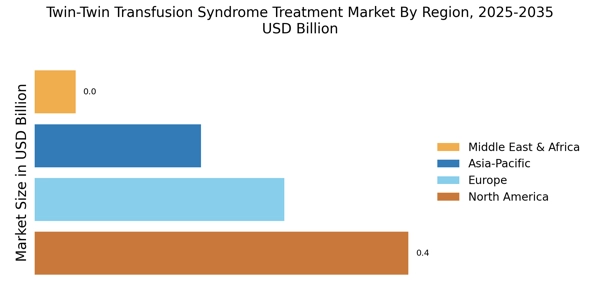
North America is the largest market for Twin-Twin Transfusion Syndrome (TTTS) treatment, holding approximately 45% of the global market share. The region benefits from advanced healthcare infrastructure, high awareness levels, and significant investments in research and development. Regulatory support from agencies like the FDA further catalyzes market growth, ensuring that innovative treatments are rapidly approved and accessible to patients. The United States and Canada are the leading countries in this market, with a strong presence of key players such as Medtronic, GE Healthcare, and Johnson & Johnson. The competitive landscape is characterized by continuous innovation and collaboration among healthcare providers and technology firms. This synergy enhances treatment options and improves patient outcomes, solidifying North America's position as a hub for TTTS treatment advancements.
Europe is the second-largest market for Twin-Twin Transfusion Syndrome (TTTS) treatment, accounting for approximately 30% of the global market share. The region is witnessing growth driven by increasing awareness of TTTS and advancements in fetal medicine. Regulatory frameworks, such as the European Medicines Agency's guidelines, are fostering innovation and ensuring that new therapies are developed and brought to market efficiently. Leading countries in Europe include Germany, the UK, and France, where healthcare systems are increasingly integrating advanced technologies for TTTS management. Key players like Siemens Healthineers and Philips Healthcare are actively involved in research and development, enhancing the competitive landscape. The collaboration between hospitals and technology firms is crucial for improving treatment protocols and patient care in this region.
Asia-Pacific is an emerging powerhouse in the Twin-Twin Transfusion Syndrome (TTTS) treatment market, holding about 20% of the global market share. The region is experiencing rapid growth due to increasing healthcare expenditure, rising awareness of fetal health issues, and advancements in medical technology. Countries like China and India are witnessing significant demand for TTTS treatments, driven by improving healthcare infrastructure and government initiatives aimed at maternal and child health. China and Japan are the leading countries in this market, with a growing number of healthcare facilities adopting advanced technologies for TTTS management. The competitive landscape is evolving, with both local and international players, including Abbott Laboratories, striving to capture market share. Collaborations between healthcare providers and technology firms are essential for enhancing treatment options and improving patient outcomes in this region.
The Middle East and Africa represent a nascent market for Twin-Twin Transfusion Syndrome (TTTS) treatment, holding approximately 5% of the global market share. The region is characterized by a growing awareness of maternal health issues and an increasing focus on improving healthcare services. Government initiatives aimed at enhancing healthcare infrastructure are expected to drive market growth in the coming years, despite current limitations in access to advanced treatments. Countries like South Africa and the UAE are leading the way in TTTS management, with healthcare systems gradually adopting innovative solutions. The competitive landscape is still developing, with opportunities for both local and international players to enter the market. As awareness and healthcare access improve, the potential for growth in TTTS treatments in this region is significant, paving the way for future advancements.
The Twin-Twin Transfusion Syndrome (TTTS) Treatment Market is characterized by a dynamic competitive landscape, driven by advancements in medical technology and a growing emphasis on maternal-fetal health. Key players such as Medtronic (US), GE Healthcare (US), and Siemens Healthineers (DE) are at the forefront, focusing on innovative solutions and strategic partnerships to enhance treatment efficacy. Medtronic (US) has been particularly active in integrating advanced imaging technologies into their treatment protocols, which appears to enhance diagnostic accuracy and patient outcomes. Meanwhile, GE Healthcare (US) emphasizes the development of non-invasive monitoring systems, which could potentially reduce risks associated with invasive procedures, thereby appealing to a broader patient demographic. Siemens Healthineers (DE) is also investing in digital health solutions, suggesting a trend towards more integrated care pathways that leverage data analytics for improved decision-making.The competitive structure of the TTTS Treatment Market seems moderately fragmented, with several players vying for market share through localized manufacturing and optimized supply chains. Companies are increasingly localizing their production to reduce costs and improve responsiveness to regional market demands. This strategy not only enhances supply chain efficiency but also allows for tailored solutions that meet specific local healthcare needs. The collective influence of these key players is shaping a market that is responsive to both technological advancements and evolving patient expectations.
In August Medtronic (US) announced a partnership with a leading maternal-fetal medicine center to develop a new telehealth platform aimed at improving remote monitoring of TTTS patients. This strategic move is likely to enhance patient engagement and provide healthcare providers with real-time data, potentially leading to better management of the condition. Such initiatives reflect a broader trend towards digital health solutions that prioritize patient-centered care.
In September GE Healthcare (US) launched a new imaging system specifically designed for prenatal diagnostics, which is expected to significantly improve the detection rates of TTTS. This innovation not only positions GE Healthcare as a leader in prenatal imaging but also underscores the importance of technological advancements in enhancing treatment outcomes. The introduction of such cutting-edge technology may lead to increased adoption rates among healthcare providers, thereby expanding GE's market presence.
In July Siemens Healthineers (DE) unveiled a collaborative initiative with several hospitals to implement AI-driven analytics in the management of TTTS. This initiative aims to streamline clinical workflows and improve diagnostic accuracy, suggesting a shift towards data-driven decision-making in the treatment of complex conditions like TTTS. The integration of AI into clinical practice could potentially revolutionize how healthcare providers approach treatment, making it more efficient and effective.
As of October the competitive trends in the TTTS Treatment Market are increasingly defined by digitalization, sustainability, and the integration of artificial intelligence. Strategic alliances among key players are shaping the landscape, fostering innovation and enhancing treatment capabilities. The shift from price-based competition to a focus on technological advancement and supply chain reliability is evident, indicating that future competitive differentiation will likely hinge on the ability to innovate and deliver high-quality, patient-centered solutions.


Recent developments in the Twin-Twin Transfusion Syndrome (TTTS) Treatment Market indicate increased attention toward therapies targeted at improving outcomes for affected twins. Companies like Sanofi, Johnson and Johnson, and GlaxoSmithKline are exploring innovative treatment methods, including advanced drugs and therapies tailored for TTTS, reflecting a broader trend of emphasis on maternal and fetal health. Current affairs show significant investment and research collaborations among pharmaceutical giants, with Merck and Co and Bristol Myers Squibb partnering on research initiatives aimed at better understanding TTTS and its treatment options.
Furthermore, AstraZeneca and Novartis have reportedly enhanced their pipelines focused on maternal-fetal medicine, driving growth in this niche market. Growth in market valuation is being seen as a result of these developments, with increased funding and resources indicating a robust interest in improving treatment efficacy. Recent mergers and acquisitions, such as Eli Lilly and Company collaborating with Baxter International for TTTS-focused pharmaceutical development, reflect strategic moves to consolidate expertise in this therapeutic area. Overall, these dynamics suggest an evolving landscape characterized by collaborative efforts and innovation focused on TTTS treatment.
Se proyecta que el mercado de tratamiento del Síndrome de Transfusión Twin-Twin crecerá a una Tasa de Crecimiento Anual Compuesto (CAGR) del 6.18% desde 2024 hasta 2035, impulsado por los avances en tecnología médica y el aumento de la concienciación.
Nuevas oportunidades se encuentran en:
Para 2035, se espera que el mercado logre un crecimiento sustancial, reflejando las metodologías de tratamiento en evolución.
| MARKET SIZE 2024 | 0.7901(USD Billion) |
| MARKET SIZE 2025 | 0.839(USD Billion) |
| MARKET SIZE 2035 | 1.528(USD Billion) |
| COMPOUND ANNUAL GROWTH RATE (CAGR) | 6.18% (2025 - 2035) |
| REPORT COVERAGE | Revenue Forecast, Competitive Landscape, Growth Factors, and Trends |
| BASE YEAR | 2024 |
| Market Forecast Period | 2025 - 2035 |
| Historical Data | 2019 - 2024 |
| Market Forecast Units | USD Billion |
| Key Companies Profiled | Fetal Medicine Foundation (GB), Medtronic (US), GE Healthcare (US), Philips Healthcare (NL), Siemens Healthineers (DE), B. Braun Melsungen AG (DE), Johnson & Johnson (US), Abbott Laboratories (US) |
| Segments Covered | Treatment Type, End User, Diagnosis Method, Disease Stage, Regional |
| Key Market Opportunities | Advancements in minimally invasive surgical techniques enhance treatment options in the Twin-Twin Transfusion Syndrome Treatment Market. |
| Key Market Dynamics | Rising demand for minimally invasive procedures drives innovation in Twin-Twin Transfusion Syndrome treatment options. |
| Countries Covered | North America, Europe, APAC, South America, MEA |


Complete el formulario a continuación para recibir una muestra gratuita de este informe

“This is really good guys. Excellent work on a tight deadline. I will continue to use you going forward and recommend you to others. Nice job”


“Thanks. It’s been a pleasure working with you, please use me as reference with any other Intel employees.”


“Thanks for sending the report it gives us a good global view of the Betaïne market.”


“Thank you, this will be very helpful for OQS.”


“We found the report very insightful! we found your research firm very helpful. I'm sending this email to secure our future business.”


“I am very pleased with how market segments have been defined in a relevant way for my purposes (such as "Portable Freezers & refrigerators" and "last-mile"). In general the report is well structured. Thanks very much for your efforts.”


“I have been reading the first document or the study, ,the Global HVAC and FP market report 2021 till 2026. Must say, good info! I have not gone in depth at all parts, but got a good indication of the data inside!”


“We got the report in time, we really thank you for your support in this process. I also thank to all of your team as they did a great job.”


“The Automotive 48V ECU Components Procurement Intelligence Study” was a complex project, but the Market Research Future (MRFR) team handled it with quality, agility, and customer-centricity. They delivered all requested data on time and within the agreed scope. The team, including Shubhendra Anand and Rahul Gotadki, was always readily available to clarify questions and swiftly implement necessary adjustments, driving the project to a successful conclusion within a very demanding timeframe.
I would also like to specifically commend Akshay Agarwal for his responsiveness and support at every stage—from our initial inquiry on May 6th through to final delivery on June 18th. His dedication made the entire process seamless.”



