Kostenloses Muster herunterladen
Bitte füllen Sie das folgende Formular aus, um ein kostenloses Muster dieses Berichts zu erhalten
Marktforschungsbericht über die Behandlung des Twin-Twin-Transfusionssyndroms nach Behandlungsart (Lasertherapie, Chirurgie, Bluttransfusion, Medikation), nach Endbenutzer (Krankenhäuser, Fachkliniken, Diagnostikzentren), nach Diagnosemethode (Ultraschall, Blutuntersuchungen, Amniozentese), nach Krankheitsstadium (Frühes Stadium, Mäßiges Stadium, Schweres Stadium) und nach Region (Nordamerika, Europa, Südamerika, Asien-Pazifik, Naher Osten und Afrika) - Prognose bis 2035
| CAGR (2025 - 2035) | 6.18% |
The Twin-Twin Transfusion Syndrome Treatment Market is currently experiencing a notable evolution, driven by advancements in medical technology and a growing understanding of the condition. This syndrome, which affects identical twins sharing a placenta, necessitates timely intervention to prevent severe complications. As healthcare providers become more aware of the implications of this condition, there is an increasing emphasis on early diagnosis and effective treatment options. Innovative techniques, such as laser therapy and amnioreduction, are gaining traction, suggesting a shift towards more targeted and less invasive approaches. Furthermore, the integration of telemedicineinto prenatal care appears to enhance access to specialists, potentially improving outcomes for affected families. In addition to technological advancements, the Twin-Twin Transfusion Syndrome Treatment Market is influenced by ongoing research and collaboration among medical professionals. This collaborative environment fosters the development of new treatment protocols and guidelines, which may lead to improved patient care. The rising prevalence of multiple pregnancies, coupled with heightened awareness among expectant parents, indicates a growing demand for specialized care. As the market continues to evolve, stakeholders must remain vigilant in adapting to emerging trends and ensuring that treatment options are both effective and accessible to those in need.
Recent innovations in medical technology are reshaping the Twin-Twin Transfusion Syndrome Treatment Market. Techniques such as laser photocoagulation and minimally invasive procedures are becoming more prevalent, offering safer alternatives for managing this complex condition. These advancements not only enhance treatment efficacy but also reduce recovery times, which is crucial for both the twins and the mother.
There is a growing emphasis on awareness and education regarding Twin-Twin Transfusion Syndrome among healthcare providers and expectant parents. This trend is likely to lead to earlier diagnosis and intervention, which can significantly improve outcomes. Educational initiatives and support networks are emerging, helping families navigate the complexities of this syndrome.
The Twin-Twin Transfusion Syndrome Treatment Market is witnessing a surge in collaborative research efforts among medical institutions. These initiatives aim to develop new treatment protocols and improve existing ones. By pooling resources and knowledge, researchers are likely to enhance the understanding of this condition, ultimately leading to better care for affected families.
Technologische Fortschritte in der medizinischen Behandlung und Intervention beeinflussen den Markt für die Behandlung des Twin-Twin-Transfusionssyndroms erheblich. Innovationen wie Laserphotokoagulationstechniken und minimalinvasive chirurgische Verfahren haben die Behandlungsergebnisse für TTTS verbessert. Diese Fortschritte erhöhen nicht nur die Wirksamkeit der Interventionen, sondern verringern auch die Risiken, die mit traditionellen chirurgischen Methoden verbunden sind. Die Einführung fortschrittlicher Bildgebungstechnologien, wie z. B. 3D-Ultraschall, ermöglicht eine bessere Diagnose und Überwachung von TTTS und erleichtert zeitnahe Interventionen. Da sich diese Technologien weiterentwickeln, wird erwartet, dass sie die Nachfrage nach spezialisierten Behandlungsoptionen im Markt für die Behandlung des Twin-Twin-Transfusionssyndroms antreiben und letztendlich die Patientenergebnisse und die Zufriedenheit verbessern.
Das Aufkommen von Patientenvertretungen und Unterstützungsgruppen spielt eine entscheidende Rolle bei der Gestaltung des Marktes für die Behandlung des Twin-Twin-Transfusionssyndroms (TTTS). Diese Organisationen bieten wesentliche Ressourcen und Unterstützung für Familien, die von TTTS betroffen sind, erhöhen das Bewusstsein und fördern die Aufklärung über die Erkrankung. Durch das Teilen persönlicher Erfahrungen und Informationen ermächtigen diese Gruppen Patienten und Familien, rechtzeitig medizinische Interventionen in Anspruch zu nehmen. Darüber hinaus führen Advocacy-Bemühungen oft zu einer erhöhten Finanzierung für Forschung und verbesserte Behandlungsoptionen. Da diese Gruppen weiterhin an Einfluss gewinnen, werden sie voraussichtlich die Nachfrage nach effektiven Behandlungen im Markt für die Behandlung des Twin-Twin-Transfusionssyndroms antreiben, was letztendlich sowohl den Patienten als auch den Gesundheitsdienstleistern zugutekommt.
Der Anstieg der Forschungsfinanzierung und der kollaborativen Initiativen unter medizinischen Einrichtungen ist ein entscheidender Treiber für den Markt für die Behandlung des Twin-Twin-Transfusionssyndroms (TTTS). Erhöhte Investitionen in die Forschung haben zu einem tieferen Verständnis von TTTS und der Entwicklung neuartiger Behandlungsprotokolle geführt. Kollaborative Bemühungen zwischen Universitäten, Krankenhäusern und Pharmaunternehmen fördern Innovationen in therapeutischen Ansätzen, die möglicherweise zu effektiveren Behandlungen führen. Beispielsweise gewinnen klinische Studien, die neue pharmakologische Wirkstoffe und chirurgische Techniken untersuchen, an Bedeutung und könnten das Behandlungsspektrum für TTTS erweitern. Dieses kollaborative Umfeld wird voraussichtlich den Markt für die Behandlung des Twin-Twin-Transfusionssyndroms durch die Einführung neuer Therapien und die Verbesserung bestehender Therapien stärken.
Das wachsende Bewusstsein für das Twin-Twin-Transfusionssyndrom unter den Gesundheitsfachkräften ist ein wesentlicher Treiber für den Markt für die Behandlung des Twin-Twin-Transfusionssyndroms. Da medizinische Ausbildungsprogramme zunehmend Informationen über TTTS integrieren, sind Gesundheitsdienstleister besser in der Lage, diesen Zustand zu erkennen und zu behandeln. Dieses erhöhte Bewusstsein führt zu einer früheren Diagnose und Intervention, die entscheidend für die Verbesserung der Ergebnisse für betroffene Zwillinge sind. Darüber hinaus fördern Fachorganisationen aktiv Richtlinien und bewährte Verfahren für das Management von TTTS, was das Wissensfundament innerhalb der medizinischen Gemeinschaft weiter stärkt. Da Gesundheitsfachkräfte besser informiert werden, wird erwartet, dass die Nachfrage nach spezialisierten Behandlungen und Interventionen im Markt für die Behandlung des Twin-Twin-Transfusionssyndroms steigt.
Die zunehmende Inzidenz des Twin-Twin-Transfusionssyndroms (TTTS) ist ein bemerkenswerter Treiber für den Markt für die Behandlung des Twin-Twin-Transfusionssyndroms. Jüngste Studien zeigen, dass TTTS in etwa 10-15 % der monochorionischen Zwillingsschwangerschaften auftritt. Diese steigende Prävalenz erfordert verbesserte Behandlungsoptionen und Interventionen, was das Marktwachstum vorantreibt. Mit dem wachsenden Bewusstsein für TTTS unter Gesundheitsfachleuten und werdenden Eltern wird die Nachfrage nach effektiven Behandlungslösungen voraussichtlich steigen. Darüber hinaus könnte die zunehmende Anzahl von assistierten Reproduktionstechnologien, die häufig zu Mehrlingsschwangerschaften führen, zur höheren Inzidenz von TTTS beitragen. Folglich steht der Markt für die Behandlung des Twin-Twin-Transfusionssyndroms vor einem signifikanten Wachstum, da Gesundheitsdienstleister bestrebt sind, die Bedürfnisse betroffener Familien zu adressieren.
Im Markt für die Behandlung des Twin-Twin-Transfusionssyndroms zeigt die Marktanteilsverteilung, dass die Bluttransfusion die größte Behandlungsmethode bleibt, die aufgrund ihrer sofortigen Wirksamkeit bei der Linderung der durch das Syndrom verursachten Symptome bevorzugt wird. Chirurgie und Medikamente halten ebenfalls signifikante Anteile, bedienen jedoch spezifischere Fälle, was zu einer engeren Anwendungsbasis führt. Die Lasertherapie, obwohl sie derzeit einen kleineren Marktanteil hat, gewinnt aufgrund von technologischen Fortschritten und zunehmendem Bewusstsein unter den Gesundheitsfachkräften an Bedeutung.
Bluttransfusion: Dominante vs. Lasertherapie: Aufkommend
Die Bluttransfusion wird als die dominierende Behandlung bei der Bewältigung des Twin-Twin-Transfusionssyndroms anerkannt, da sie eine schnelle Linderung der hämatologischen Komplikationen bietet, indem sie direkt die Ungleichgewichte im Blutfluss zwischen den Zwillingen anspricht. Ihre nachgewiesene Wirksamkeit und die etablierten Protokolle tragen zu ihrer Bevorzugung in klinischen Einrichtungen bei. Im Gegensatz dazu entwickelt sich die Lasertherapie als vielversprechende Option, die insbesondere aufgrund ihrer minimalinvasiven Natur ansprechend ist. Diese Methode verbessert die Sicherheitsprofile und verkürzt die Genesungszeiten, was sie sowohl für Chirurgen als auch für Patienten attraktiv macht. Kontinuierliche Innovationen sowie wachsende klinische Unterstützung positionieren die Lasertherapie als überzeugende Alternative, während die Forschung in diesem Bereich voranschreitet.
Im Markt für die Behandlung des Twin-Twin-Transfusionssyndroms sind Krankenhäuser die dominierenden Endnutzer, die einen signifikanten Marktanteil aufgrund ihrer umfassenden Einrichtungen und der Fähigkeit zur Behandlung komplexer Fälle erobern. Fachkliniken gewinnen ebenfalls an Bedeutung, da sie fokussierte Expertise und maßgeschneiderte Behandlungen anbieten und somit einen zunehmenden Anteil am Markt gewinnen. Diagnostikzentren sind entscheidende Mitwirkende bei der Diagnose und Überwachung des Twin-Twin-Transfusionssyndroms und bieten wesentliche Unterstützung für sowohl Krankenhäuser als auch Fachkliniken, obwohl ihr Marktanteil im Vergleich zu den anderen beiden Segmenten relativ kleiner bleibt.
Krankenhäuser (Dominant) vs. Fachkliniken (Emerging)
Im Markt für die Behandlung des Twin-Twin-Transfusionssyndroms wird das Segment der Diagnosemethoden hauptsächlich von Ultraschall dominiert, der den größten Marktanteil hält. Dieser nicht-invasive Ansatz bietet eine Echtzeitansicht des fetalen Zustands und ist daher die bevorzugte Wahl für Kliniker. Blutuntersuchungen und Amniozentese sind zwar entscheidend, machen jedoch nur einen kleineren Teil des Marktes aus. Blutuntersuchungen werden häufig verwendet, um die biologischen Bedingungen der Zwillinge zu bewerten und auf Anämie zu überprüfen, während die Amniozentese für genetische Tests unerlässlich ist, jedoch aufgrund ihrer invasiven Natur weniger bevorzugt wird. Betrachtet man die Wachstumstrends, so entwickeln sich Blutuntersuchungen als die am schnellsten wachsende Methode im Diagnosesegment. Der Anstieg der Nachfrage wird durch Fortschritte in der Biotechnologie und das zunehmende Bewusstsein für pränatale Betreuung vorangetrieben, was die effektive Erkennung von TTTS erleichtert. Ultraschall wird voraussichtlich seine Dominanz beibehalten; jedoch könnten Innovationen in den Bluttesttechniken die Landschaft umgestalten und die Effizienz der pränatalen Diagnosen verbessern.
Diagnosemethode: Ultraschall (dominant) vs. Blutuntersuchungen (aufkommend)
Ultraschall bleibt die dominierende Methode im Markt für die Behandlung des Zwillings-Zwillings-Transfusionssyndroms, hauptsächlich aufgrund seiner Sicherheit und Wirksamkeit. Diese Technik ermöglicht es den Gesundheitsfachkräften, den Zustand der Föten in Echtzeit zu überwachen, wodurch kritische Informationen bereitgestellt werden, während die Risiken minimiert werden. Im Gegensatz dazu gewinnen Blutuntersuchungen schnell an Bedeutung, da sie aufgrund ihrer Fähigkeit, aufschlussreiche biologische Daten mit weniger Stress für die werdende Mutter bereitzustellen, geschätzt werden. Mit den Fortschritten in der Technologie könnten Blutuntersuchungen schnellere Diagnosetermine bieten und die Patientenergebnisse verbessern, wodurch sie mehr Aufmerksamkeit als eine tragfähige, nicht-invasive Alternative erhalten, die die traditionellen Ultraschallmethoden ergänzt. Während Ultraschall seinen Status als primäres diagnostisches Werkzeug beibehält, zeigt die Entwicklung der Blutuntersuchung erhebliches Potenzial für Innovation und Markterweiterung.
Der Markt für die Behandlung des Twin-Twin Transfusion Syndroms (TTTS) segmentiert seine Angebote in frühe, moderate und schwere Stadien, wobei das schwere Stadium derzeit den Markt dominiert. Dieses Segment profitiert von einem erhöhten Bewusstsein und dringenden Behandlungsbedürfnissen, was zu erheblichen Akzeptanzraten bei den Praktikern führt. Im Gegensatz dazu gewinnt das moderate Stadium, das an Dynamik gewinnt, da immer mehr Fälle frühzeitig diagnostiziert werden, schnell an Marktanteil und zieht das Interesse von Gesundheitsdienstleistern an, die nach effektiven Interventionsstrategien suchen, die auf diese Patienten zugeschnitten sind.
Stadium: Schwer (Dominant) vs. Mäßig (Aufkommend)
Die schwere Phase des TTTS stellt ein kritisches Segment dar, das durch die dringende Notwendigkeit sofortiger Intervention aufgrund der risikobehafteten Natur des Zustands gekennzeichnet ist. Sie ist durch einen raschen Rückgang der fetalen Gesundheit und eine erhöhte Notwendigkeit für Operationen, wie z.B. Lasertherapie, gekennzeichnet, die sie zur bevorzugten Behandlungsoption für schwere Fälle macht. Andererseits wird die moderate Phase, obwohl sie aufkommt, zunehmend relevant, da neuere diagnostische Werkzeuge die frühere Erkennung von TTTS erleichtern. Diese frühe Identifizierung ermöglicht bessere Managementstrategien und fördert somit ihr Wachstum. Während die Praktiker auf zeitnahe Interventionen abzielen, weisen beide Segmente unterschiedliche Merkmale auf, die ihre Marktverläufe antreiben.
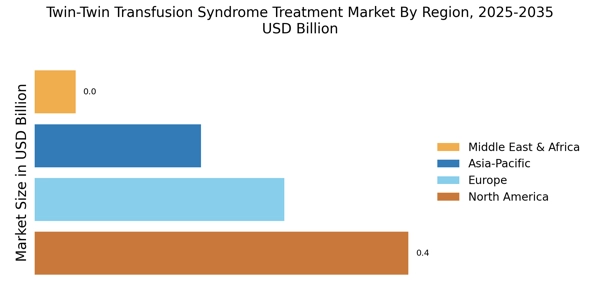
North America is the largest market for Twin-Twin Transfusion Syndrome (TTTS) treatment, holding approximately 45% of the global market share. The region benefits from advanced healthcare infrastructure, high awareness levels, and significant investments in research and development. Regulatory support from agencies like the FDA further catalyzes market growth, ensuring that innovative treatments are rapidly approved and accessible to patients. The United States and Canada are the leading countries in this market, with a strong presence of key players such as Medtronic, GE Healthcare, and Johnson & Johnson. The competitive landscape is characterized by continuous innovation and collaboration among healthcare providers and technology firms. This synergy enhances treatment options and improves patient outcomes, solidifying North America's position as a hub for TTTS treatment advancements.
Europe is the second-largest market for Twin-Twin Transfusion Syndrome (TTTS) treatment, accounting for approximately 30% of the global market share. The region is witnessing growth driven by increasing awareness of TTTS and advancements in fetal medicine. Regulatory frameworks, such as the European Medicines Agency's guidelines, are fostering innovation and ensuring that new therapies are developed and brought to market efficiently. Leading countries in Europe include Germany, the UK, and France, where healthcare systems are increasingly integrating advanced technologies for TTTS management. Key players like Siemens Healthineers and Philips Healthcare are actively involved in research and development, enhancing the competitive landscape. The collaboration between hospitals and technology firms is crucial for improving treatment protocols and patient care in this region.
Asia-Pacific is an emerging powerhouse in the Twin-Twin Transfusion Syndrome (TTTS) treatment market, holding about 20% of the global market share. The region is experiencing rapid growth due to increasing healthcare expenditure, rising awareness of fetal health issues, and advancements in medical technology. Countries like China and India are witnessing significant demand for TTTS treatments, driven by improving healthcare infrastructure and government initiatives aimed at maternal and child health. China and Japan are the leading countries in this market, with a growing number of healthcare facilities adopting advanced technologies for TTTS management. The competitive landscape is evolving, with both local and international players, including Abbott Laboratories, striving to capture market share. Collaborations between healthcare providers and technology firms are essential for enhancing treatment options and improving patient outcomes in this region.
The Middle East and Africa represent a nascent market for Twin-Twin Transfusion Syndrome (TTTS) treatment, holding approximately 5% of the global market share. The region is characterized by a growing awareness of maternal health issues and an increasing focus on improving healthcare services. Government initiatives aimed at enhancing healthcare infrastructure are expected to drive market growth in the coming years, despite current limitations in access to advanced treatments. Countries like South Africa and the UAE are leading the way in TTTS management, with healthcare systems gradually adopting innovative solutions. The competitive landscape is still developing, with opportunities for both local and international players to enter the market. As awareness and healthcare access improve, the potential for growth in TTTS treatments in this region is significant, paving the way for future advancements.
The Twin-Twin Transfusion Syndrome (TTTS) Treatment Market is characterized by a dynamic competitive landscape, driven by advancements in medical technology and a growing emphasis on maternal-fetal health. Key players such as Medtronic (US), GE Healthcare (US), and Siemens Healthineers (DE) are at the forefront, focusing on innovative solutions and strategic partnerships to enhance treatment efficacy. Medtronic (US) has been particularly active in integrating advanced imaging technologies into their treatment protocols, which appears to enhance diagnostic accuracy and patient outcomes. Meanwhile, GE Healthcare (US) emphasizes the development of non-invasive monitoring systems, which could potentially reduce risks associated with invasive procedures, thereby appealing to a broader patient demographic. Siemens Healthineers (DE) is also investing in digital health solutions, suggesting a trend towards more integrated care pathways that leverage data analytics for improved decision-making.The competitive structure of the TTTS Treatment Market seems moderately fragmented, with several players vying for market share through localized manufacturing and optimized supply chains. Companies are increasingly localizing their production to reduce costs and improve responsiveness to regional market demands. This strategy not only enhances supply chain efficiency but also allows for tailored solutions that meet specific local healthcare needs. The collective influence of these key players is shaping a market that is responsive to both technological advancements and evolving patient expectations.
In August Medtronic (US) announced a partnership with a leading maternal-fetal medicine center to develop a new telehealth platform aimed at improving remote monitoring of TTTS patients. This strategic move is likely to enhance patient engagement and provide healthcare providers with real-time data, potentially leading to better management of the condition. Such initiatives reflect a broader trend towards digital health solutions that prioritize patient-centered care.
In September GE Healthcare (US) launched a new imaging system specifically designed for prenatal diagnostics, which is expected to significantly improve the detection rates of TTTS. This innovation not only positions GE Healthcare as a leader in prenatal imaging but also underscores the importance of technological advancements in enhancing treatment outcomes. The introduction of such cutting-edge technology may lead to increased adoption rates among healthcare providers, thereby expanding GE's market presence.
In July Siemens Healthineers (DE) unveiled a collaborative initiative with several hospitals to implement AI-driven analytics in the management of TTTS. This initiative aims to streamline clinical workflows and improve diagnostic accuracy, suggesting a shift towards data-driven decision-making in the treatment of complex conditions like TTTS. The integration of AI into clinical practice could potentially revolutionize how healthcare providers approach treatment, making it more efficient and effective.
As of October the competitive trends in the TTTS Treatment Market are increasingly defined by digitalization, sustainability, and the integration of artificial intelligence. Strategic alliances among key players are shaping the landscape, fostering innovation and enhancing treatment capabilities. The shift from price-based competition to a focus on technological advancement and supply chain reliability is evident, indicating that future competitive differentiation will likely hinge on the ability to innovate and deliver high-quality, patient-centered solutions.



Recent developments in the Twin-Twin Transfusion Syndrome (TTTS) Treatment Market indicate increased attention toward therapies targeted at improving outcomes for affected twins. Companies like Sanofi, Johnson and Johnson, and GlaxoSmithKline are exploring innovative treatment methods, including advanced drugs and therapies tailored for TTTS, reflecting a broader trend of emphasis on maternal and fetal health. Current affairs show significant investment and research collaborations among pharmaceutical giants, with Merck and Co and Bristol Myers Squibb partnering on research initiatives aimed at better understanding TTTS and its treatment options.
Furthermore, AstraZeneca and Novartis have reportedly enhanced their pipelines focused on maternal-fetal medicine, driving growth in this niche market. Growth in market valuation is being seen as a result of these developments, with increased funding and resources indicating a robust interest in improving treatment efficacy. Recent mergers and acquisitions, such as Eli Lilly and Company collaborating with Baxter International for TTTS-focused pharmaceutical development, reflect strategic moves to consolidate expertise in this therapeutic area. Overall, these dynamics suggest an evolving landscape characterized by collaborative efforts and innovation focused on TTTS treatment.
Der Markt für die Behandlung des Twin-Twin-Transfusionssyndroms wird von 2024 bis 2035 voraussichtlich mit einer durchschnittlichen jährlichen Wachstumsrate (CAGR) von 6,18 % wachsen, angetrieben durch Fortschritte in der Medizintechnologie und zunehmendes Bewusstsein.
Neue Möglichkeiten liegen in:
Bis 2035 wird ein erhebliches Marktwachstum erwartet, das die sich entwickelnden Behandlungsmethoden widerspiegelt.
| MARKET SIZE 2024 | 0.7901(USD Billion) |
| MARKET SIZE 2025 | 0.839(USD Billion) |
| MARKET SIZE 2035 | 1.528(USD Billion) |
| COMPOUND ANNUAL GROWTH RATE (CAGR) | 6.18% (2025 - 2035) |
| REPORT COVERAGE | Revenue Forecast, Competitive Landscape, Growth Factors, and Trends |
| BASE YEAR | 2024 |
| Market Forecast Period | 2025 - 2035 |
| Historical Data | 2019 - 2024 |
| Market Forecast Units | USD Billion |
| Key Companies Profiled | Fetal Medicine Foundation (GB), Medtronic (US), GE Healthcare (US), Philips Healthcare (NL), Siemens Healthineers (DE), B. Braun Melsungen AG (DE), Johnson & Johnson (US), Abbott Laboratories (US) |
| Segments Covered | Treatment Type, End User, Diagnosis Method, Disease Stage, Regional |
| Key Market Opportunities | Advancements in minimally invasive surgical techniques enhance treatment options in the Twin-Twin Transfusion Syndrome Treatment Market. |
| Key Market Dynamics | Rising demand for minimally invasive procedures drives innovation in Twin-Twin Transfusion Syndrome treatment options. |
| Countries Covered | North America, Europe, APAC, South America, MEA |


Bitte füllen Sie das folgende Formular aus, um ein kostenloses Muster dieses Berichts zu erhalten

“This is really good guys. Excellent work on a tight deadline. I will continue to use you going forward and recommend you to others. Nice job”


“Thanks. It’s been a pleasure working with you, please use me as reference with any other Intel employees.”


“Thanks for sending the report it gives us a good global view of the Betaïne market.”


“Thank you, this will be very helpful for OQS.”


“We found the report very insightful! we found your research firm very helpful. I'm sending this email to secure our future business.”


“I am very pleased with how market segments have been defined in a relevant way for my purposes (such as "Portable Freezers & refrigerators" and "last-mile"). In general the report is well structured. Thanks very much for your efforts.”


“I have been reading the first document or the study, ,the Global HVAC and FP market report 2021 till 2026. Must say, good info! I have not gone in depth at all parts, but got a good indication of the data inside!”


“We got the report in time, we really thank you for your support in this process. I also thank to all of your team as they did a great job.”


“The Automotive 48V ECU Components Procurement Intelligence Study” was a complex project, but the Market Research Future (MRFR) team handled it with quality, agility, and customer-centricity. They delivered all requested data on time and within the agreed scope. The team, including Shubhendra Anand and Rahul Gotadki, was always readily available to clarify questions and swiftly implement necessary adjustments, driving the project to a successful conclusion within a very demanding timeframe.
I would also like to specifically commend Akshay Agarwal for his responsiveness and support at every stage—from our initial inquiry on May 6th through to final delivery on June 18th. His dedication made the entire process seamless.”



