Marché de la génération d'hydrogène Résumé
Selon l’analyse Market Research Future, la taille du marché de la production d’hydrogène était estimée à 134,05 milliards USD en 2024. L’industrie de la production d’hydrogène devrait passer de 146,72 milliards USD en 2025 à 361,94 milliards USD d’ici 2035, affichant un taux de croissance annuel composé (TCAC) de 9,45 % au cours de la période de prévision 2025-2035.
Principales tendances et faits saillants du marché
Le marché de la production d’hydrogène est prêt à connaître une croissance substantielle tirée par les progrès technologiques et le soutien réglementaire croissant.
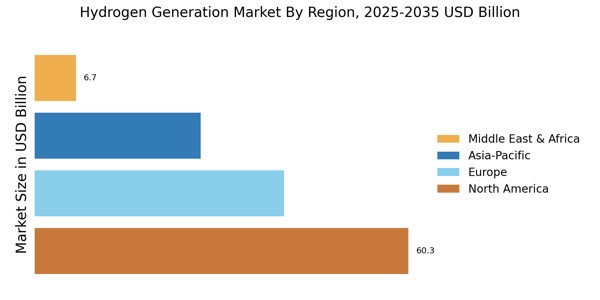
- L’Amérique du Nord reste le plus grand marché pour la production d’hydrogène, soutenu par des infrastructures et des investissements robustes.
- L’Asie-Pacifique est en train de devenir la région à la croissance la plus rapide, alimentée par la hausse de la demande énergétique et les initiatives gouvernementales.
- Blue Hydrogen continue de dominer le marché, tandis que Green Hydrogen gagne rapidement du terrain en tant qu'alternative durable.
- La demande croissante d’énergie propre et les politiques gouvernementales favorables sont les principaux moteurs de l’expansion du marché.
Taille du marché et prévisions
| Taille du marché 2024 | 134.05 (USD Billion) |
| Taille du marché en 2035 | 361.94 (USD Billion) |
| CAGR (2025 - 2035) | 9.45% |
| La plus grande part de marché régional en 2024 | Asie-Pacifique |
Principaux acteurs
Produits aériens et produits chimiques (États-Unis),Linde(DE), Nel ASA (NO), Siemens Energy (DE), Plug Power (US), Ballard Power Systems (CA), Hydrogenics (CA), ITM Power (GB), McPhy Energy (FR)