Global Rigid Plastic Packaging Market Overview
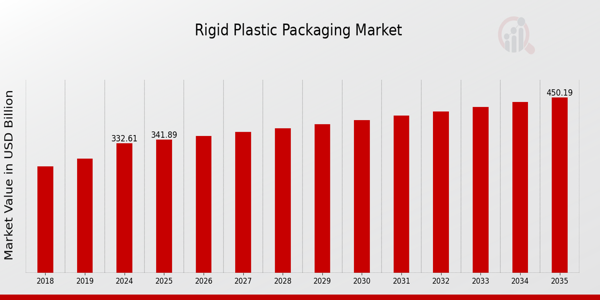
The Rigid Plastic Packaging Market Size was estimated at 323.62 (USD Billion) in 2023. The Rigid Plastic Packaging Industry is expected to grow from 332.61(USD Billion) in 2024 to 450.19 (USD Billion) by 2035. The Rigid Plastic Packaging Market CAGR (growth rate) is expected to be around 2.79% during the forecast period (2025 - 2035).
Key Rigid Plastic Packaging Market Trends Highlighted
Several critical market variables are contributing to the substantial growth of the Rigid Plastic Packaging Market. The pursuit of more sustainable packaging solutions is being driven by the growing environmental concerns of both consumers and businesses. As a result, there is a significant transition toward eco-friendly materials and products, as a number of governments worldwide are enacting regulations to reduce plastic waste and promote recycling initiatives.
Additionally, the demand for packaging that is both secure and durable, and that can withstand the rigors of shipping and handling, is being stimulated by the growth of e-commerce. Advancements in technology, particularly in the development of bio-based polymers and innovative production methods, are among the opportunities to be investigated in the Rigid Plastic Packaging Market. Companies that are able to integrate recycled materials into their packaging or create biodegradable alternatives are at a competitive advantage as they endeavor to satisfy consumer demand for transparency and sustainability.
Packaging that provides user-friendly features, such as resealable options and easy-to-handle designs, will be increasingly sought after due to the increasing trend toward convenience in consumer lifestyles. In recent years, there has been an increased emphasis on branding and customization in rigid plastic packaging. Not only are brands using distinctive designs and colors to distinguish themselves on displays, but they are also using them to convey their dedication to sustainability.In addition, the usage of smart packaging technology, such as QR codes and NFC identifiers, is on the rise, which is facilitating consumer interaction and providing them with comprehensive product information.
This convergence of factors is fostering innovation and strategic partnerships among manufacturers in the global market landscape, thereby establishing a dynamic environment that addresses both consumer preferences and regulatory challenges.
Source: Primary Research, Secondary Research, Market Research Future Database, and Analyst Review
Rigid Plastic Packaging Market Drivers
Increasing Demand for Sustainable Packaging Solutions
In the Rigid Plastic Packaging Market Industry, the growing focus on sustainability is driving significant changes in packaging materials and designs. According to a United Nations report, approximately 300 million tons of plastic are produced globally every year, with a substantial portion coming from the packaging sector. In response to environmental concerns, major organizations such as the World Wildlife Fund and the Ellen MacArthur Foundation are advocating for circular economy initiatives, which call for the use of recyclable materials.Additionally, the European Union has implemented regulations that require all plastic packaging to be recyclable by 2030.
This shift towards sustainability is expected to boost the adoption of rigid plastic packaging solutions that meet eco-friendly criteria, ultimately supporting market growth. The movement towards achieving a reduction in carbon footprint and minimizing waste in the packaging sector is thus anticipated to enhance demand for rigid plastic alternatives, which align with corporate social responsibility goals set by leading companies worldwide.
Rising Demand in the Food and Beverage Sector
The food and beverage sector remains a crucial driver for the Rigid Plastic Packaging Market. It is estimated that over 90% of packaged goods are within this sector, and trends suggest robust growth in consumer spending on packaged foods and beverages, projected to grow to around USD 6 trillion globally by 2024, according to industry reports.
Organizations like the Food and Agriculture Organization of the United Nations have highlighted the increasing reliance on packaged food products due to urbanization and changing consumer lifestyles.Moreover, with the ongoing influence of COVID-19, there has been a noticeable uptick in home consumption and e-commerce food purchases, which are further incentivizing manufacturers to use rigid plastic packaging that offers durability and convenience. This unmistakably signals a substantial opportunity for growth within the market as companies adapt their packaging strategies to align with consumer preferences.
Technological Advancements in Packaging Solutions
Technological advancements play a pivotal role in shaping the Rigid Plastic Packaging Market. With innovative developments in packaging technology, companies are now capable of producing lighter, stronger, and more environmentally friendly rigid plastic solutions. For instance, advances in injection molding and extrusion processes have led to the creation of multi-layer films and containers that not only extend shelf life but also improve product safety.According to the International Organization for Standardization, an increasing number of companies are obtaining certifications for sustainable practices through technology, resulting in enhanced operational efficiencies.
Furthermore, industry players such as Amcor and Berry Global are heavily investing in Research and Development (R&D) to create smart packaging solutions equipped with features like freshness indicators and tamper-evident technologies.This commitment to innovation is expected to propel growth in the market, as both consumer demand and regulatory pressures dictate the need for cutting-edge solutions.
Rigid Plastic Packaging Market Segment Insights
Rigid Plastic Packaging Market Application Insights
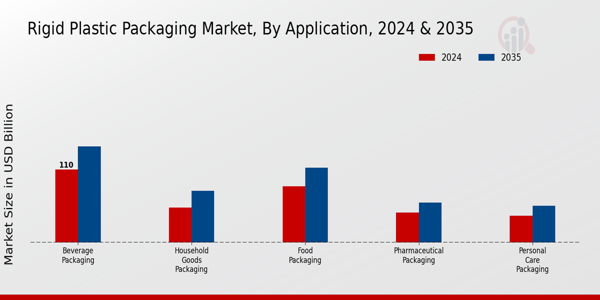
The Rigid Plastic Packaging Market, with its projected value of 332.61 USD Billion in 2024, showcases significant growth in the Application segment, highlighting its critical role across various industries. Among these applications, Food Packaging holds a valued position at 85.0 USD Billion in 2024, primarily driven by the increasing demand for ready-to-eat and processed foods. This segment is crucial as it ensures food safety and extends shelf life, making it a significant contributor to the overall market growth.
Beverage Packaging is poised to dominate the space with a valuation of 110.0 USD billion in 2024, reflecting the ever-growing consumption of packaged beverages. This application is integral as it addresses both convenience and portability while maintaining product integrity.
Pharmaceutical Packaging, valued at 45.0 USD Billion in 2024, plays a significant role as it ensures compliance with health standards and supports the integrity of sensitive medical products, leading to its stability within the market. Personal Care Packaging, at 40.0 USD billion in 2024, reflects growing consumer awareness and demand for hygiene and self-care products. This segment is vital as it encompasses an array of products from cosmetics to toiletries that require durable and safe packaging solutions.
Household Goods Packaging, valued at 52.61 USD billion in 2024, addresses the need for storage and safety in everyday household items, which enhances its relevance in consumer purchasing behavior.
Collectively, these segments reveal the Rigid Plastic Packaging Market's dynamic landscape, where each segment contributes uniquely to overall market resilience and growth. The market is influenced by increasing consumer trends towards sustainability and convenience, shifting preferences toward packaged products, and the expansion of e-commerce. Overall, understanding the valuation and significance of these applications is crucial for stakeholders aiming to capture opportunities in this evolving market landscape.
Source: Primary Research, Secondary Research, Market Research Future Database, and Analyst Review
Rigid Plastic Packaging Market Material Type Insights
The Rigid Plastic Packaging Market showcases a diverse landscape with various material types leading the sector, including Polyethylene Terephthalate, Polypropylene, Polyvinyl Chloride, Polyethylene, and Polystyrene. By 2024, the market is projected to achieve a valuation of 332.61 USD Billion, reflecting ongoing demand for robust packaging solutions across multiple industries. Polyethylene Terephthalate is widely recognized for its recyclability and strength, making it a popular choice for food and beverage packaging.
Meanwhile, Polypropylene is valued for its versatility and low density, facilitating cost-effective packaging options.Polyvinyl Chloride remains significant due to its durability and resistance to various influences, while Polyethylene is often favored for its excellent sealing properties and flexibility. Polystyrene, though facing scrutiny for environmental concerns, continues to be important in specific applications due to its insulating properties. The dynamic interplay among these materials drives innovative packaging solutions, addresses the rising demand for sustainable practices, and responds to evolving consumer behavior globally, underlined by the increasing focus on safety and shelf life.
Rigid Plastic Packaging Market Product Type Insights
The Rigid Plastic Packaging Market showcases a diverse range of product types, which play a significant role in catering to the varying demands of different industries. Among the prominent categories are Bottles, Containers, Cups, Trays, and Jars, each contributing substantially to the market dynamics. In 2024, the overall market is expected to be valued at 332.61 USD Billion while achieving remarkable growth through various consumer trends and preferences that push for convenience and sustainability.
Bottles and Containers are particularly important, as they address the essential storage and transportation needs for beverages and food products, dominating in market presence and usage.The growing trend of single-use plastics has sparked innovation in the Cups segment with a focus on eco-friendly alternatives, while Trays are increasingly recognized for their role in efficient packaging solutions for ready-to-eat meals. Jars remain significant for preserving both food and personal care products, making them a staple in the packaging landscape.
Overall, shifts towards lightweight and recyclable materials in the Rigid Plastic Packaging Market foster opportunities for growth and innovation across all product types, catering to the evolving consumer needs.
Rigid Plastic Packaging Market End Use Insights
The Rigid Plastic Packaging Market is witnessing significant growth attributed to diverse end-use applications. By 2024, the market will be valued at 332.61 billion USD, showcasing a robust upward trajectory driven by rising demand across various sectors. The Food Industry, for instance, plays a vital role, catering to consumer preferences for convenience and longevity in product storage. Additionally, the Beverage Industry is crucial, as rigid plastic packaging offers excellent durability and lightweight solutions that enhance distribution efficiency.In the Pharmaceutical Industry, safety and compliance necessitate reliable packaging, facilitating the market's expansion.
Meanwhile, the Cosmetics Industry emphasizes aesthetics and protection, making rigid plastic solutions essential for retaining product integrity. Lastly, the Household Products Industry leverages rigid plastics for their versatility and strength, satisfying daily consumer needs. Collectively, these segments not only reflect the market's diverse capabilities but also highlight a strong trend towards sustainability and functionality, paving the way for enhanced competitiveness within the global landscape.Market players are increasingly focusing on innovation in materials and designs to capture diverse consumer preferences and regulatory requirements, further driving market growth.
Rigid Plastic Packaging Market Regional Insights
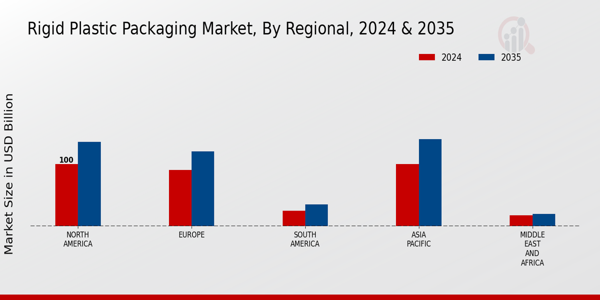
The Rigid Plastic Packaging Market is experiencing robust growth across various regions. In 2024, the market is valued at 332.61 USD Billion and is projected to grow, reaching 450.19 USD billion by 2035 at a compound annual growth rate of 2.79 from 2025 to 2035. North America, with a valuation of 100.0 USD billion in 2024, is significant due to its strong manufacturing base and consumer demand. Europe follows closely, valued at 90.0 USD billion, driven by stringent regulations favoring sustainable packaging options.
The Asia Pacific region, also valued at 100.0 USD billion, showcases a rapidly expanding market fueled by increasing urbanization and industrial activities, making it a key player in the rigid packaging landscape.South America, with a market value of 25.0 USD billion, presents growth opportunities as economies develop and consumer habits evolve. The Middle East and Africa, though at a 17.61 USD billion valuation, are gradually adopting rigid plastic packaging due to rising industrialization. Each region plays a distinct role in the Rigid Plastic Packaging Market, showcasing differing growth drivers, consumer preferences, and competitive dynamics that shape the overall market landscape.
Source: Primary Research, Secondary Research, Market Research Future Database, and Analyst Review
Rigid Plastic Packaging Market Key Players and Competitive Insights
The Rigid Plastic Packaging Market has witnessed significant growth driven by an increase in demand across various sectors such as food and beverage, healthcare, personal care, and consumer goods. The industry is characterized by rapid innovations in material technologies, sustainability trends, and regulatory pressures aimed at reducing plastic waste. Key competitive insights show that companies within this space are constantly seeking to enhance their product offerings, improve their supply chains, and adopt sustainable practices to cater to the evolving preferences of consumers and regulatory compliance.
Competitive dynamics involve not only traditional packaging companies but also new entrants focusing on niche markets, leading to an increasingly crowded marketplace. Leading firms leverage advanced technologies to improve packaging performance while maintaining affordability and accessibility.
Amcor is a prominent player in the rigid plastic packaging market due to its dedication to sustainability and innovation, as well as its extensive selection of high-performance containers. Customized packaging solutions are provided by the organization to a variety of industries, such as healthcare, personal care, food, and beverages.
Amcor's leadership is derived from its sophisticated manufacturing capabilities and material science expertise, which allow it to produce packaging that is aesthetically pleasing, durable, and lightweight. It actively engages in collaboration with clients to co-develop packaging that improves the safety, retail appeal, and shelf life of products. In order to satisfy the increasing sustainability requirements, Amcor also emphasizes circular economy principles, incorporating recyclability and eco-friendly materials into its rigid plastic products.
Mondi Group is another key player in the Rigid Plastic Packaging Market, renowned for its comprehensive range of packaging products and services designed to cater to a variety of industries, including food and beverage, pharmaceutical, and industrial applications. The company emphasizes sustainability in its operations, frequently adopting eco-friendly practices and developing innovative packaging solutions that minimize environmental impact.
Mondi Group’s strengths lie in its extensive research and development capabilities, allowing it to introduce cutting-edge products that meet consumer desires for convenience and safety. The company also pursues strategic mergers and acquisitions to expand its market presence and enhance its technological capabilities. This approach has enabled Mondi Group to maintain a competitive edge while offering versatile packaging solutions that are tailored to local and global market needs.
Key Companies in the Rigid Plastic Packaging Market Include
- UFP Technologies
- Mondi Group
- Greif
- Coveris
- ALPLA
- Promens
- Amcor
- Reynolds Group Holdings
- Pactiv Evergreen
- Berry Global
- Sonoco Products
- Silgan Holdings
- Plastipak
- Sealed Air
Rigid Plastic Packaging Industry Developments
-
Q2 2024: Berry Global to Sell European Rigid Food Packaging Unit to Apollo Funds Berry Global announced the sale of its European Rigid Food Packaging business to Apollo Funds for approximately €950 million, as part of its strategy to streamline operations and focus on core businesses.
-
Q2 2024: Berry Global Announces Sale of European Rigid Food Packaging Business to Apollo Funds Berry Global Group, Inc. entered into a definitive agreement to sell its European Rigid Food Packaging business to Apollo Funds, with the transaction expected to close in the third quarter of 2024.
-
Q2 2024: Alpla Group opens new PET recycling plant in Romania Alpla Group inaugurated a new PET recycling facility in Targu Mures, Romania, expanding its rigid plastic packaging recycling capacity in Eastern Europe.
-
Q1 2024: Amcor to Acquire Moda Systems, Expanding Rigid Packaging Automation Portfolio Amcor announced the acquisition of Moda Systems, a New Zealand-based company specializing in automated packaging systems, to enhance its rigid packaging automation capabilities.
-
Q1 2024: Silgan Holdings Announces Acquisition of Gateway Plastics Silgan Holdings completed the acquisition of Gateway Plastics, a manufacturer of rigid plastic packaging for food and beverage applications, strengthening its position in the North American market.
-
Q2 2024: Berry Global Launches New Recyclable Rigid Packaging Line for Food Applications Berry Global introduced a new line of recyclable rigid plastic packaging designed for food applications, aiming to meet increasing demand for sustainable packaging solutions.
-
Q1 2024: ALPLA and Coca-Cola HBC Open New High-Tech Recycling Plant in Italy ALPLA and Coca-Cola HBC jointly opened a new high-tech PET recycling plant in Gaglianico, Italy, to support the production of recycled rigid plastic packaging for beverages.
-
Q2 2024: Amcor Launches New Lightweight Rigid Container for Personal Care Market Amcor launched a new lightweight rigid plastic container targeting the personal care sector, designed to reduce material usage and improve recyclability.
-
Q1 2024: Plastipak Opens New Rigid Plastic Packaging Facility in Spain Plastipak Packaging opened a new manufacturing facility in Toledo, Spain, to increase its production capacity for rigid plastic packaging in Southern Europe.
-
Q2 2024: Berry Global Appoints New President of Rigid Packaging Division Berry Global announced the appointment of a new president for its Rigid Packaging Division, effective June 2024, to lead the segment’s growth and innovation strategy.
-
Q1 2024: Silgan Holdings Launches New Tamper-Evident Rigid Plastic Closure Silgan Holdings introduced a new tamper-evident rigid plastic closure for food and beverage packaging, enhancing product safety and consumer confidence.
-
Q2 2024: Amcor Partners with Nestlé to Develop Recyclable Rigid Packaging for Dairy Products Amcor announced a partnership with Nestlé to co-develop recyclable rigid plastic packaging solutions for dairy products, aiming to advance circular economy initiatives.
Rigid Plastic Packaging Market Segmentation Insights
Rigid Plastic Packaging Market Application Outlook
- Food Packaging
- Beverage Packaging
- Pharmaceutical Packaging
- Personal Care Packaging
- Household Goods Packaging
Rigid Plastic Packaging Market Material Type Outlook
- Polyethylene Terephthalate
- Polypropylene
- Polyvinyl Chloride
- Polyethylene
- Polystyrene
Rigid Plastic Packaging Market Product Type Outlook
- Bottles
- Containers
- Cups
- Trays
- Jars
Rigid Plastic Packaging Market End Use Outlook
- Food Industry
- Beverage Industry
- Pharmaceutical Industry
- Cosmetics Industry
- Household Products Industry
Rigid Plastic Packaging Market Regional Outlook
- North America
- Europe
- South America
- Asia Pacific
- Middle East and Africa






















