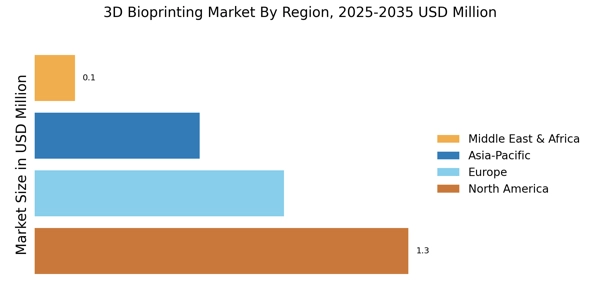
3D バイオプリンティング市場は、印刷精度と材料の多様性を向上させる継続的な技術革新によって特徴付けられます。新しい生体適合性材料が開発されており、より複雑な組織構造が可能になります。これらの進歩により、より機能的で実行可能な生物学的構築物の作成が促進され、医療用途の大幅な改善につながる可能性があります。
3D バイオプリンティング市場では、個別化医療に向けた顕著な傾向が見られます。医療提供者は、個々の患者のニーズに合わせてカスタマイズされたインプラントや組織を作成するためにバイオプリンティング技術をますます採用しています。この変化により、ソリューションが特定の健康状態にさらに適合するようになるため、治療効果と患者の満足度が向上すると考えられます。
3D バイオプリンティング市場では、学術機関と業界関係者との協力的な取り組みがますます普及してきています。これらのパートナーシップは、研究開発を加速し、革新的なアプリケーションや製品につながることを目的としています。このようなコラボレーションは、知識の共有とリソースの割り当てを強化し、最終的には市場を前進させる可能性があります。
3D バイオプリンティング産業の発展には、支援的な規制枠組みの確立が不可欠です。規制当局はバイオプリンティング技術の可能性をますます認識しており、安全性と有効性を保証するガイドラインの作成に取り組んでいます。この規制上のサポートは、社会の信頼を維持しながらイノベーションを促進するために不可欠です。 規制が進化するにつれて、バイオプリント製品の承認プロセスが迅速化され、企業の研究開発への投資が促進される可能性があります。明確な規制経路の存在は、より強固な市場環境をもたらす可能性があり、安全基準や倫理的配慮に沿った世界市場の繁栄を可能にします。
慢性疾患や臓器不全の罹患率の増加により、臓器移植の需要が高まっています。 3D バイオプリンティング産業は、生物工学による臓器や組織の生産を可能にすることで、この重大なニーズに対処する準備ができているようです。最近の推計によると、臓器移植を待っている患者の数は増え続けており、数千人が待機リストに載っています。 この状況は、ドナー臓器への依存を減らす可能性がある 3D バイオプリンティングなどの革新的なソリューションの緊急性を強調しています。患者固有の臓器を作成できるようになれば、移植の成功率が高まるだけでなく、医療システムへの負担も軽減される可能性があります。テクノロジーが成熟するにつれて、世界市場はこの需要によって大幅な成長を遂げる可能性があります。
バイオプリンティング技術の技術革新は、3D バイオプリンティング市場を大きく変えています。より洗練されたバイオインクの開発や印刷解像度の向上などの最近の進歩により、バイオプリンティングの機能が拡大しました。これらの革新により、自然の生物学的環境を厳密に模倣した複雑な組織構造の作成が可能になります。 さらに、人工知能と機械学習をバイオプリンティングプロセスに統合することで、精度と効率が向上しています。その結果、研究者や医療専門家は、薬物検査、再生医療、組織工学の用途にこれらのテクノロジーを採用することが増えています。バイオプリンティング技術の継続的な進化は、さまざまな分野にわたる潜在的な応用を伴う、世界の 3D バイオプリンティング産業の有望な未来を示唆しています。
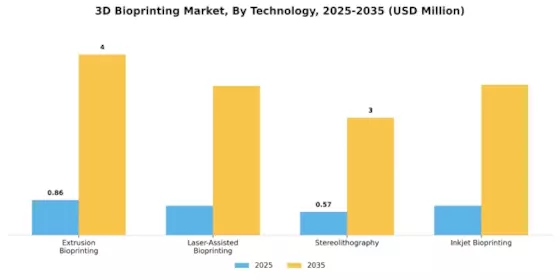
テクノロジー別: 押出バイオプリンティング (最大) vs. レーザー支援バイオプリンティング (最も急成長)
3D バイオプリンティング市場では、押出バイオプリンティングが 47% の最大シェアを占め、組織工学および再生医療におけるその広範な応用を活かしています。この技術により、生体組織のレプリカを作成するのに極めて重要なバイオインクの正確な堆積が可能になります。一方、レーザー支援バイオプリンティングは、印刷された構造物で高い精度と解像度を提供できるため勢いが増しており、急速に市場に受け入れられる重要なプレーヤーとして注目を集めています。
テクノロジー: 押出バイオプリンティング (主流) vs. レーザー支援バイオプリンティング (新興)
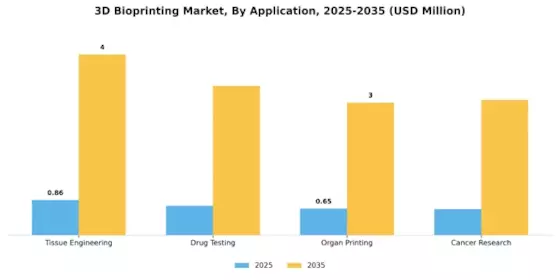
3D バイオプリンティング市場は、組織工学、薬物検査、臓器プリンティング、がん研究など、その幅広い用途が大きな特徴です。組織工学は、損傷した組織や臓器を修復するソリューションを提供するため、再生医療で広く使用されており、現在 44% の最大の市場シェアを保持しています。一方、比較的新しい応用である臓器プリンティングが急速に台頭しており、移植用に完全に機能する臓器を作成できる可能性が注目を集めています。
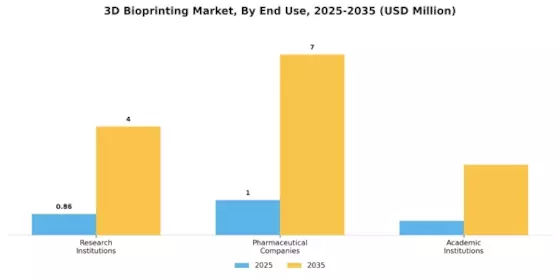
3D バイオプリンティング業界では、主要な最終用途セグメントの分布を見ると、製薬会社が大幅に集中しており、市場の 52% を占めています。このセグメントは、カスタム医薬品、再生医療、組織工学の需要の増加により、大きなシェアを占めています。学術機関は、市場シェアは小さいものの、研究および教育目的での 3D バイオプリンティング技術の使用を急速に拡大しており、この分野における新たなトレンドを示しています。成長傾向が進化するにつれ、技術の進歩、研究資金の増加、学界と産業界の共同プロジェクトなどの要因により、3D バイオプリンティング アプリケーションの増加が促進されています。製薬会社内での個別化医療への関心の高まりが引き続きこの分野をリードする一方、学術機関は新たな研究機会を活用しており、市場における 3D バイオプリンティングの応用範囲の拡大を示しています。
北米は 3D バイオプリンティング市場規模でリードしており、2024 年には世界収益の 45% 以上を占めます。この地域の成長は、研究開発への多額の投資と堅牢な医療インフラによって推進されています。 FDA などの機関からの規制支援によりイノベーションが促進され、バイオプリンティング技術の急速な進歩が可能になりました。臓器移植と個別化医療に対する需要の高まりにより、市場の拡大がさらに促進されています。
CELLINK AB や EnvisionTEC GmbH などの企業は最前線に立っており、イノベーションとコラボレーションを特徴とする競争環境に貢献しています。研究機関や大学の存在により、この地域の能力が強化され、バイオプリンティング応用の進歩を促進するパートナーシップが促進されます。
アジア太平洋地域: 急速な成長と普及
Asia-Pacific is rapidly emerging as a significant player in the 3D bioprinting market, holding approximately 20% of the global share. The region's growth is fueled by increasing healthcare expenditures, a rising population, and advancements in technology. Countries like China and Japan are leading the charge, with government initiatives aimed at promoting bioprinting research and development.個別化医療や臓器移植の需要も増加しており、市場の拡大を推進しています。
日本もこれに続き、バイオプリンティング技術に多額の投資を行っています。競争環境は、Regenhu SA や 3D Biotek LLC など、地域のバイオプリンティング アプリケーションにおける革新と成長に貢献している、国内外のプレーヤーが混在していることが特徴です。
中東とアフリカ : 新興市場のダイナミクス
中東およびアフリカ地域は世界の 3D バイオプリンティング産業で徐々に台頭しており、現在世界シェアの約 5% を占めています。この成長の原動力となっているのは、医療投資の増加と高度な医療技術に対する需要の高まりです。南アフリカやUAEなどの国々は、医療インフラの強化を目的とした政府の取り組みの支援を受けて、バイオプリンティング技術の導入を始めている。
He holds an experience of about 9+ years in Market Research and Business Consulting, working under the spectrum of Life Sciences and Healthcare domains. Rahul conceptualizes and implements a scalable business strategy and provides strategic leadership to the clients. His expertise lies in market estimation, competitive intelligence, pipeline analysis, customer assessment, etc.
read more
Co-Author
Kinjoll Dey
Senior Research Analyst
He is an extremely curious individual currently working in Healthcare and Medical Devices Domain. Kinjoll is comfortably versed in data centric research backed by healthcare educational background. He leverages extensive data mining and analytics tools such as Primary and Secondary Research, Statistical Analysis, Machine Learning, Data Modelling. His key role also involves Technical Sales Support, Client Interaction and Project management within the Healthcare team. Lastly, he showcases extensive affinity towards learning new skills and remain fascinated in implementing them.
The secondary research process involved comprehensive analysis of regulatory frameworks for advanced therapy medicinal products (ATMPs), peer-reviewed biomedical engineering journals, tissue engineering publications, and authoritative regenerative medicine organizations. Key sources included the US Food & Drug Administration (FDA) Center for Biologics Evaluation and Research (CBER), European Medicines Agency (EMA) Committee for Advanced Therapies, National Institutes of Health (NIH) National Center for Advancing Translational Sciences (NCATS), National Institute of Standards and Technology (NIST) Engineering Laboratory for biomanufacturing standards, Tissue Engineering and Regenerative Medicine International Society (TERMIS), International Society for Biological and Environmental Repositories (ISBER), International Society for Stem Cell Research (ISSCR), Organ Procurement and Transplantation Network (OPTN) / Scientific Registry of Transplant Recipients (SRTR), World Intellectual Property Organization (WIPO) Patent Database for bioprinting technology landscaping, NIH RePORTER for grant funding analysis, and national bioethics advisory commissions from key markets. These sources were utilized to collect technology adoption metrics, regulatory approval pathways for bioengineered tissues, clinical translation studies, grant funding trends, patent filing analytics, and market landscape analysis for extrusion-based systems, laser-assisted bioprinting platforms, bioink formulations, and organ printing technologies.
Primary Research
In order to acquire qualitative and quantitative insights that were unique to the 3D bioprinting ecosystem, interviews were conducted with supply-side and demand-side stakeholders during the primary research cycle. The supply-side sources consist of CEOs, Chief Technology Officers, VPs of Bioprinting R&D, regulatory affairs chiefs for combination products, and commercial directors from bioprinter manufacturers, bioink developers, and bioprinting software providers. The demand-side sources included the heads of tissue engineering laboratories, principal investigators in regenerative medicine departments, pharmaceutical R&D directors for preclinical drug testing, transplant surgery department heads, procurement leads from academic medical centers and biotechnology research institutes, and technology transfer officers from university spin-off programs. The primary research validated market segmentation across bioprinting technologies, confirmed product development pipelines for organ printing applications, and gathered insights on research funding allocation, translational gap challenges, pricing models for bioink commercialization, and regulatory reimbursement for bioprinted medical products.
Primary Respondent Breakdown:
By Designation: C-level Primaries (32%), Director Level (31%), Others (37%)
By Region: North America (38%), Europe (30%), Asia-Pacific (24%), Rest of World (8%)
Market Size Estimation
Global market valuation was derived through revenue mapping of bioprinting hardware, software, and consumables, alongside analysis of research grant allocations and contract manufacturing revenues. The methodology included:
Identification of 35+ key technology developers and solution providers across North America, Europe, Asia-Pacific, and emerging biotech hubs
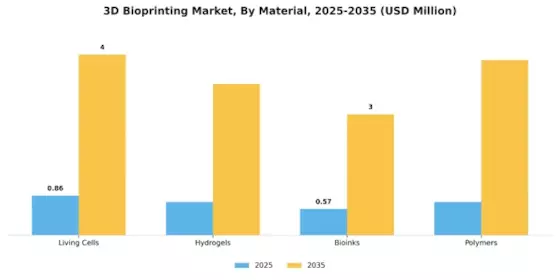
Product mapping across extrusion-based bioprinters, laser-assisted systems, stereolithography platforms, and inkjet technologies, segmented by bioink compatibility (living cells, hydrogels, polymer composites)
Analysis of reported and modeled annual revenues specific to bioprinting product portfolios, including recurring bioink and consumables revenue streams
Coverage of manufacturers and research platform providers representing 75-80% of global market share in 2024
Extrapolation using bottom-up (installed base of bioprinters × annual service and consumables spend by end-user segment) and top-down (aggregate manufacturer revenue validation adjusted for privately held company estimates) approaches to derive segment-specific valuations for tissue engineering, drug testing, organ printing, and cancer research applications
“This is really good guys. Excellent work on a tight deadline. I will continue to use you going forward and recommend you to others. Nice job”
Noah MalgeriCo-Founder
“Thanks. It’s been a pleasure working with you, please use me as reference with any other Intel employees.”
Joseph AguayoSales Operations & Pricing Manager
“Thanks for sending the report it gives us a good global view of the Betaïne market.”
Peter Groot koerkampAccount and Business Manager
“Thank you, this will be very helpful for OQS.”
La Terria DoddProgram Support Specialist
“We found the report very insightful! we found your research firm very helpful. I'm sending this email to secure our future business.”
Younghwan ChoiSenior Retail Manager
“I am very pleased with how market segments have been defined in a relevant way for my purposes (such as "Portable Freezers & refrigerators" and "last-mile").
In general the report is well structured. Thanks very much for your efforts.”
Mark IrwinManagement Consultant
“I have been reading the first document or the study, ,the Global HVAC and FP market report 2021 till 2026. Must say, good info! I have not gone in depth at all parts, but got a good indication of the data inside!”
Rob KooikerGroup Product Manager HVAC & Fire Protection GMA
“We got the report in time, we really thank you for your support in this process. I also thank to all of your team as they did a great job.”
Akif MorogluStrategy & Business Development Director
“The Automotive 48V ECU Components Procurement Intelligence Study” was a complex project, but the Market Research Future (MRFR) team handled it with quality, agility, and customer-centricity. They delivered all requested data on time and within the agreed scope. The team, including Shubhendra Anand and Rahul Gotadki, was always readily available to clarify questions and swiftly implement necessary adjustments, driving the project to a successful conclusion within a very demanding timeframe.
I would also like to specifically commend Akshay Agarwal for his responsiveness and support at every stage—from our initial inquiry on May 6th through to final delivery on June 18th. His dedication made the entire process seamless.”
Guilherme Gomes MartinsProduct Management Director