Growing Awareness and Education
The rising awareness regarding Alzheimer’s disease and its impact on individuals and families is a crucial driver for the Global Alzheimer’s Disease Diagnostic Market. Educational campaigns aimed at both healthcare professionals and the general public are increasing understanding of the disease's symptoms and the importance of early diagnosis.
This heightened awareness is likely to lead to more individuals seeking diagnostic services, thereby expanding the market. As more people recognize the signs of Alzheimer’s, the demand for effective diagnostic tools is expected to grow, further stimulating market dynamics.
- PubMed research indicates early diagnosis programs significantly improve patient management outcomes, increasing adoption of cognitive screening tools and strengthening demand for Alzheimer’s diagnostic services globally.
Aging Population and Demographic Shifts
The global demographic shift towards an aging population is a significant factor driving the market. As life expectancy increases, the number of elderly individuals susceptible to Alzheimer’s disease rises correspondingly.
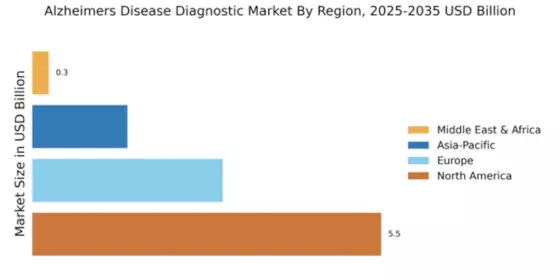
This demographic trend is projected to result in a substantial market expansion, with estimates indicating a compound annual growth rate (CAGR) of 8.3% from 2025 to 2035. The increasing number of older adults necessitates enhanced diagnostic capabilities to address the growing healthcare needs associated with Alzheimer’s, thereby fostering market growth.
- The global population aged 65 years and older continues rising rapidly, increasing long-term demand for Alzheimer’s diagnostics as age remains the strongest risk factor for dementia-related diseases.
Increased Government Funding and Support
Government initiatives and funding for Alzheimer’s research and diagnostics significantly influence the Global Alzheimer’s Disease Diagnostic Market. Various countries are allocating substantial resources to combat the rising burden of Alzheimer’s disease.
For instance, the U.S. government has committed billions towards research and development, fostering innovation in diagnostic tools. Such funding not only supports clinical trials but also encourages collaborations between public and private sectors. This financial backing is crucial for developing new diagnostic solutions, thereby propelling market growth and enhancing the overall healthcare infrastructure.
- Public investments in neurological disease research continue expanding globally, supporting innovation in biomarker testing, imaging technologies, and early Alzheimer’s diagnostic platforms.
Rising Prevalence of Alzheimer’s Disease
The increasing incidence of Alzheimer’s disease globally serves as a primary driver for the market. As populations age, the number of individuals diagnosed with Alzheimer’s is projected to rise significantly.
- Dementia cases are projected to increase from 55 million to 139 million by 2050, accelerating demand for scalable Alzheimer’s diagnostic technologies and early screening programs.
Technological Advancements in Diagnostic Tools
Innovations in diagnostic technologies are transforming the market. The development of advanced imaging techniques, biomarker identification, and artificial intelligence applications enhances the accuracy and efficiency of Alzheimer’s diagnostics.
For example, positron emission tomography (PET) scans and cerebrospinal fluid analysis have become pivotal in early diagnosis. These advancements not only improve patient outcomes but also drive market growth, as healthcare providers increasingly adopt these technologies. The integration of AI in diagnostic processes may further streamline operations, potentially leading to a more robust market landscape.
- Advanced biomarker assays and PET imaging technologies improve early Alzheimer’s detection accuracy, supporting wider adoption of precision diagnostic approaches in neurology.