What is the projected market valuation of the Healthcare Business Intelligence Market by 2035?
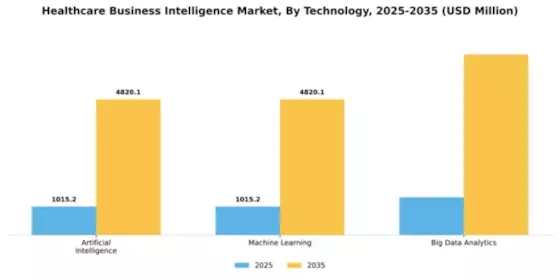
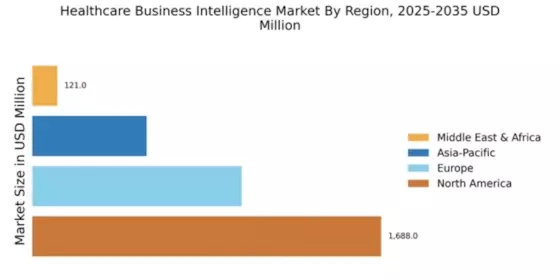
The projected market valuation for the Healthcare Business Intelligence Market by 2035 is 16040.3 USD Million.
What was the market valuation of the Healthcare Business Intelligence Industry in 2024?
The overall market valuation of the Healthcare Business Intelligence Industry was 3375.95 USD Million in 2024.
What is the expected CAGR for the Healthcare Business Intelligence Market during the forecast period 2025 - 2035?
The expected CAGR for the Healthcare Business Intelligence Market during the forecast period 2025 - 2035 is 15.22%.
Which segment is projected to have the highest valuation in the Healthcare Business Intelligence Industry by 2035?
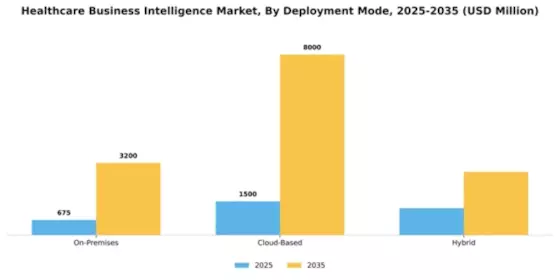
The Cloud-Based deployment mode is projected to have the highest valuation, reaching 8000.0 USD Million by 2035.
What are the key applications driving the global market?
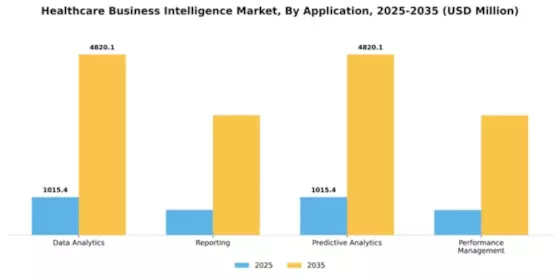
Key applications driving the market include Data Analytics, Reporting, Predictive Analytics, and Performance Management.
Which companies are considered key players in the Healthcare Business Intelligence Market?
Key players in the market include IBM, Oracle, SAP, Microsoft, Tableau, Qlik, SAS, Deloitte, and Cerner.
What is the projected valuation for Healthcare Providers in the global industry by 2035?
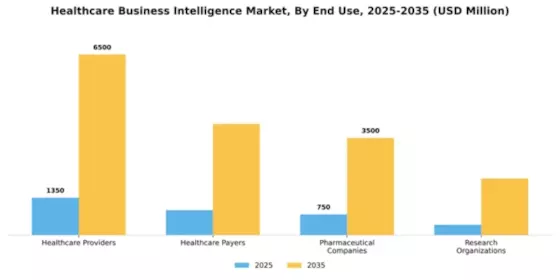
The projected valuation for Healthcare Providers in the market is 6500.0 USD Million by 2035.
How does the valuation of Healthcare Payers compare to that of Pharmaceutical Companies by 2035?
By 2035, Healthcare Payers are projected to reach 4000.0 USD Million, while Pharmaceutical Companies are expected to reach 3500.0 USD Million.
What is the expected growth trend for the Services component in the Healthcare Business Intelligence Market?
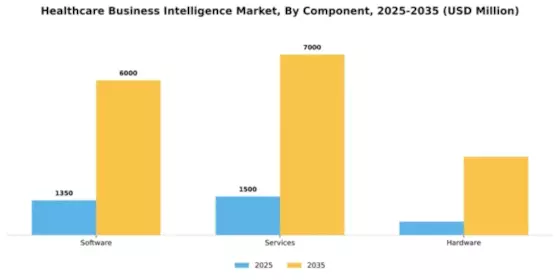
The Services component is expected to grow significantly, reaching 7000.0 USD Million by 2035.
What was the valuation of the On-Premises deployment mode in 2024?
The valuation of the On-Premises deployment mode was 675.0 USD Million in 2024.
著者
Author
Vikita Thakur
Senior Research Analyst
She holds an experience of about 5+ years in market research and business consulting projects for sectors such as life sciences, medical devices, and healthcare IT. She possesses a robust background in data analysis, market estimation, competitive intelligence, pipeline analysis market trend identification, and consumer behavior insights. Her expertise lies in technical Sales support, client interaction and project management, designing and implementing market research studies, conducting competitive analysis, and synthesizing complex data into actionable recommendations that drive business growth.
read more
Co-Author
Rahul Gotadki
Research Manager
He holds an experience of about 9+ years in Market Research and Business Consulting, working under the spectrum of Life Sciences and Healthcare domains. Rahul conceptualizes and implements a scalable business strategy and provides strategic leadership to the clients. His expertise lies in market estimation, competitive intelligence, pipeline analysis, customer assessment, etc.
The secondary research process involved comprehensive analysis of healthcare IT regulatory databases, health informatics journals, enterprise software publications, and authoritative healthcare technology organizations. Key sources included the US Department of Health and Human Services (HHS), Centers for Medicare & Medicaid Services (CMS), Office of the National Coordinator for Health Information Technology (ONC), HealthIT.gov, Healthcare Information and Management Systems Society (HIMSS), College of Healthcare Information Management Executives (CHIME), American Health Information Management Association (AHIMA), National Institutes of Health (NIH) – National Library of Medicine (NLM), Agency for Healthcare Research and Quality (AHRQ), World Health Organization (WHO) Digital Health Repository, OECD Health Statistics and Digital Health Outlook, EU Eurostat Healthcare IT Adoption Database, European Commission eHealth Network, UK NHS Digital, and national health IT agency reports from key markets. These sources were used to collect healthcare digitization statistics, regulatory compliance frameworks (HIPAA, GDPR, 21st Century Cures Act), clinical data interoperability standards, health IT spending trends, and market landscape analysis for business intelligence platforms, OLAP tools, performance management software, and AI-driven analytics solutions.
Primary Research
Qualitative and quantitative insights were obtained by interviewing supply-side and demand-side stakeholders during the primary research process. The supply-side sources consisted of CEOs, CTOs, VPs of Healthcare Product Development, cloud infrastructure leaders, and commercial directors from healthcare BI software vendors, enterprise analytics providers, and health IT consulting firms. Demand-side sources included Chief Information Officers (CIOs), Chief Medical Information Officers (CMIOs), Chief Data Officers (CDOs), analytics directors from academic medical centers, integrated health systems, and pharmaceutical business intelligence units, as well as digital transformation leads from payer organizations. Market segmentation was verified, AI/ML product pipeline timelines were confirmed, and insights regarding cloud migration patterns, SaaS subscription models, interoperability adoption, and cybersecurity compliance dynamics were obtained through primary research.
Primary Respondent Breakdown:
By Designation: C-level Primaries (30%), Director Level (35%), Others (35%)
By Region: North America (38%), Europe (25%), Asia-Pacific (28%), Rest of World (9%)
Market Size Estimation
Global market valuation was derived through revenue mapping and enterprise adoption analysis. The methodology included:
Identification of over 35 critical healthcare business intelligence vendors in North America, Europe, Asia-Pacific, and Latin America
Product mapping across BI platforms, standalone analytics software, and professional/managed services
Analysis of reported and modeled annual revenues specific to healthcare vertical portfolios
Coverage of vendors representing 75-80% of global market share in 2024
Extrapolation using bottom-up (enterprise seats/licenses × ASP by country/organization size) and top-down (vendor revenue validation) approaches to derive segment-specific valuations for OLAP/visualization tools, performance management suites, AI-enabled analytics, and predictive modeling platforms
“This is really good guys. Excellent work on a tight deadline. I will continue to use you going forward and recommend you to others. Nice job”
Noah MalgeriCo-Founder
“Thanks. It’s been a pleasure working with you, please use me as reference with any other Intel employees.”
Joseph AguayoSales Operations & Pricing Manager
“Thanks for sending the report it gives us a good global view of the Betaïne market.”
Peter Groot koerkampAccount and Business Manager
“Thank you, this will be very helpful for OQS.”
La Terria DoddProgram Support Specialist
“We found the report very insightful! we found your research firm very helpful. I'm sending this email to secure our future business.”
Younghwan ChoiSenior Retail Manager
“I am very pleased with how market segments have been defined in a relevant way for my purposes (such as "Portable Freezers & refrigerators" and "last-mile").
In general the report is well structured. Thanks very much for your efforts.”
Mark IrwinManagement Consultant
“I have been reading the first document or the study, ,the Global HVAC and FP market report 2021 till 2026. Must say, good info! I have not gone in depth at all parts, but got a good indication of the data inside!”
Rob KooikerGroup Product Manager HVAC & Fire Protection GMA
“We got the report in time, we really thank you for your support in this process. I also thank to all of your team as they did a great job.”
Akif MorogluStrategy & Business Development Director
“The Automotive 48V ECU Components Procurement Intelligence Study” was a complex project, but the Market Research Future (MRFR) team handled it with quality, agility, and customer-centricity. They delivered all requested data on time and within the agreed scope. The team, including Shubhendra Anand and Rahul Gotadki, was always readily available to clarify questions and swiftly implement necessary adjustments, driving the project to a successful conclusion within a very demanding timeframe.
I would also like to specifically commend Akshay Agarwal for his responsiveness and support at every stage—from our initial inquiry on May 6th through to final delivery on June 18th. His dedication made the entire process seamless.”
Guilherme Gomes MartinsProduct Management Director