プラスチック包装市場 概要
主要な市場動向とハイライト
市場規模と予測
| CAGR (2025 - 2035) | 4.26% |
| CAGR (2025 - 2035) | 4.26% |
グローバルプラスチック包装市場は、消費者の嗜好の変化と環境意識の高まりにより、現在変革の段階を迎えています。企業は従来のプラスチック材料に代わる持続可能な選択肢を積極的に模索しており、その結果、生分解性およびリサイクル可能な包装ソリューションの開発が急増しています。この変化は、規制の圧力やエコフレンドリーな製品への需要の高まりに影響されているようです。その結果、製造業者は提供する製品の持続可能性を高めるために革新的な技術に投資しており、業界の競争環境を再構築する可能性があります。
さらに、市場では軽量包装への顕著な傾向が見られ、これは材料の使用を削減するだけでなく、輸送コストも低下させます。この傾向は、カーボンフットプリントを最小限に抑え、サプライチェーンの効率を向上させるという広範な目標と一致しているようです。さらに、電子商取引の台頭は、輸送中の製品の安全性を確保しつつ、美的魅力を維持するために包装デザインの再評価を促しています。全体として、グローバルプラスチック包装市場は、利害関係者が変化するダイナミクスと消費者の期待に適応する中で、重要な進化を遂げる準備が整っています。
グローバルプラスチック包装市場では、持続可能な包装ソリューションへの関心が高まっています。企業は環境に優しい製品に対する消費者の需要に応えるため、生分解性およびリサイクル可能な材料をますます採用しています。この傾向は、規制の変化や環境問題への意識の高まりによって推進されている可能性があります。
軽量包装への傾向が高まっており、これは材料消費の削減や輸送コストの低下といった利点を提供します。この革新は、物流の効率性を求める必要性への戦略的な対応であり、環境への影響を減らすことへのコミットメントを示しています。
電子商取引の台頭は、グローバルプラスチック包装市場における包装デザインに影響を与えています。企業は、輸送中の製品の安全性を確保しつつ、消費者にアピールする包装の作成に注力しています。この変化は、包装の美的魅力と機能性における新しい基準をもたらす可能性があります。
規制遵守は、世界中の政府がプラスチックの使用と廃棄物管理に関する厳しい規制を実施する中で、グローバルプラスチック包装業界の重要な推進要因です。これらの規制はしばしばリサイクル可能な材料の使用を義務付け、違反に対して罰則を科すため、製造業者は包装戦略を適応させる必要があります。プラスチック汚染の削減に対する関心の高まりは、包装が満たすべきさまざまな基準の確立につながり、材料の選択や設計プロセスに影響を与えています。これらの規制に積極的に適合する企業は、潜在的な罰金を回避するだけでなく、環境意識の高い消費者の間でブランドの評判を高めることができます。この規制の状況は今後も進化し続け、グローバルプラスチック包装業界をより持続可能な実践と新しい基準に適合する革新的なソリューションへと推進するでしょう。
軽量パッケージングソリューションの追求は、グローバルプラスチックパッケージング業界に大きな影響を与えています。製造業者は、効率を高め、輸送コストを削減するために、パッケージング材料の重量を減らすことにますます注力しています。軽量パッケージングは、輸送費を削減するだけでなく、持続可能性の目標に沿った低炭素排出にも寄与します。最近のデータによると、軽量パッケージングは材料使用量を最大30%削減できることが示されており、サプライチェーンを最適化しようとする企業にとって魅力的なインセンティブとなっています。材料科学の革新により、薄くて耐久性のあるプラスチックフィルムや容器の開発が可能になっています。この傾向は、食品や飲料などの分野で特に重要であり、重量を最小限に抑えながら製品の完全性を維持することが重要です。その結果、グローバルプラスチックパッケージング業界は進化しており、軽量ソリューションが消費者や企業の標準的な期待となっています。
急速に成長する電子商取引は、グローバルプラスチック包装業界を深く変革しています。オンラインショッピングが拡大し続ける中、輸送や取り扱いの厳しさに耐えられる包装の需要が高まっています。これにより、輸送中の製品の安全性を確保するための、より堅牢で保護的な包装ソリューションの開発が進んでいます。データによると、電子商取引の包装は、効率的でコスト効果の高いソリューションの必要性に駆動されて、著しい成長が期待されています。企業は、製品を保護するだけでなく、消費者の開封体験を向上させるデザインを優先しています。この変化は、メーカーに対して材料やデザインの革新を促し、よりダイナミックで応答性の高い包装の風景を生み出しています。その結果、グローバルプラスチック包装業界は、電子商取引セクターがもたらす独自の課題に対応するために適応しています。
持続可能性への強調が高まる中、グローバルプラスチック包装業界にとって重要な推進力となっています。消費者や企業は環境意識が高まり、エコフレンドリーな包装オプションの需要が急増しています。この傾向は、生分解性およびリサイクル可能な材料の採用が増加していることに反映されています。実際、持続可能な包装市場はかなりの規模に達することが予測されており、より環境に優しい代替品へのシフトを示しています。企業は、機能性を維持しながら環境への影響を最小限に抑える革新的な材料を開発するために研究開発に投資しています。このシフトは消費者の好みに応えるだけでなく、プラスチック廃棄物を削減することを目的とした規制の圧力とも一致しています。その結果、グローバルプラスチック包装業界は変革を目撃する可能性が高く、持続可能性が包装戦略の中心的な要素となるでしょう。
技術の進歩は、グローバルなプラスチック包装業界において重要な変化をもたらしています。3Dプリンティングやスマート包装技術などの製造プロセスの革新は、プラスチック包装の効率性と機能性を向上させています。これらの進歩により、カスタマイズの幅が広がり、QRコードやセンサーなどの機能を組み込むことが可能になり、消費者に追加の製品情報を提供します。さらに、生産ラインの自動化は、業務を効率化し、コストを削減し、製品の品質を向上させています。技術の統合は、消費者の利便性や情報への要求に応えるだけでなく、材料の使用を最適化することで持続可能性の取り組みを支援します。技術が進化し続ける中で、グローバルなプラスチック包装業界は変革の準備が整っており、消費者の好みや業務の効率性に応える新しいソリューションが登場しています。
グローバルプラスチック包装市場において、剛性包装は substantial なシェアを占め、その頑丈な構造と保護機能で市場を支配しています。食品、飲料、製薬などの産業で広く使用されており、その信頼性と多様性を反映しています。一方、柔軟包装は軽量でコスト効果が高いため、製造業者にとって大きな魅力を持ち、重要な支持を得ています。この変化は、伝統的な強さと革新的な利便性が競い合う競争を示しています。
パッケージング:剛性(主流)対柔軟性(新興)
剛性包装は、その強度と耐久性が特徴であり、輸送や保管中の製品保護を確保したい企業にとって好ましい選択肢となっています。その用途はさまざまな分野にわたり、市場での優位な地位に寄与しています。一方、柔軟な包装は、その軽量特性とデザインの適応性により、便利さを求める現代の消費者にアピールし、急速に代替手段として浮上しています。持続可能な選択肢への需要の高まりは、柔軟な包装における革新を促進し、将来の市場動向における潜在的なリーダーとしての地位を確立しています。
グローバルプラスチック包装市場において、アプリケーションセグメントは、食品・飲料、産業、ヘルスケア、パーソナルケアの4つの主要セクター間で顕著な分布を示しています。この中で、食品・飲料セクターは市場を支配しており、消費者の需要と包装の革新を反映しています。ヘルスケアセグメントは市場シェアは小さいものの、健康意識の高まりや厳格な包装ソリューションを必要とする医薬品の増加により、注目を集めています。 アプリケーションセグメント内の成長トレンドは、進化する消費者の好みと技術の進歩によって推進されています。食品・飲料セクターは、利便性と持続可能性を高めるために包装ソリューションを継続的に革新しており、その支配的な地位を維持しています。一方、ヘルスケアセクターは、医療支出の急増と衛生・安全への高い関心により急速に拡大しており、市場で最も成長が早いセグメントとして位置付けられています。
食品・飲料(主導)対医療(新興)
食品・飲料セクターは、さまざまな消費者ニーズに応える多様なパッケージングフォーマットを特徴とし、グローバルプラスチックパッケージング市場において支配的な力を持っています。このセグメントは、利便性、保存期間の延長、ブランドの可視性を重視しており、材料やデザインの継続的な革新を促進しています。企業は、持続可能性に対する消費者の好みに合わせるため、エコフレンドリーな選択肢をますます採用しています。一方、ヘルスケアセクターは新興と見なされているものの、医療製品の信頼性と安全性のあるパッケージングソリューションに対する需要により急成長しています。このセクターは、厳格な規制の遵守と、改ざん防止および子供向け安全パッケージングの革新を優先しており、ヘルスケアアプリケーションにおける安全性の重要性を反映しています。
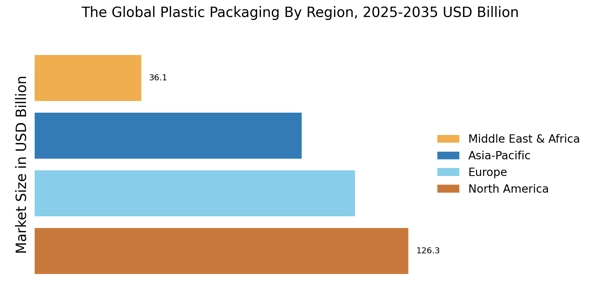
地域別に、調査は北米、ヨーロッパ、アジア太平洋地域、その他の地域における市場の洞察を提供します。北米のプラスチック包装市場は2021年に91896.0042百万米ドルを占め、調査期間中に41.80%のCAGR成長を示すと予想されています。この地域におけるプラスチック包装の柔軟な特性が、食品・飲料、工業、ヘルスケア、パーソナルケア産業での利用増加をもたらしています。さらに、市場報告書で調査された主要国は、アメリカ、カナダ、ドイツ、フランス、イギリス、イタリア、スペイン、中国、日本、インド、オーストラリア、韓国、ブラジルです。
Major market players are spending a lot of capitals on R&D to enhance their product lines, which will aid the Plastic Packaging Market expand. Market players are also taking a range of strategic measures to expand their worldwide footprint, with prime market developments such as new product innovations & launches, contracts & agreements, mergers and acquisitions, better investments, and collaboration & strategic partnerships with other organizations in the plastic packaging market. Competitors in the plastic packaging industry must offer cost-effective items to extend and survive in an increasingly high competitive and expanding market environment.
One of the primary business strategies adopted by manufacturers in the plastic packaging industry to benefit clients and expand the market sector is to manufacture locally to reduce operating costs. In recent years, plastic packaging manufacturer has provided with some of the most significant benefits. The plastic packaging manufacturers major player such as Amcor Ltd (Australia), Wipak Group (Finland), Ampac Holdings LLC (US), BASF SE (Germany), Saint-Gobain (France), and others are working to drive the market growth via investing heavily in research and development activities.
Amcor (Australia) is a company that offers packaging services. Pet bottles, plastic bottles and jars, capsules and closures, customized folding cartons, free films, bags and pouches, wrappers, rigid containers, laminates, and flow packs are just a few of the plastic, fiber, metal, and glass packaging goods it provides.
In January Amcor will present how it is redefining dairy packaging by providing more sustainable solutions and cutting-edge design and delivery, prolonging shelf life for consumers, as the headline sponsor of the 2021 International Dairy Forum. Amcor will also demonstrate the most recent advancements in dairy packaging and sustainability.
Also, Saint-Gobain (France) creates, produces, and distributes products essential to everyone's future well-being and our own. Products from Saint-Gobain are ideal for the packaging industry because they offer a durable, non-stick-release surface and chemical and high-temperature resistance. In manufacturing plastic bags, heat shrinking, sealing, and metal food confinement are common applications.
In April the brilliant idea to offer to use the plastic often used to package its goods to produce aprons for healthcare workers came from Saint-Placo.
Gobain's Placo sent its plastic packaging to nearby businesses to create protective garments for medical crews after passing the initial tests with flying colors.
SABIC, a global chemical industry leader in April 2024 rolled out the first-ever circular packaging project in Saudi Arabia as part of its TRUCIRCLE program aimed at speeding up the implementation of a circular plastic economy. The Oat Arabic Bread from FONTE, one of the key players in the bakery industry in the Kingdom of Saudi Arabia (KSA), now comes with bread bags made out of SABIC’s certified circular polyethylene (PE).
Napco National, a vertically integrated Saudi producer of flexible film and packaging products, manufactures these bags by using two food contact-approved grades of circular polyethylene resin (LLDPE) from the TRUCIRCLE catalog offered by SABIC. Starting March 2023, when this joint project was launched, and continuing until May 2023, when this experiment was successfully accomplished at Napco, FONTE has begun distributing these flexible bags throughout supermarkets located across Saudi Arabia.


January 2021: Amcor will present how it is redefining dairy packaging by providing more sustainable solutions and cutting-edge design and delivery, prolonging shelf life for consumers, as the headline sponsor of the 2021 International Dairy Forum. Amcor will also demonstrate the most recent advancements in dairy packaging and sustainability.In October 2023, Coca-Cola India introduced carbonated beverage bottles made from 100% recycled PET (rPET).
Those new bottles are being manufactured by Moon Beverages and SLMG Beverages which are bottling partners for Coca-Cola.In April 2024, Manjushree Technopack Limited reached definitive agreements to acquire Oricon Enterprises Ltd's plastic packaging business for an enterprise value of Rs.520 crores ($6.29 mn). The acquired company was composed of Oriental Containers, which is a manufacturer of plastic containers and closures primarily used in beverages.
MTL’s completion of this deal will increase the cap and closure market by twice its current position in the industry, with an annual installed capacity approaching 15 billion pieces.In December 2023, Aptar Pharma a wholly owned subsidiary of Aptar Corporation based in United States set up a new manufacturing facility at Mumbai, India to increase production capacity for Southeast Asian markets. Furthermore, it has enhanced its production capabilities so as to improve manufacturing capacity with pharmaceutical customers in Southeast Asia while offering innovative product solutions.
April 2020: the brilliant idea to offer to use the plastic often used to package its goods to produce aprons for healthcare workers came from Saint-Placo. Gobain's Placo sent its plastic packaging to nearby businesses to create protective garments for medical crews after passing the initial tests with flying colors.
グローバルプラスチック包装市場は、2024年から2035年までの間に4.26%のCAGRで成長すると予測されており、持続可能性の取り組み、技術革新、便利さを求める消費者の需要の増加がその要因です。
新しい機会は以下にあります:
2035年までに、市場は進化する消費者の好みや規制の状況を反映して、堅調な成長を遂げると予想されています。
| 市場規模 2024 | 360.86億米ドル |
| 市場規模 2025 | 376.24億米ドル |
| 市場規模 2035 | 571.12億米ドル |
| 年平均成長率 (CAGR) | 4.26% (2024 - 2035) |
| レポートの範囲 | 収益予測、競争環境、成長要因、トレンド |
| 基準年 | 2024 |
| 市場予測期間 | 2025 - 2035 |
| 過去データ | 2019 - 2024 |
| 市場予測単位 | 億米ドル |
| 主要企業のプロファイル | 市場分析進行中 |
| カバーされるセグメント | 市場セグメンテーション分析進行中 |
| 主要市場機会 | グローバルプラスチック包装における持続可能な材料と革新的なデザインの採用。 |
| 主要市場ダイナミクス | 持続可能な包装ソリューションに対する消費者の需要の高まりが、プラスチック包装セクターにおける革新と規制の変化を促進します。 |
| カバーされる国 | 北米、ヨーロッパ、APAC、南米、中東・アフリカ |


The secondary research process involved comprehensive analysis of regulatory frameworks, industry trade databases, sustainability reports, and authoritative packaging organizations. Key sources included the U.S. Food & Drug Administration (FDA), U.S. Environmental Protection Agency (EPA), European Food Safety Authority (EFSA), European Environment Agency (EEA), and the Packaging and Packaging Waste Regulation (PPWR) under the EU Circular Economy Action Plan. Industry data was gathered from the Plastics Industry Association (PLASTICS), Flexible Packaging Association (FPA), EUROPEN (The European Organization for Packaging and the Environment), National Association for PET Container Resources (NAPCOR), and the Association of Plastic Recyclers (APR).
Sustainability and circular economy intelligence was sourced from the Ellen MacArthur Foundation (New Plastics Economy Global Commitment), Ocean Conservancy, and UNEP Global Partnership on Marine Litter. Trade flow and production statistics were analyzed through UN Comtrade Database, Eurostat Waste Statistics, U.S. Census Bureau Foreign Trade Division, and Statistics Canada. Technical and market literature included Packaging Technology and Science, Journal of Plastic Film and Sheeting, Plastics Engineering, and Flexible Packaging magazine. These sources were utilized to collect regulatory compliance data, recycling infrastructure metrics, material pricing trends, production capacity analysis, and end-user demand patterns across polyethylene (PE), polypropylene (PP), polyethylene terephthalate (PET), polystyrene (PS), polyvinyl chloride (PVC), and bioplastics segments.
Qualitative and quantitative insights were obtained by interviewing supply-side and demand-side stakeholders during the primary research process. The supply-side sources comprised CEOs, VPs of Sustainability, leaders of R&D, commercial directors, and plant managers from resin manufacturers, packaging converters, OEM equipment suppliers, and raw material compounders. Procurement directors, packaging engineers, sustainability officers, and supply chain administrators from food & beverage manufacturers, pharmaceutical companies, personal care brands, e-commerce retailers, and chemical processors comprised demand-side sources. Market segmentation was validated, recycling technology deployment timelines were confirmed, and insights regarding lightweighting strategies, extended producer responsibility (EPR) compliance costs, and post-consumer recycled (PCR) content adoption rates were obtained through primary research.
Primary Respondent Breakdown:
By Designation: C-level/Executive Vice Presidents (28%), Vice Presidents/Directors (35%), Managers/Specialists/Others (37%)
By Region: North America (32%), Europe (30%), Asia-Pacific (33%), Rest of World (5%)
Global market valuation was derived through production volume analysis and revenue mapping across the value chain. The methodology included:
Identification of 60+ key manufacturers across North America, Europe, Asia-Pacific, and Latin America, encompassing resin producers, rigid packaging converters (bottles, containers, trays, IBCs, drums), and flexible packaging producers (films, pouches, bags, wraps)
Product mapping across rigid plastic packaging (bottles & jars, containers, trays & pallets, caps & closures, IBCs & drums) and flexible plastic packaging (films & laminates, pouches, bags, tapes & labels, tubes)
Material segmentation analysis covering polyethylene (HDPE, LDPE, LLDPE), polypropylene (PP), polyethylene terephthalate (PET), polystyrene (PS), polyvinyl chloride (PVC), bioplastics, and recycled polymers
Technology assessment across injection molding, blow molding, extrusion, thermoforming, and lamination processes
Analysis of reported and modeled annual revenues specific to plastic packaging portfolios, including virgin resin sales and recycled content offerings
Coverage of manufacturers representing 65-70% of global market share in 2024
Extrapolation using bottom-up (production volume × average selling price by country/material) and top-down (manufacturer revenue validation, trade data reconciliation) approaches to derive segment-specific valuations for food & beverage, healthcare, personal care, industrial, and e-commerce end-use verticals
このレポートの無料サンプルを受け取るには、以下のフォームにご記入ください

“This is really good guys. Excellent work on a tight deadline. I will continue to use you going forward and recommend you to others. Nice job”


“Thanks. It’s been a pleasure working with you, please use me as reference with any other Intel employees.”


“Thanks for sending the report it gives us a good global view of the Betaïne market.”


“Thank you, this will be very helpful for OQS.”


“We found the report very insightful! we found your research firm very helpful. I'm sending this email to secure our future business.”


“I am very pleased with how market segments have been defined in a relevant way for my purposes (such as "Portable Freezers & refrigerators" and "last-mile"). In general the report is well structured. Thanks very much for your efforts.”


“I have been reading the first document or the study, ,the Global HVAC and FP market report 2021 till 2026. Must say, good info! I have not gone in depth at all parts, but got a good indication of the data inside!”


“We got the report in time, we really thank you for your support in this process. I also thank to all of your team as they did a great job.”


“The Automotive 48V ECU Components Procurement Intelligence Study” was a complex project, but the Market Research Future (MRFR) team handled it with quality, agility, and customer-centricity. They delivered all requested data on time and within the agreed scope. The team, including Shubhendra Anand and Rahul Gotadki, was always readily available to clarify questions and swiftly implement necessary adjustments, driving the project to a successful conclusion within a very demanding timeframe.
I would also like to specifically commend Akshay Agarwal for his responsiveness and support at every stage—from our initial inquiry on May 6th through to final delivery on June 18th. His dedication made the entire process seamless.”



