×
Request Free Sample ×

Kindly complete the form below to receive a free sample of this Report

* Please use a valid business email

Leading companies partner with us for data-driven Insights

clients tt-cursor
Hero Background

Pipe Conveyor Belt Market

ID: MRFR/PCM/38180-HCR
100 Pages
Pradeep Nandi
October 2025

Pipe Conveyor Belt Market Research Report: By Application (Mining, Power Generation, Agriculture, Industrial Manufacturing), By Material Type (Rubber, PVC, Fabric, Steel), By Belt Type (Horizontal Pipe Conveyor Belt, Vertical Pipe Conveyor Belt, Combination Pipe Conveyor Belt), By End Use (Bulk Material Handling, Food Industry, Chemical Industry) and By Regional (North America, Europe, South America, Asia Pacific, Middle East and Africa) - Forecast to 2035.

공유
Download PDF ×

We do not share your information with anyone. However, we may send you emails based on your report interest from time to time. You may contact us at any time to opt-out.

Pipe Conveyor Belt Market
 Infographic
Purchase Options

Pipe Conveyor Belt Market 요약

MRFR 분석에 따르면, 파이프 컨베이어 벨트 시장 규모는 2024년에 24억 4,900만 달러로 추정되었습니다. 파이프 컨베이어 벨트 산업은 2025년 25억 7,700만 달러에서 2035년 43억 달러로 성장할 것으로 예상되며, 2025년부터 2035년까지의 예측 기간 동안 연평균 성장률(CAGR)은 5.25%에 이를 것으로 보입니다.

주요 시장 동향 및 하이라이트

파이프 컨베이어 벨트 시장은 기술 발전과 지속 가능성 이니셔티브에 의해 성장할 준비가 되어 있습니다.

  • 기술 발전이 파이프 컨베이어 벨트의 효율성과 내구성을 향상시키고 있으며, 특히 북미에서 두드러집니다.

시장 규모 및 예측

2024 Market Size 2.449 (USD 억)
2035 Market Size 4.3 (억 달러)
CAGR (2025 - 2035) 5.25%

주요 기업

콘티텍 (DE), 던롭 컨베이어 벨팅 (NL), 페너 던롭 (GB), 브리지스톤 (JP), 굿이어 (US), 미츠보시 벨팅 (JP), 반도 화학 산업 (JP), 요코하마 고무 (JP), 슈나이더 일렉트릭 (FR)

Pipe Conveyor Belt Market 동향

The Pipe Conveyor Belt Market is currently experiencing a notable evolution, driven by various factors that influence its growth trajectory. The increasing demand for efficient material handling solutions across diverse industries, such as mining, agriculture, and construction, appears to be a primary catalyst. This market segment is characterized by its ability to transport materials in a closed system, which not only enhances safety but also minimizes environmental impact. Furthermore, advancements in technology and materials science are likely to lead to the development of more durable and efficient conveyor belts, thereby expanding their applications and enhancing operational efficiency. In addition to technological advancements, the Pipe Conveyor Belt Market is also influenced by shifting regulatory frameworks aimed at promoting sustainability. Companies are increasingly adopting eco-friendly practices, which may drive the demand for conveyor systems that reduce waste and energy consumption. Moreover, the growing emphasis on automation and smart technologies in industrial processes suggests a potential shift towards more integrated and intelligent conveyor solutions. As industries continue to evolve, the Pipe Conveyor Belt Market is poised to adapt, reflecting broader trends in sustainability and efficiency.

Technological Advancements

Recent innovations in materials and design are enhancing the performance of pipe conveyor belts. These advancements may lead to increased durability, reduced maintenance costs, and improved efficiency in material handling.

Sustainability Initiatives

The growing focus on environmental responsibility is prompting industries to seek eco-friendly conveyor solutions. This trend indicates a shift towards systems that minimize waste and energy consumption.

Automation Integration

The rise of automation in manufacturing and logistics is likely to influence the Pipe Conveyor Belt Market. Smart technologies may enhance operational efficiency and streamline material handling processes.

Pipe Conveyor Belt Market Treiber

재료 과학의 혁신

Innovations in material science are significantly influencing the Pipe Conveyor Belt Market. The development of advanced materials, such as high-strength polymers and composite materials, enhances the durability and efficiency of pipe conveyor belts. These innovations not only improve the lifespan of the belts but also reduce maintenance costs, which is a critical factor for industries relying on continuous operations. Furthermore, the introduction of lightweight materials is likely to facilitate easier installation and operation, thereby expanding the market. As industries increasingly seek cost-effective and efficient solutions, the demand for technologically advanced pipe conveyor belts is expected to rise, reflecting a shift towards more sustainable practices.

환경 규제에 대한 집중 증가

The Pipe Conveyor Belt Market is also being shaped by the growing focus on environmental regulations. As industries face increasing pressure to minimize their environmental footprint, the adoption of eco-friendly conveyor systems is becoming more prevalent. Pipe conveyor belts, known for their enclosed design, significantly reduce dust emissions and material spillage, aligning with regulatory requirements. This trend is particularly evident in sectors such as mining and waste management, where compliance with environmental standards is critical. The market is likely to see a shift towards manufacturers that prioritize sustainability in their product offerings, potentially leading to increased market share for eco-conscious companies.

물류 및 운송 네트워크의 확장

The expansion of logistics and transportation networks is a key driver for the Pipe Conveyor Belt Market. As supply chains become more complex and globalized, the need for efficient material handling solutions is paramount. Pipe conveyor belts offer a versatile solution for transporting materials in various settings, including ports, warehouses, and manufacturing facilities. The logistics sector is projected to grow at a steady pace, with an expected increase in freight volumes. This growth is likely to create new opportunities for pipe conveyor belt manufacturers, as companies seek to optimize their operations and reduce transportation costs. The integration of pipe conveyor systems into logistics networks may enhance overall efficiency and productivity.

광업 및 건설 분야의 증가하는 수요

The Pipe Conveyor Belt Market is experiencing a notable surge in demand, particularly driven by the mining and construction sectors. These industries require efficient material handling solutions to transport bulk materials over long distances and challenging terrains. The increasing investments in infrastructure development and mining activities are likely to propel the demand for pipe conveyor belts. According to recent data, the mining sector alone is projected to grow at a compound annual growth rate of approximately 5.2% over the next few years. This growth indicates a robust market for pipe conveyor belts, as they offer advantages such as reduced spillage and enhanced safety, making them a preferred choice for material transport.

재생 가능 에너지 프로젝트에 대한 투자 증가

Increased investment in renewable energy projects is emerging as a significant driver for the Pipe Conveyor Belt Market. As countries strive to transition towards sustainable energy sources, the demand for efficient material handling solutions in renewable energy sectors, such as wind and solar, is likely to rise. Pipe conveyor belts are well-suited for transporting materials like sand, gravel, and other components used in renewable energy installations. The global push for cleaner energy solutions is expected to lead to a surge in projects requiring effective material transport systems. Consequently, this trend may result in a heightened demand for pipe conveyor belts, as industries adapt to the evolving energy landscape.

시장 세그먼트 통찰력

응용 분야별: 광업(가장 큰) 대 발전(가장 빠르게 성장하는)

The Pipe Conveyor Belt Market is characterized by a diverse range of applications, among which mining holds the largest market share. This segment significantly benefits from its extensive utilization in transporting bulk materials such as coal, minerals, and aggregates, showcasing its dominance in the market. Agriculture and industrial manufacturing also contribute to the market, albeit at a smaller scale. The mining industry’s reliance on conveyor systems enhances its operational efficiency, making it a crucial component of the sector. On the other hand, the power generation segment is recognized as the fastest-growing within the Pipe Conveyor Belt Market. This rapid growth is primarily driven by the increasing demand for efficient and automated material handling systems in power plants. The shift towards renewable energy sources also propels the requirement for advanced conveyor solutions that can manage various types of fuels, thereby fostering innovation and expansion in this segment.

광업 (주요) 대 농업 (신흥)

In the context of the Pipe Conveyor Belt Market, mining is the dominant application, primarily due to its extensive reliance on conveyor systems for efficient bulk material transportation. Mining operations benefit from the durability and reliability of pipe conveyors, which can handle a variety of materials while navigating complex terrains. In contrast, agriculture emerges as a growing segment, investing in conveyor solutions to streamline operations, enhance productivity, and reduce labor costs. Although smaller in market share, agricultural applications are increasingly adopting advanced conveyor technologies to manage feed, fertilizers, and grains, indicating a shift towards mechanization and efficiency in the sector.

By Material Type: Rubber (Largest) vs. PVC (Fastest-Growing)

The Pipe Conveyor Belt Market exhibits a diverse material type distribution, with rubber leading the pack due to its durability and resistance to wear and tear. This segment captures the largest market share, driven by increasing demand from industries such as mining and bulk material transport. PVC, while currently smaller in market share, is rapidly gaining traction due to its lightweight and cost-effective properties, making it an attractive choice for emerging applications. As environmental concerns rise, alternative materials like PVC are seeing accelerated adoption. The growth is fueled by innovations in formulation and production that enhance performance characteristics. Furthermore, the ongoing expansion of infrastructure projects worldwide necessitates efficient conveying systems, bolstering the demand for both rubber and PVC materials in the pipe conveyor belt sector.

Rubber (Dominant) vs. Steel (Emerging)

Rubber is the dominant material in the Pipe Conveyor Belt Market, known for its exceptional strength and flexibility, making it ideal for heavy-duty applications. Companies favor rubber due to its excellent resistance to impacts, chemicals, and extreme weather conditions. The segment remains preferred in sectors where reliability and longevity are paramount. In contrast, steel is emerging as a significant contender, particularly in applications that require increased load-bearing capacity and durability. Although still capturing a smaller share of the market, advancements in steel technology are enhancing its performance, making it increasingly suitable for high-tonnage operations. As manufacturers seek higher efficiency in transport systems, steel's unique benefits are poised to become more prominent in the coming years.

By Belt Type: Horizontal Pipe Conveyor Belt (Largest) vs. Vertical Pipe Conveyor Belt (Fastest-Growing)

In the Pipe Conveyor Belt Market, the Horizontal Pipe Conveyor Belt segment holds the largest share, attributed to its established utilization in various industries for transporting bulk materials efficiently. This segment is favored for its simple design and ability to handle large volumes, making it a reliable choice for many businesses. Meanwhile, the Vertical Pipe Conveyor Belt segment is rapidly gaining traction, driven by the need for space-saving solutions and its efficiency in transporting materials in limited areas.

Horizontal Pipe Conveyor Belt (Dominant) vs. Vertical Pipe Conveyor Belt (Emerging)

The Horizontal Pipe Conveyor Belt segment is recognized for its dominant market position, largely due to its proven reliability and extensive applications in industries such as mining and construction. It effectively reduces environmental impact by enclosing conveyed materials and minimizes spillage, leading to enhanced operational efficiency. In contrast, the Vertical Pipe Conveyor Belt is emerging as a significant alternative, designed to facilitate the vertical transportation of materials. This segment appeals particularly to sectors where floor space is at a premium, offering innovative solutions that allow for elevation without compromising throughput, thus reflecting a growing trend towards efficient material handling systems.

By End Use: Bulk Material Handling (Largest) vs. Food Industry (Fastest-Growing)

In the Pipe Conveyor Belt Market, 'Bulk Material Handling' holds the largest share, reflecting the robust demand across industries involved in transporting large quantities of materials. The operational efficiency and cost-effectiveness of pipe conveyors significantly contribute to their preference in sectors dealing with heavy-duty processes. Meanwhile, the 'Food Industry' emerges as an essential segment, increasingly adopting pipe conveyor systems to ensure the safe and hygienic transport of food products, thereby showcasing the versatility of this technology. Growth trends indicate a strong inclination towards automation and process optimization across these sectors. The 'Bulk Material Handling' segment sees consistent demand driven by infrastructure projects and mining activities. In contrast, the 'Food Industry' benefits from strict compliance with hygiene standards and increased focus on efficient supply chains. These trends underpin the evolving landscape of the Pipe Conveyor Belt Market, highlighting a dynamic exchange between established practices and innovations.

Bulk Material Handling: Dominant vs. Food Industry: Emerging

The 'Bulk Material Handling' segment is characterized by its significant role in industries such as mining, construction, and waste management, where the need for transporting heavy materials seamlessly is critical. The systems employed in this sector are robust, designed to handle extreme conditions and large quantities, making them indispensable in operational processes. On the other hand, the 'Food Industry' represents an emerging segment, showcasing growing adoption due to its emphasis on maintaining product quality and safety. Innovations such as sanitary design and easy cleanability are key factors driving market penetration. Both segments illustrate the adaptability of pipe conveyor belts, positioning them as a bridge between reliability and technological advancement.

Pipe Conveyor Belt Market 에 대한 더 자세한 통찰력 얻기

지역 통찰력

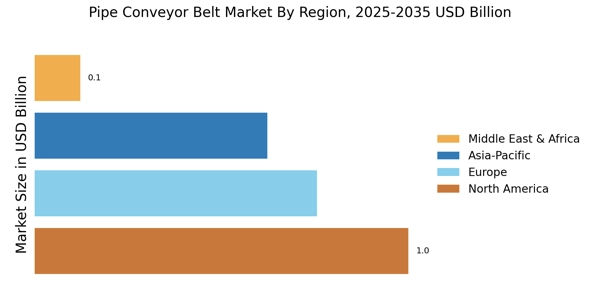
North America : Innovation and Demand Surge

The North American pipe conveyor belt market is driven by increasing demand from industries such as mining, construction, and agriculture. The region holds the largest market share at approximately 40%, with the U.S. being the primary contributor. Regulatory support for infrastructure development and sustainability initiatives further catalyzes growth. The market is also witnessing a shift towards advanced materials and technologies to enhance efficiency and reduce environmental impact. Leading countries in this region include the United States and Canada, with major players like Goodyear and ContiTech dominating the landscape. The competitive environment is characterized by innovation and strategic partnerships aimed at improving product offerings. The presence of established manufacturers and a robust supply chain network further strengthens the market position in North America.

Europe : Sustainability and Innovation Focus

Europe is witnessing a significant transformation in the pipe conveyor belt market, driven by stringent environmental regulations and a push for sustainable practices. The region holds the second-largest market share at around 30%. Countries like Germany and the Netherlands are leading the charge, with a growing emphasis on recycling and eco-friendly materials. Regulatory frameworks are encouraging investments in innovative technologies that enhance operational efficiency and reduce carbon footprints. Germany, the UK, and France are key players in this market, with companies like Dunlop Conveyor Belting and Schneider Electric leading the way. The competitive landscape is marked by a focus on R&D and collaboration among manufacturers to meet evolving customer demands. The presence of advanced manufacturing facilities and a skilled workforce further bolster the region's market potential.

Asia-Pacific : Rapid Growth and Expansion

The Asia-Pacific region is experiencing rapid growth in the pipe conveyor belt market, driven by industrialization and urbanization. This region is projected to hold a market share of approximately 25%. Countries like China and India are at the forefront, with increasing investments in infrastructure and mining sectors. Regulatory support for industrial growth and modernization is further propelling demand for advanced conveyor solutions. China is the largest market, followed by India, with significant contributions from local manufacturers and international players. Companies like Bridgestone and Yokohama Rubber are expanding their presence to cater to the growing demand. The competitive landscape is characterized by a mix of established firms and emerging players, focusing on innovation and cost-effective solutions to capture market share.

Middle East and Africa : Resource-Rich and Growing Demand

The Middle East and Africa (MEA) region is witnessing a gradual increase in the pipe conveyor belt market, driven by resource extraction and infrastructure development. The market share is estimated to be around 5%. Countries like South Africa and the UAE are leading the way, with investments in mining and construction projects. Regulatory frameworks are evolving to support industrial growth, creating opportunities for manufacturers in the region. South Africa is the largest market in this region, with a growing presence of international players like Fenner Dunlop. The competitive landscape is still developing, with local manufacturers emerging to meet the increasing demand. The focus on enhancing operational efficiency and sustainability is shaping the market dynamics, providing a platform for growth and innovation.

Pipe Conveyor Belt Market
 Regional Image

주요 기업 및 경쟁 통찰력

파이프 컨베이어 벨트 시장은 다양한 산업에서 효율적인 자재 처리 솔루션에 대한 수요 증가로 인해 치열한 경쟁이 특징입니다. 기업들이 운영 최적화를 위해 노력함에 따라 신뢰할 수 있고 고성능의 컨베이어 벨트의 중요성이 크게 증가했습니다. 이 시장은 기술 발전, 자동화 필요성, 제조 및 운송 과정에서의 지속 가능성 추진에 영향을 받습니다. 이 시장의 주요 기업들은 제품 혁신, 전략적 파트너십, 지리적 범위 확장에 집중하여 경쟁 우위를 강화하고 있습니다.

첨단 소재 및 제조 기술의 지속적인 개발은 시장 역학을 형성하는 데 중요한 역할을 하며, 원자재 가격 변동과 환경 규제는 이 분야에서 활동하는 기업들에게 여전히 중요한 도전 과제가 됩니다. 하바싯 AG는 품질과 신뢰성에 대한 강한 강조로 인해 파이프 컨베이어 벨트 시장에서 두드러집니다. 이 회사는 도전적인 운영 조건에서 원활한 성능을 보장하도록 설계된 혁신적인 제품으로 확고한 명성을 쌓아왔습니다. 강력한 글로벌 존재감을 가진 하바싯 AG는 광범위한 유통 네트워크와 기술 지원 능력을 활용하여 다양한 고객층에 서비스를 제공합니다.

그들의 연구 및 개발에 대한 헌신은 시장 트렌드에 앞서고 특정 고객의 요구를 충족할 수 있게 해줍니다. 회사의 지속 가능한 솔루션과 향상된 벨트 내구성에 대한 집중은 시장 위치를 더욱 강화하여 동종 업계에서 경쟁 우위를 유지할 수 있게 합니다. 하바싯 AG의 변화하는 시장 수요에 적응하면서도 높은 성능 기준을 유지하는 능력은 파이프 컨베이어 벨트 부문에서의 전략적 강점을 잘 보여줍니다. 베이언스 테크놀로지스는 파이프 컨베이어 벨트 시장에서 또 다른 중요한 플레이어로, 이 산업에 풍부한 경험과 전문성을 제공합니다.

이 회사는 다양한 자재 처리 응용 프로그램에 대한 효과적인 솔루션을 제공하는 고급 벨트 디자인 및 엔지니어링 능력으로 인정받고 있습니다. 베이언스 테크놀로지스는 컨베이어 시스템에서 최적화된 성능과 신뢰성을 추구하는 조직의 신뢰할 수 있는 파트너로 성공적으로 자리 잡았습니다. 혁신에 중점을 두고, 이 회사는 제품의 기능성과 내구성을 향상시키는 새로운 기술 개발에 지속적으로 투자하고 있습니다. 그들의 광범위한 제품군과 고객 서비스 및 지원에 대한 헌신은 베이언스 테크놀로지스가 충성도 높은 고객 기반을 구축할 수 있게 해주었습니다.

이와 함께 시장 범위를 확장하기 위한 전략적 이니셔티브는 베이언스 테크놀로지스의 글로벌 파이프 컨베이어 벨트 시장에서의 강력한 경쟁자로서의 지위를 확고히 합니다.

Pipe Conveyor Belt Market 시장의 주요 기업은 다음과 같습니다

산업 발전

In recent developments within the Pipe Conveyor Belt Market, companies such as Habasit AG and Continental AG have been focusing on enhancing their product portfolios to cater to increasing demand across various sectors. The market dynamics have shifted notably due to a surge in infrastructure projects and materials handling, propelling the growth of emerging manufacturers. Veyance Technologies and Goodyear Tire and Rubber Company have been actively pursuing innovations in conveyor belt technologies to improve efficiency and durability.

Additionally, Fenner Dunlop and Bando Chemical Industries have reported strategic collaborations to expand their market presence and technological capabilities. Noteworthy acquisition activities include several companies looking to consolidate their positions amidst growing competition, although specific mergers have not been disclosed. Companies like Cobra Europe and Trelleborg AB are also known to be modernizing manufacturing processes to align with sustainability goals. The overall market is expected to witness significant growth, driven by increasing construction activities and advancements in belt technology, impacting companies such as Dunlop Conveyor Belting and Flexco positively in terms of market share and valuation.

향후 전망

Pipe Conveyor Belt Market 향후 전망

The Pipe Conveyor Belt Market is projected to grow at a 5.25% CAGR from 2024 to 2035, driven by increasing demand for efficient material handling and sustainability initiatives.

새로운 기회는 다음에 있습니다:

  • Development of eco-friendly conveyor materials to meet sustainability goals.
  • Integration of IoT technology for real-time monitoring and predictive maintenance.
  • Expansion into emerging markets with tailored solutions for local industries.

By 2035, the Pipe Conveyor Belt Market is expected to achieve robust growth, reflecting evolving industry needs.

시장 세분화

파이프 컨베이어 벨트 시장 응용 전망

  • Mining
  • Power Generation
  • Agriculture
  • Industrial Manufacturing

파이프 컨베이어 벨트 시장 벨트 유형 전망

  • Horizontal Pipe Conveyor Belt
  • Vertical Pipe Conveyor Belt
  • Combination Pipe Conveyor Belt

파이프 컨베이어 벨트 시장 소재 유형 전망

  • Rubber
  • PVC
  • Fabric
  • Steel

파이프 컨베이어 벨트 시장 최종 용도 전망

  • Bulk Material Handling
  • Food Industry
  • Chemical Industry

보고서 범위

MARKET SIZE 20242.449(USD Billion)
MARKET SIZE 20252.577(USD Billion)
MARKET SIZE 20354.3(USD Billion)
COMPOUND ANNUAL GROWTH RATE (CAGR)5.25% (2024 - 2035)
REPORT COVERAGERevenue Forecast, Competitive Landscape, Growth Factors, and Trends
BASE YEAR2024
Market Forecast Period2025 - 2035
Historical Data2019 - 2024
Market Forecast UnitsUSD Billion
Key Companies ProfiledMarket analysis in progress
Segments CoveredMarket segmentation analysis in progress
Key Market OpportunitiesIntegration of advanced materials enhances efficiency and sustainability in the Pipe Conveyor Belt Market.
Key Market DynamicsRising demand for efficient material handling solutions drives innovation and competition in the Pipe Conveyor Belt Market.
Countries CoveredNorth America, Europe, APAC, South America, MEA

댓글 남기기

FAQs

2035년까지 파이프 컨베이어 벨트 시장의 예상 시장 가치는 얼마입니까?

파이프 컨베이어 벨트 시장은 2035년까지 43억 달러의 가치를 달성할 것으로 예상됩니다.

2024년 파이프 컨베이어 벨트 시장의 시장 가치는 얼마였습니까?

파이프 컨베이어 벨트 시장의 전체 시장 가치는 2024년에 24억 4,900만 USD였습니다.

2025년부터 2035년까지의 예측 기간 동안 파이프 컨베이어 벨트 시장의 예상 CAGR은 얼마입니까?

2025 - 2035년 예측 기간 동안 파이프 컨베이어 벨트 시장의 예상 CAGR은 5.25%입니다.

파이프 컨베이어 벨트 시장에서 가장 높은 성장을 보일 것으로 예상되는 애플리케이션 세그먼트는 무엇입니까?

채굴 애플리케이션 부문은 2024년 0.979억 USD에서 2035년 1.75억 USD로 성장할 것으로 예상됩니다.

파이프 컨베이어 벨트 시장에서 사용되는 주요 자재는 무엇인가요?

주요 자재로는 고무, PVC, 직물 및 강철이 포함되며, 고무는 2024년 0.979억 USD에서 2035년까지 1.75억 USD로 성장할 것으로 예상됩니다.

파이프 컨베이어 벨트 시장에서 주요 기업은 어떤 곳인가요?

파이프 컨베이어 벨트 시장의 주요 업체로는 ContiTech, Dunlop Conveyor Belting, Fenner Dunlop, Bridgestone 등이 있습니다.

파이프 컨베이어 벨트 시장에서 식품 산업 부문의 예상 성장률은 얼마입니까?

식품 산업 부문은 2024년 0.735억 USD에서 2035년까지 1.3억 USD로 성장할 것으로 예상됩니다.

수직 파이프 컨베이어 벨트의 성능은 다른 벨트 유형과 어떻게 비교됩니까?

수직 파이프 컨베이어 벨트는 2024년 0.735억 USD에서 2035년까지 1.25억 USD로 성장할 것으로 예상되며, 이는 강력한 수요를 나타냅니다.

파이프 컨베이어 벨트 시장에서 화학 산업 부문의 예상 성장 궤적은 무엇인가요?

화학 산업 부문은 2024년 0.735억 USD에서 2035년까지 1.3억 USD로 성장할 것으로 예상됩니다.

무료 샘플 다운로드

이 보고서의 무료 샘플을 받으려면 아래 양식을 작성하십시오

Compare Licence

×
Features License Type
Single User Multiuser License Enterprise User
Price $4,950 $5,950 $7,250
Maximum User Access Limit 1 User Upto 10 Users Unrestricted Access Throughout the Organization
Free Customization
Direct Access to Analyst
Deliverable Format
Platform Access
Discount on Next Purchase 10% 15% 15%
Printable Versions