×
Request Free Sample ×

Kindly complete the form below to receive a free sample of this Report

* Please use a valid business email

Leading companies partner with us for data-driven Insights

clients tt-cursor
Hero Background

Pipe Conveyor Belt Market

ID: MRFR/PCM/38180-HCR
100 Pages
Pradeep Nandi
October 2025

Pipe Conveyor Belt Market Research Report: By Application (Mining, Power Generation, Agriculture, Industrial Manufacturing), By Material Type (Rubber, PVC, Fabric, Steel), By Belt Type (Horizontal Pipe Conveyor Belt, Vertical Pipe Conveyor Belt, Combination Pipe Conveyor Belt), By End Use (Bulk Material Handling, Food Industry, Chemical Industry) and By Regional (North America, Europe, South America, Asia Pacific, Middle East and Africa) - Forecast to 2035.

Teilen
Download PDF ×

We do not share your information with anyone. However, we may send you emails based on your report interest from time to time. You may contact us at any time to opt-out.

Pipe Conveyor Belt Market
 Infographic
Purchase Options

Pipe Conveyor Belt Market Zusammenfassung

Laut der Analyse von MRFR wurde die Marktgröße für Rohrförderbänder im Jahr 2024 auf 2,449 Milliarden USD geschätzt. Die Branche der Rohrförderbänder wird voraussichtlich von 2,577 im Jahr 2025 auf 4,3 bis 2035 wachsen, was einer durchschnittlichen jährlichen Wachstumsrate (CAGR) von 5,25 während des Prognosezeitraums 2025 - 2035 entspricht.

Wichtige Markttrends & Highlights

Der Markt für Rohrförderbänder steht vor einem Wachstum, das durch technologische Fortschritte und Nachhaltigkeitsinitiativen vorangetrieben wird.

  • Technologische Fortschritte verbessern die Effizienz und Haltbarkeit von Fördergurten, insbesondere in Nordamerika.
  • Nachhaltigkeitsinitiativen beeinflussen zunehmend die Marktdynamik, mit einem Fokus auf umweltfreundliche Materialien und Praktiken.
  • Der Bergbausektor bleibt der größte Markt, während der Energiesektor in der Asien-Pazifik-Region ein schnelles Wachstum verzeichnet.
  • Die steigende Nachfrage in den Bereichen Bergbau und Bauwesen sowie Innovationen in der Materialwissenschaft sind die Haupttreiber des Marktwachstums.

Marktgröße & Prognose

2024 Market Size 2.449 (USD Milliarden)
2035 Market Size 4,3 (USD Milliarden)
CAGR (2025 - 2035) 5,25 %

Hauptakteure

ContiTech (DE), Dunlop Conveyor Belting (NL), Fenner Dunlop (GB), Bridgestone (JP), Goodyear (US), Mitsuboshi Belting (JP), Bando Chemical Industries (JP), Yokohama Rubber (JP), Schneider Electric (FR)

Pipe Conveyor Belt Market Trends

The Pipe Conveyor Belt Market is currently experiencing a notable evolution, driven by various factors that influence its growth trajectory. The increasing demand for efficient material handling solutions across diverse industries, such as mining, agriculture, and construction, appears to be a primary catalyst. This market segment is characterized by its ability to transport materials in a closed system, which not only enhances safety but also minimizes environmental impact. Furthermore, advancements in technology and materials science are likely to lead to the development of more durable and efficient conveyor belts, thereby expanding their applications and enhancing operational efficiency. In addition to technological advancements, the Pipe Conveyor Belt Market is also influenced by shifting regulatory frameworks aimed at promoting sustainability. Companies are increasingly adopting eco-friendly practices, which may drive the demand for conveyor systems that reduce waste and energy consumption. Moreover, the growing emphasis on automation and smart technologies in industrial processes suggests a potential shift towards more integrated and intelligent conveyor solutions. As industries continue to evolve, the Pipe Conveyor Belt Market is poised to adapt, reflecting broader trends in sustainability and efficiency.

Technological Advancements

Recent innovations in materials and design are enhancing the performance of pipe conveyor belts. These advancements may lead to increased durability, reduced maintenance costs, and improved efficiency in material handling.

Sustainability Initiatives

The growing focus on environmental responsibility is prompting industries to seek eco-friendly conveyor solutions. This trend indicates a shift towards systems that minimize waste and energy consumption.

Automation Integration

The rise of automation in manufacturing and logistics is likely to influence the Pipe Conveyor Belt Market. Smart technologies may enhance operational efficiency and streamline material handling processes.

Pipe Conveyor Belt Market Treiber

Innovationen in der Materialwissenschaft

Innovations in material science are significantly influencing the Pipe Conveyor Belt Market. The development of advanced materials, such as high-strength polymers and composite materials, enhances the durability and efficiency of pipe conveyor belts. These innovations not only improve the lifespan of the belts but also reduce maintenance costs, which is a critical factor for industries relying on continuous operations. Furthermore, the introduction of lightweight materials is likely to facilitate easier installation and operation, thereby expanding the market. As industries increasingly seek cost-effective and efficient solutions, the demand for technologically advanced pipe conveyor belts is expected to rise, reflecting a shift towards more sustainable practices.

Wachsende Konzentration auf Umweltvorschriften

The Pipe Conveyor Belt Market is also being shaped by the growing focus on environmental regulations. As industries face increasing pressure to minimize their environmental footprint, the adoption of eco-friendly conveyor systems is becoming more prevalent. Pipe conveyor belts, known for their enclosed design, significantly reduce dust emissions and material spillage, aligning with regulatory requirements. This trend is particularly evident in sectors such as mining and waste management, where compliance with environmental standards is critical. The market is likely to see a shift towards manufacturers that prioritize sustainability in their product offerings, potentially leading to increased market share for eco-conscious companies.

Erweiterung von Logistik- und Transportnetzwerken

The expansion of logistics and transportation networks is a key driver for the Pipe Conveyor Belt Market. As supply chains become more complex and globalized, the need for efficient material handling solutions is paramount. Pipe conveyor belts offer a versatile solution for transporting materials in various settings, including ports, warehouses, and manufacturing facilities. The logistics sector is projected to grow at a steady pace, with an expected increase in freight volumes. This growth is likely to create new opportunities for pipe conveyor belt manufacturers, as companies seek to optimize their operations and reduce transportation costs. The integration of pipe conveyor systems into logistics networks may enhance overall efficiency and productivity.

Steigende Nachfrage in den Bergbau- und Bausektoren

The Pipe Conveyor Belt Market is experiencing a notable surge in demand, particularly driven by the mining and construction sectors. These industries require efficient material handling solutions to transport bulk materials over long distances and challenging terrains. The increasing investments in infrastructure development and mining activities are likely to propel the demand for pipe conveyor belts. According to recent data, the mining sector alone is projected to grow at a compound annual growth rate of approximately 5.2% over the next few years. This growth indicates a robust market for pipe conveyor belts, as they offer advantages such as reduced spillage and enhanced safety, making them a preferred choice for material transport.

Erhöhte Investitionen in Projekte für erneuerbare Energien

Increased investment in renewable energy projects is emerging as a significant driver for the Pipe Conveyor Belt Market. As countries strive to transition towards sustainable energy sources, the demand for efficient material handling solutions in renewable energy sectors, such as wind and solar, is likely to rise. Pipe conveyor belts are well-suited for transporting materials like sand, gravel, and other components used in renewable energy installations. The global push for cleaner energy solutions is expected to lead to a surge in projects requiring effective material transport systems. Consequently, this trend may result in a heightened demand for pipe conveyor belts, as industries adapt to the evolving energy landscape.

Einblicke in Marktsegmente

Nach Anwendung: Bergbau (Größter) vs. Stromerzeugung (Schnellstwachsende)

The Pipe Conveyor Belt Market is characterized by a diverse range of applications, among which mining holds the largest market share. This segment significantly benefits from its extensive utilization in transporting bulk materials such as coal, minerals, and aggregates, showcasing its dominance in the market. Agriculture and industrial manufacturing also contribute to the market, albeit at a smaller scale. The mining industry’s reliance on conveyor systems enhances its operational efficiency, making it a crucial component of the sector. On the other hand, the power generation segment is recognized as the fastest-growing within the Pipe Conveyor Belt Market. This rapid growth is primarily driven by the increasing demand for efficient and automated material handling systems in power plants. The shift towards renewable energy sources also propels the requirement for advanced conveyor solutions that can manage various types of fuels, thereby fostering innovation and expansion in this segment.

Bergbau (Dominant) vs. Landwirtschaft (Emerging)

In the context of the Pipe Conveyor Belt Market, mining is the dominant application, primarily due to its extensive reliance on conveyor systems for efficient bulk material transportation. Mining operations benefit from the durability and reliability of pipe conveyors, which can handle a variety of materials while navigating complex terrains. In contrast, agriculture emerges as a growing segment, investing in conveyor solutions to streamline operations, enhance productivity, and reduce labor costs. Although smaller in market share, agricultural applications are increasingly adopting advanced conveyor technologies to manage feed, fertilizers, and grains, indicating a shift towards mechanization and efficiency in the sector.

By Material Type: Rubber (Largest) vs. PVC (Fastest-Growing)

The Pipe Conveyor Belt Market exhibits a diverse material type distribution, with rubber leading the pack due to its durability and resistance to wear and tear. This segment captures the largest market share, driven by increasing demand from industries such as mining and bulk material transport. PVC, while currently smaller in market share, is rapidly gaining traction due to its lightweight and cost-effective properties, making it an attractive choice for emerging applications. As environmental concerns rise, alternative materials like PVC are seeing accelerated adoption. The growth is fueled by innovations in formulation and production that enhance performance characteristics. Furthermore, the ongoing expansion of infrastructure projects worldwide necessitates efficient conveying systems, bolstering the demand for both rubber and PVC materials in the pipe conveyor belt sector.

Rubber (Dominant) vs. Steel (Emerging)

Rubber is the dominant material in the Pipe Conveyor Belt Market, known for its exceptional strength and flexibility, making it ideal for heavy-duty applications. Companies favor rubber due to its excellent resistance to impacts, chemicals, and extreme weather conditions. The segment remains preferred in sectors where reliability and longevity are paramount. In contrast, steel is emerging as a significant contender, particularly in applications that require increased load-bearing capacity and durability. Although still capturing a smaller share of the market, advancements in steel technology are enhancing its performance, making it increasingly suitable for high-tonnage operations. As manufacturers seek higher efficiency in transport systems, steel's unique benefits are poised to become more prominent in the coming years.

By Belt Type: Horizontal Pipe Conveyor Belt (Largest) vs. Vertical Pipe Conveyor Belt (Fastest-Growing)

In the Pipe Conveyor Belt Market, the Horizontal Pipe Conveyor Belt segment holds the largest share, attributed to its established utilization in various industries for transporting bulk materials efficiently. This segment is favored for its simple design and ability to handle large volumes, making it a reliable choice for many businesses. Meanwhile, the Vertical Pipe Conveyor Belt segment is rapidly gaining traction, driven by the need for space-saving solutions and its efficiency in transporting materials in limited areas.

Horizontal Pipe Conveyor Belt (Dominant) vs. Vertical Pipe Conveyor Belt (Emerging)

The Horizontal Pipe Conveyor Belt segment is recognized for its dominant market position, largely due to its proven reliability and extensive applications in industries such as mining and construction. It effectively reduces environmental impact by enclosing conveyed materials and minimizes spillage, leading to enhanced operational efficiency. In contrast, the Vertical Pipe Conveyor Belt is emerging as a significant alternative, designed to facilitate the vertical transportation of materials. This segment appeals particularly to sectors where floor space is at a premium, offering innovative solutions that allow for elevation without compromising throughput, thus reflecting a growing trend towards efficient material handling systems.

By End Use: Bulk Material Handling (Largest) vs. Food Industry (Fastest-Growing)

In the Pipe Conveyor Belt Market, 'Bulk Material Handling' holds the largest share, reflecting the robust demand across industries involved in transporting large quantities of materials. The operational efficiency and cost-effectiveness of pipe conveyors significantly contribute to their preference in sectors dealing with heavy-duty processes. Meanwhile, the 'Food Industry' emerges as an essential segment, increasingly adopting pipe conveyor systems to ensure the safe and hygienic transport of food products, thereby showcasing the versatility of this technology. Growth trends indicate a strong inclination towards automation and process optimization across these sectors. The 'Bulk Material Handling' segment sees consistent demand driven by infrastructure projects and mining activities. In contrast, the 'Food Industry' benefits from strict compliance with hygiene standards and increased focus on efficient supply chains. These trends underpin the evolving landscape of the Pipe Conveyor Belt Market, highlighting a dynamic exchange between established practices and innovations.

Bulk Material Handling: Dominant vs. Food Industry: Emerging

The 'Bulk Material Handling' segment is characterized by its significant role in industries such as mining, construction, and waste management, where the need for transporting heavy materials seamlessly is critical. The systems employed in this sector are robust, designed to handle extreme conditions and large quantities, making them indispensable in operational processes. On the other hand, the 'Food Industry' represents an emerging segment, showcasing growing adoption due to its emphasis on maintaining product quality and safety. Innovations such as sanitary design and easy cleanability are key factors driving market penetration. Both segments illustrate the adaptability of pipe conveyor belts, positioning them as a bridge between reliability and technological advancement.

Erhalten Sie detailliertere Einblicke zu Pipe Conveyor Belt Market

Regionale Einblicke

North America : Innovation and Demand Surge

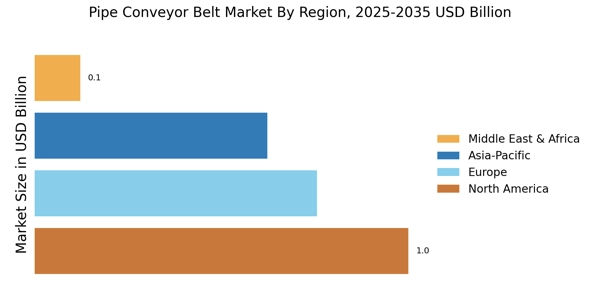
The North American pipe conveyor belt market is driven by increasing demand from industries such as mining, construction, and agriculture. The region holds the largest market share at approximately 40%, with the U.S. being the primary contributor. Regulatory support for infrastructure development and sustainability initiatives further catalyzes growth. The market is also witnessing a shift towards advanced materials and technologies to enhance efficiency and reduce environmental impact. Leading countries in this region include the United States and Canada, with major players like Goodyear and ContiTech dominating the landscape. The competitive environment is characterized by innovation and strategic partnerships aimed at improving product offerings. The presence of established manufacturers and a robust supply chain network further strengthens the market position in North America.

Europe : Sustainability and Innovation Focus

Europe is witnessing a significant transformation in the pipe conveyor belt market, driven by stringent environmental regulations and a push for sustainable practices. The region holds the second-largest market share at around 30%. Countries like Germany and the Netherlands are leading the charge, with a growing emphasis on recycling and eco-friendly materials. Regulatory frameworks are encouraging investments in innovative technologies that enhance operational efficiency and reduce carbon footprints. Germany, the UK, and France are key players in this market, with companies like Dunlop Conveyor Belting and Schneider Electric leading the way. The competitive landscape is marked by a focus on R&D and collaboration among manufacturers to meet evolving customer demands. The presence of advanced manufacturing facilities and a skilled workforce further bolster the region's market potential.

Asia-Pacific : Rapid Growth and Expansion

The Asia-Pacific region is experiencing rapid growth in the pipe conveyor belt market, driven by industrialization and urbanization. This region is projected to hold a market share of approximately 25%. Countries like China and India are at the forefront, with increasing investments in infrastructure and mining sectors. Regulatory support for industrial growth and modernization is further propelling demand for advanced conveyor solutions. China is the largest market, followed by India, with significant contributions from local manufacturers and international players. Companies like Bridgestone and Yokohama Rubber are expanding their presence to cater to the growing demand. The competitive landscape is characterized by a mix of established firms and emerging players, focusing on innovation and cost-effective solutions to capture market share.

Middle East and Africa : Resource-Rich and Growing Demand

The Middle East and Africa (MEA) region is witnessing a gradual increase in the pipe conveyor belt market, driven by resource extraction and infrastructure development. The market share is estimated to be around 5%. Countries like South Africa and the UAE are leading the way, with investments in mining and construction projects. Regulatory frameworks are evolving to support industrial growth, creating opportunities for manufacturers in the region. South Africa is the largest market in this region, with a growing presence of international players like Fenner Dunlop. The competitive landscape is still developing, with local manufacturers emerging to meet the increasing demand. The focus on enhancing operational efficiency and sustainability is shaping the market dynamics, providing a platform for growth and innovation.

Pipe Conveyor Belt Market
 Regional Image

Hauptakteure und Wettbewerbseinblicke

Der Markt für Rohrförderbänder ist durch einen intensiven Wettbewerb gekennzeichnet, der durch die steigende Nachfrage nach effizienten Materialhandhabungslösungen in verschiedenen Branchen angetrieben wird. Während Unternehmen bestrebt sind, ihre Abläufe zu optimieren, hat die Bedeutung von zuverlässigen und leistungsstarken Förderbändern erheblich zugenommen. Dieser Markt wird von technologischen Fortschritten, dem Bedarf an Automatisierung und dem Streben nach Nachhaltigkeit in den Herstellungs- und Transportprozessen beeinflusst. Schlüsselakteure in diesem Markt konzentrieren sich auf Produktinnovation, strategische Partnerschaften und die Erweiterung ihrer geografischen Reichweite, um ihren Wettbewerbsvorteil zu verbessern.

Die kontinuierliche Entwicklung fortschrittlicher Materialien und Fertigungstechniken spielt ebenfalls eine entscheidende Rolle bei der Gestaltung der Marktdynamik, während schwankende Rohstoffpreise und Umweltvorschriften erhebliche Herausforderungen für Unternehmen darstellen, die in diesem Bereich tätig sind. Habasit AG hebt sich im Markt für Rohrförderbänder durch ihren starken Fokus auf Qualität und Zuverlässigkeit hervor. Das Unternehmen hat sich einen soliden Ruf für seine innovativen Produkte erarbeitet, die darauf ausgelegt sind, eine nahtlose Leistung unter herausfordernden Betriebsbedingungen zu gewährleisten. Mit einer robusten globalen Präsenz nutzt Habasit AG sein umfangreiches Vertriebsnetz und seine technischen Unterstützungsfähigkeiten, um eine vielfältige Kundenbasis zu bedienen.

Ihr Engagement für Forschung und Entwicklung ermöglicht es ihnen, den Markttrends einen Schritt voraus zu sein und spezifische Kundenbedürfnisse zu bedienen. Der Fokus des Unternehmens auf nachhaltige Lösungen und verbesserte Bandhaltbarkeit stärkt seine Marktposition weiter und ermöglicht es ihm, einen Wettbewerbsvorteil gegenüber Mitbewerbern zu behalten. Die Fähigkeit von Habasit AG, sich an die sich ändernden Marktnachfragen anzupassen und gleichzeitig hohe Leistungsstandards aufrechtzuerhalten, exemplifiziert ihre strategische Stärke im Segment der Rohrförderbänder. Veyance Technologies ist ein weiterer bedeutender Akteur im Markt für Rohrförderbänder, der eine Fülle von Erfahrung und Fachwissen in die Branche einbringt.

Das Unternehmen ist bekannt für seine fortschrittlichen Banddesigns und Ingenieurfähigkeiten, die effektive Lösungen für verschiedene Materialhandhabungsanwendungen bieten. Veyance Technologies hat sich erfolgreich als vertrauenswürdiger Partner für Organisationen positioniert, die optimierte Leistung und Zuverlässigkeit in ihren Fördersystemen suchen. Mit einem Fokus auf Innovation investiert das Unternehmen kontinuierlich in die Entwicklung neuer Technologien, die die Funktionalität und Langlebigkeit seiner Produkte verbessern. Ihr umfangreiches Produktsortiment, gepaart mit einem Engagement für Kundenservice und -unterstützung, hat es Veyance Technologies ermöglicht, eine treue Kundenbasis aufzubauen.

Dies, kombiniert mit strategischen Initiativen zur Erweiterung ihrer Marktpräsenz, festigt den Status von Veyance Technologies als ernstzunehmenden Wettbewerber im globalen Markt für Rohrförderbänder.

Zu den wichtigsten Unternehmen im Pipe Conveyor Belt Market -Markt gehören

Branchenentwicklungen

In recent developments within the Pipe Conveyor Belt Market, companies such as Habasit AG and Continental AG have been focusing on enhancing their product portfolios to cater to increasing demand across various sectors. The market dynamics have shifted notably due to a surge in infrastructure projects and materials handling, propelling the growth of emerging manufacturers. Veyance Technologies and Goodyear Tire and Rubber Company have been actively pursuing innovations in conveyor belt technologies to improve efficiency and durability.

Additionally, Fenner Dunlop and Bando Chemical Industries have reported strategic collaborations to expand their market presence and technological capabilities. Noteworthy acquisition activities include several companies looking to consolidate their positions amidst growing competition, although specific mergers have not been disclosed. Companies like Cobra Europe and Trelleborg AB are also known to be modernizing manufacturing processes to align with sustainability goals. The overall market is expected to witness significant growth, driven by increasing construction activities and advancements in belt technology, impacting companies such as Dunlop Conveyor Belting and Flexco positively in terms of market share and valuation.

Zukunftsaussichten

Pipe Conveyor Belt Market Zukunftsaussichten

The Pipe Conveyor Belt Market is projected to grow at a 5.25% CAGR from 2024 to 2035, driven by increasing demand for efficient material handling and sustainability initiatives.

Neue Möglichkeiten liegen in:

  • Development of eco-friendly conveyor materials to meet sustainability goals.
  • Integration of IoT technology for real-time monitoring and predictive maintenance.
  • Expansion into emerging markets with tailored solutions for local industries.

By 2035, the Pipe Conveyor Belt Market is expected to achieve robust growth, reflecting evolving industry needs.

Marktsegmentierung

Rohrenförderbandmarkt Gurtart Ausblick

  • Horizontal Pipe Conveyor Belt
  • Vertical Pipe Conveyor Belt
  • Combination Pipe Conveyor Belt

Anwendungsausblick für Förderbandmärkte

  • Mining
  • Power Generation
  • Agriculture
  • Industrial Manufacturing

Rohstofftyp-Aussichten für den Markt der Rohrförderbänder

  • Rubber
  • PVC
  • Fabric
  • Steel

Markt für Rohrförderbänder - Ausblick auf die Endverwendung

  • Bulk Material Handling
  • Food Industry
  • Chemical Industry

Berichtsumfang

MARKET SIZE 20242.449(USD Billion)
MARKET SIZE 20252.577(USD Billion)
MARKET SIZE 20354.3(USD Billion)
COMPOUND ANNUAL GROWTH RATE (CAGR)5.25% (2024 - 2035)
REPORT COVERAGERevenue Forecast, Competitive Landscape, Growth Factors, and Trends
BASE YEAR2024
Market Forecast Period2025 - 2035
Historical Data2019 - 2024
Market Forecast UnitsUSD Billion
Key Companies ProfiledMarket analysis in progress
Segments CoveredMarket segmentation analysis in progress
Key Market OpportunitiesIntegration of advanced materials enhances efficiency and sustainability in the Pipe Conveyor Belt Market.
Key Market DynamicsRising demand for efficient material handling solutions drives innovation and competition in the Pipe Conveyor Belt Market.
Countries CoveredNorth America, Europe, APAC, South America, MEA

Einen Kommentar hinterlassen

FAQs

Wie hoch wird die voraussichtliche Marktbewertung des Pipe Conveyor Belt Marktes bis 2035 sein?

Der Markt für Rohrförderbänder wird bis 2035 voraussichtlich einen Wert von 4,3 USD Milliarden erreichen.

Wie hoch war die Marktbewertung des Pipe Conveyor Belt Marktes im Jahr 2024?

Die Gesamtmarktbewertung des Pipe Conveyor Belt Marktes betrug 2,449 USD Milliarden im Jahr 2024.

Was ist die erwartete CAGR für den Pipe Conveyor Belt Markt während des Prognosezeitraums 2025 - 2035?

Die erwartete CAGR für den Pipe Conveyor Belt Markt während des Prognosezeitraums 2025 - 2035 beträgt 5,25 %.

Welches Anwendungssegment wird voraussichtlich das höchste Wachstum im Markt für Rohrförderbänder zeigen?

Der Mining-Anwendungsbereich wird voraussichtlich von 0,979 USD Milliarden im Jahr 2024 auf 1,75 USD Milliarden bis 2035 wachsen.

Was sind die wichtigsten Materialien, die im Markt für Rohrförderbänder verwendet werden?

Die wichtigsten Materialien sind Gummi, PVC, Stoff und Stahl, wobei Gummi voraussichtlich von 0,979 USD Milliarden im Jahr 2024 auf 1,75 USD Milliarden bis 2035 wachsen wird.

Welche Unternehmen gelten als Schlüsselakteure im Markt für Rohrförderbänder?

Wichtige Akteure im Markt für Rohrförderbänder sind ContiTech, Dunlop Conveyor Belting, Fenner Dunlop und Bridgestone, unter anderem.

Was ist das prognostizierte Wachstum für den Lebensmittelindustrie-Segment im Markt für Rohrförderbänder?

Der Lebensmittelindustrie-Sektor wird voraussichtlich von 0,735 USD Milliarden im Jahr 2024 auf 1,3 USD Milliarden bis 2035 wachsen.

Wie schneidet die Leistung des vertikalen Rohrförderbands im Vergleich zu anderen Bandtypen ab?

Der vertikale Rohrfördergurt wird voraussichtlich von 0,735 USD Milliarden im Jahr 2024 auf 1,25 USD Milliarden bis 2035 wachsen, was auf eine starke Nachfrage hinweist.

Was ist die erwartete Wachstumsentwicklung für den Chemieindustriesektor im Markt für Rohrförderbänder?

Der Chemieindustriesektor wird voraussichtlich von 0,735 USD Milliarden im Jahr 2024 auf 1,3 USD Milliarden bis 2035 wachsen.

Kostenloses Muster herunterladen

Bitte füllen Sie das folgende Formular aus, um ein kostenloses Muster dieses Berichts zu erhalten

Compare Licence

×
Features License Type
Single User Multiuser License Enterprise User
Price $4,950 $5,950 $7,250
Maximum User Access Limit 1 User Upto 10 Users Unrestricted Access Throughout the Organization
Free Customization
Direct Access to Analyst
Deliverable Format
Platform Access
Discount on Next Purchase 10% 15% 15%
Printable Versions