Author

Snehal Singh

출처별(박테리아, 효모, 균류), 형태별(건조, 액상), 가축별(돼지, 가금류, 반추동물, 양식업, 기타) 및 지역별(북미, 유럽, 남미, 아시아 태평양, 중동 및 아프리카)로 구분된 동물 사료 시장 조사 보고서의 프로바이오틱스 - 2035년까지 예측.
Our Impact
Enabled $4.3B Revenue Impact for Fortune 500 and Leading Multinationals
Partnering with 2000+ Global Organizations Each Year
30K+ Citations by Top-Tier Firms in the Industry
The rising livestock production across various regions is a significant driver for the Probiotics in animal feed Market. As the global population continues to grow, the demand for meat, dairy, and other animal products is expected to rise correspondingly. This increase in production necessitates the use of effective feed additives, such as probiotics, to ensure optimal growth rates and health in livestock. Recent data indicates that the livestock sector is projected to expand by 5% annually, creating a substantial market for probiotics. Consequently, the integration of these beneficial microorganisms into animal feed is becoming a standard practice among producers aiming to meet the escalating demand for high-quality animal products.
Regulatory bodies are increasingly recognizing the benefits of probiotics in animal feed, which serves as a significant driver for the Probiotics in Animal Feed Market. Various countries have established guidelines and frameworks that support the use of probiotics as safe and effective feed additives. This regulatory backing not only enhances consumer confidence but also encourages manufacturers to innovate and expand their product offerings. For instance, the approval of specific probiotic strains for use in livestock feed has been observed in several regions, contributing to a market growth rate that could reach 8% annually. As regulations evolve, the market is likely to witness a surge in the adoption of probiotics, further solidifying their role in animal nutrition.
The growing awareness regarding animal health and nutrition is a pivotal driver in the Probiotics in Animal Feed Market. As consumers become more informed about the benefits of probiotics, livestock producers are increasingly adopting these additives to enhance animal well-being. This trend is reflected in the rising demand for high-quality animal products, which has led to a projected growth rate of approximately 7% in the probiotics segment. The emphasis on health benefits, such as improved digestion and enhanced immune response, is likely to propel the market further. Consequently, the integration of probiotics into animal feed is seen as a proactive measure to ensure optimal health and productivity in livestock, thereby influencing purchasing decisions across the industry.
The shift towards sustainable farming practices is a crucial driver in the Probiotics in Animal Feed Market. As environmental concerns escalate, farmers are increasingly seeking alternatives to conventional feed additives that may have adverse effects on animal health and the ecosystem. Probiotics offer a natural solution, promoting gut health and reducing the need for antibiotics. This transition aligns with the growing consumer preference for sustainably sourced animal products, which is projected to increase market demand by approximately 6% over the next few years. By integrating probiotics into animal feed, producers can enhance sustainability while maintaining productivity, thus appealing to a broader audience concerned with ethical farming practices.
Technological innovations in probiotic formulations are emerging as a key driver in the Probiotics in Animal Feed Market. Advances in biotechnology and microbiology have led to the development of more effective and stable probiotic strains, enhancing their efficacy in animal nutrition. These innovations not only improve the delivery and viability of probiotics in feed but also allow for tailored solutions that meet specific animal health needs. The market is witnessing a trend towards customized probiotic formulations, which could potentially increase market growth by 9% in the coming years. As producers seek to optimize animal health and productivity, the role of advanced probiotic technologies is likely to become increasingly prominent.
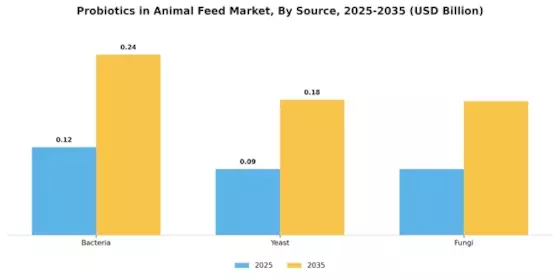
In the Probiotics in Animal Feed Market, the source segment is primarily dominated by bacteria, which holds the largest market share. This trend is driven by the recognized efficacy of bacterial probiotics in enhancing animal health and productivity. On the other hand, yeast is emerging as a significant player, capturing a faster-growing share of the market as its benefits for gut health and overall animal performance are increasingly acknowledged. The distribution of market share among these sources indicates a competitive landscape, with bacteria currently leading but yeast showing strong potential for future growth.
Bacteria (Dominant) vs. Yeast (Emerging)
Bacteria serve as the dominant source of probiotics in animal feed, favored for their established role in promoting digestion and nutrient absorption among livestock. Various strains, such as Lactobacillus and Bifidobacterium, are widely used, providing proven benefits that farmers trust. On the other hand, yeast-based probiotics are considered an emerging source, gaining traction due to their ability to enhance gut flora and stimulate immune responses in animals. The rising awareness of these benefits contributes to the rapid expansion of yeast in this market. Both sources are integral to formulating effective probiotic products, catering to diverse animal nutrition needs.
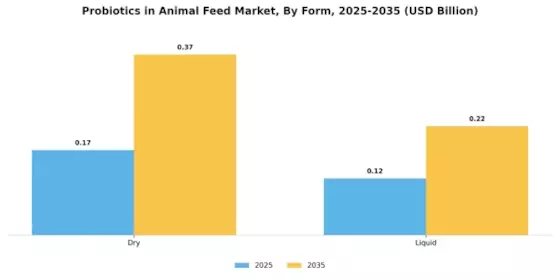
In the Probiotics in Animal Feed Market, the distribution of market share between the dry and liquid forms of probiotics illustrates distinct preferences among feed producers. The dry form has established itself as the dominant form, preferred largely for its ease of use and extended shelf life. On the other hand, the liquid form is gaining traction. As feeding methods evolve, liquid probiotics are being used more frequently in various animal feed applications. This shift is indicative of changing production practices and consumer preferences towards more flexible feed solutions.
Form: Dry (Dominant) vs. Liquid (Emerging)
The dry form of probiotics is characterized by its stability and convenience, making it the dominant choice among feed manufacturers. It allows for precise dosing and is less susceptible to degradation over time, providing a reliable option for producers. Conversely, the liquid form is emerging as a popular alternative, driven by its instant bioavailability and palatability among animals. As the market continues to expand, liquid probiotics are positioned to address the specific needs of various livestock and poultry sectors, appealing to producers seeking innovative feeding solutions. Both forms cater to different segments, reflecting the diverse requirements of the animal nutrition landscape.
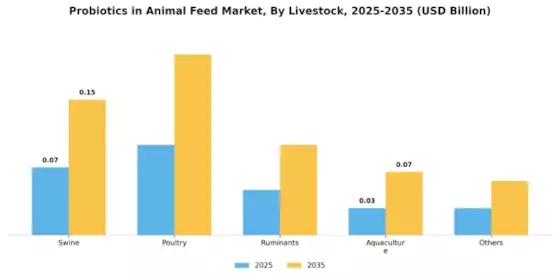
In the Probiotics in Animal Feed Market, the livestock segment is prominently dominated by poultry, which occupies a significant share due to the rising demand for poultry products worldwide. Swine and ruminants also contribute to the market, yet they hold comparatively smaller portions, reflecting their focused application in specific regions or farming practices. Aquaculture and other segments are growing but remain niche markets in comparison to poultry's established position.
Poultry (Dominant) vs. Ruminants (Emerging)
The poultry segment, being the dominant player in the probiotics in animal feed market, is characterized by its extensive use of probiotics to enhance gut health and overall performance in chickens and turkeys. This segment benefits from the increasing consumption of poultry meat and eggs, driving farmers to adopt probiotics for higher yield and disease prevention. On the other hand, the ruminant sector is emerging rapidly as farmers recognize the benefits of probiotics in improving digestion and nutrient absorption in cattle and sheep. The growing trend towards sustainable livestock farming practices further supports the adoption of probiotics in this segment, making it one of the fastest-growing areas within the overall market.
Probiotics Animal Feed Market에 대한 더 자세한 통찰력 얻기 무료 샘플 요청



The projected market valuation for probiotics in animal feed is expected to reach 0.5886 USD Billion by 2035.
The overall market valuation for probiotics in animal feed was 0.2881 USD Billion in 2024.
The expected CAGR for the probiotics in animal feed market during the forecast period 2025 - 2035 is 6.71%.
Key players in the probiotics in animal feed market include BASF, DuPont, Evonik Industries, Chr. Hansen, Lallemand, Novozymes, Alltech, Kemin Industries, and Probi.
The main sources of probiotics in animal feed include bacteria valued at 0.2363 USD Billion, yeast at 0.1772 USD Billion, and fungi at 0.1751 USD Billion.
The market is segmented by form, with dry probiotics valued at 0.3671 USD Billion and liquid probiotics at 0.2215 USD Billion.
The livestock categories in the probiotics in animal feed market include swine, poultry, ruminants, aquaculture, and others, with poultry valued at 0.2 USD Billion.
The market value of probiotics in animal feed for swine is 0.15 USD Billion.
Market values differ among livestock categories, with poultry at 0.2 USD Billion, swine at 0.15 USD Billion, and ruminants at 0.1 USD Billion.
Trends anticipated in the probiotics in animal feed market by 2035 suggest continued growth, driven by increasing demand for animal health and productivity.


The secondary research process involved comprehensive analysis of regulatory databases, peer-reviewed veterinary journals, livestock production publications, and authoritative agricultural organizations. Key sources included the US Food and Drug Administration – Center for Veterinary Medicine (FDA-CVM), European Food Safety Authority (EFSA) FEEDAP Panel, Food and Agriculture Organization (FAO) Animal Production and Health Division, World Organisation for Animal Health (WOAH), US Department of Agriculture (USDA) APHIS, Environmental Protection Agency (EPA) Office of Pesticide Programs, Association of American Feed Control Officials (AAFCO), European Commission Directorate-General for Health and Food Safety (DG SANTE), International Feed Industry Federation (IFIF), European Feed Manufacturers' Federation (FEFAC), American Feed Industry Association (AFIA), National Research Council (NRC) Nutrient Requirements Committees, NIH/NCBI PubMed Veterinary Database, Journal of Animal Science, Poultry Science, Journal of Dairy Science, Animal Feed Science and Technology, and national veterinary regulatory agencies from key livestock-producing markets. These sources were used to collect livestock population statistics, probiotic strain approval data, zootechnical efficacy studies, feed safety regulations, antimicrobial resistance policies, and market landscape analysis for Lactobacillus, Bacillus, Bifidobacterium, Saccharomyces, and other probiotic technologies.
Qualitative and quantitative insights were obtained by interviewing supply-side and demand-side stakeholders during the primary research process. The supply-side sources that were consulted included CEOs, VPs of Product Development, regulatory affairs chiefs, and commercial directors from probiotic strain manufacturers (bacteria, yeast, fungi), animal nutrition companies, and feed additive suppliers. Chief veterinarians, animal nutritionists, feed formulators, livestock operations managers, and procurement leads from integrated poultry/swine operations, commercial feed mills, cattle feedlots, and aquaculture farms comprised demand-side sources. Market segmentation was validated, product pipeline timelines for spore-forming and microencapsulated strains were confirmed, and clinical adoption patterns across livestock species, pricing strategies by colony-forming units (CFU) concentration, and regulatory approval dynamics for antibiotic-free production systems were gathered through primary research.
Primary Respondent Breakdown:
By Designation: C-level Primaries (32%), Director Level (30%), Others (38%)
By Region: North America (32%), Europe (30%), Asia-Pacific (28%), Rest of World (10%)
Global market valuation was derived through revenue mapping and livestock consumption analysis. The methodology included:
Identification of over 40 significant manufacturers in North America, Europe, Asia-Pacific, and Latin America, including specialized probiotic developers and integrated animal health conglomerates
Product mapping across bacterial strains (Lactobacillus, Bacillus, Bifidobacterium, Streptococcus), yeast (Saccharomyces cerevisiae, Kluyveromyces), and fungal sources, further segmented by dry (powder, granules) and liquid (suspensions, emulsions) formulations
Species-specific analysis covering poultry (broilers, layers, breeders), swine (piglets, growers, sows), ruminants (dairy, beef, calves), aquaculture (finfish, crustaceans), and companion animals/equine
Analysis of reported and modeled annual revenues specific to probiotic feed additive portfolios, including direct sales and premix distributor channels
Coverage of manufacturers representing 70-75% of global market share in 2024
Extrapolation using bottom-up (livestock population × feed inclusion rates × ASP by species/region) and top-down (manufacturer revenue validation) approaches to derive segment-specific valuations for bacteria-dominated and emerging yeast categories
이 보고서의 무료 샘플을 받으려면 아래 양식을 작성하십시오

“This is really good guys. Excellent work on a tight deadline. I will continue to use you going forward and recommend you to others. Nice job”


“Thanks. It’s been a pleasure working with you, please use me as reference with any other Intel employees.”


“Thanks for sending the report it gives us a good global view of the Betaïne market.”


“Thank you, this will be very helpful for OQS.”


“We found the report very insightful! we found your research firm very helpful. I'm sending this email to secure our future business.”


“I am very pleased with how market segments have been defined in a relevant way for my purposes (such as "Portable Freezers & refrigerators" and "last-mile"). In general the report is well structured. Thanks very much for your efforts.”


“I have been reading the first document or the study, ,the Global HVAC and FP market report 2021 till 2026. Must say, good info! I have not gone in depth at all parts, but got a good indication of the data inside!”


“We got the report in time, we really thank you for your support in this process. I also thank to all of your team as they did a great job.”


“The Automotive 48V ECU Components Procurement Intelligence Study” was a complex project, but the Market Research Future (MRFR) team handled it with quality, agility, and customer-centricity. They delivered all requested data on time and within the agreed scope. The team, including Shubhendra Anand and Rahul Gotadki, was always readily available to clarify questions and swiftly implement necessary adjustments, driving the project to a successful conclusion within a very demanding timeframe.
I would also like to specifically commend Akshay Agarwal for his responsiveness and support at every stage—from our initial inquiry on May 6th through to final delivery on June 18th. His dedication made the entire process seamless.”



