Request Free Sample ×

Kindly complete the form below to receive a free sample of this Report

* Please use a valid business email

Leading companies partner with us for data-driven Insights

clients tt-cursor
Hero Background

Reactive Dyes Market

ID: MRFR/CnM/2583-HCR
111 Pages
Chitranshi Jaiswal
Last Updated: May 15, 2026
반응성 염료 시장 조사 보고서 - 2034년 예측
Download PDF ×

We do not share your information with anyone. However, we may send you emails based on your report interest from time to time. You may contact us at any time to opt-out.

글로벌 반응성 염료 시장 개요

반응성 염료 시장 규모는 2024년에 56억 6천만 달러로 평가되었습니다. 반응성 염료 산업은 2025년 61억 2천만 달러에서 2034년까지 123억 2천만 달러로 성장할 것으로 예상되며, 예측 기간(2025~2034년) 동안 8.1%의 연평균 성장률(CAGR)을 보일 것으로 예상됩니다. 탁월한 기능으로 인해 섬유 산업 전반에 걸쳐 채택이 증가하는 것은 시장 성장을 촉진하는 주요 시장 동인입니다.반응성 염료 시장 개요출처: 2차 조사, 1차 조사, MRFR 데이터베이스 및 분석가 검토

반응성 염료 시장 동향

    섬유 산업 전반에 걸친 채택 증가가 시장 성장을 주도하고 있습니다

반응성 염료의 채택이 증가하면서 반응성 염료 시장의 CAGR이 증가했습니다. 직물을 염색하는 데 사용되는 대부분의 유기 화학 물질은 반응성 염료라는 그룹에 속합니다. 반응성염료는 면섬유의 주성분인 섬유와 화학적 화합물을 만드는 능력은 물론, 착색이 필요한 기질과의 공유결합을 이루는 능력도 갖고 있다. 반응성 염료가 섬유에 통합되어 세탁될 가능성이 줄어듭니다. 면, 실크, 나일론, 양모 등을 생산하는 섬유산업에서는 주로 반응성 염료를 사용한다. 이러한 부문의 변화는 반응성 염료 시장에 즉시 영향을 미칩니다.

섬유 및 가죽 산업은 반응성 염료의 주요 동인입니다. 반응성 염료의 대규모 최종 사용자인 섬유 부문은 가처분 소득 증가, 인구 증가, 소비자 선호도 변화 등 다양한 변수로 인해 향후 몇 년 동안 극적으로 성장할 것으로 예상됩니다. 또한 섬유 부문과 결과적으로 반응성 염료 시장은 예상 기간 동안 정기적으로 변화하는 패션 트렌드와 브랜드 의류의 인기 증가에 의해 주도될 것으로 예상됩니다. 그러나 예상 기간 동안 다양한 정부에서 시행하는 엄격한 규정으로 인해 반응성 염료 시장이 제한될 것으로 예상됩니다.

반응성 염료 시장을 성장시키는 주된 이유는 종이, 섬유, 목재, 가죽 등 다양한 응용 산업의 확장입니다. 생활 방식의 세계화와 인구 증가는 모두 성장에 기여합니다.

2024년 Archroma는 셀룰로오스 섬유 및 혼합물을 위한 확립된 반응성 염료 기술인 Avitera SE의 새 버전을 출시할 예정이며, 테스트 결과 물과 에너지 사용량을 50%까지 낮출 수 있는 것으로 나타났습니다. Archroma에 따르면 Avitera SE Generation Next라는 브랜드로 명명된 이 최신 제품은 새로운 다크 및 엑스트라 다크 색상에 대한 향상된 비용 대비 성능 비율을 제공하여 브랜드 및 소매업체의 환경 요구 사항을 충족하려는 공장이 더 쉽게 접근할 수 있도록 한다고 주장합니다.

반응성 염료 시장 부문 통찰력

반응성 염료 유형 정보

유형에 따른 반응성 염료 시장 세분화에는 반응성 저온 염료, 반응성 고온 염료, 반응성 HE 염료, 반응성 ME 염료 등이 포함됩니다. 반응성 차가운 염료 부문이 시장을 지배했습니다. 저온 반응성 염료는 25°C~50°C 사이의 온도에서 적용할 수 있습니다. 이러한 염료는 위에서 언급한 온도에서 섬유와 높은 반응성을 보입니다.

반응성 염료 유통 기능 통찰력

기능을 기준으로 한 반응성 염료 시장 세분화에는 모노클로로트리아진, 비닐 설폰, 이중 기능성 등이 포함됩니다. 모노클로로트리아진 카테고리가 가장 많은 수익을 창출했습니다. 이런 종류의 반응성 염료는 반응성이 덜하고 실질적입니다. 이러한 염료는 제한된 반응성으로 인해 셀룰로오스 물질을 고정하기 위해 더 가혹한 조건이 필요합니다. 80~85oC의 물을 분말 위에 붓고 색상이 쉽게 녹을 수 있도록 잘 휘젓습니다.

반응성 염료 유통 애플리케이션 통찰력

응용 분야에 따른 반응성 염료 시장 세분화에는 면, 종이, 나일론, 가죽 등이 포함됩니다. 면화 부문이 가장 많은 수입을 창출했습니다. 이런 종류의 반응성 염료는 반응성이 덜하고 실질적입니다. 반응성 염료는 주로 면과 같은 셀룰로오스 섬유를 착색하는 데 사용되지만 양모와 폴리아미드 착색에도 점점 더 인기를 얻고 있습니다. 반응성 염료는 매우 다양하며 다양한 염색 절차를 사용할 수 있습니다.

그림 1: 반응성 염료 시장(응용 분야별, 2022년 2032년(10억 달러)반응성 염료 시장, 용도별, 2022년 및 2032년 strong출처: 2차 조사, 1차 조사, MRFR 데이터베이스 및 분석가 검토

반응성 염료 지역 통찰력

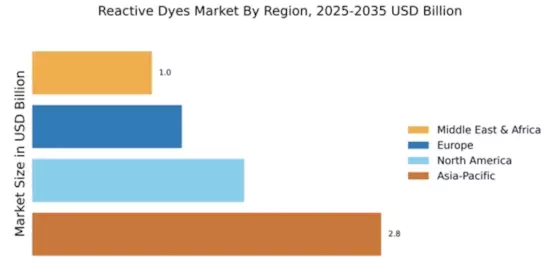
이 연구는 지역별로 북미, 유럽, 아시아 태평양 및 기타 지역에 대한 시장 통찰력을 제공합니다. 아시아 태평양 반응성 염료 시장 영역은 인도 및 중국과 같은 국가의 인구 비율 증가로 인해 이 시장을 지배할 것입니다. 또한 성장하는 섬유 산업은 이 지역의 시장 성장을 촉진할 것입니다.

또한 시장 보고서에서 연구된 주요 국가는 미국, 캐나다, 독일, 프랑스, ​​영국, 이탈리아, 스페인, 중국, 일본, 인도, 호주, 한국 및 브라질입니다.

그림 2: 2022년 지역별 반응 염료 시장 점유율(10억 달러) 지역별 반응 염료 시장 점유율 2022출처: 2차 연구, 1차 연구, MRFR 데이터베이스 및 분석가 검토

유럽 반응성 염료 시장은 해당 지역 내 염료 생산 능력의 증가로 인해 두 번째로 큰 시장 점유율을 차지하고 있습니다. 또한 독일 반응성 염료 시장은 가장 큰 시장 점유율을 차지했으며 영국 반응성 염료 시장은 유럽 지역에서 가장 빠르게 성장하는 시장이었습니다.

아시아 태평양 반응성 염료 시장은 2023년부터 2032년까지 가장 빠른 CAGR로 성장할 것으로 예상됩니다. 이는 건강한 생활 방식과 영양에 대한 인식이 확대되고 1인당 가처분 소득이 증가하기 때문입니다. 또한 중국의 반응성 염료 시장이 가장 큰 시장 점유율을 차지했으며 인도의 반응성 염료 시장은 아시아 태평양 지역에서 가장 빠르게 성장하는 시장이었습니다.

반응성 염료 주요 시장 참여자 경쟁 통찰력

선도적인 시장 참가자들은 반응성 염료 시장이 더욱 성장하는 데 도움이 될 제품 및 서비스 라인을 확장하기 위해 연구 개발 활동에 막대한 투자를 하고 있습니다. 또한 시장 참여자들은 신제품 출시, 계약 합의, 인수합병, 더 많은 투자, 다른 조직과의 협력 등 중요한 시장 개발을 통해 자신의 입지를 확장하기 위해 다양한 전략적 이니셔티브를 채택하고 있습니다. 경쟁이 더욱 치열해지고 상승하는 시장 환경에서 확장하고 생존하려면 반응성 염료 산업이 비용 효율적인 품목을 제공해야 합니다.

운영 비용을 줄이기 위해 현지에서 제조하는 것은 반응성 염료 업계 제조업체가 고객에게 혜택을 주고 시장 부문을 확대하기 위해 사용하는 주요 비즈니스 전략 중 하나입니다. 최근 몇 년 동안 반응성 염료 산업은 의학에 가장 중요한 이점을 제공했습니다. Huntsman International LLC, Nippon Kayaku Co., Ltd., Sumika Chemtex Co., Ltd., Archroma, Colourtex, Kiri Industries Ltd., IM Dye Chem, Roop 염료 및 중간체, Kevin India Co. 등을 포함한 반응성 염료 시장의 주요 업체들은 연구 개발 운영에 투자하여 시장 수요를 늘리려고 노력하고 있습니다.

Huntsman Corporation은 다양한 소비재 및 산업 최종 산업 분야의 광범위한 제조업체에 서비스를 제공하는 전문적이고 차별화된 화학 물질을 생산하는 다국적 제조업체이자 마케팅 업체입니다. 약 30개국에 걸쳐 60개 이상의 제조, RD 및 운영 시설을 갖춘 이 회사는 3개 부문으로 운영됩니다. 2020년 9월, Huntsman Textile Effects는 HIGH IQ Lasting Black 에코를 도입하면서 업계에서 인정받는 HIGH IQ 브랜드 보증 프로그램을 확장했습니다. 수상 경력에 빛나는 Huntsman의 AVITERA SE Black 반응성 염료를 기반으로 하는 새로운 색상 유지 프로그램은 수많은 세탁 후에도 풍부한 색상을 유지하는 친환경 블랙 색상에 대한 수요를 만족시키는 공장, 브랜드 및 소매업체에 도움이 될 것입니다.

Archroma Management GmbH(Archroma)라는 회사는 특수 화학 제품과 염료를 제공합니다. 종이 및 포장 산업을 위한 공정 및 표면 화학 물질, 섬유 화학 물질, 염료, 형광 증백제, 착색제, 페인트, 접착제, 직물, 가죽, 종이 및 건설 산업을 위한 특수 유제를 공급합니다. 사업은 코팅, 접착제, 실런트의 세 가지 부문으로 구분됩니다. 브랜드 및 기능성 섬유 전문 분야; 포장 및 종이 전문 분야. 유럽 ​​외에도 미주, 아시아, 아프리카에도 모두 생산공장이 있습니다. 자회사를 통해 회사는 북미, 남미, 유럽, 아프리카 및 아시아 태평양 지역에 제품을 제공합니다. SK캐피탈파트너스의 기업 포트폴리오에 속합니다. Archroma의 본사는 스위스 바젤의 Reinach에 있습니다. 2022년 10월, 전통적인 원사 세척 공정과 그에 따른 높은 물 사용 및 오염을 대체하기 위해 이탈리아 회사 Archroma와 섬유 및 데님 산업의 초음파 세척 분야 선두업체인 Panatronix 간에 협력이 형성되었습니다.

Birla Cellulose는 2024년 권위 있는 Bharat Tex 행사에서 최신 혁신 기술인 Birla Viscose - Intellicolor를 공개할 예정입니다. Birla Cellulose는 기존 반응성 염색의 오랜 문제를 해결하는 고유한 솔루션으로 섬유 산업 환경을 바꿀 준비가 되어 있습니다. Intellicolor는 양이온 또는 염기성 염료를 사용하는 염색 공정의 획기적인 개선입니다. 95%가 넘는 경이적인 염료 소모율을 보여 기존 방식보다 뛰어난 성능을 발휘합니다. 염색 과정에서 소금과 소다회가 필요하지 않아 작업이 단순화되고 환경에 미치는 영향이 줄어듭니다.

반응성 염료 시장의 주요 기업은 다음과 같습니다

    헌츠맨 인터내셔널 LLC, 리

    닛폰 가야쿠(주) 리

    스미카켐텍스(주) 리

    Archroma,  리

    컬러텍스 리

    키리산업(주) 리

    아이엠다이켐, 리

    루프 염료 및 중간체 리

    케빈 인디아

반응성 염료 산업 발전

2022년 8월: Archroma와 Huntsman Corporation은 Textile Effects 사업부 인수에 대해 법적 구속력이 있는 계약을 체결했습니다.

반응성 염료 시장 세분화

반응성 염료 유형 전망

    반응성 냉염료 리

    반응성 고온 염료 리

    반응성 HE 염료 리

    반응성 ME 염료 리

    기타

반응성 염료 기능 전망

    모노클로로트리아진 리

    비닐술폰 리

    이중 기능 리

    기타

반응성 염료 애플리케이션 전망

    면 리

    종이 리

    나일론 리

    가죽 리

    기타

반응성 염료 지역 전망

  • 북미
    • 미국
    • 캐나다
  • 유럽
    • 독일
    • 프랑스
    • 영국
    • 이탈리아
    • 스페인
    • 나머지 유럽
  • 아시아 태평양
    • 중국
    • 일본
    • 인도
    • 호주
    • 한국
    • 호주
    • 나머지 아시아 태평양 지역
  • 기타 국가
    • 중동
    • 아프리카
    • 라틴 아메리카


FAQs

What is the current valuation of the Reactive Dyes Market?

As of 2024, the Reactive Dyes Market was valued at 5.66 USD Billion.

What is the projected market size for the Reactive Dyes Market in 2035?

The market is projected to reach 13.32 USD Billion by 2035.

What is the expected CAGR for the Reactive Dyes Market during the forecast period?

The expected CAGR for the Reactive Dyes Market from 2025 to 2035 is 8.09%.

Which applications are driving growth in the Reactive Dyes Market?

Key applications include Textile, Paper, Leather, Plastic, and Cosmetics, with Textile projected to grow from 3.0 to 7.0 USD Billion.

What are the primary end-use segments in the Reactive Dyes Market?

The main end-use segments are Apparel, Home Textiles, Industrial Textiles, Automotive, and Medical, with Apparel expected to grow from 1.7 to 4.0 USD Billion.

How do the types of reactive dyes impact market performance?

Types such as Monoazo, Disazo, and Triazo are crucial, with Monoazo projected to increase from 1.7 to 3.9 USD Billion.

What chemical structures are prevalent in the Reactive Dyes Market?

Amino, Naphthol, and Azo structures dominate, with Amino expected to grow from 1.7 to 3.9 USD Billion.

What formulations are available in the Reactive Dyes Market?

Formulations include Liquid, Powder, Granular, and Paste, with Liquid projected to rise from 1.7 to 4.0 USD Billion.

Who are the key players in the Reactive Dyes Market?

Prominent players include Huntsman Corporation, Dystar Global, BASF SE, and Clariant AG.

What trends are influencing the Reactive Dyes Market in 2025?

Trends include increasing demand in textiles and sustainable practices, potentially driving market growth.
저자
Author
Author Profile
Chitranshi Jaiswal LinkedIn
Team Lead - Research
Chitranshi is a Team Leader in the Chemicals & Materials (CnM) and Energy & Power (EnP) domains, with 6+ years of experience in market research. She leads and mentors teams to deliver cross-domain projects that equip clients with actionable insights and growth strategies. She is skilled in market estimation, forecasting, competitive benchmarking, and both primary & secondary research, enabling her to turn complex data into decision-ready insights. An engineer and MBA professional, she combines technical expertise with strategic acumen to solve dynamic market challenges. Chitranshi has successfully managed projects that support market entry, investment planning, and competitive positioning, while building strong client relationships. Certified in Advanced Excel & Power BI she leverages data-driven approaches to ensure accuracy, clarity, and impactful outcomes.
댓글 남기기

Research Approach

Secondary Research

The secondary research process involved comprehensive analysis of regulatory databases, peer-reviewed chemical engineering journals, industrial publications, and authoritative environmental and trade organizations. Key sources included the US Environmental Protection Agency (EPA), European Chemicals Agency (ECHA), REACH Regulation Database, OECD Chemicals and Biotechnology Committee, American Association of Textile Chemists and Colorists (AATCC), Society of Dyers and Colourists (SDC, UK), International Textile Manufacturers Federation (ITMF), World Dye Variety Organization, German Chemical Industry Association (VCI), Indian Chemical Council (ICC), China Dye Industry Association, Turkish Dyeing and Finishing Association, National Institute of Standards and Technology (NIST), US Bureau of Labor Statistics (BLS) – Chemical Manufacturing Employment Data, Eurostat – Industrial Production of Chemicals, UN Comtrade Database – Dye & Pigment Trade Flows, World Bank – Manufacturing Value Added Indicators, International Trade Centre (ITC) – Trade Map for HS Code 3204, Textile Exchange – Organic & Sustainable Textile Reports, ZDHC (Zero Discharge of Hazardous Chemicals) Foundation, Bluesign Technologies AG – Restricted Substances Lists, Oeko-Tex Association – Standard 100 Certification Data, and national environmental ministry reports from key manufacturing markets (India, China, Germany, Turkey, Brazil). These sources were used to collect production statistics, regulatory compliance data (particularly REACH SVHC and EPA TSCA), environmental discharge standards, trade volume analytics, feedstock pricing trends, patent filings for bi-functional and low-temperature reactive dye technologies, and market landscape analysis for azo-based, anthraquinone-based, and phthalocyanine-based reactive dye chemistries.

Primary Research

Qualitative and quantitative insights were obtained by interviewing supply-side and demand-side stakeholders during the primary research process. The supply-side sources consist of CEOs, VPs of Manufacturing, leaders of R&D and Coloration Technology, regulatory compliance officers, and commercial directors from reactive dye manufacturers, chemical intermediates suppliers, and textile auxiliary producers. The demand-side sources included chief colorists and technical directors from textile dyeing houses, procurement heads from apparel and home textile brands, sustainability officers from fashion retailers, leather tanning specialists, paper coating technologists, and technical service managers from dye application machinery OEMs. Market segmentation was validated across reactive cold dyes, hot dyes, HE (High Exhaust) dyes, and ME (Middle Exhaust) dye categories through primary research. Meanwhile, product pipeline timelines for vinyl sulphone and bi-functional reactive systems were confirmed. Insights regarding clinical adoption patterns of low-salt and low-alkali dyeing processes, bulk pricing strategies for cotton versus nylon substrates, and sustainability-driven procurement dynamics were gathered.

Primary Respondent Breakdown:

By Designation: C-level Primaries (28%), Director Level (34%), Others (38%)

By Region: North America (28%), Europe (32%), Asia-Pacific (34%), Rest of World (6%)

By Stakeholder Type: Dye Manufacturers & Chemical Intermediates Suppliers (45%), Textile & Apparel End-Users (30%), Paper/Leather/Nylon Application Specialists (18%), Regulatory & Sustainability Consultants (7%)

Market Size Estimation

Global market valuation was derived through revenue mapping and production volume analysis. The methodology included:

Identification of 50+ key manufacturers across North America, Europe, Asia-Pacific, Latin America, and Middle East & Africa

Product mapping across reactive cold dyes, reactive hot dyes, reactive HE dyes, reactive ME dyes, and other temperature-specific reactive categories

Functional chemistry mapping across monochlorotriazine, vinyl sulphone, bi-functional (hetero-bifunctional), and other bridging chemistries

Application mapping across cotton (cellulosic), paper, nylon (polyamide), leather, and other specialty substrates

Analysis of reported and modeled annual revenues specific to reactive dye portfolios, including granular data on liquid versus powder formulation splits

Coverage of manufacturers representing 75–80% of global market share in 2024

Extrapolation using bottom-up (production volume × ASP by country, adjusted for dyeing exhaustion rates and fixation efficiency by substrate type) and top-down (manufacturer revenue validation, cross-referenced with trade statistics for HS Code 3204 and national chemical production indices) approaches to derive segment-specific valuations

Demand-side triangulation using textile production volume data from ITMF and national textile ministries, applied against average dye consumption rates (grams of reactive dye per kilogram of substrate, differentiated by cotton, paper, nylon, and leather)

Supply-side triangulation using capacity utilization rates from major manufacturing hubs (Ahmedabad/India, Zhejiang/China, Basel/Switzerland, Ludwigshafen/Germany) and verified against import/export data from UN Comtrade and ITC Trade Map

Data Validation & Triangulation

All secondary data points were cross-validated through at least two independent primary sources. Market estimates were subjected to time-series analysis incorporating feedstock price volatility (particularly naphthalene derivatives, cyanuric chloride, and H-acid intermediates), and factor analysis examining macroeconomic drivers including environmental regulation stringency (REACH, EPA 40 CFR, China MEEP), textile industry automation trends, and shifting consumer preferences toward GOTS-certified and ZDHC MRSL-compliant coloration. Final market figures were validated through expert panel review with senior color technologists and commercial heads from three Tier 1 and two Tier 2 reactive dye manufacturers to ensure accuracy within ±5% variance thresholds.
무료 샘플 다운로드

이 보고서의 무료 샘플을 받으려면 아래 양식을 작성하십시오