×
Request Free Sample ×

Kindly complete the form below to receive a free sample of this Report

* Please use a valid business email

Leading companies partner with us for data-driven Insights

clients tt-cursor
Hero Background

3D Mapping Modelling Market

ID: MRFR/SEM/3587-HCR
100 Pages
Ankit Gupta
October 2025

3D mapping & 3D Modelling Market Research Report Information By Type (3D Mapping and 3D Modeling), By Component (Software and Service), By Application (Projection Mapping, Texture Mapping, Maps and Navigation, and Other Applications ), By Industry Vertical (Entertainment and Media, Automotive, Healthcare, Building and Construction, Defense, Transportation, and Others), and By Region (North America, Europe, Asia-Pacific, Middle East & Africa, and South America) - Forecast till 2035

Share:
Download PDF ×

We do not share your information with anyone. However, we may send you emails based on your report interest from time to time. You may contact us at any time to opt-out.

3D Mapping Modelling Market Infographic
Purchase Options

3D Mapping Modelling Market Summary

As per MRFR analysis, the 3D Mapping Modelling Market Size was estimated at 7.93 USD Billion in 2024. The 3D Mapping Modelling industry is projected to grow from 9.08 USD Billion in 2025 to 35.24 USD Billion by 2035, exhibiting a compound annual growth rate (CAGR) of 14.52 during the forecast period 2025 - 2035.

Key Market Trends & Highlights

The 3D Mapping Modelling Market is poised for substantial growth driven by technological advancements and increasing applications across various sectors.

  • The integration of AI and machine learning is transforming the capabilities of 3D mapping and modelling solutions.
  • North America remains the largest market, while the Asia-Pacific region is experiencing rapid growth in adoption rates.
  • The surveying segment continues to dominate the market, whereas the construction segment is emerging as the fastest-growing area.
  • Key drivers include the increased demand for geographic information systems and advancements in 3D scanning technologies.

Market Size & Forecast

2024 Market Size 7.93 (USD Billion)
2035 Market Size 35.24 (USD Billion)
CAGR (2025 - 2035) 14.52%

Major Players

Esri (US), Autodesk (US), Bentley Systems (US), Trimble (US), Pix4D (CH), 3D Systems (US), RealityCapture (SK), Mapbox (US), Hexagon (SE)

3D Mapping Modelling Market Trends

The 3D Mapping Modelling Market is currently experiencing a transformative phase, driven by advancements in technology and increasing demand across various sectors. The integration of artificial intelligence and machine learning into mapping processes enhances accuracy and efficiency, allowing for more detailed and realistic representations of environments. This evolution is particularly evident in industries such as urban planning, construction, and environmental monitoring, where precise data visualization is crucial for decision-making. Furthermore, the proliferation of drones and satellite imagery has expanded the capabilities of 3D mapping, enabling the collection of vast amounts of data from previously inaccessible areas. In addition to technological advancements, the growing emphasis on sustainability and smart city initiatives is shaping the landscape of the 3D Mapping Modelling Market. Stakeholders are increasingly recognizing the value of spatial data in addressing urban challenges and promoting efficient resource management. As cities evolve, the need for comprehensive mapping solutions that facilitate planning and development becomes more pronounced. Consequently, the market is poised for continued growth, with innovations likely to emerge that further enhance the utility and application of 3D mapping technologies across diverse fields.

Integration of AI and Machine Learning

The incorporation of artificial intelligence and machine learning into 3D mapping processes is revolutionizing the industry. These technologies enhance data analysis, improve accuracy, and streamline workflows, allowing for more sophisticated modeling and visualization.

Rise of Drone Technology

The increasing use of drones for data collection is significantly impacting the 3D Mapping Modelling Market. Drones provide access to hard-to-reach areas, enabling the capture of high-resolution imagery and data, which enhances the quality of mapping outputs.

Focus on Sustainability and Smart Cities

The growing emphasis on sustainability and the development of smart cities is driving demand for advanced mapping solutions. Stakeholders are leveraging spatial data to address urban challenges, optimize resource management, and promote environmentally friendly practices.

3D Mapping Modelling Market Drivers

Market Growth Projections

The Global 3D Mapping and 3D Modelling Market Industry is poised for remarkable growth, with projections indicating a market value of 7.93 USD Billion in 2024 and an anticipated increase to 35.2 USD Billion by 2035. This growth trajectory suggests a robust CAGR of 14.52% from 2025 to 2035, reflecting the increasing adoption of 3D mapping technologies across various sectors. The market's expansion is driven by technological advancements, urbanization, and the rising demand for accurate data in decision-making processes.

Technological Advancements

The Global 3D Mapping and 3D Modelling Market Industry experiences substantial growth driven by rapid technological advancements. Innovations in software and hardware, such as LiDAR and photogrammetry, enhance the accuracy and efficiency of 3D mapping processes. For instance, the integration of artificial intelligence in data processing allows for quicker analysis and improved decision-making. As a result, the market is projected to reach 7.93 USD Billion in 2024, reflecting a growing demand for precise and detailed mapping solutions across various sectors, including urban planning and environmental monitoring.

Urbanization and Smart Cities

Urbanization trends are reshaping the Global 3D Mapping and 3D Modelling Market Industry, as cities expand and evolve. The development of smart cities necessitates advanced mapping solutions for infrastructure management, transportation planning, and environmental monitoring. Governments and municipalities are increasingly investing in 3D mapping technologies to enhance urban planning and improve public services. This trend is likely to propel the market's growth, with a projected CAGR of 14.52% from 2025 to 2035, as urban areas seek to leverage data-driven insights for sustainable development and efficient resource allocation.

Increased Demand in Construction

The construction sector significantly influences the Global 3D Mapping and 3D Modelling Market Industry, as the need for accurate site assessments and project visualizations rises. 3D mapping technologies facilitate better planning and execution of construction projects, minimizing errors and enhancing safety. The industry's growth is evident, with projections indicating a market value of 35.2 USD Billion by 2035. This surge is attributed to the increasing adoption of Building Information Modeling (BIM) and the necessity for real-time data in construction management, which ultimately leads to cost savings and improved project outcomes.

Environmental Monitoring and Management

Environmental concerns are increasingly influencing the Global 3D Mapping and 3D Modelling Market Industry, as stakeholders seek effective solutions for monitoring and managing natural resources. 3D mapping technologies enable detailed analysis of ecosystems, land use, and climate change impacts. Governments and organizations utilize these tools for environmental assessments, conservation efforts, and disaster management. The growing emphasis on sustainability and regulatory compliance is likely to drive market expansion, as stakeholders recognize the value of accurate data in making informed decisions regarding environmental stewardship.

Growing Applications in Defense and Security

The defense and security sectors are pivotal in driving the Global 3D Mapping and 3D Modelling Market Industry. 3D mapping technologies provide critical situational awareness and intelligence for military operations, surveillance, and disaster response. The ability to create detailed terrain models and simulations enhances strategic planning and operational effectiveness. As nations prioritize national security and defense capabilities, investments in 3D mapping solutions are expected to rise, contributing to the overall market growth. This sector's demand underscores the importance of accurate and timely data in safeguarding national interests.

Market Segment Insights

By Application: Surveying (Largest) vs. Construction (Fastest-Growing)

In the 3D Mapping Modelling Market, the application segment shows a varied distribution of market shares across different areas. Surveying stands out as the largest segment, dominated by its widespread adoption in geospatial analysis and land assessments. In contrast, the construction sector is quickly gaining ground, showcasing an impressive demand for 3D mapping technologies to enhance project planning and execution. This competitive landscape highlights the strategic importance of both segments in driving the overall market growth. The growth trends in the application segment are significantly influenced by technological advancements and the increasing need for accurate data representation. The rise in urbanization and infrastructure development drives the demand for 3D mapping in construction. Additionally, emerging applications in disaster management and environmental monitoring are propelling innovation within the sector. As stakeholders recognize the crucial role of 3D mapping in improving efficiency and decision-making processes, these applications are expected to witness sustained growth in the coming years.

Surveying: Dominant vs. Construction: Emerging

Surveying is a well-established application in the 3D Mapping Modelling Market, known for its critical role in land assessment, topographical mapping, and geospatial data utilization. Its dominance stems from the necessity for detailed and accurate representations of physical environments, which are essential for regulatory compliance and informed decision-making. In contrast, the construction sector is an emerging application, rapidly adopting 3D mapping technologies to streamline project workflows, enhance precision in building designs, and improve collaboration among stakeholders. The integration of these technologies is transforming traditional practices, leading to increased productivity and reduced costs. As construction projects become more complex, the demand for robust 3D mapping solutions will likely rise, establishing it as a vital component in modern construction methodologies.

By End Use: Aerospace (Largest) vs. Automotive (Fastest-Growing)

The 3D Mapping Modelling Market is prominently driven by various end-use sectors, with aerospace leading the market due to its extensive applications in aircraft design, maintenance, and spatial analysis. Aerospace holds the largest share, leveraging advanced technologies to improve accuracy and operational efficiency. On the other hand, the automotive sector is rapidly evolving, fueled by the increasing demand for autonomous vehicles and sophisticated design tools that enhance vehicle performance and safety through innovative 3D mapping solutions.

Automotive: Dominant vs. Telecommunications: Emerging

The automotive sector is solidifying its position as a dominant end-use segment in the 3D Mapping Modelling Market. It is characterized by the widespread adoption of technologies that facilitate precise vehicle design, navigation, and safety systems. With the ongoing trend toward electric and autonomous vehicles, automotive companies are investing heavily in 3D mapping to simulate real-world environments and test vehicle systems efficiently. In contrast, the telecommunications sector, while emerging, is increasingly integrating 3D mapping for network design, planning, and optimization, highlighting the need for more robust infrastructure for connectivity. As telecommunications continuously evolves, its reliance on 3D mapping solutions is expected to grow, opening new avenues for innovation and development.

By Technology: LiDAR (Largest) vs. Photogrammetry (Fastest-Growing)

In the 3D Mapping Modelling Market, technology segments exhibit distinct shares and growth trajectories. LiDAR remains the largest segment, holding a significant portion of the market due to its high accuracy and extensive applications in sectors like construction and environmental monitoring. Meanwhile, photogrammetry is quickly gaining traction and is recognized as the fastest-growing segment, owing to advancements in camera technology and software, which enhance its usability for capturing accurate data in diverse fields such as aviation and cultural heritage preservation. The growth trends in this market reflect a shift towards more efficient and precise methods of mapping. Factors driving the increase in LiDAR adoption include the need for detailed topographical data and improvements in LiDAR technology that make it more accessible and affordable. Conversely, the rapid growth of photogrammetry is fueled by the proliferation of drone technology and the growing demand for high-resolution imagery, which are crucial for projects requiring meticulous detail and analysis. Both segments are expected to thrive as industries increasingly recognize the value of innovative mapping solutions.

LiDAR (Dominant) vs. Remote Sensing (Emerging)

LiDAR has established itself as a dominant player in the 3D Mapping Modelling Market due to its unique capacity to provide highly detailed and accurate topographical information, making it indispensable in sectors like urban planning and natural resource mapping. Its cutting-edge laser technology allows for quick data acquisition and processing, positioning LiDAR as a go-to solution for many applications. On the other hand, remote sensing is emerging as a significant segment within the market, leveraging satellite and aerial imagery to conduct environmental monitoring and resource management. This segment is quickly gaining ground as advancements in satellite technologies and analytical methods enhance its capabilities, making it a valuable tool for large-scale mapping projects and geographical analysis.

By Deployment Type: Cloud-based (Largest) vs. On-premises (Fastest-Growing)

The 3D Mapping Modelling Market exhibits a diverse deployment type landscape, where cloud-based solutions currently dominate the market share. The increasing demand for scalable and accessible mapping solutions has led organizations to favor cloud deployment. On-premises solutions, while historically significant, are gradually giving way to more flexible cloud models, though they still hold a vital place in industries needing stringent control over data. Hybrid deployments are also gaining traction, though they lag behind the main competitors in terms of overall market share. In terms of growth trends, cloud-based deployments are poised for continued expansion due to their ability to support large-scale data processing and collaboration among geographically dispersed teams. Meanwhile, the on-premises segment is witnessing a resurgence as organizations prioritize data security and compliance. Hybrid options are expected to grow as businesses seek the best of both worlds, leveraging cloud flexibility while retaining critical on-premises infrastructure for sensitive operations.

Cloud-based (Dominant) vs. Hybrid (Emerging)

Cloud-based deployment in the 3D Mapping Modelling Market has solidified its position as the dominant force, offering unparalleled scalability and collaborative benefits for enterprises. Businesses increasingly adopt cloud solutions to streamline their workflows, integrate advanced analytics, and enhance visualization capabilities. On the other hand, hybrid deployments are emerging as a popular choice for organizations seeking a balanced approach. Hybrid models enable users to utilize cloud resources while retaining on-premises infrastructure, allowing for greater customization and control over sensitive data. This balance caters to industries needing flexibility without sacrificing security, making the hybrid segment an attractive alternative as technology evolves and firms seek tailored solutions.

By Data Type: Point Cloud Data (Largest) vs. Vector Data (Fastest-Growing)

In the 3D Mapping Modelling Market, point cloud data holds the largest share due to its widespread adoption in applications such as surveying, construction, and autonomous vehicles. It allows for precise representation of real-world objects in 3D, making it invaluable for industries seeking detailed spatial analysis. Following closely, mesh data and raster data contribute significantly to the market, yet their shares are comparatively smaller. Vector data, while currently in the minority, is gaining popularity, particularly in GIS (Geographic Information Systems), as it offers advantages in representing complex structures and features.

Data Type: Point Cloud (Dominant) vs. Vector Data (Emerging)

Point cloud data is a dominant force within the 3D Mapping Modelling Market, recognized for its accuracy and detail in spatial representations. It is increasingly used in varied sectors, including real estate and city planning, thanks to its ability to provide precise measurements and analysis. In contrast, vector data is an emerging segment that demonstrates rapid growth owing to its effectiveness in modeling highly detailed geometries and its seamless integration with GIS platforms. As industries continue to evolve towards more data-driven decisions, the versatility of vector data is attracting significant attention, positioning it as a powerful contender in the market.

Get more detailed insights about 3D Mapping Modelling Market

Regional Insights

North America : Market Leader in 3D Mapping

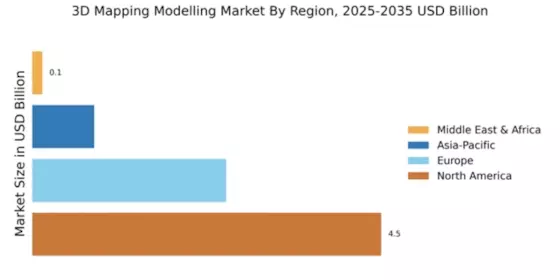
North America is poised to maintain its leadership in the 3D Mapping Modelling Market, holding a significant market share of $4.5B in 2025. The region's growth is driven by advancements in technology, increasing demand for geospatial data, and supportive government regulations promoting infrastructure development. The integration of AI and machine learning in mapping solutions further fuels this growth, making it a hub for innovation and investment. The competitive landscape in North America is robust, featuring key players such as Esri, Autodesk, and Trimble. These companies are at the forefront of technological advancements, providing cutting-edge solutions that cater to various industries, including construction, urban planning, and environmental management. The presence of these industry leaders, along with a strong focus on R&D, positions North America as a critical player in the global market.

Europe : Emerging Market with Growth Potential

Europe is witnessing a significant rise in the 3D Mapping Modelling Market, with a projected market size of $2.5B by 2025. The region benefits from stringent regulations aimed at enhancing urban planning and environmental sustainability, which drive demand for advanced mapping solutions. Countries like Germany and the UK are leading this growth, supported by government initiatives that promote digital transformation in various sectors. The competitive landscape in Europe is characterized by a mix of established firms and innovative startups. Key players such as Hexagon and Bentley Systems are leveraging their expertise to develop tailored solutions for diverse applications. The European market is also seeing increased collaboration between public and private sectors, fostering an environment conducive to technological advancements and market expansion. "The European Union is committed to enhancing digital infrastructure, which is crucial for the growth of the 3D mapping sector," European Commission report 2023.

Asia-Pacific : Emerging Powerhouse in Mapping

The Asia-Pacific region is emerging as a significant player in the 3D Mapping Modelling Market, with a market size of $0.9B anticipated by 2025. Rapid urbanization, coupled with increasing investments in smart city initiatives, is driving demand for advanced mapping technologies. Countries like China and India are at the forefront, implementing policies that encourage the adoption of 3D mapping solutions for urban planning and infrastructure development. The competitive landscape in Asia-Pacific is evolving, with both local and international players vying for market share. Companies such as Pix4D and Mapbox are expanding their presence, offering innovative solutions tailored to regional needs. The growing emphasis on data-driven decision-making in government and private sectors is further propelling the demand for 3D mapping technologies, making this region a focal point for future growth.

Middle East and Africa : Resource-Rich Frontier for Mapping

The Middle East and Africa region is in the nascent stages of developing its 3D Mapping Modelling Market, with a projected size of $0.03B by 2025. The growth is primarily driven by increasing investments in infrastructure and urban development projects, particularly in countries like the UAE and South Africa. Government initiatives aimed at enhancing digital capabilities are also contributing to the rising demand for mapping solutions. The competitive landscape is still developing, with a few key players beginning to establish their presence. Local firms are increasingly collaborating with international companies to leverage advanced technologies and expertise. As the region continues to invest in smart city projects and digital transformation, the potential for growth in the 3D mapping sector is significant, paving the way for future opportunities.

Key Players and Competitive Insights

The 3D Mapping Modelling Market is currently characterized by a dynamic competitive landscape, driven by technological advancements and increasing demand across various sectors such as construction, urban planning, and environmental monitoring. Key players like Esri (US), Autodesk (US), and Trimble (US) are at the forefront, leveraging innovation and strategic partnerships to enhance their market positions. Esri (US) focuses on integrating advanced GIS capabilities with 3D mapping solutions, while Autodesk (US) emphasizes its commitment to cloud-based services and collaborative tools, thereby fostering a more interconnected user experience. Trimble (US) appears to be concentrating on expanding its portfolio through acquisitions, which collectively shapes a competitive environment that is increasingly reliant on technological integration and user-centric solutions.

The market structure is moderately fragmented, with a mix of established players and emerging startups. Key business tactics include localizing manufacturing to reduce costs and optimize supply chains, which is particularly relevant in a globalized economy. The influence of major players is substantial, as they not only set industry standards but also drive innovation through research and development initiatives. This competitive structure allows for a diverse range of offerings, catering to various customer needs and preferences.

In November 2025, Autodesk (US) announced a strategic partnership with a leading cloud service provider to enhance its 3D mapping capabilities. This collaboration aims to integrate AI-driven analytics into its existing platforms, thereby improving data visualization and decision-making processes for users. The strategic importance of this move lies in Autodesk's commitment to staying ahead in a rapidly evolving market, where data-driven insights are becoming increasingly critical for clients.

In October 2025, Trimble (US) launched a new suite of 3D mapping tools designed specifically for the construction industry. This initiative not only showcases Trimble's focus on sector-specific solutions but also highlights its strategy to enhance operational efficiency through advanced technology. By addressing the unique challenges faced by construction professionals, Trimble positions itself as a leader in providing tailored solutions that meet industry demands.

In September 2025, Esri (US) unveiled a new feature within its ArcGIS platform that allows for real-time 3D mapping updates. This innovation is particularly significant as it enables users to visualize changes in urban environments instantaneously, thus facilitating better planning and resource allocation. Esri's focus on real-time data integration reflects a broader trend towards immediacy in data accessibility, which is becoming a crucial factor in decision-making processes across various sectors.

As of December 2025, the competitive trends in the 3D Mapping Modelling Market are increasingly defined by digitalization, sustainability, and the integration of AI technologies. Strategic alliances are playing a pivotal role in shaping the landscape, as companies seek to combine their strengths to deliver more comprehensive solutions. Looking ahead, competitive differentiation is likely to evolve from traditional price-based competition towards a focus on innovation, technological advancements, and supply chain reliability. This shift underscores the importance of adaptability and forward-thinking strategies in maintaining a competitive edge.

Key Companies in the 3D Mapping Modelling Market market include

Industry Developments

  • Q2 2024: Matterport launches new Pro4 3D camera for digital twins and spatial data capture Matterport, a leader in 3D spatial data, announced the launch of its Pro4 3D camera, designed to enhance digital twin creation and 3D mapping for industries such as real estate, construction, and insurance. The new device offers improved image quality and faster data processing for large-scale environments.
  • Q2 2024: Bentley Systems acquires 3D geospatial modeling firm Orbit GT Bentley Systems, a global infrastructure engineering software company, completed the acquisition of Orbit GT, a provider of 3D mapping and mobile mapping software, to strengthen its capabilities in geospatial and reality modeling solutions.
  • Q2 2024: Esri and Autodesk expand partnership to integrate 3D GIS and BIM workflows Esri and Autodesk announced an expanded partnership to integrate Esri’s 3D GIS technology with Autodesk’s Building Information Modeling (BIM) tools, enabling seamless workflows for urban planning, infrastructure, and construction projects.
  • Q1 2024: Pix4D launches Pix4Dcatch RTK for centimeter-accurate 3D mobile mapping Pix4D introduced Pix4Dcatch RTK, a mobile device solution that enables users to capture highly accurate 3D models and maps with real-time kinematic (RTK) positioning, targeting professionals in surveying, construction, and asset management.
  • Q2 2024: NavVis raises $50 million in Series D funding to accelerate 3D mapping technology NavVis, a provider of indoor spatial intelligence solutions, secured $50 million in Series D funding to expand its 3D mapping hardware and software offerings for enterprise digital twin and facility management applications.
  • Q1 2024: Hexagon AB acquires LocLab to boost 3D digital twin and modeling capabilities Hexagon AB, a global leader in digital reality solutions, announced the acquisition of LocLab, a specialist in 3D digital twin modeling, to enhance its portfolio for infrastructure, transportation, and industrial applications.
  • Q2 2024: Trimble launches new 3D scanning solution for construction and civil engineering Trimble introduced a new 3D scanning system designed to improve accuracy and efficiency in construction and civil engineering projects, offering rapid data capture and integration with existing modeling workflows.
  • Q1 2024: Autodesk appoints new Chief Technology Officer to drive 3D modeling innovation Autodesk announced the appointment of a new Chief Technology Officer, tasking the executive with advancing the company’s 3D modeling and design technology for architecture, engineering, and media industries.
  • Q2 2024: HERE Technologies and Cesium partner to deliver high-precision 3D geospatial data HERE Technologies and Cesium announced a partnership to provide high-precision 3D geospatial data and visualization tools, supporting applications in urban planning, simulation, and autonomous vehicle navigation.
  • Q1 2024: Topcon Positioning Group unveils new 3D mapping software for surveyors Topcon Positioning Group launched a new 3D mapping software platform aimed at surveyors and geospatial professionals, offering enhanced data processing and visualization capabilities for land and infrastructure projects.
  • Q2 2024: DroneDeploy acquires StructionSite to expand 3D construction mapping solutions DroneDeploy, a leader in drone mapping software, acquired StructionSite, a provider of 3D construction mapping and progress tracking solutions, to broaden its offerings for the construction and engineering sectors.
  • Q1 2024: FARO Technologies launches new 3D modeling platform for manufacturing and inspection FARO Technologies introduced a new 3D modeling and inspection platform designed for manufacturing, quality assurance, and industrial applications, featuring advanced automation and cloud-based collaboration tools.

Future Outlook

3D Mapping Modelling Market Future Outlook

The 3D Mapping Modelling Market is projected to grow at a 14.52% CAGR from 2024 to 2035, driven by advancements in technology, increased demand for geospatial data, and applications in various industries.

New opportunities lie in:

  • Integration of AI-driven analytics for enhanced data interpretation.
  • Development of mobile 3D mapping solutions for real-time applications.
  • Expansion into emerging markets with tailored 3D mapping services.

By 2035, the market is expected to be robust, driven by innovation and diverse applications.

Market Segmentation

3D Mapping Modelling Market End Use Outlook

  • Aerospace
  • Automotive
  • Architecture
  • Telecommunications
  • Mining

3D Mapping Modelling Market Data Type Outlook

  • Point Cloud Data
  • Mesh Data
  • Raster Data
  • Vector Data

3D Mapping Modelling Market Technology Outlook

  • LiDAR
  • Photogrammetry
  • 3D Scanning
  • Remote Sensing
  • Geographic Information System

3D Mapping Modelling Market Application Outlook

  • Surveying
  • Construction
  • Urban Planning
  • Disaster Management
  • Environmental Monitoring

3D Mapping Modelling Market Deployment Type Outlook

  • Cloud-based
  • On-premises
  • Hybrid

Report Scope

MARKET SIZE 20247.93(USD Billion)
MARKET SIZE 20259.08(USD Billion)
MARKET SIZE 203535.24(USD Billion)
COMPOUND ANNUAL GROWTH RATE (CAGR)14.52% (2024 - 2035)
REPORT COVERAGERevenue Forecast, Competitive Landscape, Growth Factors, and Trends
BASE YEAR2024
Market Forecast Period2025 - 2035
Historical Data2019 - 2024
Market Forecast UnitsUSD Billion
Key Companies ProfiledEsri (US), Autodesk (US), Bentley Systems (US), Trimble (US), Pix4D (CH), 3D Systems (US), RealityCapture (SK), Mapbox (US), Hexagon (SE)
Segments CoveredApplication, End Use, Technology, Deployment Type, Data Type
Key Market OpportunitiesIntegration of artificial intelligence enhances precision and efficiency in the 3D Mapping Modelling Market.
Key Market DynamicsTechnological advancements drive competitive forces, enhancing 3D mapping modeling applications across various industries.
Countries CoveredNorth America, Europe, APAC, South America, MEA

Market Highlights

Author
Ankit Gupta
Senior Research Analyst

Ankit Gupta is an analyst in market research industry in ICT and SEMI industry. With post-graduation in "Telecom and Marketing Management" and graduation in "Electronics and Telecommunication" vertical he is well versed with recent development in ICT industry as a whole. Having worked on more than 150+ reports including consultation for fortune 500 companies such as Microsoft and Rio Tinto in identifying solutions with respect to business problems his opinions are inclined towards mixture of technical and managerial aspects.

Leave a Comment

FAQs

How much is the 3D Mapping & 3D Modelling market?

3D mapping & 3D Modelling Market was valued at USD 7.93 billion in 2024

What is the market size for 2035, for the 3D mapping & 3D Modelling Market?

3D mapping & 3D Modelling Market is projected to reach USD 35.24 billion by 2035

What is the growth rate of the 3D Mapping & 3D Modelling market?

3D mapping & 3D Modelling Market Size is predicetd to hit at a CAGR of 14.52% by 2035

Which region held the largest market share in the 3D Mapping & 3D Modelling market?

North America is expected to hold the highest market share in the global 3D mapping and 3D modelling market.

Who are the prominent players in the 3D Mapping & 3D Modelling market?

Autodesk (US), GeoDigital (US), Golden Software (US), Apple (US), WRLD (UK), Mitsubishi Electric (Japan), MAXON (Germany), and other.

Download Free Sample

Kindly complete the form below to receive a free sample of this Report

Compare Licence

×
Features License Type
Single User Multiuser License Enterprise User
Price $4,950 $5,950 $7,250
Maximum User Access Limit 1 User Upto 10 Users Unrestricted Access Throughout the Organization
Free Customization
Direct Access to Analyst
Deliverable Format
Platform Access
Discount on Next Purchase 10% 15% 15%
Printable Versions