×
Request Free Sample ×

Kindly complete the form below to receive a free sample of this Report

* Please use a valid business email

Leading companies partner with us for data-driven Insights

clients tt-cursor
Hero Background

5G Smart Farming Market

ID: MRFR/ICT/10175-HCR
100 Pages
Garvit Vyas
October 2025

5G Smart Farming Market Research Report: Information By Component (Hardware, Software, and Services), By Application (Precision Farming, Irrigation and Water Management, Plant Health, Soil Moisture, Water Supply Control, and Smart Greenhouse), By Farm Size (Large Farms, and Small & Medium Farms), By Region (North America, Europe, Asia-Pacific, And Rest of The World) –Market Forecast Till 2035.

Share:
Download PDF ×

We do not share your information with anyone. However, we may send you emails based on your report interest from time to time. You may contact us at any time to opt-out.

5G Smart Farming Market Infographic
Purchase Options

5G Smart Farming Market Summary

As per MRFR analysis, the 5G Smart Farming Market Size was estimated at 21.39 USD Billion in 2024. The 5G Smart Farming industry is projected to grow from 25.13 USD Billion in 2025 to 126.07 USD Billion by 2035, exhibiting a compound annual growth rate (CAGR) of 17.5 during the forecast period 2025 - 2035.

Key Market Trends & Highlights

The 5G Smart Farming Market is poised for substantial growth driven by technological advancements and increasing demand for sustainable agricultural practices.

  • North America remains the largest market for 5G smart farming solutions, reflecting a strong adoption of advanced agricultural technologies.
  • Asia-Pacific is emerging as the fastest-growing region, propelled by rapid urbanization and a shift towards modern farming techniques.
  • The hardware segment dominates the market, while the software segment is experiencing the fastest growth due to rising demand for data analytics.
  • Key market drivers include increased demand for precision agriculture and government initiatives supporting sustainable farming practices.

Market Size & Forecast

2024 Market Size 21.39 (USD Billion)
2035 Market Size 126.07 (USD Billion)
CAGR (2025 - 2035) 17.5%

Major Players

Deere & Company (US), AG Leader Technology (US), Trimble Inc. (US), BASF SE (DE), CNH Industrial N.V. (GB), Bayer AG (DE), Topcon Positioning Systems (US), Raven Industries (US), Trelleborg AB (SE), Hexagon AB (SE)

5G Smart Farming Market Trends

The 5G Smart Farming Market is currently experiencing a transformative phase, driven by advancements in technology and the increasing need for sustainable agricultural practices. The integration of fifth-generation wireless technology into farming operations appears to enhance connectivity, enabling real-time data exchange and improved decision-making processes. This evolution seems to facilitate precision agriculture, where farmers can monitor crop health, soil conditions, and weather patterns with unprecedented accuracy. As a result, the market is likely to witness a surge in demand for smart farming solutions that leverage 5G capabilities, potentially leading to higher yields and reduced resource consumption. Moreover, the ongoing development of Internet of Things (IoT) devices tailored for agriculture is expected to play a pivotal role in the growth of the 5G Smart Farming Market. These devices, which include sensors and drones, may provide farmers with critical insights into their operations, thereby optimizing productivity. Additionally, the collaboration between technology providers and agricultural stakeholders suggests a concerted effort to address challenges such as labor shortages and climate change. This synergy could foster innovative solutions that not only enhance efficiency but also promote environmental sustainability in farming practices.

Enhanced Connectivity and Data Utilization

The advent of 5G technology is likely to revolutionize connectivity in agriculture, allowing for seamless communication between devices. This enhanced connectivity may enable farmers to utilize data more effectively, leading to informed decision-making and optimized resource management.

Integration of IoT Devices

The proliferation of IoT devices in agriculture appears to be a key trend within the 5G Smart Farming Market. These devices can collect and transmit data in real-time, providing farmers with valuable insights into crop health and environmental conditions, thereby improving overall farm management.

Sustainability and Resource Efficiency

There is a growing emphasis on sustainable farming practices, which the 5G Smart Farming Market seems to support. By utilizing advanced technologies, farmers may reduce waste and enhance resource efficiency, contributing to more environmentally friendly agricultural methods.

5G Smart Farming Market Drivers

Government Initiatives and Support

Government initiatives play a pivotal role in the growth of the 5G Smart Farming Market. Various countries are implementing policies aimed at promoting smart farming practices and the adoption of 5G technology. For instance, funding programs and grants are being offered to farmers who invest in digital agriculture solutions. These initiatives not only encourage technological adoption but also aim to improve food security and sustainability. As governments recognize the potential of 5G in transforming agriculture, the support provided is likely to stimulate investment and innovation within the 5G Smart Farming Market.

Enhanced Data Analytics Capabilities

The 5G Smart Farming Market benefits from enhanced data analytics capabilities enabled by 5G technology. With the ability to transmit large volumes of data at high speeds, farmers can leverage advanced analytics to make informed decisions. This includes analyzing soil health, weather patterns, and crop performance in real-time. The market for agricultural data analytics is expected to grow significantly, with estimates suggesting it could reach USD 2.5 billion by 2025. As farmers increasingly rely on data-driven insights to optimize their operations, the demand for 5G connectivity will likely continue to expand, further driving the 5G Smart Farming Market.

Advancements in Agricultural Technology

The 5G Smart Farming Market is significantly influenced by advancements in agricultural technology. Innovations such as autonomous tractors, drones, and smart irrigation systems are becoming more prevalent. These technologies rely on high-speed connectivity provided by 5G networks, which allows for seamless communication between devices. The market for agricultural drones alone is projected to reach USD 6.5 billion by 2026, indicating a robust growth trajectory. As farmers seek to adopt these technologies to enhance operational efficiency, the demand for 5G connectivity in agriculture is expected to rise, further propelling the 5G Smart Farming Market.

Increased Demand for Precision Agriculture

The 5G Smart Farming Market is witnessing a surge in demand for precision agriculture techniques. Farmers are increasingly adopting technologies that allow for real-time monitoring and management of crops and livestock. This shift is driven by the need to enhance yield while minimizing resource usage. According to recent data, precision agriculture can lead to yield increases of up to 20%. The integration of 5G technology facilitates the deployment of advanced sensors and drones, enabling farmers to collect and analyze data more efficiently. This trend not only improves productivity but also supports sustainable farming practices, making it a crucial driver in the 5G Smart Farming Market.

Rising Consumer Demand for Sustainable Practices

The 5G Smart Farming Market is also driven by the rising consumer demand for sustainable agricultural practices. As consumers become more environmentally conscious, there is a growing expectation for food producers to adopt sustainable methods. 5G technology enables farmers to implement precision farming techniques that reduce waste and optimize resource use. This alignment with consumer preferences is crucial, as studies indicate that over 70% of consumers are willing to pay a premium for sustainably produced food. Consequently, the integration of 5G in farming practices is likely to enhance market competitiveness and drive growth in the 5G Smart Farming Market.

Market Segment Insights

By Component: Hardware (Largest) vs. Software (Fastest-Growing)

In the 5G Smart Farming Market, the component segment is distinctly divided into hardware, software, and services, with hardware holding the largest market share. This segment includes various physical devices ranging from sensors to drones that leverage 5G technology to enhance agricultural efficiency. Software, while currently smaller in share, is rapidly gaining traction as farmers seek smart, data-driven solutions to manage their operations effectively. Services encompass the support and consulting needed for implementation and optimization, playing a crucial role as well.

Components: Hardware (Dominant) vs. Software (Emerging)

Hardware in the 5G Smart Farming Market represents a dominant component, essential for implementing technologies such as automated machinery, advanced sensors, and smart irrigation systems. These devices benefit from low latency and high connectivity offered by 5G, positioning hardware as the backbone of smart farming solutions. In contrast, software is emerging as a critical component, driven by the demand for data analytics and precision farming tools that enhance operational efficiency. As IoT integration increases, software solutions that process and analyze data collected by hardware are becoming indispensable, making them a focal point for investment and growth within the market.

By Application: Precision Farming (Largest) vs. Irrigation and Water Management (Fastest-Growing)

In the 5G Smart Farming Market, segmentation reflects varied applications crucial for advancing agricultural efficiency. Precision Farming holds the largest market share, driven by the increasing adoption of smart technologies that optimize farming practices. It encompasses various technologies that enhance crop yield, resulting in significant demand within this segment. On the other hand, Irrigation and Water Management is rapidly gaining traction, supported by the global emphasis on sustainable water use and the necessity for smart irrigation solutions to combat water scarcity in agriculture. The growth trajectory of this segment is propelled by ongoing technological advancements and rising awareness among farmers regarding the benefits of implementing 5G-enabled solutions. As farmers increasingly recognize the potential for improved efficiency and productivity, the adoption of Irrigation and Water Management solutions is expected to escalate at an impressive rate. The integration of IoT and data analytics through 5G networks further enhances the need for effective water management strategies, contributing to this segment's robust growth.

Precision Farming (Dominant) vs. Smart Greenhouse (Emerging)

Precision Farming is recognized as the dominant force in the 5G Smart Farming Market, leveraging data and technology to optimize every aspect of agricultural production. This approach employs advanced tools such as sensors, drones, and satellite imagery to provide real-time insights, significantly enhancing yield and resource management. Meanwhile, Smart Greenhouses represent an emerging segment that capitalizes on controlled environments to ensure optimal growth conditions for crops, utilizing 5G connectivity to monitor and manage factors like temperature, humidity, and light. This synergy promotes a shift towards more efficient, sustainable farming practices, bridging the gap between traditional agriculture and modern technological applications.

By Farm Size: Large Farms (Largest) vs. Small & Medium Farms (Fastest-Growing)

In the 5G Smart Farming Market, the distribution of market share by farm size reveals a distinctive landscape, with large farms accounting for the lion's share of market engagement. These expansive agricultural operations leverage 5G technology to enhance productivity through better connectivity and automation, enabling them to implement complex systems that optimize resource use and crop management. Meanwhile, small and medium farms, although smaller in market share currently, are rapidly adopting 5G technologies, driven by competitive necessity and the need for efficient farming solutions. The growth trends within this segment indicate that while large farms will continue to dominate the market in terms of share, small and medium farms are emerging as the faster-growing segment due to the need for cost-effective solutions. Factors supporting this growth include increased access to funding for technology adoption, rising consumer demand for locally-sourced produce, and the scalability of smart farming practices that can cater to smaller operations, thus making them more efficient and profitable.

Farm Size: Large Farms (Dominant) vs. Small & Medium Farms (Emerging)

Large farms hold a dominant position in the 5G Smart Farming Market, primarily due to their ability to invest substantially in technology and infrastructure that leverage high-speed connectivity. These farms utilize advanced sensors and IoT devices to collect and analyze data in real-time, enhancing their operational efficiency and maximizing yield. On the other hand, small and medium farms represent an emerging segment characterized by a strong uptake of digital solutions, dictated by the need for enhancing productivity with limited resources. These farms are increasingly becoming focal points for innovation, as they adopt 5G technologies to develop smart agricultural practices that improve efficiency, sustainability, and profitability, making them a crucial part of the market's future growth.

Get more detailed insights about 5G Smart Farming Market

Regional Insights

North America : Technological Innovation Leader

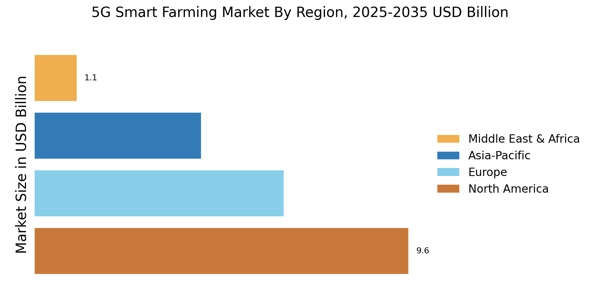
North America is poised to dominate the 5G smart farming market, accounting for approximately 45% of the global share. The region's growth is driven by rapid technological advancements, increasing demand for precision agriculture, and supportive government policies promoting digital farming solutions. The U.S. and Canada are leading this transformation, with significant investments in 5G infrastructure and agricultural technology. The competitive landscape is robust, featuring key players like Deere & Company, Trimble Inc., and AG Leader Technology. These companies are at the forefront of integrating 5G technology into farming practices, enhancing efficiency and productivity. The presence of established agricultural firms and tech innovators fosters a dynamic environment for growth, making North America a critical hub for 5G smart farming advancements.

Europe : Sustainable Agriculture Focus

Europe is emerging as a significant player in the 5G smart farming market, holding around 30% of the global share. The region's growth is fueled by stringent regulations aimed at sustainability and environmental protection, alongside increasing investments in digital agriculture. Countries like Germany and France are leading the charge, supported by EU initiatives that promote the adoption of advanced technologies in farming practices. The competitive landscape in Europe is characterized by a mix of established agricultural firms and innovative startups. Key players such as BASF SE and Bayer AG are actively investing in 5G technologies to enhance crop management and resource efficiency. The European market is also witnessing collaborations between tech companies and agricultural stakeholders, further driving the adoption of smart farming solutions.

Asia-Pacific : Emerging Market Potential

Asia-Pacific is rapidly emerging as a key market for 5G smart farming, accounting for approximately 20% of the global share. The region's growth is driven by increasing agricultural productivity demands, urbanization, and government initiatives promoting smart farming technologies. Countries like China and India are at the forefront, with significant investments in 5G infrastructure to support agricultural innovation and efficiency. The competitive landscape is diverse, with a mix of local and international players. Companies such as CNH Industrial N.V. and Topcon Positioning Systems are actively expanding their presence in the region. The growing focus on precision agriculture and the integration of IoT technologies are expected to further enhance the adoption of 5G solutions in farming practices across Asia-Pacific, making it a vibrant market for future growth.

Middle East and Africa : Resource-Rich Opportunities

The Middle East and Africa region is gradually recognizing the potential of 5G smart farming, holding about 5% of the global market share. The growth is driven by the need for food security, water management, and the adoption of innovative agricultural practices. Countries like South Africa and the UAE are leading initiatives to integrate 5G technology into farming, supported by government policies aimed at enhancing agricultural productivity and sustainability. The competitive landscape is still developing, with emerging players and collaborations between tech firms and agricultural stakeholders. Companies like Hexagon AB and Trelleborg AB are exploring opportunities in this region, focusing on smart farming solutions that address local challenges. As investments in technology and infrastructure increase, the Middle East and Africa are poised for significant advancements in 5G smart farming.

5G Smart Farming Market Regional Image

Key Players and Competitive Insights

Leading market players are investing heavily in research and development to expand their product lines, which will help the 5G Smart Farming Market, grow even more. Market participants are also undertaking a variety of strategic activities to expand their footprint, with important market developments including new product launches, contractual agreements, mergers and acquisitions, higher investments, and collaboration with other organizations. To expand and survive in a more competitive and rising market climate, the 5G Smart Farming industry must offer cost-effective items.

Manufacturing locally to minimize operational costs is one of the key business tactics used by manufacturers in the 5G Smart Farming industry to benefit clients and increase the market sector. In recent years, the 5G Smart Farming industry has offered some of the most significant advantages to the agricultural sector. Major players in the 5G Smart Farming Market, including Huawei, Dronetech, Ericsson, John Deere, Indigo Ag, LumiGrow, Raven Industries, DroneDeploy, and Vodacom are attempting to increase market demand by investing in research and development operations.

Huawei, a subsidiary of Huawei Investment & Holding Co Ltd, is a prominent provider of information and communication technology (ICT) infrastructure and smart devices. The company boasts a diverse product portfolio encompassing laptops, tablets, routers, wearables, headphones, enterprise wireless products, optical transmission and access products, networking products, and cloud and computing solutions. Huawei also delivers services and software tailored for carrier networks and smart services for enterprises. Its clientele spans various industries, including education, finance, healthcare, internet services, manufacturing, oil and gas, public safety, retail, smart city, smart grid, and transportation.

Huawei has established a business presence, with operations spanning the Americas, Africa, Europe, and the Asia-Pacific region. Headquartered in Shenzhen, Guangdong, China, Huawei is recognized for its comprehensive offerings. In a strategic collaboration, China Mobile Zibo has partnered with Huawei to implement the inaugural 5G site at the Hefeng Unmanned Farm in Linzi District of Zibo. Spanning approximately 33 hectares, the farm is a collaborative initiative led by Professor Lan Yubin of Shandong University of Technology and Zibo Hefeng Seed, a seed production company.

Deere & Co, commonly known as John Deere, is a leading provider of advanced products and services, specializing in the manufacturing and distribution of agricultural, construction, and forestry equipment, along with related service parts. The company's comprehensive product portfolio encompasses agriculture and turf equipment, outdoor power products, and machinery used in construction, earthmoving, material handling, and timber harvesting. In addition to its equipment offerings, Deere & Co. provides financing solutions for sales and leases, including wholesale financing and extended equipment warranties. The company owns and operates manufacturing facilities, administrative offices, and research centers ly, supporting its widespread business operations.

With a robust presence in North America, Africa, Asia-Pacific, the Middle East, and Europe, Deere & Co. strategically markets its products through an extensive network of dealers and distributors. Headquartered in Moline, Illinois, the United States, the company is recognized for its commitment to delivering cutting-edge solutions in the realms of agriculture, construction, and forestry.
Key Companies in the 5G Smart Farming Market market include

Industry Developments

February 2022: In February 2022, Sway AI, a developer specializing in AI technology and services, announced its collaboration with Trilogy Networks to join the Rural Cloud Initiative (RCI). This unique coalition comprises network and edge innovation partners committed to facilitating and accelerating the digital transformation of rural America. The collaboration aimed to provide farmers with a comprehensive AI-enabled precision agricultural solution.

December 2021: In December 2021, DJI introduced its latest AGRAS T20 drone as part of its crop protection series for agriculture. This advanced drone is capable of carrying a maximum payload of 20 kg and boasts a 20% improvement in spray uniformity, covering an approximate distance of seven meters.

Future Outlook

5G Smart Farming Market Future Outlook

The 5G Smart Farming Market is projected to grow at a 17.5% CAGR from 2024 to 2035, driven by advancements in IoT, precision agriculture, and enhanced connectivity.

New opportunities lie in:

  • Development of AI-driven crop monitoring systems
  • Integration of autonomous drones for precision spraying
  • Implementation of real-time data analytics platforms for yield optimization

By 2035, the market is expected to be robust, driven by technological advancements and increased adoption.

Market Segmentation

5G Smart Farming Market Component Outlook

  • Hardware
  • Software
  • Services

5G Smart Farming Market Farm Size Outlook

  • Large Farms
  • Small & Medium Farms

5G Smart Farming Market Application Outlook

  • Precision Farming
  • Irrigation and Water Management
  • Plant Health
  • Soil Moisture
  • Water Supply Control
  • Smart Greenhouse

Report Scope

MARKET SIZE 202421.39(USD Billion)
MARKET SIZE 202525.13(USD Billion)
MARKET SIZE 2035126.07(USD Billion)
COMPOUND ANNUAL GROWTH RATE (CAGR)17.5% (2024 - 2035)
REPORT COVERAGERevenue Forecast, Competitive Landscape, Growth Factors, and Trends
BASE YEAR2024
Market Forecast Period2025 - 2035
Historical Data2019 - 2024
Market Forecast UnitsUSD Billion
Key Companies ProfiledMarket analysis in progress
Segments CoveredMarket segmentation analysis in progress
Key Market OpportunitiesIntegration of advanced sensors and automation in the 5G Smart Farming Market enhances productivity and sustainability.
Key Market DynamicsRising adoption of 5G technology enhances precision agriculture, driving efficiency and productivity in smart farming practices.
Countries CoveredNorth America, Europe, APAC, South America, MEA

Market Highlights

Author
Garvit Vyas
Analyst

Explore the profile of Garvit Vyas, one of our esteemed authors at Market Research Future, and access their expert research contributions in the field of market research and industry analysis

Leave a Comment

FAQs

What is the projected market valuation of the 5G Smart Farming Market by 2035?

The projected market valuation for the 5G Smart Farming Market is expected to reach 126.07 USD Billion by 2035.

What was the market valuation of the 5G Smart Farming Market in 2024?

The overall market valuation of the 5G Smart Farming Market was 21.39 USD Billion in 2024.

What is the expected CAGR for the 5G Smart Farming Market during the forecast period 2025 - 2035?

The expected CAGR for the 5G Smart Farming Market during the forecast period 2025 - 2035 is 17.5%.

Which companies are considered key players in the 5G Smart Farming Market?

Key players in the 5G Smart Farming Market include Deere & Company, AG Leader Technology, Trimble Inc., BASF SE, and Bayer AG.

What are the main components of the 5G Smart Farming Market and their valuations?

The main components include Hardware valued at 30.0 USD Billion, Software at 42.0 USD Billion, and Services at 54.07 USD Billion.

How does the market size for large farms compare to small and medium farms in the 5G Smart Farming Market?

The market size for large farms is projected at 75.64 USD Billion, while small and medium farms are expected to reach 50.43 USD Billion.

Download Free Sample

Kindly complete the form below to receive a free sample of this Report

Compare Licence

×
Features License Type
Single User Multiuser License Enterprise User
Price $4,950 $5,950 $7,250
Maximum User Access Limit 1 User Upto 10 Users Unrestricted Access Throughout the Organization
Free Customization
Direct Access to Analyst
Deliverable Format
Platform Access
Discount on Next Purchase 10% 15% 15%
Printable Versions