×
Request Free Sample ×

Kindly complete the form below to receive a free sample of this Report

* Please use a valid business email

Leading companies partner with us for data-driven Insights

clients tt-cursor
Hero Background

Activated Alumina Market

ID: MRFR/CnM/4144-HCR
140 Pages
Anshula Mandaokar
October 2025

Activated Alumina Market Research Report Information by Application (Catalyst, Desiccant, Adsorbent and others), End-Use Industry (Water Treatment, Pharmaceutical, Textile, Oil & Gas, Chemical and others) and Region (Asia-Pacific, North America, Europe, Latin America and Middle East & Africa) - Forecast till 2035

Share:
Download PDF ×

We do not share your information with anyone. However, we may send you emails based on your report interest from time to time. You may contact us at any time to opt-out.

Activated Alumina Market Infographic
Purchase Options

Activated Alumina Market Summary

As per MRFR analysis, the Activated Alumina Market Size was estimated at 4897.41 USD Million in 2024. The Activated Alumina industry is projected to grow from 5071.41 USD Million in 2025 to 7190.41 USD Million by 2035, exhibiting a compound annual growth rate (CAGR) of 3.55 during the forecast period 2025 - 2035.

Key Market Trends & Highlights

The Activated Alumina Market is poised for growth driven by sustainability and technological advancements.

  • The market is witnessing a pronounced shift towards sustainability, influencing product development and consumer preferences.
  • North America remains the largest market, while Asia-Pacific is emerging as the fastest-growing region for activated alumina applications.
  • In the desiccant segment, activated alumina holds the largest share, whereas the catalyst support segment is experiencing rapid growth.
  • Key drivers include the increasing demand for water treatment solutions and the expansion of the pharmaceutical industry, highlighting the material's versatility.

Market Size & Forecast

2024 Market Size 4897.41 (USD Million)
2035 Market Size 7190.41 (USD Million)
CAGR (2025 - 2035) 3.55%

Major Players

Almatis (DE), Axens (FR), BASF (DE), Honeywell (US), SABIC (SA), Sorbead (IN), Strem Chemicals (US), UOP (US), Huntsman (US)

Activated Alumina Market Trends

The Activated Alumina Market is currently experiencing a notable transformation, driven by increasing demand across various sectors such as water treatment, pharmaceuticals, and air purification. This material, known for its high adsorption capacity, is becoming essential in applications that require moisture control and contaminant removal. As industries strive for sustainability, the utilization of activated alumina is likely to expand, reflecting a shift towards eco-friendly solutions. Furthermore, advancements in production technologies may enhance the efficiency and effectiveness of activated alumina, potentially leading to broader adoption in emerging markets. In addition to its growing applications, the Activated Alumina Market is witnessing a rise in research and development activities aimed at improving product performance. Companies are investing in innovative methods to enhance the properties of activated alumina, which could result in superior products that meet the evolving needs of consumers. The competitive landscape is also changing, with new entrants emerging alongside established players, fostering a dynamic environment that encourages collaboration and technological advancements. Overall, the Activated Alumina Market appears poised for growth, driven by both demand and innovation.

Sustainability Focus

The Activated Alumina Market is increasingly influenced by a global emphasis on sustainability. Industries are prioritizing eco-friendly materials, leading to a heightened interest in activated alumina for its ability to reduce environmental impact. This trend suggests that companies may seek to incorporate activated alumina into their processes to align with green initiatives.

Technological Advancements

Ongoing technological advancements are shaping the Activated Alumina Market. Innovations in production techniques and material enhancements are likely to improve the efficiency and effectiveness of activated alumina. This trend indicates that manufacturers may invest in research and development to create superior products that cater to diverse applications.

Emerging Market Opportunities

The Activated Alumina Market is witnessing the emergence of new opportunities in developing regions. As industrialization accelerates in these areas, the demand for activated alumina in water treatment and air purification applications is expected to rise. This trend suggests that companies may focus on expanding their presence in these markets to capitalize on growth potential.

Activated Alumina Market Drivers

Rising Applications in Oil and Gas Sector

The Global Activated Alumina Market Industry is witnessing a notable rise in applications within the oil and gas sector. Activated alumina is employed as a desiccant and adsorbent in the refining process, where it aids in the removal of impurities and moisture from hydrocarbons. This application is particularly critical as the industry seeks to enhance efficiency and reduce operational costs. The anticipated growth of the oil and gas sector, coupled with the increasing emphasis on sustainability, suggests a promising future for activated alumina. As the market evolves, it is expected to contribute significantly to the projected market value of 2.56 USD Billion by 2035.

Expanding Use in Pharmaceutical Applications

The Global Activated Alumina Market Industry is experiencing an expansion in the use of activated alumina within pharmaceutical applications. Its properties as an adsorbent make it suitable for various processes, including drug formulation and purification. The pharmaceutical sector's continuous growth, driven by increasing healthcare needs and innovation, is likely to enhance the demand for activated alumina. As regulatory bodies enforce stricter quality control measures, the reliance on high-purity activated alumina is expected to rise. This trend may further solidify the market's position, contributing to the overall growth and development of the industry.

Increasing Demand for Water Treatment Solutions

The Global Activated Alumina Market Industry is experiencing a surge in demand for water treatment solutions, driven by the growing need for clean and safe drinking water. Activated alumina is widely utilized in the removal of fluoride, arsenic, and other contaminants from water. As urbanization progresses and industrial activities expand, the pressure on water resources intensifies. This trend is reflected in the projected market value of 1.29 USD Billion in 2024, indicating a robust growth trajectory. Furthermore, the increasing regulatory focus on water quality standards is likely to propel the adoption of activated alumina in various regions, enhancing its market presence.

Technological Advancements in Production Methods

Technological advancements in the production methods of activated alumina are playing a pivotal role in shaping the Global Activated Alumina Market Industry. Innovations in manufacturing processes are enhancing the quality and efficiency of activated alumina, making it more accessible for various applications. For instance, the development of more efficient calcination techniques is likely to reduce energy consumption and production costs. This improvement not only benefits manufacturers but also encourages wider adoption across industries. As these advancements continue to unfold, they may contribute to the expected compound annual growth rate of 6.44% from 2025 to 2035, reflecting a dynamic market landscape.

Growing Awareness of Environmental Sustainability

The Global Activated Alumina Market Industry is increasingly influenced by the growing awareness of environmental sustainability. As industries and consumers alike prioritize eco-friendly solutions, activated alumina emerges as a viable option due to its recyclable nature and minimal environmental impact. This trend is particularly evident in sectors such as pharmaceuticals and food processing, where stringent regulations on waste management are in place. The shift towards sustainable practices is likely to drive demand for activated alumina, as companies seek to align with environmental standards. Consequently, this heightened awareness may bolster the market's growth trajectory in the coming years.
Market Segment Insights

By Application: Desiccant (Largest) vs. Catalyst Support (Fastest-Growing)

The Activated Alumina Market is primarily driven by various applications, among which Desiccants hold the largest share. This segment is widely utilized for moisture control and is favored in industries such as pharmaceuticals and food processing. The Catalyst Support segment follows closely and is gaining momentum due to increasing demand for catalysts in chemical reactions, highlighting evolving preferences in industrial applications. Meanwhile, the Catalyst Support segment is projected to be the fastest-growing, primarily driven by trends in sustainable practices and advancements in catalytic technologies. Water and Air Treatment applications are also critical but represent a smaller part of the market. The necessity for environmentally friendly solutions is steering growth, particularly in water and air purification applications, which are becoming essential in various sectors.

Desiccant (Dominant) vs. Water Treatment (Emerging)

Desiccant applications are integral to the Activated Alumina Market, known for their effectiveness in moisture control. This segment leads the market, utilized extensively in industries like pharmaceuticals and food packaging. In contrast, Water Treatment is an emerging segment, increasingly recognized for its role in meeting regulatory standards and ensuring safe drinking water. As global awareness regarding water quality rises, the demand for activated alumina in this area is also on the rise. These segments highlight the diverse use of activated alumina, where desiccants maintain dominance while water treatment applications show significant potential for future growth.

By End Use: Chemical Industry (Largest) vs. Pharmaceutical Industry (Fastest-Growing)

The Activated Alumina Market exhibits a varied distribution of market share across its end-use segments. The Chemical Industry stands as the largest segment, leveraging activated alumina for applications such as catalysts and adsorbents. Following closely, the Pharmaceutical Industry is gaining traction, propelled by increasing demand for high-purity activated alumina in drug manufacturing processes. Other notable segments include Food and Beverage, Oil and Gas, and Water Treatment Facilities, each contributing significantly to the market dynamics.

Chemical Industry: Dominant vs. Pharmaceutical Industry: Emerging

The Chemical Industry remains the dominant force in the Activated Alumina Market due to its extensive applications including catalysis and moisture adsorption, which are crucial for various chemical processes. This segment benefits from established usage patterns and ongoing demand across multiple chemical applications. In contrast, the Pharmaceutical Industry is emerging rapidly, driven by the rising need for specialized materials that ensure sterility and reliability in drug formulations. This shift is supported by innovations and regulatory guidelines favoring high-quality materials. Collectively, these segments illustrate a complex interplay of stability and growth within the market.

By Form: Powder (Largest) vs. Pellets (Fastest-Growing)

In the Activated Alumina Market, the form segment is characterized by various product types, including Powder, Granular, Pellets, and Beads. The Powder form holds the largest market share due to its widespread application in adsorbent materials and catalyst supports. In contrast, while the Granular and Beads forms contribute significantly, they are overshadowed by the growth of Pellets, which is quickly gaining traction in the market due to its unique properties and versatility.

Granular (Dominant) vs. Beads (Emerging)

In the Activated Alumina Market, Granular form is regarded as the dominant player due to its effectiveness in various industrial applications, including water treatment and gas drying. Its ability to maintain structural integrity and high adsorption capacity makes it a preferred choice for many manufacturers. Meanwhile, Beads represent an emerging segment characterized by their enhanced surface area and spherical shape, which facilitate improved flow and adsorption efficiency. As industries seek more efficient solutions for moisture control and pollutant removal, Beads are expected to witness rapid growth, attracting interest from both producers and end-users.

By Type: Activated Alumina for Water Treatment (Largest) vs. Activated Alumina for Fluoride Removal (Fastest-Growing)

The Activated Alumina Market is segmented into various types, of which Activated Alumina for Water Treatment holds the largest market share, attributed to its extensive application in municipal water purification and industrial processes. Activated Alumina for Fluoride Removal is gaining traction, reflecting a growing emphasis on health and environmental protection. Meanwhile, Activated Alumina for Air Drying and Catalyst Support represent niche markets that contribute significantly to the segment dynamics. Growth trends indicate a robust demand for Activated Alumina for Water Treatment, driven by increasing awareness of water quality and treatment regulations across various regions. In contrast, Activated Alumina for Fluoride Removal is emerging as a response to rising fluoride contamination concerns in drinking water, primarily in specific geographic locations. The increased focus on environmental sustainability is also propelling the adoption of Activated Alumina for Air Drying and Catalyst Support, indicating a diversified growth trajectory within this market segment.

Activated Alumina for Water Treatment (Dominant) vs. Activated Alumina for Fluoride Removal (Emerging)

Activated Alumina for Water Treatment is recognized as a dominant force in the Activated Alumina Market, widely utilized for its efficacy in removing contaminants from water sources, thereby enhancing water purity for both residential and industrial applications. Its versatility and capacity to handle various impurities make it integral to environmental health initiatives. On its journey towards full market integration, Activated Alumina for Fluoride Removal is emerging, addressing specific contamination issues that have escalated in priority due to health safeguards and regulatory measures. This segment caters to a targeted demand, particularly in regions facing fluoride pollution challenges, positioning it for rapid growth as consumer awareness on water safety increases. Industry innovations further support the development of these products.

By Functionality: Adsorption (Largest) vs. Filtration (Fastest-Growing)

The Activated Alumina Market is segmented into various functionalities, with Adsorption capturing the largest market share due to its established role in water purification and air treatment applications. This segment has a versatile nature, serving industries ranging from pharmaceuticals to food processing, which significantly bolsters its demand. Filtration, although a smaller segment, is rapidly gaining traction as industries seek efficient solutions for air and liquid purification, increasing its share considerably in recent years.

Filtration: Leading vs. Desiccation: Emerging

Filtration is emerging as a leading functionality in the Activated Alumina Market, driven by the increasing need for high-performance filtration solutions in sectors such as pharmaceuticals, water treatment, and environmental applications. This segment benefits from growing regulatory frameworks pushing for cleaner air and water, prompting manufacturers to innovate and enhance their filtration products. On the other hand, Desiccation, while currently less dominant, is gaining importance in industries like packaging and electronics, where moisture control is critical. The added focus on energy-efficient and effective moisture adsorbents continues to shape advancements in both functionalities, with filtration staying at the forefront of market developments.

Get more detailed insights about Activated Alumina Market

Regional Insights

North America : Innovation and Demand Growth

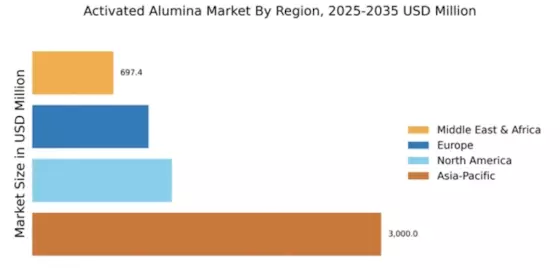
The North American activated alumina market is projected to reach $1500.0 million by 2025, driven by increasing demand in water treatment and air purification applications. Regulatory support for environmental sustainability and the adoption of advanced technologies are key growth catalysts. The region's focus on reducing industrial emissions and enhancing water quality is propelling market expansion, with a notable shift towards eco-friendly materials. Leading countries in this region include the US and Canada, where major players like Honeywell and BASF are actively involved. The competitive landscape is characterized by innovation and strategic partnerships, enhancing product offerings. The presence of established companies ensures a robust supply chain, catering to diverse industrial needs and maintaining a strong market share in activated alumina production.

Europe : Sustainable Solutions and Regulations

Europe's activated alumina market is expected to reach $1200.0 million by 2025, fueled by stringent environmental regulations and a growing emphasis on sustainable solutions. The region's commitment to reducing carbon footprints and enhancing water quality is driving demand for activated alumina in various applications. Regulatory bodies are promoting the use of advanced materials, which is expected to further boost market growth in the coming years. Germany, France, and the UK are leading countries in this market, with key players like BASF and Axens contributing significantly. The competitive landscape is marked by innovation and collaboration among companies to develop eco-friendly products. The presence of established firms ensures a steady supply of activated alumina, catering to the increasing demand from industries focused on sustainability and compliance with environmental standards.

Asia-Pacific : Emerging Powerhouse in Market

Asia-Pacific is the largest market for activated alumina, projected to reach $2000.0 million by 2025. The region's rapid industrialization, urbanization, and increasing environmental awareness are driving demand. Countries like China and India are leading this growth, supported by government initiatives aimed at improving air and water quality. The rising need for efficient filtration systems in various sectors is also a significant growth driver. China, India, and Japan are the primary contributors to this market, with key players such as Sorbead and UOP establishing a strong presence. The competitive landscape is characterized by a mix of local and international companies, fostering innovation and enhancing product offerings. The region's focus on sustainable practices and regulatory support is expected to further solidify its position as a market leader in activated alumina.

Middle East and Africa : Resource-Rich Frontier for Growth

The Middle East and Africa activated alumina market is projected to reach $197.41 million by 2025, driven by increasing industrial activities and a growing focus on water treatment solutions. The region's rich natural resources and investments in infrastructure are key growth drivers. Additionally, the rising awareness of environmental issues is pushing industries to adopt activated alumina for various applications, including air and water purification. Countries like South Africa and Saudi Arabia are leading the market, with key players such as SABIC making significant contributions. The competitive landscape is evolving, with both local and international companies vying for market share. The presence of established firms and the influx of new entrants are expected to enhance product offerings and drive innovation in the activated alumina sector.

Key Players and Competitive Insights

The Activated Alumina Market is characterized by a dynamic competitive landscape, driven by increasing demand for water treatment, air purification, and various industrial applications. Key players such as BASF (DE), Honeywell (US), and Almatis (DE) are strategically positioned to leverage innovation and sustainability initiatives. BASF (DE) focuses on enhancing its product portfolio through research and development, while Honeywell (US) emphasizes digital transformation and smart technologies to optimize operational efficiency. Almatis (DE) is actively pursuing regional expansion to tap into emerging markets, thereby shaping a competitive environment that is increasingly focused on technological advancements and sustainable practices.

In terms of business tactics, companies are localizing manufacturing to reduce costs and enhance supply chain resilience. The market appears moderately fragmented, with several players vying for market share. The collective influence of these key players fosters a competitive structure that encourages innovation and collaboration, as companies seek to differentiate themselves through unique offerings and enhanced customer service.

In November 2025, BASF (DE) announced a strategic partnership with a leading water treatment company to develop advanced activated alumina solutions aimed at improving water purification processes. This collaboration is likely to enhance BASF's market presence and reinforce its commitment to sustainability, as it aligns with global efforts to provide cleaner water solutions. The partnership underscores the importance of innovation in addressing environmental challenges and meeting regulatory standards.

In October 2025, Honeywell (US) launched a new line of activated alumina products designed for air filtration applications, incorporating AI-driven technologies to optimize performance. This move not only positions Honeywell as a leader in the air purification segment but also reflects a broader trend towards integrating smart technologies in traditional manufacturing processes. The introduction of AI capabilities may significantly enhance product efficiency and customer satisfaction, thereby strengthening Honeywell's competitive edge.

In September 2025, Almatis (DE) expanded its production capacity in Asia, responding to the growing demand for activated alumina in the region. This strategic expansion is indicative of Almatis's commitment to meeting regional market needs and enhancing supply chain reliability. By increasing its footprint in Asia, Almatis is likely to capture a larger market share and improve its operational efficiency, which is crucial in a competitive landscape.

As of December 2025, the Activated Alumina Market is witnessing trends such as digitalization, sustainability, and AI integration, which are reshaping competitive dynamics. Strategic alliances are becoming increasingly prevalent, as companies recognize the value of collaboration in driving innovation and enhancing market reach. The shift from price-based competition to a focus on technology, innovation, and supply chain reliability is evident, suggesting that future competitive differentiation will hinge on the ability to adapt to these evolving trends.

Key Companies in the Activated Alumina Market market include

Industry Developments

    • In October 2021, Shell plc and SE collaborated to determine risk and roll out the basic sorbed adsorption technology. Unlike activated alumina or molecular sieves, Sorbead, which is an aluminosilicate gel, is able to regenerate at relatively low temperatures and is resistant to water and acids. Furthermore, the Szorb adsorption technology guarantees the high quality of the treated gas, which meets the requirements for its transport through pipelines and underground storage and, therefore, is free from glycol.
    • February 2023, Evonik made a statement on the expansion of its fumed aluminum oxide production plant in Yokohama, Japan. The company plans to build its first alumina site in Asia. It is planned to specialize in the development of solutions for lithium-ion batteries, which are found in electric vehicle batteries. It is due to be completed in 2025.
    • In October 2022, Axens signed an Asset Sale Agreement ASA with Rio Tinto Alcan Canada concerning the acquisition of the Rio Tinto Alcan activated alumina business located in Brockville, Ontario, Canada. There will be potential for growth in this business for new global markets.
    • SiAT, a Taiwanese company that specializes in advanced nanomaterials used in batteries, has announced a partnership with Taiwan C.S. Aluminum Corporation. This Foil was unveiled in March 2024 and is intended to enhance the capabilities of Lithium Ion batteries, Sodium batteries, and supercapacitors, which require faster charge and longer life span.
    • In an effort to tackle single-use plastic waste, Grove Collaborative Holdings, Inc. unveiled updates to their preexisting products and launched an entirely new line of products under the brand name “Grove Co.” in March 2024. The company revealed that in order to maintain their competitive edge, they are formulating strong partnerships and intensely focusing on reaching their sustainability goals, these changes come as the company has repositioned itself as a certified B corporation and Public Benefit Corporation.

Intended Audience

    • Potential investors

    • Activated alumina manufacturers

    • Distributors

    • Industry associations

Future Outlook

Activated Alumina Market Future Outlook

The Activated Alumina Market is projected to grow at a 3.55% CAGR from 2024 to 2035, driven by increasing demand in water treatment and air purification applications.

New opportunities lie in:

  • Expansion into emerging markets with tailored products
  • Development of high-performance activated alumina for specialized applications
  • Strategic partnerships with water treatment facilities for bulk supply contracts

By 2035, the Activated Alumina Market is expected to achieve robust growth and enhanced market presence.

Market Segmentation

Activated Alumina Market Form Outlook

  • Powder
  • Granular
  • Pellets
  • Beads

Activated Alumina Market Type Outlook

  • Activated Alumina for Fluoride Removal
  • Activated Alumina for Water Treatment
  • Activated Alumina for Air Drying
  • Activated Alumina for Catalyst Support

Activated Alumina Market End Use Outlook

  • Chemical Industry
  • Pharmaceutical Industry
  • Food and Beverage Industry
  • Oil and Gas Industry
  • Water Treatment Facilities

Activated Alumina Market Application Outlook

  • Desiccant
  • Catalyst Support
  • Fluoride Adsorbent
  • Water Treatment
  • Air Treatment

Activated Alumina Market Functionality Outlook

  • Adsorption
  • Desiccation
  • Filtration
  • Catalysis

Report Scope

MARKET SIZE 20244897.41(USD Million)
MARKET SIZE 20255071.41(USD Million)
MARKET SIZE 20357190.41(USD Million)
COMPOUND ANNUAL GROWTH RATE (CAGR)3.55% (2024 - 2035)
REPORT COVERAGERevenue Forecast, Competitive Landscape, Growth Factors, and Trends
BASE YEAR2024
Market Forecast Period2025 - 2035
Historical Data2019 - 2024
Market Forecast UnitsUSD Million
Key Companies ProfiledAlmatis (DE), Axens (FR), BASF (DE), Honeywell (US), SABIC (SA), Sorbead (IN), Strem Chemicals (US), UOP (US), Huntsman (US)
Segments CoveredApplication, End Use, Form, Type, Functionality
Key Market OpportunitiesGrowing demand for water treatment solutions drives innovation in the Activated Alumina Market.
Key Market DynamicsRising demand for activated alumina in water treatment applications drives market growth and innovation in purification technologies.
Countries CoveredNorth America, Europe, APAC, South America, MEA

Market Highlights

Author
Anshula Mandaokar
Team Lead - Research

Anshula Mandaokar holds an academic degree in Chemical Engineering and has been contributing to the field for more than 5 years. She has expertise in Market Research and Business Consulting and serves as a Team Lead for a reputed Market Research firm under the Chemicals and Materials domain spectrum. She has worked on multiple projects, generating explicit results in a quick turnaround time. Her understanding of data interpretation justifies her role as a leader.

Leave a Comment

FAQs

What would be the projected Activated Alumina Market CAGR for the forecast period of 2024 to 2035?

The forecasted CAGR would be 5.9% for the duration of 2025 to 2035.

What could be the market restraints for the Activated Alumina Market?

The easy availability of activated carbon and zeolites can hamper market prospects.

Which region dominates the global Activated Alumina Market?

The Asia Pacific market has market control.

What drives the Activated Alumina Market in the Asia Pacific region?

Rising industrialization and urbanization can set the speed for the regional market.

What drives the North American Activated Alumina Market?

The North American Activated Alumina Market would grow due to the growing environmental concerns.

Download Free Sample

Kindly complete the form below to receive a free sample of this Report

Compare Licence

×
Features License Type
Single User Multiuser License Enterprise User
Price $4,950 $5,950 $7,250
Maximum User Access Limit 1 User Upto 10 Users Unrestricted Access Throughout the Organization
Free Customization
Direct Access to Analyst
Deliverable Format
Platform Access
Discount on Next Purchase 10% 15% 15%
Printable Versions