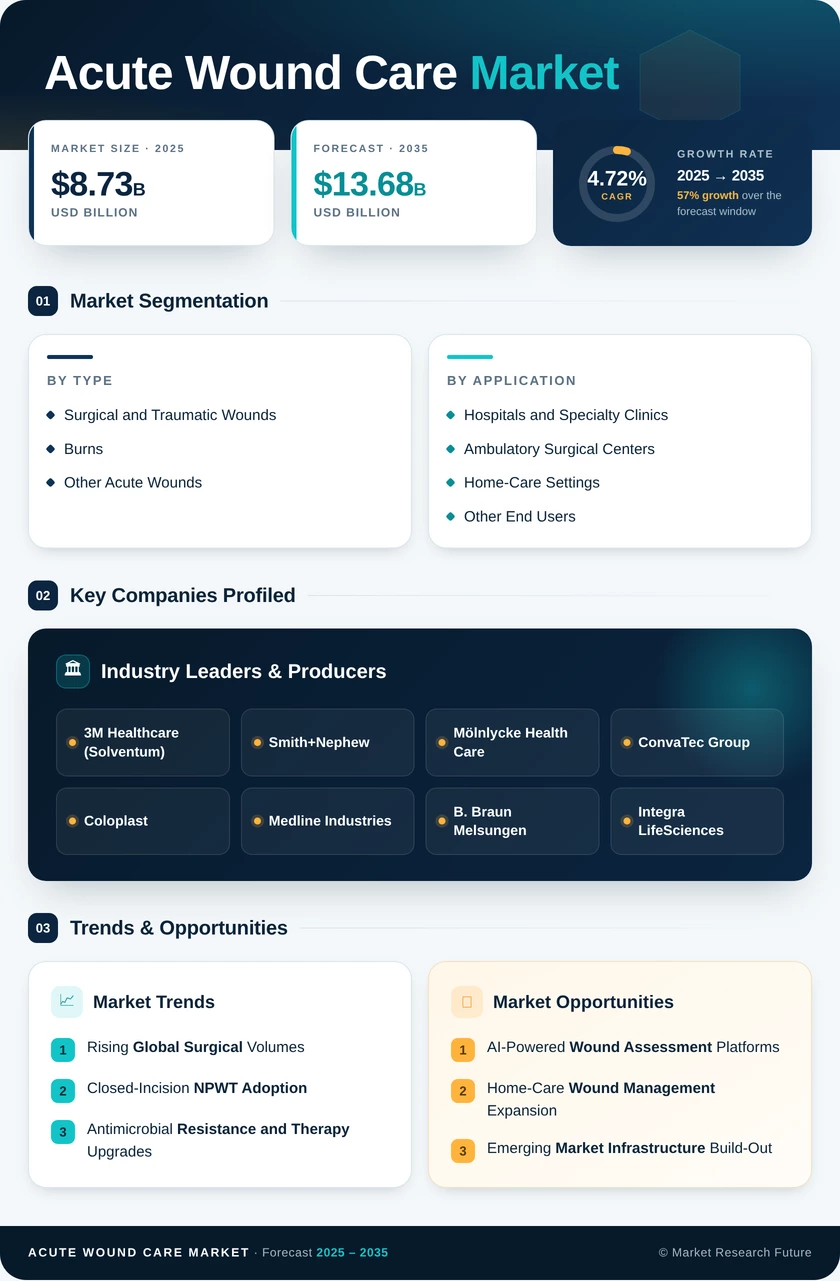
Segmentation Quick Reference
| Dimension | Sub-Segments | Dominant Segment | Fastest Growing Segment |
| Product Type | Advanced Wound Care, Surgical Wound Care, Traditional Wound Care | Advanced Wound Care | Surgical Wound Care |
| Wound Type | Surgical and Traumatic Wounds, Burns, Other Acute Wounds | Surgical and Traumatic Wounds | Burns |
| End User | Hospitals and Specialty Clinics, Ambulatory Surgical Centers, Home-Care Settings, Other End Users | Hospitals and Specialty Clinics | Home-Care Settings |
| Region | North America, Europe, Asia-Pacific, South America, Middle East & Africa | North America | Asia-Pacific |
Market Segmentation Overview
By Product Type
| Sub-Segment | Key Trend |
| Advanced Wound Care | Shift toward foam, hydrocolloid, and alginate dressings with integrated antimicrobial properties. |
| Surgical Wound Care | NPWT device miniaturization and single-use kit adoption are driving rapid growth |
| Traditional Wound Care | Declining share in developed markets; remains dominant in cost-sensitive developing regions |
Advanced wound care products continue to displace traditional gauze-based alternatives across hospital and ambulatory settings. The integration of antimicrobial agents directly into dressing substrates reduces infection risk and simplifies wound management protocols, making these products the preferred choice for post-surgical and trauma care applications.
By Wound Type
| Sub-Segment | Key Trend |
| Surgical and Traumatic Wounds | Largest segment by revenue, driven by global surgical volume exceeding 310 million procedures annually |
| Burns | Fastest-growing wound type; specialized burn care infrastructure expanding in the Asia-Pacific and the Middle East |
| Other Acute Wounds | Includes lacerations, abrasions, and acute infections managed in emergency and primary care settings |
Surgical and traumatic wounds represent the core demand driver for the acute wound care market, with every surgical incision and emergency trauma admission generating product consumption. Burn treatment is attracting disproportionate investment as governments in high-burden regions establish dedicated burn units equipped with advanced dressing technologies.
By End User
| Sub-Segment | Key Trend |
| Hospitals and Specialty Clinics | Dominant channel; specialized wound care units driving advanced product adoption |
| Ambulatory Surgical Centers | Rapid growth as procedures migrate from inpatient to outpatient settings. |
| Home-Care Settings | Fastest-growing channel; portable NPWT and simplified dressing kits enabling patient self-management |
| Other End Users | Includes military field hospitals, long-term care facilities, and rehabilitation centers |
Hospitals remain the primary procurement channel for acute wound care products, though the fastest growth is occurring in home-care settings where reimbursement reform and portable device innovation are converging. Ambulatory surgical centers represent an important bridge market, adopting many of the same advanced wound management protocols used in hospital operating rooms while benefiting from lower overhead structures.