Adhesives Sealants Handheld Devices Market

Key Players: Henkel AG & Co. KGaA, Sika AG, Bostik (Arkema), Dow Inc., Huntsman Corporation, Pidilite Industries, RPM International, Mapei S.p.A.

Adhesives Sealants Handheld Devices Market

Adhesives and Sealants for Handheld Devices Market Size, Share & Industry Analysis Research Report Information By Adhesive Type (Hot Melt Adhesives, Waterborne Adhesives, Pressure-Sensitive Adhesives, and Solvent-borne Adhesives), By Sealant Type (Acrylic Latex Sealants, Silicone Sealants, Epoxy Sealants, Polyurethane Sealant and Butyl Sealant), By Application (Laptops, Mobiles and Tablets, Medical devices, and Hard Disc Devices), and Region (North America, Europe, Asia-Pacific, and Rest of the World)โ€”Forecast till 2035
ID: MRFR/CnM/2578-CR
111 Pages
Chitranshi Jaiswal
Last Updated: June 18, 2026

Adhesives Sealants Handheld Devices Market Summary

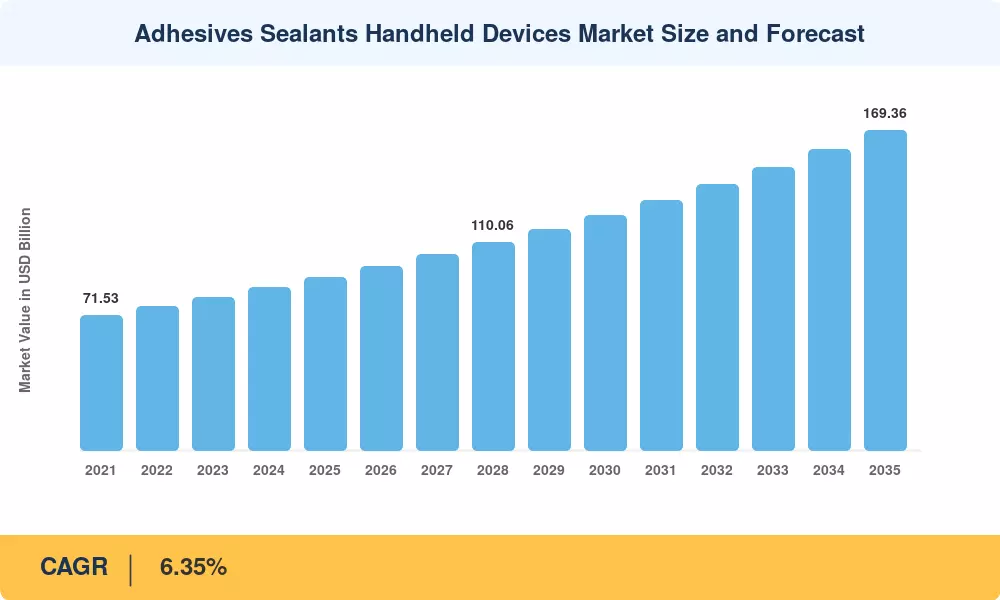
The Adhesives & Sealants Market reached an estimated USD 91.50 billion in 2025 and is projected to grow from USD 97.31 Billion in 2026 to USD 169.36 billion by 2035, registering a CAGR of 6.35% during the forecast period. Two forces anchor this trajectory: the EU Green Deal's mandate for low-VOC formulations across industrial applications, and a global wave of infrastructure spending exceeding USD 3.2 trillion through 2030 that is pulling bonding and sealing demand sharply upward [1]. Packaging automation for e-commerce fulfillment centers and the vehicle light-weighting push under CAFE and Euro 7 emission standards continue to expand addressable volumes across both adhesive and sealant categories.

The market for adhesives and sealants is fundamentally changing due to a shift in technology. Once predominant in industrial assembly, solvent-borne formulations are gradually being replaced by water-based and reactive chemistries that provide reduced emissions, quicker cure times, and better bond endurance. Major producers pledged to invest more than USD 4.8 billion in UV-cure production lines and bio-based feedstock facilities between 2023 and 2025 alone [2]. This change is being accelerated by regulatory pressure under the Toxic Substances Control Act and REACH, which is turning compliance from a cost burden into a competitive differentiator.

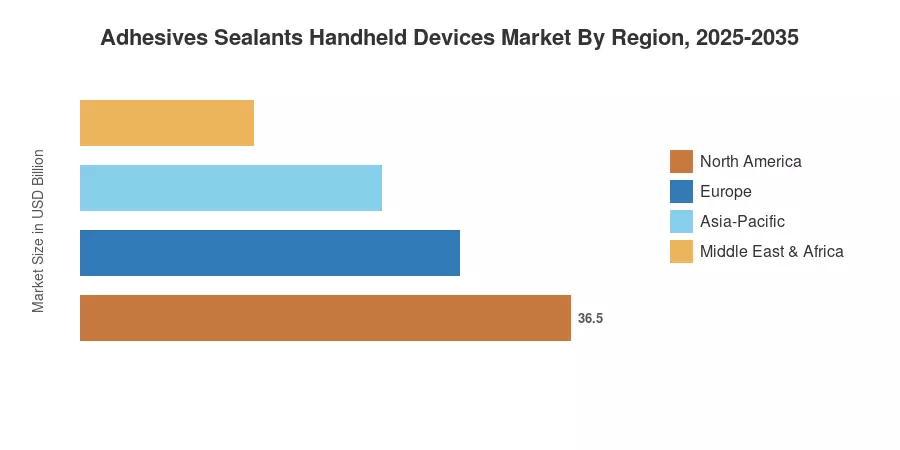
With 39.3% of 2025 revenue, Asia-Pacific holds the greatest share of the Adhesives & Sealants Market thanks to strong electronics manufacturing in ASEAN and infrastructure growth in China and India. Additionally, the region is expanding at the greatest rate, with a 6.90% CAGR until 2035. Thanks to reshoring trends in defense procurement and automobile production, North America now maintains a 24.8% stake. The adoption of sustainable adhesive chemistries is dominated by Germany and France, accounting for 22.4% of the European market. The market for adhesives and sealants stands to gain from the quick replacement of mechanical fasteners and welding in a variety of end-use industries as worldwide decarbonization targets tighten.

ย 

ย 

Key Report Takeaways

โ€ข By Adhesive Resin

  • Acrylics accounted for 25.1% of the Adhesives & Sealants Market in 2025, led by demand in pressure-sensitive tape and label applications.
  • Silicone resins are poised to expand at an 8.82% CAGR through 2035, the fastest among resin types, driven by electronics and high-temperature industrial uses.
  • Polyurethane adhesives generated approximately USD 16.2 billion in 2025 revenue, reflecting strong uptake in automotive structural bonding.

โ€ข By Technology

  • Water-based solutions captured 38.8% revenue share in 2025, supported by regulatory preference for low-emission chemistries.
  • Reactive systems are forecast to post the fastest technology-segment CAGR of 8.58% over 2026โ€“2035, favored for structural and high-performance assemblies.

โ€ข By End-User Industry

  • Packaging led the Adhesives & Sealants Market with 45.2% share in 2025, propelled by e-commerce logistics and flexible packaging growth.
  • Building and construction is projected to grow at a 6.78% CAGR through 2035, supported by modular construction and green building codes.

โ€ข By Region

  • Asia-Pacific commanded 39.3% of the Adhesives & Sealants Market share in 2025, with China contributing the single largest country-level demand pool.
  • North America represented 24.8% share, anchored by reshoring investments and defense manufacturing.

ย 

Adhesives & Sealants Market Size and Forecast (2021โ€“2035)

Market Research Future derives its sizing from a triangulated methodology combining bottom-up revenue aggregation across resin types, technology platforms, and end-user verticals with top-down validation against trade association production volumes and customs data. Historical estimates (2021โ€“2024) reflect actual shipment data from producer filings; the base year (2025) integrates interim results and channel checks. Forecast values (2026โ€“2035) apply a calibrated CAGR of 6.35%, consistent with macroeconomic growth assumptions from the IMF and sector-specific demand models.
Adhesives Sealants Handheld Devices Market Size and Forecast
Our Impact
Enabled $4.3B Revenue Impact for Fortune 500 and Leading Multinationals
Partnering with 2000+ Global Organizations Each Year
30K+ Citations by Top-Tier Firms in the Industry

Driver Impact Analysis

Driver ~% Impact on CAGR Geographic Relevance Impact Timeline
Vehicle light-weighting and EV assembly +1.1% Global Medium-term (2โ€“4 yr)
E-commerce packaging automation +0.9% North America, Asia-Pacific Short-term (โ‰ค2 yr)
EU Green Deal and low-VOC mandates +0.8% Europe, Global Long-term (โ‰ฅ4 yr)
Modular and prefab construction growth +0.7% Asia-Pacific, North America Medium-term (2โ€“4 yr)
Electronics miniaturization and 5G rollout +0.5% Asia-Pacific Medium-term (2โ€“4 yr)
Bio-based and sustainable chemistry adoption +0.4% Europe, North America Long-term (โ‰ฅ4 yr)
Infrastructure stimulus programs (India, US, ASEAN) +0.6% Asia-Pacific, North America Short-term (โ‰ค2 yr)

ย 

Vehicle Light-Weighting and EV Assembly

Automakers are replacing mechanical fasteners with structural adhesives to shave vehicle weight. The US Department of Transportationโ€™s NHTSA CAFE standards dictate a fleet-wide regulatory target of approximately 49.2 mpg for light-duty vehicles by model year 2026. This technical pivot ensures that multi-material construction relies heavily on high-performance adhesives to satisfy strict federal efficiency metrics.

ย 

E-Commerce Packaging Automation

The rapid surge in direct-to-consumer shipping has transformed packaging line economics globally. According to UNCTAD data, the e-commerce sector experienced a major rise, pushing online retail to a 19% share of all global retail sales. Automated fulfillment networks process thousands of parcels hourly, relying on automated adhesive dispensing systems to maintain consistent, high-speed structural bonding.

EU Green Deal and Low-VOC Mandates

Regulatory upgrades are reshifting consumer adhesive portfolios toward sustainable platforms. Under the UN Environment Program's Global Framework on Chemicals, international benchmarks mandate strict management of hazardous lifecycles. Concurrently, European REACH revisions restrict specific isocyanate formulations, forcing a technological shift toward low-VOC, water-based, and UV-cure adhesive platforms across global consumer and industrial assembly markets.

Infrastructure Stimulus Programs

Large-scale public investments are driving intensive consumption of construction sealants and structural adhesives. The Government of Indiaโ€™s National Infrastructure Pipeline outlines an estimated investment outlay of USD 1.4 trillion across crucial transport and housing projects. These large national development frameworks generate sustained, long-term demand for heavy-duty waterproofing systems and industrial bonding technologies.

ย 

ย 

Restraints Impact Analysis

Restraint impacts are assessed as negative directional pressures on CAGR. These effects operate concurrently and may partially offset each other as market participants adapt strategies.

Restraint ~% Impact on CAGR Geographic Relevance Impact Timeline
Volatile raw-material pricing (isocyanates, acrylics) โ€“0.6% Global Short-term (โ‰ค2 yr)
Stringent VOC and chemical safety regulations โ€“0.4% Europe, North America Medium-term (2โ€“4 yr)
Substitution risk from mechanical fastening innovations โ€“0.3% Automotive, Aerospace Long-term (โ‰ฅ4 yr)
Supply chain concentration for petrochemical monomers โ€“0.3% Global Short-term (โ‰ค2 yr)
Extended cure times limit throughput in manufacturing โ€“0.2% Global Medium-term (2โ€“4 yr)

ย 

Volatile Raw-Material Pricing

Petrochemical feedstocks create structural budget vulnerabilities for industrial formulators. United Nations Conference on Trade and Development data tracks severe commodity price variations, which frequently spike up to 50% within a single year. Furthermore, the US Bureau of Labor Statistics Producer Price Index for adhesive manufacturing recently hit an all-time record high index level of 384.58.

Stringent VOC and Chemical Safety Regulations

Transitioning to cleaner chemical mixtures imposes severe operational and structural friction. Under regional air quality frameworksโ€”such as Californiaโ€™s South Coast Air Quality Management District Rule 1168โ€”regulators enforce strict limits on volatile organic compound grams per liter. This localized compliance squeeze directly restricts near-term production capacities while raising capital expenditure barriers for smaller adhesive manufacturers.

Substitution Risk from Mechanical Fastening Innovations

Adhesives encounter continuous technological pressure from structural fastening advancements in high-volume industrial contracts. Official government manufacturing patents document next-generation self-piercing riveting and mechanical systems achieving joining cycle times under 1.5 seconds. Because these rapid structural alternatives outpace standard chemical curing windows, they limit the long-term pricing power of premium adhesive manufacturers.

ย 

Adhesives Sealants Handheld Devices Market Opportunities

Bio-Based and Circular-Economy Adhesives

Industrial demand is moving toward renewable, bio-based chemical platforms. The United Nations Environment Program outlines comprehensive frameworks urging chemical manufacturers to adopt circular product lifecycles. This major international policy push accelerates commercial deployment of plant-derived polyols and starch-based hot-melts, allowing producers to capture substantial material procurement budgets from sustainability-focused global packaging brands.

ย 

EV Battery Assembly and Thermal Management

Electric vehicle manufacturing requires specialized structural adhesives and thermal gap fillers. According to data published by the International Energy Agency, announced global battery manufacturing capacities are positioned to cross 9 terawatt-hours by 2030. This enormous battery manufacturing scale creates massive demand for specialized, highly advanced flame-retardant and thermally conductive adhesive formulations.

ย 

Smart-Cure and IoT-Enabled Dispensing Systems

Digitalization across modern assembly floors directly optimizes adhesive material utilization. Official government manufacturing patent databases track a major rise in computerized machine vision and automated feedback loop technologies. These integrated industrial systems monitor real-time viscosity and fluid application precision, minimizing production lines' material waste and lowering component rework overheads across advanced manufacturing facilities.

Emerging Markets in Africa and South Asia

Public infrastructure developments are unlocking new long-term regional demand centers. United Nations data tracks substantial urbanization and transport asset investments across Sub-Saharan Africa and South Asia, while regional development reports identify target infrastructure funding outlays averaging USD 155 billion annually. These frameworks trigger steady demand for structural adhesives, sealants, and waterproofing systems.

Flexible and Sustainable Packaging Conversion

Global fast-moving consumer goods sectors are transitioning swiftly toward flexible packaging setups. Multilateral organizations like the United Nations Environment Assembly promote strict targets for completely recyclable or reusable consumer packaging. Achieving these international circularity benchmarks requires a rapid manufacturing shift toward solvent-free laminating adhesive systems that support eco-friendly, mono-material structures.

ย 

ย 

Adhesives Sealants Handheld Devices Market Future Outlook

Electrification and Advanced Mobility

The electrification supercycle expands well beyond passenger vehicles into massive transit and commercial platforms. International Energy Agency data tracks a rapid acceleration in public electric mobility investments, projecting charging assets alone to reach approximately USD 3.8 billion by 2035 across leading emerging economies. This long-term mobility expansion secures a highly durable structural demand runway for specialized thermal and sealing materials.

Sustainability Reporting and ESG Integration

Mandatory emissions tracking frameworks are transforming sustainable product development from a brand differentiator into a strict baseline procurement requirement. While the US Securities and Exchange Commission projects direct climate-related corporate compliance costs to rise past USD 10.2 billion, multi-regional reporting rules force adhesive chemical formulators to formally quantify and aggressively mitigate Scope emissions across upstream supply chains.

ย 

Digital Manufacturing and Industry 4.0

Advanced factory automation integrates chemical applications into highly intelligent, data-driven production networks. Official United Nations Industrial Development Organization frameworks emphasize that transitioning to Industry 4.0 cyber-physical configurations significantly enhances raw resource efficiency. Real-time computerized monitoring loops optimize material usage and prevent fluid waste, lowering production error overheads across high-volume industrial assembly operations.

Regionalization of Supply Chains

Global manufacturing sectors are structurally realigning production footprints to insulate operations against external logistical shocks. World Trade Organization monitoring tracks over 380 active regional trade agreements in force, reflecting a broader economic shift away from concentrated single-source procurement models. This decentralization forces adhesive manufacturers to establish localized facilities closer to primary end-use consumer markets.

ย 

Adhesives Sealants Handheld Devices Market Segmentation

By Adhesive Resin

Segment Metric (2025) Primary Demand Driver
Acrylics 25.1% share Pressure-sensitive tapes and labels
Polyurethane USD 16.20 Billion Automotive structural and flexible packaging
Epoxy 6.52% CAGR (2026โ€“2035) Aerospace composites, electronics encapsulation
Silicone 8.82% CAGR (2026โ€“2035) Electronics, high-temperature industrial sealing
Others (EVA, PVA, cyanoacrylate) USD 11.40 Billion Consumer, woodworking, medical

ย 

Acrylics dominate the Adhesives & Sealants Market by resin type, driven by their versatility in pressure-sensitive applications across packaging labels, medical tapes, and graphic films. The segment benefits from relatively low formulation costs and broad substrate compatibility. Polyurethane resins hold the second position by revenue, finding strong traction in automotive body-shop adhesives where flexibility, impact resistance, and paintability are critical performance requirements.

Silicone resins, while smaller in absolute terms, are the fastest-growing resin category at 8.82% CAGR. Their exceptional thermal stability (โ€“65ยฐC to +300ยฐC operating range) and UV resistance make them indispensable in electronics assembly, LED lighting, and solar panel manufacturing. As 5G infrastructure and EV power electronics proliferate, silicone's penetration of the Adhesives & Sealants Market will continue expanding.

By Technology

Segment Metric (2025) Primary Demand Driver
Water-Based 38.8% share Regulatory preference, packaging and construction
Solvent-Borne USD 18.90 Billion Legacy industrial, footwear, automotive repair
Reactive 8.58% CAGR (2026โ€“2035) Structural bonding, composites, EV assembly
Hot-Melt 14.3% share Packaging closure, nonwovens, bookbinding
Others (UV-cure, pressure-sensitive) 5.80% CAGR (2026โ€“2035) Electronics, medical devices

ย 

Water-based adhesives lead the technology landscape within the Adhesives & Sealants Market, reflecting a global regulatory trajectory that penalizes solvent emissions. The segment has matured technically, now delivering performance levels that match solvent-borne systems in many packaging and construction applications. Reactive adhesives represent the technology frontier โ€” epoxy, polyurethane, and silicone systems that cure through chemical crosslinking to deliver the highest bond strengths available. Their adoption accelerates wherever structural integrity and environmental resistance take priority over raw speed.

By Sealant Resin

Segment Metric (2025) Primary Demand Driver
Silicone 47.5% share Glazing, electronics, high-performance construction
Polyurethane 5.97% CAGR (2026โ€“2035) Automotive, construction joint sealing
Acrylic USD 4.25 Billion General-purpose construction, DIY
Polysulfide 4.1% share Aerospace fuel-tank sealing, marine
Others (butyl, SMP) 5.55% CAGR (2026โ€“2035) Automotive glazing, window manufacturing

ย 

Silicone sealants command nearly half the sealant resin segment within the Adhesives & Sealants Market, a position built on unmatched weatherability, UV resistance, and adhesion to glass and aluminum substrates. The commercial glazing and curtain wall market is the single largest application, followed by electronics potting and bathroom/kitchen installations. Polyurethane sealants are gaining ground in construction expansion joints and automotive windshield bonding, where paintability and mechanical toughness justify higher per-unit costs.

By End-User Industry

Segment Metric (2025) Primary Demand Driver
Packaging 45.2% share E-commerce, flexible packaging conversion
Building & Construction 6.78% CAGR (2026โ€“2035) Modular construction, green building codes
Automotive USD 11.65 Billion Light-weighting, EV battery bonding
Aerospace 7.10% CAGR (2026โ€“2035) Composite airframes, interior bonding
Electronics USD 6.80 Billion Semiconductor packaging, display assembly
Others (medical, woodworking, textiles) 5.45% CAGR (2026โ€“2035) Wound care, furniture manufacturing

ย 

Packaging remains the largest end-user vertical of the Adhesives & Sealants Market by a considerable margin. The segment spans case and carton sealing, labeling, lamination, and flexible packaging assembly โ€” applications where speed, food-contact compliance, and recyclability drive formulation choices. Building and construction is the fastest-growing end-user segment, benefiting from the convergence of urbanization in developing economies with energy-efficiency retrofit programs in mature markets.

ย 

Regional Market Share Analysis

Region Metric (2025) Primary Investment Themes
Asia-Pacific 39.3% share Infrastructure build-out, electronics manufacturing, EV supply chain
North America 24.8% share Automotive reshoring, e-commerce packaging, and defense applications
Europe 22.4% share Green chemistry transition, automotive light-weighting, renovation wave
South America 7.2% share Construction expansion, consumer goods packaging
Middle East & Africa 6.3% share Mega-project construction, oil and gas maintenance
Total 100.0% โ€”

The Adhesives & Sealants Market exhibits a concentrated geographic profile, with Asia-Pacific and North America together accounting for nearly two-thirds of global revenue. Regional growth trajectories diverge based on industrialization stage, regulatory maturity, and infrastructure investment intensity.

ย 

North America

Country Metric Key Driver
US 72.5% of regional revenue Automotive, defense, and packaging demand
Canada 6.48% CAGR (2026โ€“2035) Infrastructure modernization and housing starts
Mexico USD 3.95 Billion (2025) Nearshoring automotive and electronics assembly

ย 

North American demand for the Adhesives & Sealants Market is shaped by the Inflation Reduction Act's manufacturing incentives and a resurgence in domestic automotive assembly. The US alone accounts for nearly three-quarters of regional revenue, with construction and packaging forming the primary consumption verticals. Mexico's rapid integration into North American supply chains โ€” fueled by nearshoring of Asian production โ€” has made it the region's fastest-growing country market [9].

Europe

Country Metric Key Driver
Germany 26.8% of regional revenue Automotive OEM adhesive adoption
UK 5.92% CAGR (2026โ€“2035) Residential retrofit and insulation programs
France USD 3.70 Billion (2025) Aerospace composites and food packaging
Italy 10.2% of regional revenue Furniture, footwear, and ceramics assembly
Spain 5.75% CAGR (2026โ€“2035) Renewable energy infrastructure
Nordic Countries USD 1.85 Billion (2025) Sustainable building and marine applications
Russia 7.6% of regional revenue Construction and oil/gas infrastructure
Rest of Europe 5.60% CAGR (2026โ€“2035) General industrial and packaging

ย 

Europe's Adhesives & Sealants Market is defined by regulatory leadership. The REACH framework and EU Ecolabel certification drive a technology premium for water-based and bio-based formulations. Germany's automotive corridor โ€” home to Volkswagen, BMW, and Mercedes-Benz โ€” absorbs the largest share of structural adhesives on the continent. At the same time, France's aerospace sector (Airbus, Safran) sustains demand for high-performance epoxy and polyurethane compounds [1].

Asia-Pacific

Country Metric Key Driver
China 44.8% of regional revenue Construction, electronics, and EV battery assembly
India 7.25% CAGR (2026โ€“2035) National Infrastructure Pipeline and housing programs
Japan USD 7.10 Billion (2025) Automotive, electronics, precision bonding
South Korea 12.4% of regional revenue Semiconductor packaging, display manufacturing
ASEAN 6.85% CAGR (2026โ€“2035) Industrial expansion and infrastructure development
Rest of Asia-Pacific USD 2.80 Billion (2025) Emerging industrial base

ย 

Asia-Pacific dominates the Adhesives & Sealants Market with nearly two-fifths of global consumption. China's construction sector โ€” the world's largest โ€” remains the primary demand engine, complemented by an electronics manufacturing ecosystem that spans Shenzhen to Shanghai. India is emerging as the region's growth standout, where the Pradhan Mantri Awas Yojana (PMAY) housing initiative is generating adhesive demand in segments ranging from tile fixing to structural glazing [9].

South America

Country Metric Key Driver
Brazil 58.3% of regional revenue Construction, automotive assembly, and packaging
Argentina 5.40% CAGR (2026โ€“2035) Agri-packaging and infrastructure renewal
Rest of South America USD 1.68 Billion (2025) General industrial applications

ย 

Brazil anchors the South American Adhesives & Sealants Market, where Minha Casa Minha Vida housing programs and a growing food-packaging sector sustain adhesive demand. The region faces headwinds from currency volatility and raw-material import dependence, but local production by Henkel, Bostik, and Pidilite is expanding to capture domestic growth [18].

Middle East & Africa

Country Metric Key Driver
Saudi Arabia 31.5% of regional revenue Vision 2030 mega-projects, NEOM construction
UAE 5.95% CAGR (2026โ€“2035) Commercial real estate and infrastructure
South Africa USD 0.92 Billion (2025) Mining infrastructure and construction
Egypt 6.15% CAGR (2026โ€“2035) New Administrative Capital and industrial zones
Rest of MEA 22.8% of regional revenue Oil/gas, general construction

ย 

Large-scale construction programs propel the Middle East & Africa Adhesives & Sealants Market. Saudi Arabia's NEOM project and Red Sea tourism development alone carry budgets exceeding USD 800 billion combined, generating substantial demand for construction sealants, tile adhesives, and waterproofing systems [20]. South Africa provides the sub-Saharan anchor, where mining and residential construction drive steady consumption.

ย 

Adhesives Sealants Handheld Devices Market By Region, 2025-2035

Competitive Benchmarking

The Adhesives & Sealants Market exhibits low concentration, with a top-five share estimated at approximately 35โ€“40% and a Herfindahl-Hirschman Index below 600. The competitive field ranges from global chemical conglomerates with diversified adhesive portfolios to regional specialists focused on specific resin chemistries or application niches. Competitive advantage increasingly correlates with sustainability credentials, application engineering capabilities, and proximity to end-user manufacturing clusters.

Company Est. Revenue Share Range Key Offerings Strategic Positioning
Henkel AG & Co. KGaA ~9โ€“12% Loctite structural adhesives, Bonderite surface treatments, Technomelt hot-melts Broadest portfolio across consumer and industrial; strong in automotive and electronics
3M Company ~7โ€“10% VHB tapes, Scotch-Weld structural adhesives, Command consumer strips Technology leader in pressure-sensitive and structural bonding; deep IP portfolio
Sika AG ~6โ€“9% SikaFlex sealants, SikaPower structural adhesives, SikaBond tile adhesives Construction-focused with an expanding automotive and industrial footprint
H.B. Fuller Company ~4โ€“6% Swift hot-melts, Advantra reactive adhesives, Sesame laminating adhesives Mid-market industrial specialist; strong in packaging and hygiene
Bostik (Arkema) ~3โ€“5% Smart adhesive technologies, elastic bonding and construction sealants Innovation-driven; focus on flexible packaging and construction
Dow Inc. ~4โ€“7% DOWSIL silicone sealants, BETAMATE structural adhesives Silicone and polyurethane chemistry leader; strong in building and automotive
Huntsman Corporation ~3โ€“5% Araldite epoxies, structural polyurethanes Specialty epoxy and PU focus; aerospace and composites positioning
Pidilite Industries ~2โ€“4% Fevicol, Dr. Fixit waterproofing, M-Seal Dominant in India; strong brand equity in consumer and construction
RPM International ~2โ€“4% Tremco sealants, DAP consumer products and Illbruck construction tapes Construction waterproofing and sealant specialist
Mapei S.p.A. ~2โ€“3% Kerabond tile adhesives, Mapeflex sealants, Planicrete admixtures Construction-focused; tile and flooring adhesive leader

ย 

ย 

Recent News & Developments

Graco Inc. (May 2026)โ€”Announced a definitive agreement to acquire Valco Melton for $447 million, expanding Graco's industrial portfolio into precision adhesive dispensing and quality assurance systems.

Big Dog Adhesives (January 2026)โ€”Launched the RELOAD reusable handheld dispensing platform for two-component structural adhesives, reducing cartridge container waste by up to 99%.

  • APPLIED Adhesives (March 2026)โ€”Completed the strategic acquisition of East Coast distributor LJD Packaging to expand its regional footprint in specialized product assembly and dispensing equipment.

ย 

ย 

ย 

ย 

ย 

ย 

ย 

Adhesives Sealants Handheld Devices Market Report Scope

Parameter Detail
Market Scope Global Adhesives & Sealants Market covering adhesive resins, adhesive technologies, sealant resins, and end-user industries
Study Period 2021โ€“2035
CAGR (2026โ€“2035) 6.35%
Market Size (2025) USD 91.50 Billion
Market Size (2035) USD 169.36 Billion
Fastest Growing Segments Silicone resins (by resin); Reactive systems (by technology); Aerospace (by end user); Asia-Pacific (by region)
Companies Profiled Henkel, 3M, Sika, H.B. Fuller, Bostik (Arkema), Dow, Huntsman, Pidilite, RPM International, Mapei
Valuation Currency USD Billion

ย 

ย 

FAQs

What adhesive chemistry offers the best cost-to-performance ratio for general industrial assembly?

Acrylic-based adhesives provide the strongest cost-performance balance for most industrial assembly tasks. They bond well to diverse substrates without primers and cure rapidly under ambient conditions.

How do procurement teams evaluate adhesive suppliers for automotive OEM contracts?

Automotive procurement prioritizes OEM-specific qualification testing, Scope 3 emissions data, and dual-source supply guarantees. Suppliers must demonstrate IATF 16949 certification and consistent batch-to-batch performance under accelerated aging protocols. [10]

What shelf-life considerations affect adhesive inventory management?

Most reactive adhesive systems carry 6โ€“12 month shelf lives under controlled storage (15โ€“25ยฐC). Procurement should implement first-in-first-out rotation and negotiate supplier-managed inventory programs to minimize waste from expired stock. [17]

How does the Adhesives & Sealants Market address recyclability challenges in flexible packaging?

Formulators are developing debondable adhesives that release cleanly at specific temperatures, enabling mono-material recycling streams. Several major FMCG brands have validated these systems in pilot-scale production. [19]

What testing standards should buyers specify for structural adhesive joints?

ASTM D1002 (lap shear) and ISO 11003 (fracture mechanics) are the baseline standards. Buyers should also require environmental durability testing per ASTM D1151 to verify bond integrity under humidity and thermal cycling. [15]

How does the Adhesives & Sealants Market respond to tariff disruptions on petrochemical feedstocks?

Producers manage tariff exposure through regional manufacturing diversification and long-term supply contracts with price-adjustment clauses. Several leading companies have invested in bio-based feedstock routes to reduce petrochemical dependence. [16]

What role do adhesives play in the Adhesives & Sealants Market for modular construction?

Factory-assembled building modules rely on adhesives for panel lamination, insulation bonding, and weather-seal installation at controlled-environment production speeds. This shifts demand toward fast-cure systems compatible with automated applications. [13]

ย 

ย 

Author
Author
Author Profile
Chitranshi Jaiswal LinkedIn
Team Lead - Research
Chitranshi is a Team Leader in the Chemicals & Materials (CnM) and Energy & Power (EnP) domains, with 6+ years of experience in market research. She leads and mentors teams to deliver cross-domain projects that equip clients with actionable insights and growth strategies. She is skilled in market estimation, forecasting, competitive benchmarking, and both primary & secondary research, enabling her to turn complex data into decision-ready insights. An engineer and MBA professional, she combines technical expertise with strategic acumen to solve dynamic market challenges. Chitranshi has successfully managed projects that support market entry, investment planning, and competitive positioning, while building strong client relationships. Certified in Advanced Excel & Power BI she leverages data-driven approaches to ensure accuracy, clarity, and impactful outcomes.

Research Approach

ย 

Secondary Research

The secondary research process involved comprehensive analysis of chemical regulatory frameworks, electronics industry standards, patent databases, and authoritative manufacturing publications. Key sources included the US Environmental Protection Agency (EPA) Chemical Substance Inventory, European Chemicals Agency (ECHA) REACH Database, Restriction of Hazardous Substances Directive (RoHS) compliance registries, China RoHS (Administrative Measure on the Control of Pollution Caused by Electronic Information Products), Adhesive and Sealant Council (ASC) Industry Statistics, American Chemistry Council (ACC) End-Use Market Surveys, IPC Association Connecting Electronics Industries Standards Database, SEMI (Semiconductor Equipment and Materials International) Global Silicon Inventory, Japan Electronics and Information Technology Industries Association (JEITA) Production Statistics, US Geological Survey (USGS) Mineral Commodity Summaries (for silicone and polymer feedstock tracking), US Bureau of Labor Statistics (Chemical Manufacturing PPI), EU Eurostat Industrial Production Indices for Chemical Products, National Bureau of Statistics of China (Electronics Manufacturing Output), United States Patent and Trademark Office (USPTO) Adhesive Technology Patents, and World Intellectual Property Organization (WIPO) Electronics Assembly IP Filings.

These sources were used to collect regulatory compliance requirements, material safety data sheets (MSDS), electronics production volumes, adhesive consumption coefficients per device category, raw material pricing trends, and competitive landscape mapping across structural adhesives, conductive adhesives, thermal interface materials, and protective sealants.

ย 

Primary Research

In order to gather both qualitative and quantitative insights, supply-side and demand-side stakeholders were interviewed during the primary research phase. Global Business Directors, Heads of Electronics Materials R&D, Regional Sales Directors for Consumer Electronics, and Application Engineering Managers from manufacturers of precision dispensing equipment, chemical intermediate suppliers, and adhesive/sealant formulators were examples of supply-side sources. Senior Directors of Mechanical Engineering, Commodity Managers for Direct Materials, Manufacturing Process Engineers, and New Product Introduction (NPI) Managers from handheld device OEMs, electronics manufacturing services (EMS) providers, and original design manufacturers (ODMs) were among the demand-side sources. Primary research validated adhesive specification trends by device component (display bonding, battery assembly, PCB protection), confirmed regulatory compliance timelines (PFAS restrictions, VOC emissions), and gathered insights on thermal management requirements, miniaturization challenges, and supply chain localization strategies.

Primary Respondent Breakdown:

By Designation: C-level Primaries (30%), Director Level (35%), Others (35%)

By Region: North America (32%), Europe (28%), Asia-Pacific (35%), Rest of World (5%)

ย 

Market Size Estimation

Global market valuation was estimated by consumption volume modeling and value-chain analysis. The methods included:

Finding more than fifty major raw material suppliers and adhesive/sealant formulators in North America, Europe, Asia-Pacific, and Latin America

Product mapping across acrylic, polyurethane, epoxy, silicone, and cyanoacrylate adhesive chemistries, with sub-segmentation by functional applications (structural bonding, EMI shielding, temperature management, moisture sealing) Analysis of stated and modeled annual sales unique to electronics adhesive portfolios, benchmarked against device manufacturing bill-of-materials (BOM) data

Coverage of formulators comprising 75-80% of worldwide market share in 2024

Correlation between handheld device shipping statistics (smartphones, tablets, wearables, portable gaming devices) received from tier-1 EMS providers and ODMs

Extrapolation using bottom-up (device shipment volume ร— adhesive consumption per unit ร— ASP by chemistry type) and top-down (formulator revenue validation and chemical feedstock consumption ratios) approaches to derive segment-specific valuations by end-use device category and regional manufacturing clusters

Download Free Sample

Kindly complete the form below to receive a free sample of this Report

Download PDF ×

We do not share your information with anyone. However, we may send you emails based on your report interest from time to time. You may contact us at any time to opt-out.