Automotive ADAS Market Summary
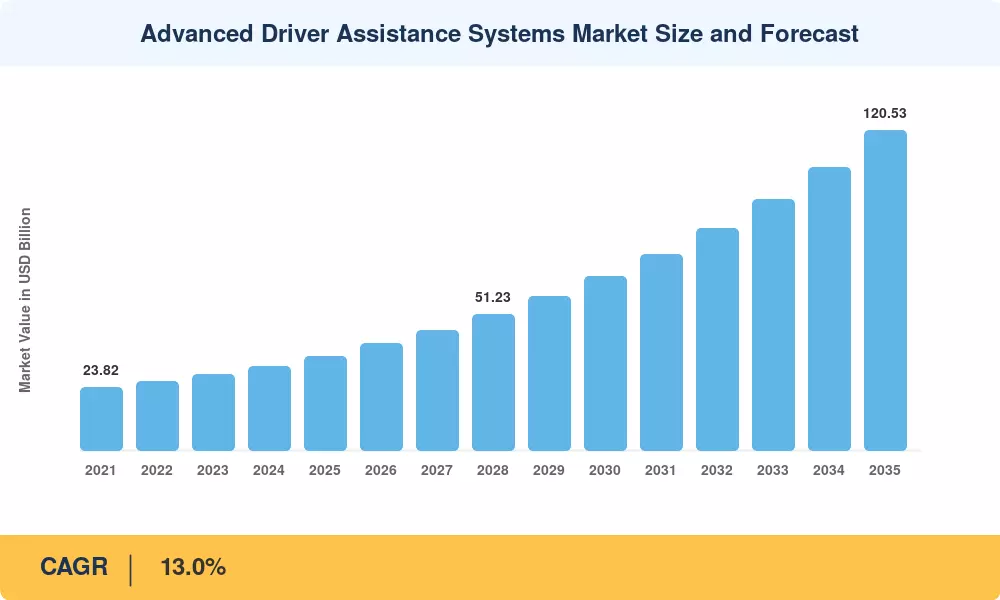
The Advanced Driver Assistance Systems Market reached an estimated USD 35.50 Billion in 2025 and is projected to climb from USD 40.12 Billion in 2026 to USD 120.53 Billion by 2035, registering a CAGR of 13.0% across the forecast window. Two catalysts are reshaping this trajectory: the European Union's General Safety Regulation (GSR 2), which mandates intelligent speed assistance and driver drowsiness detection on every new vehicle sold from July 2024, and the U.S. National Highway Traffic Safety Administration's final rule requiring automatic emergency braking on all light vehicles by September 2029 [1][2]. Together, these policies convert optional feature bundles into compliance necessities, compressing adoption timelines by several years.
Beneath the regulatory surface, a technology transition is rewriting cost structures. Camera-centric perception stacks, once limited to premium sedans, now deliver Level 2 functionality at component costs below USD 120 per unit — roughly 40% less than radar-plus-camera fusion architectures of 2020 [3]. Software-defined vehicle platforms allow OEMs to push over-the-air feature upgrades, turning the Advanced Driver Assistance Systems Market into a recurring-revenue engine rather than a one-time hardware sale.
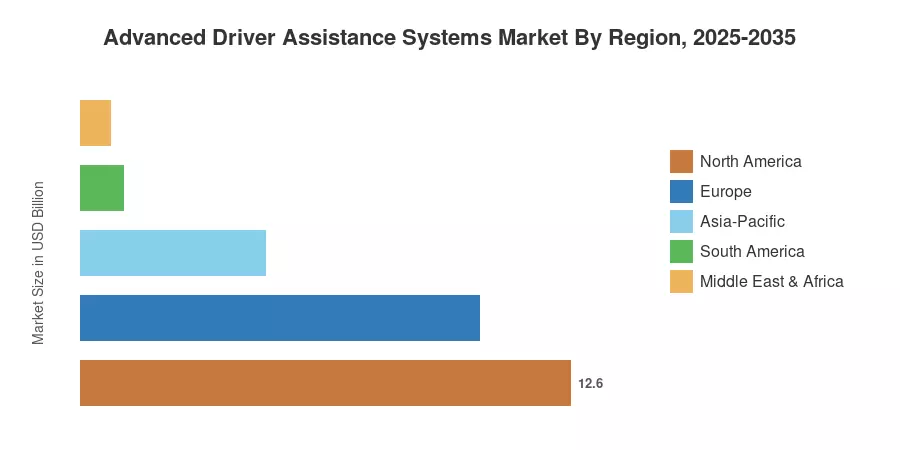
North America held the largest share at roughly 35.5% of global revenue in 2025, driven by insurance-telematics incentives and high pickup-truck fitment rates. Asia-Pacific is the fastest-growing territory, expanding at a 13.4% CAGR through 2035, as China's C-NCAP alignment and India's Bharat NCAP framework push mandatory fitment deep into mass-market segments. Europe commands the second-largest position, contributing approximately 28.9% of global value, buoyed by Euro NCAP's Safe Driving domain scoring. The next decade will see the Advanced Driver Assistance Systems Market shift from a feature-differentiation play toward a compliance-driven infrastructure layer embedded in virtually every new vehicle sold worldwide.
Key Report Takeaways
• By System Type
- Adaptive cruise control captured the leading revenue share of approximately 26.5% in 2025, reflecting widespread adoption across mid-range passenger vehicles.
- Automatic emergency braking is the fastest-growing system category, tracking a 13.3% CAGR through 2035, propelled by NHTSA and Euro NCAP mandates.
• By Sensor Type
- Radar-based systems accounted for roughly 41.5% of the Advanced Driver Assistance Systems Market in 2025.
- LiDAR sensors are expanding at approximately 13.5% CAGR to 2035, benefiting from solid-state cost reductions below USD 500 per unit.
• By Region
- North America led the Advanced Driver Assistance Systems Market with a 35.5% share in 2025, underpinned by OEM bundling strategies and fleet safety programs.
- Asia-Pacific is the fastest-growing region at 13.4% CAGR, as domestic EV brands integrate Level 2+ suites as standard equipment.
Market Size and Forecast (2021–2035)
Market Research Future estimates are compiled from OEM disclosure filings, Tier-1 supplier revenue statements, regulatory adoption schedules, and validated trade-level shipment data. Historical values (2021–2024) reflect actual industry performance; the base year (2025) blends preliminary actuals with analyst estimates; forecast years (2026–2035) apply a constant 13.0% CAGR underpinned by mandatory fitment regulations and sensor-cost deflation curves.





















.webp?v=1787579611)
