Aerospace Maintenance Cleaning Chemicals Market (2026 - 2035)

Aerospace Maintenance Cleaning Chemicals Market Research Report Information By Product Type (Engine & Compressor Cleaning Chemicals, Airframe & Exterior Cleaning Chemicals, and Component-Specific Cleaning Chemicals), By Nature (Organic Chemicals, Inorganic Chemicals, and Hybrid Chemicals), By Formulation Base (Water-Based, Solvent-Based, and Bio-Based), By Aircraft Type (Commercial Aircraft, Military/Defense, Business/General Aviation, Cargo Aircraft, and Helicopters & UAVs), By Service Mode (On-Wing and Off-Wing), By End Use Industry Facility (Airlines & Fleet Operators, Third-Party Maintenance Service Providers, and OEM Facilities) – Forecast Till 2035
ID: MRFR/CnM/66586-CR
111 Pages
Chitranshi Jaiswal
Last Updated: July 16, 2026
Aerospace Maintenance Cleaning Chemicals Market
Market Size
Forecast Period2026-2035
CAGR (2026-2035)6.47%
2025 Market SizeUSD 1,350.00 Million (USD 1.35 Billion)
2035 Market SizeUSD 2,286.06 Million (USD 2.29 Billion)
Key Players
Henkel AG & Co. KGaA
Chemetall
PPG Industries
Callington Haven
Socomore
Celeste Industries Corporation
Opportunities
  • Shift Toward Eco-Friendly & Biodegradable Formulations
  • Growth in Emerging Markets

Aerospace Maintenance Cleaning Chemicals Market Summary

The global aerospace maintenance cleaning chemicals market was valued at USD 1,350.00 million in 2025 and is projected to reach USD 2,286.06 million by 2035, expanding at a compound annual growth rate (CAGR) of 5.45% during the forecast period of 2026–2035. The market's upward trajectory is underpinned by several structural forces, chief among them the sustained rise in global air traffic and the corresponding expansion of commercial and military fleets worldwide. With the International Air Transport Association (IATA) forecasting passenger numbers to exceed 5.2 billion annually by 2030, airlines and MRO operators are allocating increasingly larger budgets toward aircraft upkeep, of which cleaning chemicals constitute a critical and recurring expenditure category [2]. The parallel growth of MRO activities, driven by aging fleet demographics and the extension of aircraft operational lifespans, further reinforces the demand for high-performance cleaning solutions across engine, airframe, and component applications.

With a value of USD 476.40 million, component-specific cleaning chemicals constituted the largest product segment in 2025. This was due to the widespread usage of fuel system cleansers (USD 103.89 million) and landing gear cleaners (USD 233.99 million) in regular maintenance cycles [3]. However, as airlines increasingly use on-wing wash systems to reduce engine downtime and maximize fuel efficiency in between overhauls, the fastest-growing product segment is on-wing engine cleaners, growing at a 6.47% CAGR. Chemetall's May 2026 expansion into Asia with a new application laboratory in Vietnam serves as an example of this change, indicating the increasing need for specialized technical support in high-growth aviation markets [4]. In the meantime, the competitive drive to secure distribution channels in the fastest-growing regional market is highlighted by Socomore's March 2026 master distribution agreement with Blend Supply for its aerospace chemical portfolio throughout North America.

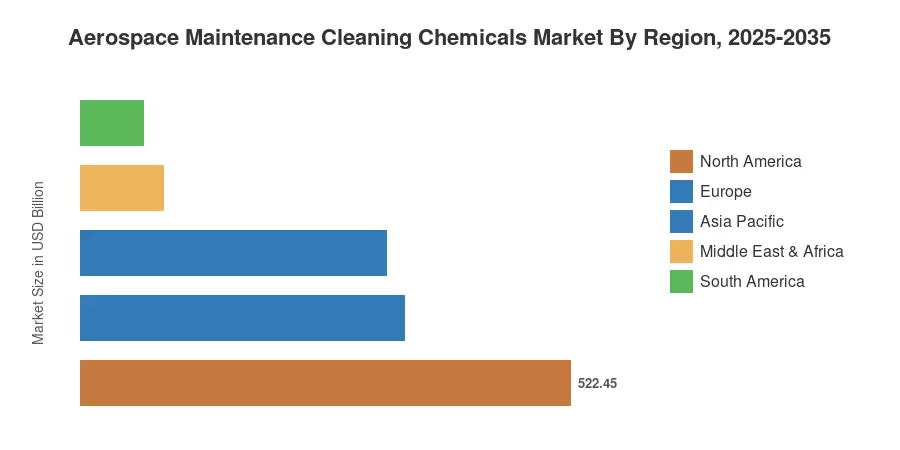
Due to the existence of significant OEMs like Airbus and a dense network of MRO facilities spread throughout France, Germany, and the United Kingdom, Europe held the largest regional share of the worldwide market in 2025 [5]. With a 6.17% CAGR, North America is the fastest-growing market, with a value of USD 522.45 million in 2025. Strong defense spending, fleet modernization initiatives, and a sizable installed base of commercial and cargo aircraft fuel this growth. With USD 325.81 million, the Asia Pacific is the third-largest area. As low-cost carriers develop their operations and new MRO hubs appear in Southeast Asia, China, and India, the market is expected to grow at a faster rate. By the conclusion of the projected period, above-average growth is anticipated due to the combination of emerging market expansion, fleet digitization, and sustainability standards.


Key Report Takeaways

Segment Dimension Key Metric Notes
By Product Type — Dominant Component-Specific Cleaning Chemicals: USD 476.40 Mn (2025) Landing gear and fuel system cleaners lead demand
By Product Type — Fastest Growing On-Wing Engine Cleaners: 6.47% CAGR Driven by on-wing wash adoption for fuel efficiency
By Nature — Dominant Organic Chemicals: USD 745.88 Mn (2025) Broad compatibility with aerospace substrates
By Nature — Fastest Growing Organic Chemicals: 5.83% CAGR Regulatory preference and performance versatility
By Formulation Base — Dominant Water-Based: USD 639.77 Mn (2025) Lower VOC emissions support adoption
By Formulation Base — Fastest Growing Water-Based: 5.70% CAGR Aligned with environmental compliance mandates
By Aircraft Type — Dominant Commercial Aircraft: USD 796.91 Mn (2025) Largest fleet base and highest maintenance frequency
By Aircraft Type — Fastest Growing Commercial Aircraft: 5.70% CAGR Fleet expansion by low-cost carriers
By Service Mode — Dominant On-Wing: USD 796.91 Mn (2025) Preference for reduced aircraft ground time
By End Use Facility — Dominant Third-Party MRO Providers: USD 679.60 Mn (2025) Outsourcing of maintenance by airlines
By End Use Facility — Fastest Growing Airlines & Fleet Operators: 5.90% CAGR In-house maintenance capability growth
By Region — Dominant (2025) North America: USD 522.45 Mn Large commercial and military fleet base
By Region — Fastest Growing North America: 6.17% CAGR Defense spending and fleet modernization


Market Size and Forecast (2019–2035)

Market Research Future (MRFR) employs a rigorous bottom-up and top-down methodology to estimate and validate global and regional market sizes. The bottom-up approach aggregates revenue across product types, formulation bases, aircraft types, service modes, and end-use facilities, cross-referenced with supply-side data from major chemical manufacturers and MRO operators. The top-down approach validates totals against macroeconomic indicators such as global RPK (revenue passenger kilometers), fleet size data from aircraft OEMs, and MRO spending forecasts published by IATA and the FAA. All historical data (2019–2024) is sourced from company annual reports, trade association publications, and government databases; the base year (2025) is estimated using the latest available financial disclosures; and forecast years (2026–2035) are modeled using demand-side elasticities, regulatory scenario analysis, and competitive intelligence [6].
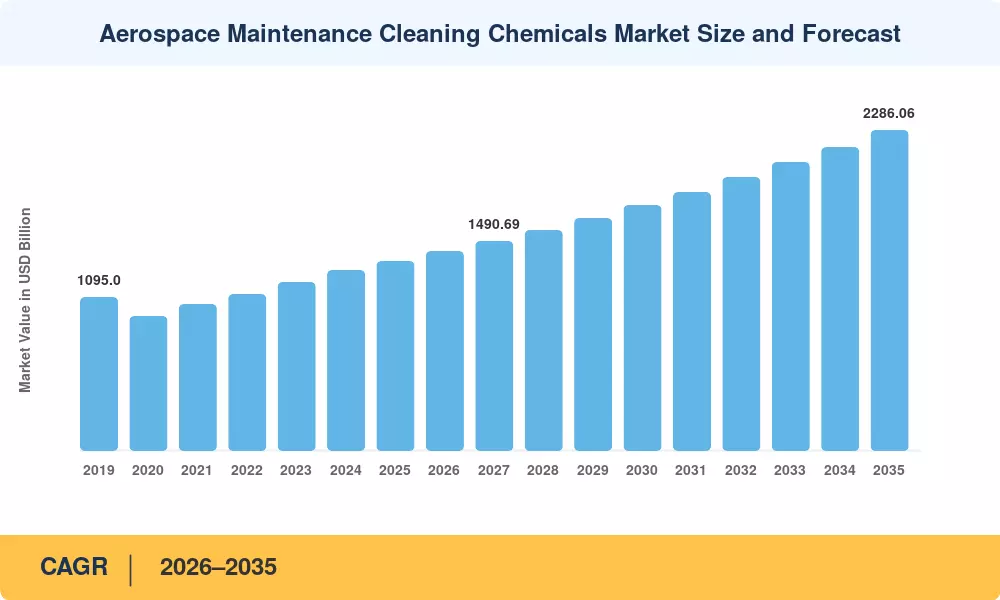
Aerospace Maintenance Cleaning Chemicals Market Size and Forecast
Our Impact
Enabled $4.3B Revenue Impact for Fortune 500 and Leading Multinationals
Partnering with 2000+ Global Organizations Each Year
30K+ Citations by Top-Tier Firms in the Industry

Driver Impact Analysis

Driver ~% Impact on CAGR Geographic Relevance Impact Timeline
Rising Global Air Traffic & Fleet Expansion ~40% Global — strongest in Asia Pacific and North America Long-term
Growth of MRO Activities ~35% Global — Europe and North America lead Medium-to-long-term
Increasing Complexity of Modern Aircraft ~25% Global — OEM-driven Medium-term


Rising Global Air Traffic & Fleet Expansion

The market for airplane maintenance cleaning chemicals is still primarily driven by the steady growth of air travel worldwide. Through 2035, IATA predicts that the number of passengers worldwide will increase at a rate of roughly 3.5–4.0% each year, with the Asia Pacific region accounting for the majority of the additional demand as middle-class people in China, India, and Southeast Asia increase their spending power [2]. According to Boeing's 2025 Commercial Market Outlook, the world will need over 44,000 additional commercial aircraft deliveries over the next 20 years, with single-aisle aircraft making up more than 75% of the total. This growth directly translates into fleet expansion. Because manufacturer maintenance plans include required wash cycles for engines, airframes, and landing gear, every new aircraft that enters service generates a steady stream of income for providers of cleaning chemicals.

Commercial aviation is not the only industry that may expand its fleet. The purchase of cutting-edge fighter jets, cargo aircraft, and unmanned aerial vehicles—all of which require specific cleaning procedures—is being driven by military and defense budgets in NATO countries, India, and the Gulf states [8]. The structural move toward e-commerce logistics and dedicated freighter conversions is helping the cargo aircraft industry, even if it is smaller in absolute terms at USD 91.67 million in 2025. As a result, there is a larger and more varied installed base of aircraft, each with unique cleaning chemical needs that support providers' long-term volume growth.


Growth of MRO Activities

The global aerospace MRO market is estimated to exceed USD 115 billion by 2030, with engine MRO accounting for the largest share at approximately 40% of total spend. As the average age of the global commercial fleet remains above 10 years, scheduled maintenance events, C-checks, and D-checks generate substantial demand for cleaning chemicals used in engine compressor washes, airframe degreasing, and component overhaul preparation. Third-party MRO providers, which represented USD 679.60 million or approximately 50.3% of end-use demand in 2025, are particularly chemical-intensive given the volume and variety of aircraft types serviced at independent facilities.

The growth in MRO activity is further amplified by the extension of aircraft service lives beyond original design parameters. Airlines in cost-sensitive markets are opting to operate aircraft for 25–30 years rather than the traditional 20-year cycle, necessitating more frequent and intensive maintenance interventions [3]. Each additional maintenance event generates incremental cleaning chemical consumption, particularly for engine wash fluids that maintain compressor efficiency and reduce specific fuel consumption. Callington Haven's February 2025 partnership with CanRep exemplifies the strategic response of chemical suppliers seeking to deepen their MRO channel coverage in key markets.

Increasing Complexity of Modern Aircraft

Modern aircraft platforms such as the Airbus A350, Boeing 787, and next-generation narrowbody variants employ advanced composite materials, thermal barrier coatings, and integrated avionics systems that demand specialized cleaning chemistries [4]. Traditional solvent-based cleaners are often incompatible with carbon fiber reinforced polymer (CFRP) structures and advanced sensor arrays, creating demand for precision-formulated cleaning agents that deliver effective soil removal without substrate degradation. This complexity extends to engine architecture, where high-bypass turbofan engines with ceramic matrix composite (CMC) components in the hot section require cleaning agents formulated to remove combustion residues without attacking the protective coatings.

The growing integration of digital health monitoring systems and IoT-enabled sensors on modern aircraft also necessitates cleaning protocols that preserve sensor accuracy and data transmission quality. Avionics and precision parts cleaners, while a smaller segment at USD 51.48 million in 2025, are expected to grow as fleet modernization introduces more electronics-dense platforms into service. Chemical suppliers that invest in application-specific R&D — as demonstrated by Chemetall's new laboratory in Vietnam — are positioning to capture premium margins in this high-specification segment [8].


Restraints Impact Analysis

Restraint ~% Drag on CAGR Geographic Relevance Impact Timeline
Strict Environmental Regulations ~60% of the restraint effect Europe and North America — REACH, EPA Medium-to-long-term
Safety & Handling Concerns ~40% of the restraint effect Global Short-to-medium-term


Strict Environmental Regulations

Environmental restrictions that limit product formulation, application, and disposal are becoming more and more strict for the aircraft cleaning chemicals business. Important active chemicals used in traditional solvent-based cleaning formulations may be restricted or outright prohibited by the European Union's REACH law and ongoing assessment of halogenated solvents, volatile organic compounds (VOCs), and per- and polyfluoroalkyl substances (PFAS) [9]. In the US, state-level air quality requirements (such as California's South Coast Air Quality Management District standards) and EPA regulations under the Toxic Substances Control Act (TSCA) establish emission caps that raise compliance costs for MRO operators. While encouraging long-term environmental sustainability, these restrictions can cause product launches to be delayed and impose short-term reformulation costs on chemical suppliers. Requalification testing with airframe and engine OEMs and a substantial R&D investment are necessary for the shift away from restricted compounds, which prolongs the time to market for compatible substitutes.


Safety & Handling Concerns

Aerospace cleaning chemicals frequently involve corrosive, flammable, or toxic substances that necessitate specialized handling, storage, and personal protective equipment (PPE) [11]. The occupational health risks associated with prolonged exposure to solvent vapors, alkaline degreasers, and acid-based cleaners impose training and infrastructure costs on MRO operators, particularly smaller third-party providers in emerging markets with less mature health and safety regulatory frameworks. These concerns can slow adoption of higher-performance chemical formulations and bias purchasing decisions toward safer but less effective alternatives, potentially reducing per-unit value in certain application segments.


Aerospace Maintenance Cleaning Chemicals Market Opportunities

Shift Toward Eco-Friendly & Biodegradable Formulations

The accelerating regulatory pressure on conventional solvent-based cleaning chemicals is creating a substantial opportunity for suppliers that develop eco-friendly, biodegradable, and water-based formulations [10]. Water-based cleaning chemicals already represented the largest formulation segment at USD 639.77 million in 2025 and are forecast to grow at 5.70% CAGR, reflecting the ongoing substitution of solvent-based products. Bio-based formulations, valued at USD 187.77 million in 2025, represent the earliest-stage opportunity with significant upside as OEM qualification programs expand. The addressable opportunity for bio-based cleaning chemicals is estimated to reach USD 290–310 million by 2035, with the potential for faster adoption if regulatory timelines for PFAS and halogenated solvent restrictions are accelerated. Companies such as Socomore and Celeste Industries that have invested in green chemistry platforms are well-positioned to capture premium pricing and preferred supplier status with environmentally conscious airline operators and OEM partners.

Growth in Emerging Markets

Cleaning chemical suppliers have a strong growth opportunity due to the expansion of aviation infrastructure in South America, the Middle East, and the Asia Pacific [12]. Due to government investment in aviation manufacturing and the exponential rise of low-cost carriers, the Asia Pacific region, which is estimated to be worth USD 325.81 million in 2025, is rapidly developing MRO hubs in Singapore, Malaysia, Vietnam, and India. Despite being smaller at USD 88.32 million, the Middle East and Africa is expanding at a 4.04% CAGR as Gulf-based carriers build in-region MRO capabilities and extend their fleets. As Brazilian carriers modernize and the size of the regional fleet grows, South America, at USD 67.58 million, promises incremental potential. Over the course of the projected period, suppliers who are prepared to make investments in local distribution, regulatory compliance, and technical support infrastructure stand to gain an additional USD 200–250 million from these markets.


Aerospace Maintenance Cleaning Chemicals Market Future Outlook

Product and Technology Evolution

Commodity solvent-based products are giving way to application-specific, high-performance formulations designed for cutting-edge materials and next-generation propulsion systems in the aerospace cleaning chemicals sector. The need for cleaning solutions with precisely controlled pH, viscosity, and residue properties will be fueled by the increasing usage of ceramic matrix composites, additively built engine parts, and sophisticated thermal barrier coatings in contemporary turbofan engines. Chemical suppliers will have more opportunities to create integrated wash system solutions as on-wing engine wash technology advances toward automated, robotic application systems that lower labor costs and increase cleaning uniformity [8].


Competitive Dynamics and Market Structure

The top five companies in the market, Henkel, 3M, Chemetall (BASF), PPG Industries, and Eastman Chemical, together account for an estimated 60–68% of global revenue, indicating a modest level of market consolidation. As OEMs tighten their permitted product lists and specialized chemical businesses from the Asia Pacific enter the market, competitive intensity is predicted to rise during the projection period. Strategic initiatives like Chemetall's Asia expansion and Socomore's North American distribution deal point to an intensifying competition for customer proximity and geographic coverage. There will probably be further mergers and acquisitions, especially in the areas of bio-based and specialty cleaning formulation capabilities [14].


Sustainability and Regulatory-Driven Shifts

Environmental sustainability is evolving from a compliance obligation to a competitive differentiator in the aerospace cleaning chemicals market. The EU's Green Deal and proposed tightening of REACH substance restrictions, combined with airline-level sustainability commitments (including net-zero carbon pledges by major carriers), are expected to accelerate the phase-out of halogenated solvents and high-VOC formulations by 2030–2032 [9][10]. Chemical suppliers that proactively develop bio-based, closed-loop, and zero-discharge cleaning solutions will capture preferential sourcing status and command premium pricing in regulated markets.

Long-Range Demand Scenario

Under MRFR's base-case scenario, the global aerospace maintenance cleaning chemicals market is projected to exceed USD 2.28 billion by 2035, with the potential for upside to approximately USD 2.4–2.5 billion under an accelerated fleet growth and sustainability-driven reformulation scenario. Key upside variables include faster-than-expected fleet deliveries from Boeing and Airbus, accelerated MRO hub development in India and Southeast Asia, and earlier-than-anticipated regulatory phase-outs of legacy solvent chemistries. Downside risks include a global economic slowdown that depresses air travel demand, supply chain disruptions affecting specialty chemical raw materials, and geopolitical disruptions that delay fleet deliveries and MRO investment.


Aerospace Maintenance Cleaning Chemicals Market Segmentation

Dimension Sub-Segments Dominant Segment (2025) Fastest Growing Segment
Product Type Engine & Compressor, Airframe & Exterior, Component-Specific Component-Specific (USD 476.40 Mn) On-Wing Engine Cleaners (6.47% CAGR)
Nature Organic, Inorganic, Hybrid Organic (USD 745.88 Mn) Organic (5.83% CAGR)
Formulation Base Water-Based, Solvent-Based, Bio-Based Water-Based (USD 639.77 Mn) Water-Based (5.70% CAGR)
Aircraft Type Commercial, Military/Defense, Business/GA, Cargo, Helicopters & UAVs Commercial (USD 796.91 Mn) Commercial (5.70% CAGR)
Service Mode On-Wing, Off-Wing On-Wing (USD 796.91 Mn) On-Wing (5.62% CAGR)
End Use Industry Facility Airlines & Fleet Operators, Third-Party MRO, OEM Facilities Third-Party MRO (USD 679.60 Mn) Airlines & Fleet Operators (5.90% CAGR)


By Product Type

Segment 2025 (USD Mn) CAGR (2026–2035) Primary Demand Driver
Engine & Compressor Cleaning Chemicals 471.43 5.97% Fuel efficiency optimization and engine MRO frequency
— On-Wing Engine Cleaners 226.16 6.47% Reduced downtime via on-wing wash adoption
— Off-Wing / Overhaul Cleaning Chemicals 116.88 5.89% Engine shop visit cycles and fleet age
— Compressor Wash Fluids 64.50 5.50% Gas turbine compressor efficiency maintenance
— Turbine & Combustion Residue Cleaners 46.92 4.98% Hot section deposit removal requirements
— Other Engine & Compressor 16.97 3.92% Niche engine component applications
Airframe & Exterior Cleaning Chemicals 402.17 5.52% Aerodynamic efficiency and corrosion prevention
— Fuselage Wash Chemicals 175.68 6.09% Airline brand image and drag reduction
— Degreasers 116.80 5.41% Line maintenance and heavy check cycles
— Carbon / Soot Removal Agents 75.14 5.06% Exhaust zone and APU area cleaning
— Other Airframe & Exterior 34.55 3.76% Specialty exterior applications
Component-Specific Cleaning Chemicals 476.40 4.73% Landing gear, fuel, and hydraulic system maintenance
— Landing Gear Cleaners 233.99 5.17% Heavy-use component cleaning frequency
— Fuel System Cleaners 103.89 4.63% Fuel contamination prevention
— Hydraulic System Cleaners 65.16 4.34% Hydraulic fluid purity requirements
— Precision Parts / Avionics Cleaners 51.48 3.87% Electronics-dense platform growth
— Other Component-Specific 21.88 3.33% Niche component applications


Component-specific cleaning chemicals dominate the product mix in 2025 due to the recurring demand for landing gear and fuel system maintenance across all aircraft types. However, the engine and compressor cleaning segment is growing faster, driven by the adoption of on-wing engine wash programs that enable airlines to maintain compressor efficiency and reduce fuel burn between scheduled engine shop visits. The on-wing engine cleaners sub-segment, at 6.47% CAGR, is the fastest-growing product category overall, reflecting a structural shift toward predictive maintenance and operational cost optimization.

By Nature

Segment 2025 (USD Mn) CAGR (2026–2035) Primary Demand Driver
Organic Chemicals 745.88 5.83% Broad compatibility and regulatory alignment
Inorganic Chemicals 267.71 5.25% High-temperature and alkaline cleaning applications
Hybrid Chemicals 336.40 4.56% Multi-purpose formulation flexibility


Organic chemicals account for over 55% of the market by nature classification, reflecting the preference for carbon-based solvents, surfactants, and emulsifiers that offer effective soil removal with compatibility across aluminum, composite, and coated surfaces. Organic formulations also align more readily with evolving environmental regulations, supporting their growth leadership at 5.83% CAGR.

By Formulation Base

Segment 2025 (USD Mn) CAGR (2026–2035) Primary Demand Driver
Water-Based 639.77 5.70% Low-VOC compliance and environmental mandates
Solvent-Based 522.46 5.36% High-performance degreasing and legacy OEM specs
Bio-Based 187.77 4.53% Sustainability commitments and green procurement


Water-based formulations lead the market by formulation type, reflecting the industry-wide transition away from high-VOC solvent systems driven by REACH, EPA, and airline sustainability targets. Solvent-based products retain a significant share due to their superior degreasing performance in heavy maintenance applications, but the segment faces long-term substitution pressure. Bio-based formulations, while growing at a more moderate 4.53% CAGR, represent the highest-growth-potential category over the longer term as OEM qualification programs expand.

By Aircraft Type

Segment 2025 (USD Mn) CAGR (2026–2035) Primary Demand Driver
Commercial Aircraft 796.91 5.70% Fleet expansion and high maintenance frequency
Military / Defense 292.69 5.32% Defense budget growth and platform modernization
Business / General Aviation 144.86 5.02% Corporate fleet maintenance standards
Cargo Aircraft 91.67 4.13% E-commerce logistics and freighter conversions
Helicopters & UAVs 23.86 3.45% Rotary-wing MRO and emerging UAV maintenance


Commercial aircraft dominate cleaning chemical consumption, accounting for nearly 59% of the 2025 market. The segment benefits from the largest global fleet base, the highest maintenance frequency per airframe, and the broadest range of required cleaning chemistries spanning engines, airframes, and components. Military and defense aircraft, the second-largest segment, are driven by government procurement and the specialized cleaning requirements of advanced fighter and transport platforms.

By Service Mode

Segment 2025 (USD Mn) CAGR (2026–2035) Primary Demand Driver
On-Wing 796.91 5.62% Minimized aircraft downtime and line maintenance
Off-Wing 553.09 5.09% Engine overhaul and heavy component maintenance


On-wing cleaning applications represent the larger service mode, reflecting the aviation industry's emphasis on maximizing aircraft utilization by performing cleaning operations without engine removal or extended ground time. Off-wing cleaning, associated with scheduled shop visits and heavy maintenance events, maintains steady demand driven by the aging global fleet.

By End Use Industry Facility

Segment 2025 (USD Mn) CAGR (2026–2035) Primary Demand Driver
Airlines & Fleet Operators 511.66 5.90% In-house maintenance capability expansion
Third-Party Maintenance Service Providers 679.60 5.35% MRO outsourcing trend
OEM Facilities 158.74 3.96% New aircraft production and delivery preparation


Third-party MRO providers are the largest end-use category, processing cleaning chemicals at higher volumes per facility than airline in-house operations due to the diversity of aircraft types serviced. However, airlines and fleet operators represent the fastest-growing facility type at 5.90% CAGR, as major carriers invest in proprietary maintenance capabilities to reduce outsourcing costs and improve turnaround times.


Regional Market Share Analysis

Region 2025 Market (USD Mn) CAGR (2026–2035) Primary Investment Themes
North America 522.45 6.17% Defense modernization, fleet renewal, bio-based formulations
Europe 345.84 5.37% REACH compliance, OEM partnerships, sustainable chemistry
Asia Pacific 325.81 4.73% MRO hub expansion, low-cost carrier growth, and localization
South America 67.58 4.31% Fleet modernization, regional MRO development
Middle East & Africa 88.32 4.04% Fleet expansion, in-region MRO investment, and defense procurement
Total 1,350.00 5.45%


North America

Country / Sub-Region Key Metric Key Driver
United States Largest national market; >80% of regional revenue Defense MRO spending and commercial fleet size
Canada Significant MRO hub (Montreal, Winnipeg) Aerospace manufacturing cluster and MRO exports
Mexico Emerging aerospace manufacturing Low-cost manufacturing and nearshoring


North America is the fastest-growing regional market for aerospace maintenance cleaning chemicals, driven by the largest installed commercial fleet base globally, robust US Department of Defense maintenance budgets, and an increasingly competitive MRO services sector. The United States alone accounts for over 80% of regional revenue, supported by major MRO operations in Oklahoma City, Miami, and Dallas-Fort Worth. Socomore's March 2026 distribution agreement with Blend Supply for North America underscores the region's strategic importance for global chemical suppliers seeking to expand their channel reach.

Europe

Country / Sub-Region Key Metric Key Driver
Germany Leading market: Lufthansa Technik hub OEM presence (Airbus Hamburg) and MRO scale
France Significant revenue; Airbus headquarters OEM-driven maintenance specifications
United Kingdom Major MRO cluster (Rolls-Royce, GE Aviation) Engine overhaul and defense MRO
Rest of Europe Distributed MRO operations Low-cost carrier maintenance networks


Europe holds the dominant regional share of the global market, underpinned by the presence of Airbus, Rolls-Royce, Safran, and a dense network of certified MRO facilities. The region's leadership in environmental regulation, particularly through REACH, is driving early adoption of water-based and bio-based cleaning formulations, creating both compliance costs and first-mover advantages for suppliers with green chemistry portfolios. The growing emphasis on sustainable aviation across EU policy frameworks is expected to sustain demand for premium eco-compliant cleaning products through the forecast period.

Asia Pacific

Country / Sub-Region Key Metric Key Driver
China Largest APAC market; COMAC fleet introduction Domestic aviation growth and fleet localization
India Fastest-growing APAC sub-market Low-cost carrier boom and MRO policy reforms
Southeast Asia (Singapore, Vietnam, Malaysia) Major MRO hub cluster Third-party MRO services for regional and global carriers
Japan & South Korea Mature markets; technology-intensive OEM partnerships and advanced material maintenance


Asia Pacific is the third-largest and one of the most dynamic regional markets, supported by explosive growth in air passenger traffic across China and India, and the emergence of Southeast Asia as a global MRO hub. Chemetall's May 2026 opening of an application laboratory in Vietnam directly addresses the need for localized technical support as MRO operators in the region transition to newer-generation aircraft platforms requiring specialized cleaning chemistries. India's recent MRO policy reforms, including reduced GST rates and infrastructure incentives, are expected to catalyze domestic MRO capacity expansion that will drive incremental demand for cleaning chemicals over the forecast period.

South America

Country / Sub-Region Key Metric Key Driver
Brazil Dominant sub-regional market Embraer manufacturing and LATAM Airlines MRO
Rest of South America Smaller but growing Fleet modernization and route expansion


South America's aerospace cleaning chemicals market is concentrated in Brazil, where Embraer's manufacturing operations and the MRO activities of LATAM Airlines and GOL create a localized demand base. The region's growth at 4.31% CAGR reflects gradual fleet modernization and the expansion of air connectivity across secondary cities, though regulatory fragmentation and economic volatility remain headwinds for sustained growth acceleration.

Middle East & Africa

Country / Sub-Region Key Metric Key Driver
UAE Regional hub; Emirates and Etihad MRO Hub carrier fleet expansion and MRO investment
Saudi Arabia Growing defense and commercial aviation Vision 2030 aviation investment program
Rest of MEA Nascent markets with high growth potential African carrier fleet modernization


The Middle East and Africa market is anchored by the UAE, where Emirates Engineering Centre and Etihad Airways Engineering operate among the world's largest single-site MRO facilities. Saudi Arabia's Vision 2030 program is investing heavily in aviation infrastructure, including domestic airline expansion and MRO capacity development, which is expected to drive incremental demand for cleaning chemicals. The African aviation market, while nascent, represents a long-term growth frontier as carriers such as Ethiopian Airlines expand operations and develop in-house maintenance capabilities.


Aerospace Maintenance Cleaning Chemicals Market By Region, 2025-2035

Competitive Benchmarking

The global aerospace maintenance cleaning chemicals market is moderately consolidated, with the top five companies — Henkel AG & Co. KGaA, 3M Company, Chemetall (BASF SE), PPG Industries, and Eastman Chemical Company — collectively accounting for an estimated 65–68% of global revenue in 2025 [14]. The market exhibits a two-tier structure: a group of large multinational chemical conglomerates with diversified aerospace product portfolios, and a tier of specialized aerospace cleaning chemical companies that compete on technical expertise, OEM qualification depth, and regional service coverage. Market concentration is moderate, with an estimated Herfindahl-Hirschman Index (HHI) in the 1,200–1,500 range, indicating meaningful competitive rivalry without excessive fragmentation.

Company Est. Revenue Share (%) Key Offerings Strategic Positioning
Henkel AG & Co. KGaA ~18% Surface treatment, cleaning, and adhesive solutions for aerospace Global leader with a broad OEM-qualified portfolio
3M Company ~15% Engineered cleaning solutions, abrasives, and surface preparation Technology-diversified platform with aerospace MRO focus
Chemetall (BASF SE) ~14% Surface treatment chemicals, engine wash, and corrosion inhibitors BASF-backed R&D depth; Asia expansion (Vietnam lab)
PPG Industries ~12% Aerospace coatings, sealants, and cleaning chemicals Integrated coatings-plus-cleaning value proposition
Eastman Chemical Company ~9% Specialty solvents and cleaning formulations Performance chemistry for demanding applications
Callington Haven ~7% Aerospace cleaning and passivation products MRO specialist with strong ANZ and Asia presence
Socomore ~6% Aerospace chemical solutions and surface preparation European leader with North American expansion
Celeste Industries Corporation ~5% Cleaning chemicals for aviation and defense U.S.-focused aerospace cleaning specialist
Skywash International ~4% Aircraft exterior wash systems and chemicals Integrated wash service and chemical supply model
Vantage Specialty Chemicals ~3% Specialty chemical formulations Niche applications and custom formulation services
Other Market Players ~7% Various regional and specialty products Fragmented regional suppliers and distributors


Recent News & Developments

Zip-Chem Products (November 2025)

Zip-Chem Products announced a comprehensive restructuring of its global supply chain operations, shifting toward a distribution-centric model to optimize the fulfillment of its specialized aerospace chemical portfolio. This strategic overhaul focuses on expanding the availability of Zip-Chem's aviation-grade cleaning preparations, corrosion-inhibiting compounds, and precision surface-treatment solutions across international maintenance, repair, and overhaul (MRO) hubs. By leveraging its parent organization, ADDEV Materials' logistics footprint and advanced packaging capabilities, Zip-Chem aims to improve regional product availability and reduce transit times for critical airline operators. This supply chain evolution responds to steady, ongoing growth in the global aerospace maintenance cleaning chemicals sector, where operators increasingly favor suppliers that can combine specialized chemical delivery systems with localized inventory management

.

Hontek and Socomore (January 2025)

Strategic Partnership Socomore officially enacted an exclusive production and sales partnership with Hontek Corporation for high-performance erosion protection and specialized surface coatings. Under this strategic initiative, Socomore assumed global production and commercialization responsibilities for Hontek’s leading-edge protection product families across both the wind energy and aerospace maintenance markets. These advanced technical coatings, newly designated as the Socoblade line, are manufactured at Socomore's production facility in Rhome, Texas. The partnership combines Hontek's specialized chemical formulations with Socomore's global logistics network to streamline delivery to commercial and military aerospace operators requiring critical surface protection solutions.


McGean-Rohco / Cee-Bee (May 2025)

McGean announced the commercial expansion of its Cee-Bee A-643 FF light-duty deoxidizer across global aerospace maintenance channels. Formulated specifically to address strict environmental regulations regarding heavy metals, this aviation-approved surface chemistry operates as a chrome-free and fluoride-free compound. The chemical solution is designed to deoxidize and desmut aluminum alloys during critical MRO tasks prior to the application of conversion coatings, anodizing, or non-destructive testing procedures. By offering an alternative that extends processing bath life, the launch provides regional aircraft repair facilities with a drop-in replacement for traditional hexavalent chrome deoxidizer systems.


Aerospace Maintenance Cleaning Chemicals Market Report Scope

Parameter Detail
Market Scope Global Aerospace Maintenance Cleaning Chemicals
Study Period 2019–2035
CAGR Window 2026–2035
Base Year 2025
Market Size (2025) USD 1,350.00 Million (USD 1.35 Billion)
Market Size (2035) USD 2,286.06 Million (USD 2.29 Billion)
Fastest Growing Region North America (6.17% CAGR)
Dominant Region Europe
Fastest Growing Segment (Product Type) On-Wing Engine Cleaners (6.47% CAGR)
Fastest Growing Segment (Nature) Organic Chemicals (5.83% CAGR)
Fastest Growing Segment (Formulation Base) Water-Based (5.70% CAGR)
Fastest Growing Segment (Aircraft Type) Commercial Aircraft (5.70% CAGR)
Fastest Growing Segment (Service Mode) On-Wing (5.62% CAGR)
Fastest Growing Segment (End Use Facility) Airlines & Fleet Operators (5.90% CAGR)
Companies Profiled Henkel AG & Co. KGaA, 3M Company, Chemetall (BASF SE), PPG Industries, Eastman Chemical Company, Callington Haven, Skywash International, Socomore, Celeste Industries Corporation, Vantage Specialty Chemicals
Valuation Currency USD (Million / Billion)
Segments Covered Product Type, Nature, Formulation Base, Aircraft Type, Service Mode, End Use Industry Facility, Region


FAQs

What is the projected size of the global aerospace maintenance cleaning chemicals market by 2035?
The global market is projected to reach USD 2,286.06 million (approximately USD 2.29 billion) by 2035, growing from USD 1,350.00 million in 2025 at a CAGR of 5.45% during 2026–2035 [1]. This growth is driven by rising air traffic, fleet expansion, and increasing MRO activity worldwide.
Which product segment holds the largest market share in 2025?
Component-specific cleaning chemicals are the largest product segment at USD 476.40 million in 2025, led by landing gear cleaners (USD 233.99 million) and fuel system cleaners (USD 103.89 million) [3]. The segment's dominance reflects the recurring, high-frequency nature of component-level cleaning in scheduled maintenance programs.
What is driving the shift from solvent-based to water-based cleaning formulations?
Environmental regulations, particularly REACH in Europe and EPA mandates in the United States, are restricting the use of high-VOC solvents and halogenated cleaning agents [9][10]. Airlines' own sustainability commitments and OEM reformulation of approved product lists are accelerating the transition. Water-based formulations are growing at 5.70% CAGR and represented USD 639.77 million of the market in 2025.
Which region offers the highest growth potential for market participants?
North America is the fastest-growing region at 6.17% CAGR, driven by US defense MRO spending, commercial fleet modernization, and active distribution expansion by major chemical suppliers [7][13]. Asia Pacific also presents significant long-term growth potential as MRO hubs develop across Vietnam, India, and Malaysia.
How are competitive dynamics evolving in the market?
The market is moderately consolidated, with the top five players (Henkel, 3M, Chemetall/BASF, PPG, Eastman) holding an estimated 65–68% share [14]. Recent strategic moves include geographic expansion (Chemetall's Vietnam lab), distribution partnerships (Socomore–Blend Supply, Callington–CanRep), and investment in eco-friendly formulations. Further consolidation through M&A is expected as specialty chemical companies seek to acquire bio-based formulation capabilities.
What role do OEM qualification programs play in market access?
OEM qualification is a critical market entry barrier, as airframe and engine manufacturers (Boeing, Airbus, GE Aerospace, Rolls-Royce, Safran) maintain approved product lists that MRO operators must adhere to for warranty compliance [8]. Achieving OEM qualification requires extensive testing for material compatibility, cleaning efficacy, and environmental impact, with timelines of 12–24 months per product. Suppliers with broader OEM-qualified portfolios command higher market share and pricing power.                                        
Author
Author
Author Profile
Chitranshi Jaiswal LinkedIn
Team Lead - Research
Chitranshi is a Team Leader in the Chemicals & Materials (CnM) and Energy & Power (EnP) domains, with 6+ years of experience in market research. She leads and mentors teams to deliver cross-domain projects that equip clients with actionable insights and growth strategies. She is skilled in market estimation, forecasting, competitive benchmarking, and both primary & secondary research, enabling her to turn complex data into decision-ready insights. An engineer and MBA professional, she combines technical expertise with strategic acumen to solve dynamic market challenges. Chitranshi has successfully managed projects that support market entry, investment planning, and competitive positioning, while building strong client relationships. Certified in Advanced Excel & Power BI she leverages data-driven approaches to ensure accuracy, clarity, and impactful outcomes.
Download Free Sample

Kindly complete the form below to receive a free sample of this Report

Download PDF ×

We do not share your information with anyone. However, we may send you emails based on your report interest from time to time. You may contact us at any time to opt-out.