Download Free Sample
Kindly complete the form below to receive a free sample of this Report
Aerostructures Repair and Maintenance Services Market Research Report By End Use (OEMs, MROs, Fleet Operators), By Application (Commercial Aviation, Military Aviation, Business Aviation, Helicopters), By Service Type (Repair Services, Maintenance Services, Overhaul Services, Modification Services), By Material Type (Aluminum, Composite Materials, Titanium, Steel) And By Region (North America, Europe, Asia-Pacific, And Rest Of The World) – Market Forecast Till 2035.
As per MRFR analysis, the Aerostructures Repair and Maintenance Services Market was estimated at 33.5 USD Billion in 2024. The Aerostructures Repair and Maintenance Services industry is projected to grow from 34.49 USD Billion in 2025 to 46.2 USD Billion by 2035, exhibiting a compound annual growth rate (CAGR) of 2.97% during the forecast period 2025 - 2035.
The Aerostructures Repair and Maintenance Services Market is poised for growth driven by technological advancements and increasing air traffic.
| 2024 Market Size | 33.5 (USD Billion) |
| 2035 Market Size | 46.2 (USD Billion) |
| CAGR (2025 - 2035) | 2.97% |
Boeing (US), Airbus (FR), Lockheed Martin (US), Northrop Grumman (US), Raytheon Technologies (US), General Dynamics (US), Leonardo (IT), Safran (FR), MTU Aero Engines (DE), Hindustan Aeronautics Limited (IN)
Our Impact
Enabled $4.3B Revenue Impact for Fortune 500 and Leading Multinationals
Partnering with 2000+ Global Organizations Each Year
30K+ Citations by Top-Tier Firms in the Industry
The Aerostructures Repair and Maintenance Services Market is currently experiencing a dynamic evolution, driven by advancements in technology and increasing demand for efficient aircraft operations. As the aviation industry continues to expand, the need for reliable repair and maintenance services becomes paramount. This market encompasses a wide range of activities, including inspections, repairs, and modifications of various aircraft components, which are essential for ensuring safety and compliance with regulatory standards. The integration of innovative technologies, such as predictive maintenance and digital twin simulations, appears to enhance operational efficiency and reduce downtime, thereby attracting more stakeholders to this sector. Moreover, the growing emphasis on sustainability and environmental considerations is influencing the Aerostructures Repair and Maintenance Services Market. Companies are increasingly adopting eco-friendly practices and materials, which not only comply with stringent regulations but also appeal to environmentally conscious consumers. This shift towards greener operations may lead to the development of new service offerings that prioritize sustainability while maintaining high-quality standards. As the market continues to adapt to these trends, it is likely to witness further growth and diversification in service capabilities, ultimately benefiting the entire aviation ecosystem.
The integration of cutting-edge technologies, such as artificial intelligence and machine learning, is transforming the Aerostructures Repair and Maintenance Services Market. These innovations facilitate predictive maintenance, allowing for timely interventions that minimize aircraft downtime and enhance operational efficiency.
A growing focus on environmental sustainability is reshaping the Aerostructures Repair and Maintenance Services Market. Companies are increasingly adopting eco-friendly practices, which not only comply with regulations but also resonate with consumers who prioritize green initiatives.
The Aerostructures Repair and Maintenance Services Market is heavily influenced by evolving regulatory frameworks. Stricter safety and maintenance standards necessitate continuous adaptation by service providers, ensuring that they meet compliance requirements while delivering high-quality services.
The aging aircraft fleet presents a significant opportunity for the Aerostructures Repair and Maintenance Services Market. Many commercial and military aircraft are reaching the end of their operational lifespan, necessitating extensive repair and maintenance services to extend their usability. Data indicates that a substantial percentage of the global fleet is over 20 years old, which raises concerns regarding safety and performance. As airlines and operators strive to maximize the lifespan of their assets, they are increasingly turning to specialized repair services. This trend not only supports the Aerostructures Repair and Maintenance Services Market but also encourages innovation in repair techniques and materials. The need for effective maintenance solutions for aging aircraft is likely to drive investments in the sector, fostering growth and development.
The rise in air traffic is a pivotal driver for the Aerostructures Repair and Maintenance Services Market. As more airlines expand their fleets to accommodate growing passenger demand, the need for maintenance and repair services becomes increasingly critical. According to recent data, air traffic is projected to grow at a compound annual growth rate of approximately 4.5% over the next decade. This surge necessitates regular maintenance of aerostructures to ensure safety and compliance with aviation standards. Consequently, the Aerostructures Repair and Maintenance Services Market is likely to experience heightened demand as airlines seek to maintain operational efficiency and safety standards. The increasing number of aircraft in service directly correlates with the demand for specialized repair and maintenance services, thereby driving market growth.
The focus on sustainability is emerging as a key driver for the Aerostructures Repair and Maintenance Services Market. As environmental concerns gain prominence, the aviation sector is increasingly prioritizing sustainable practices. This includes the adoption of eco-friendly materials and processes in repair and maintenance operations. Companies are exploring ways to reduce waste and improve energy efficiency in their services. The shift towards sustainability is not only a response to regulatory pressures but also a market differentiator. Organizations that embrace sustainable practices are likely to enhance their competitive edge in the Aerostructures Repair and Maintenance Services Market. This trend may lead to the development of innovative repair solutions that align with environmental goals, thereby fostering growth in the sector.
Technological innovations are transforming the Aerostructures Repair and Maintenance Services Market. Advancements in materials science, such as the development of lightweight composites and advanced alloys, are enhancing the durability and performance of aerostructures. Furthermore, the integration of digital technologies, including predictive maintenance and data analytics, is revolutionizing how maintenance services are delivered. These innovations enable operators to anticipate maintenance needs, thereby reducing downtime and operational costs. The market is witnessing a shift towards more efficient and effective repair methodologies, which is likely to attract investment and drive growth. As technology continues to evolve, the Aerostructures Repair and Maintenance Services Market is expected to adapt, leading to improved service offerings and enhanced customer satisfaction.
Regulatory compliance and safety standards are critical drivers for the Aerostructures Repair and Maintenance Services Market. Aviation authorities worldwide impose stringent regulations to ensure the safety and reliability of aircraft operations. Compliance with these regulations necessitates regular inspections, maintenance, and repairs of aerostructures. As regulations evolve, the demand for specialized repair services that meet these standards is likely to increase. This trend compels operators to invest in maintenance services that not only comply with current regulations but also anticipate future changes. The Aerostructures Repair and Maintenance Services Market must remain agile to adapt to these regulatory demands, which can significantly influence market dynamics and growth opportunities.
In the Aerostructures Repair and Maintenance Services Market, the application segment is predominantly led by Commercial Aviation, which holds the largest market share. This sector encompasses extensive operations ranging from routine maintenance to major repairs, driven by a vast fleet of aircraft in operation globally. In contrast, Military Aviation, while smaller in share, is recognized as the fastest-growing segment, fueled by increasing defense budgets and technological advancements in military aircraft maintenance.
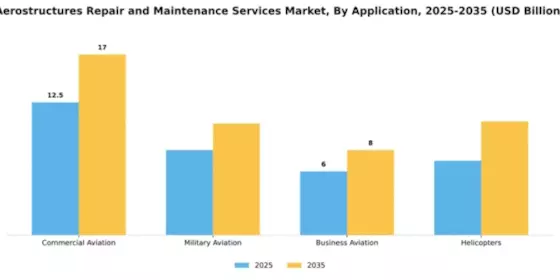
Commercial Aviation (Dominant) vs. Military Aviation (Emerging)
Commercial Aviation remains the dominant application segment in the Aerostructures Repair and Maintenance Services Market, characterized by a large volume of aircraft requiring regular servicing and extensive maintenance programs. This sector thrives on continuous passenger demand and evolving airline operational strategies. Meanwhile, Military Aviation emerges as a growing segment, reflecting an uptick driven by defense contracts and modernization efforts within military fleets. The unique requirements of military aircraft maintenance, which include uncompromised reliability and advanced technology integration, emphasize the importance of specialized services that cater to this segment's distinct needs.
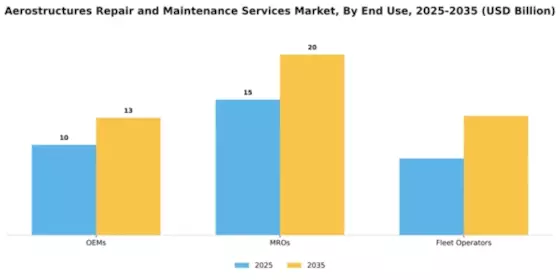
In the Aerostructures Repair and Maintenance Services Market, Repair Services holds the largest share, driven by the ongoing need for maintaining aircraft in operation and ensuring compliance with regulatory standards. Maintenance Services also contribute significantly, providing essential support to prolong the life of aerostructures. Meanwhile, Overhaul Services, which involve comprehensive refurbishments, and Modification Services, which adapt existing structures for new requirements, are gaining traction among operators seeking efficiency and performance enhancements.
Repair Services (Dominant) vs. Modification Services (Emerging)
Repair Services dominate the market due to their crucial role in the operation and longevity of aerostructures. These services focus on restoring damaged parts to original specifications, ensuring safety and compliance. In contrast, Modification Services are emerging as a significant segment, providing upgrades to meet modern aviation standards and operational efficiencies. Operators are increasingly investing in modifications to improve performance and reduce fuel consumption. Together, these services represent a critical aspect of maintaining and enhancing the lifecycle of aerostructures, with Repair Services providing reliability while Modification Services reflect innovation.
The Aerostructures Repair and Maintenance Services Market showcases a varied distribution of material types, with aluminum leading as the largest segment due to its lightweight properties and widespread use in aerospace applications. Composite materials are rapidly gaining traction, representing a fast-growing segment as manufacturers increasingly leverage their strength and versatility for modern aircraft designs. In contrast, titanium and steel, while important, hold smaller shares in comparison to these predominant materials.
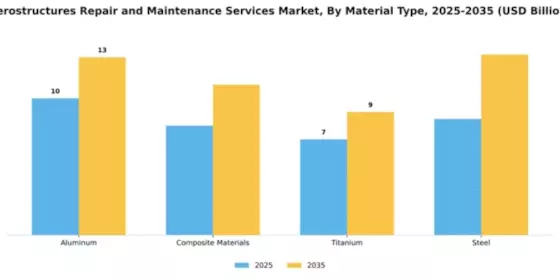
Aluminum (Dominant) vs. Composite Materials (Emerging)
Aluminum remains the dominant material in aerostructures repair and maintenance services, celebrated for its favorable strength-to-weight ratio, cost-effectiveness, and extensive applications in both commercial and military aviation. However, composite materials are emerging as strong contenders, offering superior performance characteristics such as resistance to corrosion and fatigue. As advancements in manufacturing processes reduce costs and improve durability, composites are quickly becoming favored choices for newer aircraft. This shift is particularly pronounced in commercial aviation, where the need for fuel efficiency drives the adoption of lighter materials. Thus, while aluminum holds a strong market position, composite materials are set to reshape the landscape of this sector.
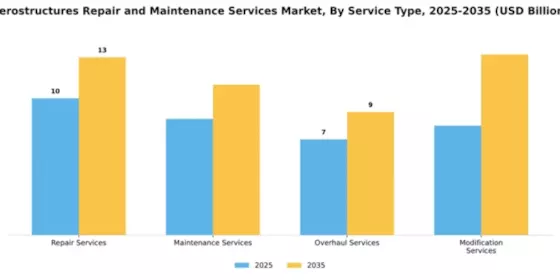
In the Aerostructures Repair and Maintenance Services Market, the end-use segment is primarily dominated by Original Equipment Manufacturers (OEMs), holding the largest share of the market. OEMs benefit from strong brand loyalty and established relationships with aircraft manufacturers, positioning them as the go-to source for maintenance services. On the other hand, Maintenance, Repair, and Overhaul (MRO) service providers are witnessing significant growth, driven by an increasing demand for aftermarket services as fleet operators seek to extend the lifespan of aircraft components and ensure operational efficiency.
OEMs (Dominant) vs. MROs (Emerging)
OEMs play a dominant role in the Aerostructures Repair and Maintenance Services Market, offering precision maintenance services tailored to specific aircraft models. Their deep integration with manufacturers allows them to access proprietary technologies and original specifications, which enhances service quality and customer trust. In contrast, MROs are emerging as viable alternatives, particularly as airlines and fleet operators increasingly outsource maintenance tasks to reduce operational costs. MROs often provide flexibility and competitive pricing, appealing to diverse customer needs, and are investing in innovative service delivery models to capture a greater market share as demand for efficient maintenance solutions grows.
Get more detailed insights about Aerostructures Repair and Maintenance Services Market Request Free Sample
North America is poised to maintain its leadership in the Aerostructures Repair and Maintenance Services Market, holding a significant market share of 16.75% as of 2024. The region benefits from a robust aerospace industry, driven by increasing air travel demand and stringent safety regulations. Government initiatives aimed at enhancing aviation infrastructure further catalyze market growth, ensuring a steady demand for repair and maintenance services. The competitive landscape in North America is characterized by the presence of major players such as Boeing, Lockheed Martin, and Raytheon Technologies. These companies leverage advanced technologies and extensive service networks to meet the growing needs of airlines and military operators. The U.S. remains the largest market, supported by a strong defense budget and a focus on innovation in aerospace technologies.
Europe's Aerostructures Repair and Maintenance Services Market is valued at €10.5 billion, reflecting a growing demand driven by increasing aircraft utilization and regulatory support. The European Union's commitment to enhancing aviation safety and sustainability is a key growth driver, with regulations promoting the maintenance of aging fleets and the adoption of eco-friendly practices. This regulatory environment fosters innovation and investment in repair services, positioning Europe as a competitive player in the global market. Leading countries in this region include Germany, France, and the UK, where major companies like Airbus and Safran are headquartered. The competitive landscape is marked by collaborations between manufacturers and service providers, enhancing service offerings. The presence of advanced research institutions further supports the development of cutting-edge repair technologies, ensuring that Europe remains at the forefront of the aerospace sector.
The Asia-Pacific region, with a market size of $5.5 billion, is witnessing rapid growth in the Aerostructures Repair and Maintenance Services Market. This growth is fueled by increasing air travel, rising disposable incomes, and the expansion of low-cost carriers. Additionally, government initiatives aimed at enhancing aviation infrastructure and safety standards are driving demand for repair services, making this region a focal point for market expansion. Countries like China, India, and Japan are leading the charge, with significant investments in aerospace capabilities. The competitive landscape features both established players and emerging companies, creating a dynamic environment. Key players such as Hindustan Aeronautics Limited are expanding their service offerings to cater to the growing needs of airlines and military operators in the region.
The Middle East and Africa region, with a market size of $0.75 billion, is gradually emerging in the Aerostructures Repair and Maintenance Services Market. Growth is primarily driven by substantial investments in aviation infrastructure and a rising number of air travelers. Countries in the Gulf Cooperation Council (GCC) are particularly focused on enhancing their aviation capabilities, which is expected to boost demand for repair and maintenance services in the coming years. Leading countries in this region include the UAE and South Africa, where government initiatives are fostering a conducive environment for market growth. The competitive landscape is characterized by collaborations between local and international players, enhancing service delivery. As the region continues to develop its aviation sector, opportunities for growth in aerostructures repair services are expected to expand significantly.
The Aerostructures Repair and Maintenance Services Market is characterized by a dynamic competitive landscape, driven by technological advancements, increasing demand for aircraft maintenance, and a growing emphasis on sustainability. Major players such as Boeing (US), Airbus (FR), and Lockheed Martin (US) are strategically positioned to leverage their extensive experience and technological capabilities. Boeing (US) focuses on innovation and digital transformation, enhancing its service offerings through advanced analytics and predictive maintenance solutions. Meanwhile, Airbus (FR) emphasizes partnerships and collaborations to expand its service portfolio, particularly in the realm of eco-friendly technologies. Lockheed Martin (US) adopts a strategy centered on mergers and acquisitions, aiming to bolster its capabilities in aerostructures repair and maintenance, thereby enhancing its competitive edge.The market structure appears moderately fragmented, with a mix of established players and emerging companies vying for market share. Key business tactics include localizing manufacturing to reduce costs and optimize supply chains, which is crucial in maintaining competitiveness. The collective influence of these major players shapes the market dynamics, as they continuously adapt to evolving customer needs and regulatory requirements.In November Boeing (US) announced a strategic partnership with a leading technology firm to develop AI-driven maintenance solutions aimed at improving operational efficiency and reducing downtime for aircraft. This move is likely to enhance Boeing's service capabilities, positioning it as a leader in the integration of advanced technologies within the aerostructures repair sector. The partnership underscores the importance of innovation in maintaining competitive advantage in a rapidly evolving market.In October Airbus (FR) launched a new initiative focused on sustainable repair practices, which includes the implementation of eco-friendly materials and processes in its maintenance operations. This initiative not only aligns with global sustainability goals but also enhances Airbus's reputation as a forward-thinking leader in the aerospace industry. The strategic importance of this initiative lies in its potential to attract environmentally conscious clients and comply with increasingly stringent regulations.In September Lockheed Martin (US) completed the acquisition of a specialized repair firm, significantly expanding its capabilities in aerostructures maintenance. This acquisition is expected to enhance Lockheed Martin's service offerings and provide a competitive edge in the market. The strategic importance of this move is evident in its potential to streamline operations and improve service delivery, thereby meeting the growing demand for efficient maintenance solutions.As of December current competitive trends in the Aerostructures Repair and Maintenance Services Market are heavily influenced by digitalization, sustainability, and AI integration. Strategic alliances are increasingly shaping the landscape, as companies recognize the need for collaboration to drive innovation and enhance service offerings. The shift from price-based competition to a focus on technological advancement and supply chain reliability is becoming more pronounced. In this evolving environment, companies that prioritize innovation and sustainability are likely to differentiate themselves and secure a competitive advantage.


The Aerostructures Repair and Maintenance Services Market is projected to grow at a 2.97% CAGR from 2025 to 2035, driven by technological advancements and increasing aircraft utilization.
New opportunities lie in:
By 2035, the market is expected to achieve robust growth, reflecting evolving industry demands.
| MARKET SIZE 2024 | 33.5(USD Billion) |
| MARKET SIZE 2025 | 34.49(USD Billion) |
| MARKET SIZE 2035 | 46.2(USD Billion) |
| COMPOUND ANNUAL GROWTH RATE (CAGR) | 2.97% (2025 - 2035) |
| REPORT COVERAGE | Revenue Forecast, Competitive Landscape, Growth Factors, and Trends |
| BASE YEAR | 2024 |
| Market Forecast Period | 2025 - 2035 |
| Historical Data | 2019 - 2024 |
| Market Forecast Units | USD Billion |
| Key Companies Profiled | Boeing (US), Airbus (FR), Lockheed Martin (US), Northrop Grumman (US), Raytheon Technologies (US), General Dynamics (US), Leonardo (IT), Safran (FR), MTU Aero Engines (DE), Hindustan Aeronautics Limited (IN) |
| Segments Covered | Application, Service Type, Material Type, End Use |
| Key Market Opportunities | Integration of advanced materials and automation enhances efficiency in the Aerostructures Repair and Maintenance Services Market. |
| Key Market Dynamics | Technological advancements and regulatory changes drive innovation and efficiency in aerostructures repair and maintenance services. |
| Countries Covered | North America, Europe, APAC, South America, MEA |
As of 2024, the market valuation stands at 33.5 USD Billion.
The market is expected to reach a valuation of 46.2 USD Billion by 2035.
The market is anticipated to grow at a CAGR of 2.97% from 2025 to 2035.
Key players include Boeing, Airbus, Lockheed Martin, Northrop Grumman, and Raytheon Technologies.
The market segments by application include Commercial Aviation, Military Aviation, Business Aviation, and Helicopters.
In 2024, the Commercial Aviation segment was valued at 12.5 USD Billion.
In 2024, the Military Aviation segment was valued at 8.0 USD Billion, while Business Aviation was valued at 6.0 USD Billion.
Service types include Repair Services, Maintenance Services, Overhaul Services, and Modification Services.
By 2035, the Modification Services segment is projected to reach a valuation of 13.2 USD Billion.
End-use segments consist of OEMs, MROs, and Fleet Operators.



Kindly complete the form below to receive a free sample of this Report

“This is really good guys. Excellent work on a tight deadline. I will continue to use you going forward and recommend you to others. Nice job”


“Thanks. It’s been a pleasure working with you, please use me as reference with any other Intel employees.”


“Thanks for sending the report it gives us a good global view of the Betaïne market.”


“Thank you, this will be very helpful for OQS.”


“We found the report very insightful! we found your research firm very helpful. I'm sending this email to secure our future business.”


“I am very pleased with how market segments have been defined in a relevant way for my purposes (such as "Portable Freezers & refrigerators" and "last-mile"). In general the report is well structured. Thanks very much for your efforts.”


“I have been reading the first document or the study, ,the Global HVAC and FP market report 2021 till 2026. Must say, good info! I have not gone in depth at all parts, but got a good indication of the data inside!”


“We got the report in time, we really thank you for your support in this process. I also thank to all of your team as they did a great job.”


“The Automotive 48V ECU Components Procurement Intelligence Study” was a complex project, but the Market Research Future (MRFR) team handled it with quality, agility, and customer-centricity. They delivered all requested data on time and within the agreed scope. The team, including Shubhendra Anand and Rahul Gotadki, was always readily available to clarify questions and swiftly implement necessary adjustments, driving the project to a successful conclusion within a very demanding timeframe.
I would also like to specifically commend Akshay Agarwal for his responsiveness and support at every stage—from our initial inquiry on May 6th through to final delivery on June 18th. His dedication made the entire process seamless.”



