Request Free Sample ×

Kindly complete the form below to receive a free sample of this Report

* Please use a valid business email

Leading companies partner with us for data-driven Insights

clients tt-cursor
Hero Background

Agricultural Inoculants Market

ID: MRFR/Agri/3077-CR
144 Pages
Snehal Singh
Last Updated: May 28, 2026
Agricultural Inoculants Market Size, Share, Industry Trend & Analysis Research Report Information By Function (Crop Nutrition, Biocontrol Agents), By Microorganism (Bacteria, Fungi, Other Microorganisms), By Mode of Application (Seed Inoculation, Soil Inoculation), By Crop Type (Cereals and Grains, Pulses and Oilseeds, Fruits and Vegetables, Other Crops) – Forecast Till 2035
Download PDF ×

We do not share your information with anyone. However, we may send you emails based on your report interest from time to time. You may contact us at any time to opt-out.

  1. 1 Market Overview |
    1. 1.1 Study Assumptions & Market Definition |
    2. 1.2 Scope of the Study |
    3. 1.3 Research Methodology
  2. 2 Market Summary & Key Takeaways
  3. 3 Market Dynamics |
    1. 3.1 Market Drivers Analysis | |
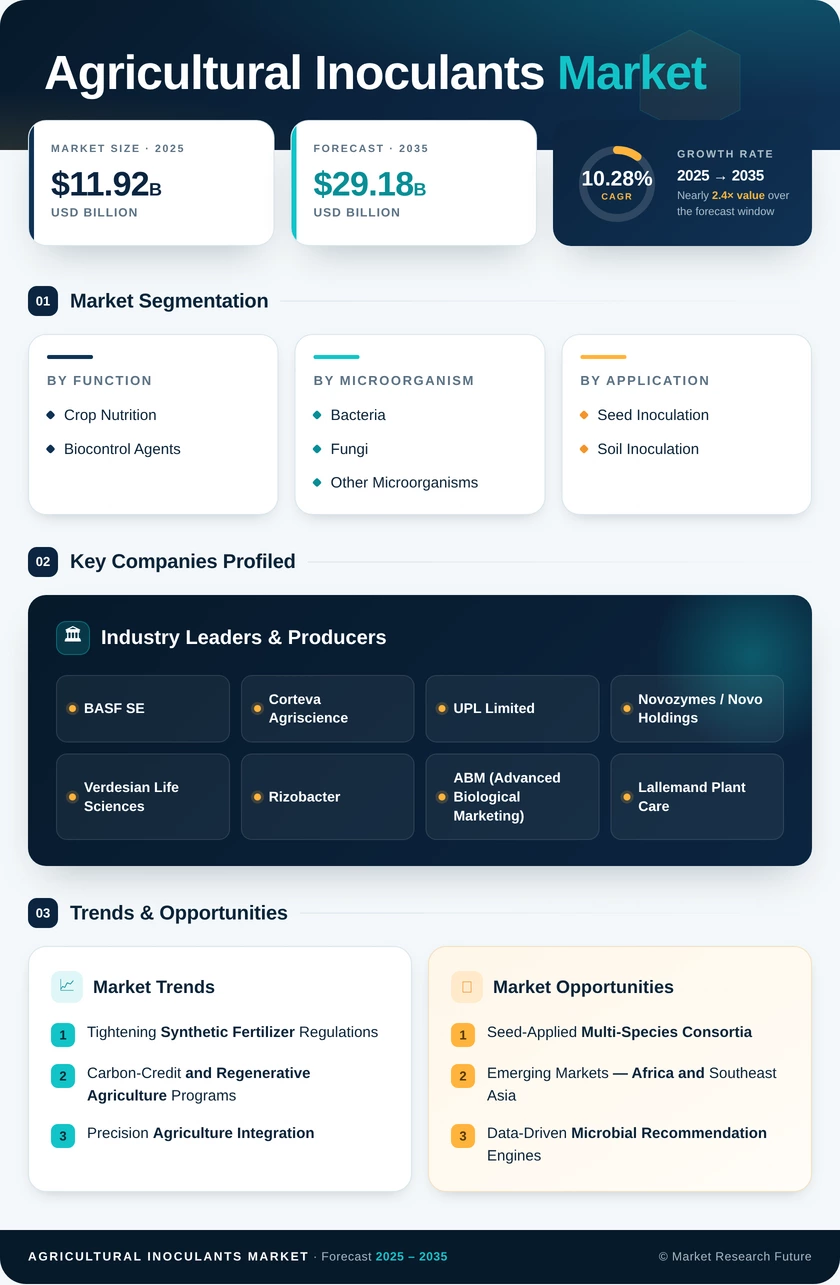
      1. 3.1.1 Tightening Synthetic Fertilizer Regulations | |
      2. 3.1.2 Carbon-Credit and Regenerative Agriculture Programs | |
      3. 3.1.3 Precision Agriculture Integration for Microbial Placement | |
      4. 3.1.4 Venture Funding for Encapsulation and Shelf-Life Platforms | |
      5. 3.1.5 Expanding Seed-Applied Microbial Consortia Portfolios | |
      6. 3.1.6 Government Biofertilizer Subsidy Programs | |
      7. 3.1.7 Retailer Sustainability Audits and Supply-Chain Traceability |
    2. 3.2 Market Restraints Analysis | |
      1. 3.2.1 Inconsistent Regulatory Approval Pathways | |
      2. 3.2.2 Limited Shelf Life of Live Microbial Products | |
      3. 3.2.3 Farmer Awareness and Adoption Inertia | |
      4. 3.2.4 Incompatibility with Chemical Seed Treatments | |
      5. 3.2.5 Strain Efficacy Variability Across Soil Types |
    3. 3.3 Market Opportunity Analysis | |
      1. 3.3.1 Seed-Applied Multi-Species Consortia | |
      2. 3.3.2 Emerging Markets — Africa and Southeast Asia | |
      3. 3.3.3 Data-Driven Microbial Recommendation Engines | |
      4. 3.3.4 Organic and Regenerative Certification Premiums | |
      5. 3.3.5 Integration with Carbon MRV Platforms |
    4. 3.4 Industry Value Chain Analysis |
    5. 3.5 Porter's Five Forces Analysis
  4. 4 Global Agricultural Inoculants Market Size & Forecast (2021–2035) |
    1. 4.1 Historical Market Size (2021–2025) |
    2. 4.2 Current & Forecast Market Size (2026–2035) |
    3. 4.3 Market Size by Revenue (USD Billion) |
    4. 4.4 Year-over-Year Growth Analysis
  5. 5 Segmentation Analysis |
    1. 5.1 By Function | |
      1. 5.1.1 Crop Nutrition | |
      2. 5.1.2 Biocontrol Agents |
    2. 5.2 By Microorganism | |
      1. 5.2.1 Bacteria | |
      2. 5.2.2 Fungi | |
      3. 5.2.3 Other Microorganisms |
    3. 5.3 By Mode of Application | |
      1. 5.3.1 Seed Inoculation | |
      2. 5.3.2 Soil Inoculation |
    4. 5.4 By Crop Type | |
      1. 5.4.1 Cereals and Grains | |
      2. 5.4.2 Pulses and Oilseeds | |
      3. 5.4.3 Fruits and Vegetables | |
      4. 5.4.4 Other Crops
  6. 6 Regional Analysis |
    1. 6.1 North America | |
      1. 6.1.1 United States | |
      2. 6.1.2 Canada | |
      3. 6.1.3 Mexico |
    2. 6.2 Europe | |
      1. 6.2.1 Germany | |
      2. 6.2.2 United Kingdom | |
      3. 6.2.3 France | |
      4. 6.2.4 Italy | |
      5. 6.2.5 Spain | |
      6. 6.2.6 Nordic Countries | |
      7. 6.2.7 Russia | |
      8. 6.2.8 Rest of Europe |
    3. 6.3 Asia-Pacific | |
      1. 6.3.1 China | |
      2. 6.3.2 India | |
      3. 6.3.3 Japan | |
      4. 6.3.4 South Korea | |
      5. 6.3.5 ASEAN | |
      6. 6.3.6 Rest of Asia-Pacific |
    4. 6.4 South America | |
      1. 6.4.1 Brazil | |
      2. 6.4.2 Argentina | |
      3. 6.4.3 Rest of South America |
    5. 6.5 Middle East & Africa | |
      1. 6.5.1 Saudi Arabia | |
      2. 6.5.2 UAE | |
      3. 6.5.3 South Africa | |
      4. 6.5.4 Egypt | |
      5. 6.5.5 Rest of MEA
  7. 7 Competitive Landscape |
    1. 7.1 Market Share Analysis (2025) |
    2. 7.2 Competitive Benchmarking Matrix |
    3. 7.3 Company Profiles | |
      1. 7.3.1 BASF SE | |
      2. 7.3.2 Corteva Agriscience | |
      3. 7.3.3 UPL Limited | |
      4. 7.3.4 Novozymes / Novo Holdings | |
      5. 7.3.5 Verdesian Life Sciences | |
      6. 7.3.6 Rizobacter | |
      7. 7.3.7 ABM (Advanced Biological Marketing) | |
      8. 7.3.8 Lallemand Plant Care | |
      9. 7.3.9 Groundwork BioAg | |
      10. 7.3.10 Pivot Bio
  8. 8 Future Outlook & Strategic Recommendations (2026–2035) |
    1. 8.1 AI-Guided Strain Discovery and Formulation |
    2. 8.2 Biologicals–Genetics Bundling and Platform Economics |
    3. 8.3 ESG Reporting and Scope 3 Agricultural Emissions |
    4. 8.4 Climate Adaptation and Stress-Tolerant Microbiomes
  9. 9 Recent Developments & News
  10. 10 Frequently Asked Questions (FAQs)
  11. 11 Report Scope & Methodology |
    1. 11.1 Study Period & Base Year |
    2. 11.2 Data Sources & Citations |
    3. 11.3 Abbreviations
  12. 1 LIST OF TABLES |
  13. TABLE 1 Global Agricultural Inoculants Market Size & Forecast, by Revenue (USD Billion), 2021–2035 |
  14. TABLE 2 Global Agricultural Inoculants Market – Year-over-Year Growth Analysis, 2021–2035 |
  15. TABLE 3 Global Agricultural Inoculants Market – Driver Impact Analysis |
  16. TABLE 4 Global Agricultural Inoculants Market – Restraints Impact Analysis |
  17. TABLE 5 Global Agricultural Inoculants Market Size, by Function, 2021–2035 (USD Billion) |
  18. TABLE 6 Global Agricultural Inoculants Market Size, by Microorganism, 2021–2035 (USD Billion) |
  19. TABLE 7 Global Agricultural Inoculants Market Size, by Mode of Application, 2021–2035 (USD Billion) |
  20. TABLE 8 Global Agricultural Inoculants Market Size, by Crop Type, 2021–2035 (USD Billion) |
  21. TABLE 9 Global Agricultural Inoculants Market Size, by Region, 2021–2035 (USD Billion) |
  22. TABLE 10 North America Agricultural Inoculants Market Size, by Country, 2021–2035 (USD Billion) |
  23. TABLE 11 Europe Agricultural Inoculants Market Size, by Country, 2021–2035 (USD Billion) |
  24. TABLE 12 Asia-Pacific Agricultural Inoculants Market Size, by Country, 2021–2035 (USD Billion) |
  25. TABLE 13 South America Agricultural Inoculants Market Size, by Country, 2021–2035 (USD Billion) |
  26. TABLE 14 Middle East & Africa Agricultural Inoculants Market Size, by Country, 2021–2035 (USD Billion) |
  27. TABLE 15 Competitive Benchmarking Matrix – Global Agricultural Inoculants Market, 2025 |
  28. TABLE 16 Company Profiles – Key Players, Global Agricultural Inoculants Market |
  29. TABLE 17 Recent Developments & Strategic Announcements, 2023–2025 |
  30. TABLE 18 North America Agricultural Inoculants Market Size, by Function, 2021–2035 (USD Billion) |
  31. TABLE 19 North America Agricultural Inoculants Market Size, by Microorganism, 2021–2035 (USD Billion) |
  32. TABLE 20 North America Agricultural Inoculants Market Size, by Mode of Application, 2021–2035 (USD Billion) |
  33. TABLE 21 North America Agricultural Inoculants Market Size, by Crop Type, 2021–2035 (USD Billion) |
  34. TABLE 22 Europe Agricultural Inoculants Market Size, by Function, 2021–2035 (USD Billion) |
  35. TABLE 23 Europe Agricultural Inoculants Market Size, by Microorganism, 2021–2035 (USD Billion) |
  36. TABLE 24 Europe Agricultural Inoculants Market Size, by Mode of Application, 2021–2035 (USD Billion) |
  37. TABLE 25 Europe Agricultural Inoculants Market Size, by Crop Type, 2021–2035 (USD Billion) |
  38. TABLE 26 Asia-Pacific Agricultural Inoculants Market Size, by Function, 2021–2035 (USD Billion) |
  39. TABLE 27 Asia-Pacific Agricultural Inoculants Market Size, by Microorganism, 2021–2035 (USD Billion) |
  40. TABLE 28 Asia-Pacific Agricultural Inoculants Market Size, by Mode of Application, 2021–2035 (USD Billion) |
  41. TABLE 29 Asia-Pacific Agricultural Inoculants Market Size, by Crop Type, 2021–2035 (USD Billion) |
  42. TABLE 30 South America Agricultural Inoculants Market Size, by Function, 2021–2035 (USD Billion) |
  43. TABLE 31 South America Agricultural Inoculants Market Size, by Microorganism, 2021–2035 (USD Billion) |
  44. TABLE 32 South America Agricultural Inoculants Market Size, by Mode of Application, 2021–2035 (USD Billion) |
  45. TABLE 33 South America Agricultural Inoculants Market Size, by Crop Type, 2021–2035 (USD Billion) |
  46. TABLE 34 Middle East & Africa Agricultural Inoculants Market Size, by Function, 2021–2035 (USD Billion) |
  47. TABLE 35 Middle East & Africa Agricultural Inoculants Market Size, by Microorganism, 2021–2035 (USD Billion) |
  48. TABLE 36 Middle East & Africa Agricultural Inoculants Market Size, by Mode of Application, 2021–2035 (USD Billion) |
  49. TABLE 37 Middle East & Africa Agricultural Inoculants Market Size, by Crop Type, 2021–2035 (USD Billion) |
  50. TABLE 38 Report Scope & Methodology Summary
  51. 2 LIST OF FIGURES |
  52. FIGURE 1 Agricultural Inoculants Market — Market Dynamics Overview |
  53. FIGURE 2 Agricultural Inoculants Market — Industry Value Chain Analysis |
  54. FIGURE 3 Agricultural Inoculants Market — Porter's Five Forces Analysis |
  55. FIGURE 4 Global Agricultural Inoculants Market Size Trend (USD Billion), 2021–2035 |
  56. FIGURE 5 Agricultural Inoculants Market Share, by Function, 2025 (%) |
  57. FIGURE 6 Agricultural Inoculants Market Share, by Microorganism, 2025 (%) |
  58. FIGURE 7 Agricultural Inoculants Market Share, by Mode of Application, 2025 (%) |
  59. FIGURE 8 Agricultural Inoculants Market Share, by Crop Type, 2025 (%) |
  60. FIGURE 9 Agricultural Inoculants Market Share, by Region, 2025 (%) |
  61. FIGURE 10 North America Agricultural Inoculants Market Size (USD Billion), 2021–2035 |
  62. FIGURE 11 Europe Agricultural Inoculants Market Size (USD Billion), 2021–2035 |
  63. FIGURE 12 Asia-Pacific Agricultural Inoculants Market Size (USD Billion), 2021–2035 |
  64. FIGURE 13 South America Agricultural Inoculants Market Size (USD Billion), 2021–2035 |
  65. FIGURE 14 Middle East & Africa Agricultural Inoculants Market Size (USD Billion), 2021–2035 |
  66. FIGURE 15 Competitive Landscape — Market Share Analysis, 2025

Segmentation Quick Reference

DimensionSub-SegmentsDominant SegmentFastest Growing Segment
By FunctionCrop Nutrition, Biocontrol AgentsCrop Nutrition (63.4% share, 2025)Biocontrol Agents (12.3% CAGR)
By MicroorganismBacteria, Fungi, Other MicroorganismsBacteria (USD 8.49B, 2025)Fungi (13.9% CAGR)
By Mode of ApplicationSeed Inoculation, Soil InoculationSeed Inoculation (60.8% share, 2025)Soil Inoculation (13.5% CAGR)
By Crop TypeCereals & Grains, Pulses & Oilseeds, Fruits & Vegetables, Other CropsCereals & Grains (44.6% share, 2025)Fruits & Vegetables (11.8% CAGR)
By GeographyNorth America, Europe, Asia-Pacific, South America, MEANorth America (35.1% share, 2025)Asia-Pacific (10.72% CAGR)


Market Segmentation Overview

By Function

Sub-SegmentKey Trend
Crop NutritionRhizobium and phosphorus-solubilizing bacteria remain the volume backbone; consortia formulations gaining share
Biocontrol AgentsTrichoderma and Bacillus lines displacing synthetic fungicides under IPM mandates


Crop nutrition products form the operational core of the agricultural inoculants industry, with rhizobium strains for soybean and pulse crops accounting for the bulk of unit volume. Biocontrol agents are transitioning from niche specialty applications into mainstream row crop programs as resistance management pressures mount.

By Microorganism

Sub-SegmentKey Trend
BacteriaBroadacre nitrogen fixation dominance; Azospirillum expanding into non-legume cereals
FungiArbuscular mycorrhizal fungi moving from nursery into field-crop applications
Other MicroorganismsAlgal biostimulants and actinomycete biocontrol agents entering commercial pipeline


Bacterial inoculants benefit from established regulatory pathways and extensive field-trial databases. Fungal products are attracting R&D investment as mycorrhizal networks demonstrate quantifiable phosphorus uptake and drought tolerance benefits across diverse soil types.

By Mode of Application

Sub-SegmentKey Trend
Seed InoculationIntegration into planter-box seed treatment workflows; liquid and peat formulations
Soil InoculationGranular in-furrow products gaining traction for cereals; liquid soil drench for horticulture


Seed inoculation dominates due to operational simplicity and precision dosing, while soil inoculation is expanding as formulation advances enable consistent microbial delivery in non-legume cropping systems.

By Crop Type

Sub-SegmentKey Trend
Cereals and GrainsNon-symbiotic nitrogen fixers scaling for wheat, rice, and maize
Pulses and OilseedsSoybean remains the anchor crop; pea and lentil inoculants expanding in Canada
Fruits and VegetablesPremium mycorrhizal products for berries, tomatoes, and vine crops
Other CropsSugarcane Gluconacetobacter inoculants in Brazil; cotton and turf applications


Cereals and grains lead by acreage volume, but fruits and vegetables command the highest per-hectare product value, reflecting premium pricing for residue-free and organic-certified microbial inputs.

By Geography

Sub-SegmentKey Trend
North AmericaMature soybean inoculant base; carbon-credit programs driving incremental adoption
EuropeRegulatory tailwinds from Farm to Fork and Fertilising Products Regulation
Asia-PacificGovernment biofertilizer subsidies in India and China; rice inoculant frontier
South AmericaBrazil soybean dominance; Argentina dual-inoculation programs
Middle East & AfricaTAAT scaling; South Africa commercial farm adoption


North America and Europe account for the majority of current revenue, while Asia-Pacific and the Middle East & Africa represent the fastest-growing opportunity corridors driven by policy support and untapped arable land.