Agricultural Surfactants Market Size, Share, Industry Trend & Analysis Research Report Information By Product Type (Non-ionic, Anionic, Cationic, and Amphoteric), By Substrate Type (Synthetic and Bio-based), By Application (Herbicides, Fungicides, and Insecticides), And By Region (North America, Europe, Asia-Pacific, And Rest Of The World) – Forecast Till 2035
Forecast Period
2025 - 2035
CAGR
5.23%
2024 Market Size
$ 2,320.77 Million
2035 Market Size
$ 4,083.83 Million
Agriculture● Updated April 28, 2026Report ID: MRFR/Agri/4630-HCR|Pages: 100|Author: Snehal Singh, Varsha More
Agricultural Surfactants Market Summary
As per MRFR analysis, the Agricultural Surfactants Market Size was estimated at 2320.77 USD Million in 2024. The Agricultural Surfactants industry is projected to grow from 2468.74 USD Million in 2025 to 4083.83 USD Million by 2035, exhibiting a compound annual growth rate (CAGR) of 5.23% during the forecast period 2025 - 2035. North America holds the largest share of the global Agricultural Surfactants Market at approximately 35%, driven by strong demand for effective crop protection solutions, advanced farming practices, and extensive use of herbicides requiring surfactant adjuvants. The United States is the leading country within North America, capturing approximately 28% of the global Agricultural Surfactants Market share, supported by the world's largest commercial crop protection market and high adoption of precision agriculture technologies. Herbicides dominate the Agricultural Surfactants Market as the largest application segment, accounting for an estimated 42% of the global market share, driven by the essential role of surfactants in improving herbicide efficacy, coverage, and penetration in large-scale weed management programs.
Key Market Trends & Highlights
The Agricultural Surfactants Market is poised for growth driven by sustainability and technological advancements.
North America remains the largest market for agricultural surfactants, reflecting a strong demand for effective crop protection solutions.
Asia-Pacific is emerging as the fastest-growing region, fueled by increasing agricultural activities and modernization efforts.
Herbicides dominate the market as the largest segment, while adjuvants are experiencing rapid growth due to their role in enhancing pesticide efficacy.
Key market drivers include a heightened focus on sustainability and rising crop production, supported by regulatory frameworks promoting eco-friendly practices.
Market Size & Forecast
2024 Market Size
2320.77 (USD Million)
2035 Market Size
4083.83 (USD Million)
CAGR (2025 - 2035)
5.23%
Major Players
BASF SE (DE), Dow Inc. (US), Huntsman Corporation (US), Clariant AG (CH), Solvay SA (BE), Evonik Industries AG (DE), Nufarm Limited (AU), Croda International Plc (GB), Wilbur-Ellis Company (US)
Our Impact
Enabled $4.3B Revenue Impact for Fortune 500 and Leading Multinationals
Partnering with 2000+ Global Organizations Each Year
30K+ Citations by Top-Tier Firms in the Industry
Agricultural Surfactants Market Trends
The Agricultural Surfactants Market is currently experiencing a notable transformation, driven by the increasing demand for sustainable agricultural practices and the need for enhanced crop productivity. As farmers seek to optimize their yields while minimizing environmental impact, the role of surfactants in improving the efficacy of agrochemicals becomes increasingly apparent. These substances facilitate better absorption and distribution of pesticides and fertilizers, thereby promoting more efficient use of resources. Furthermore, the growing awareness of the benefits of integrated pest management strategies is likely to bolster the adoption of surfactants in various agricultural applications. In addition to sustainability, the Agricultural Surfactants Market is influenced by advancements in formulation technologies. Innovations in product development are leading to the creation of more effective and environmentally friendly surfactants. This trend is further supported by regulatory frameworks that encourage the use of biodegradable and non-toxic ingredients. As a result, manufacturers are focusing on developing products that not only meet performance expectations but also align with the evolving preferences of consumers and regulatory bodies. Overall, the Agricultural Surfactants Market appears poised for growth, driven by a combination of environmental considerations and technological advancements.
Sustainability Focus
The emphasis on sustainable agricultural practices is reshaping the Agricultural Surfactants Market. As environmental concerns rise, farmers are increasingly adopting surfactants that enhance the efficiency of agrochemicals while reducing ecological footprints. This trend reflects a broader shift towards eco-friendly farming methods.
Technological Advancements
Innovations in formulation technologies are significantly impacting the Agricultural Surfactants Market. New product developments are leading to the creation of more effective and environmentally safe surfactants. This evolution is driven by the need for improved performance and compliance with regulatory standards.
Integrated Pest Management
The growing adoption of integrated pest management strategies is influencing the Agricultural Surfactants Market. Surfactants play a crucial role in enhancing the effectiveness of pest control measures, thereby supporting the trend towards more holistic and sustainable approaches to crop protection.
Agricultural Surfactants Market Drivers
Market Growth Projections
The Global Agricultural Surfactants Market Industry is poised for substantial growth, with projections indicating a market value of 6200 USD Million by 2035. This growth trajectory is supported by a compound annual growth rate of 5.34% from 2025 to 2035. The increasing adoption of surfactants in various agricultural applications, coupled with the rising demand for sustainable farming practices, contributes to this optimistic outlook. As the industry evolves, it is anticipated that new surfactant formulations will emerge, further driving market expansion and meeting the diverse needs of modern agriculture.
Expansion of Agrochemical Market
The expansion of the global agrochemical market is a key driver for the Global Agricultural Surfactants Market Industry. As the demand for fertilizers and pesticides increases, so does the need for surfactants that enhance their effectiveness. The agrochemical sector is projected to grow significantly, with surfactants playing a crucial role in improving the performance of these products. This growth is reflected in the market's expected value of 3500 USD Million in 2024. The synergy between agrochemicals and surfactants is likely to foster innovation, leading to the development of new formulations that cater to evolving agricultural needs.
Advancements in Agricultural Technology
Technological advancements in agriculture are significantly influencing the Global Agricultural Surfactants Market Industry. Innovations such as precision agriculture and biotechnology are leading to the development of more effective surfactants that enhance the performance of agrochemicals. These advancements allow for targeted application, reducing waste and improving environmental sustainability. As a result, the market is expected to grow, with projections indicating a value of 6200 USD Million by 2035. The integration of smart farming technologies with surfactants could potentially revolutionize crop management, making it more efficient and sustainable.
Rising Awareness of Environmental Impact
Growing awareness regarding the environmental impact of agricultural practices is shaping the Global Agricultural Surfactants Market Industry. Stakeholders are increasingly recognizing the role of surfactants in reducing chemical runoff and improving the efficiency of agrochemical applications. This awareness is driving demand for eco-friendly surfactants that align with sustainable farming practices. As consumers and regulatory bodies push for greener solutions, the market is likely to see a shift towards products that minimize ecological footprints. This trend may contribute to the projected growth of the market, reaching 6200 USD Million by 2035.
Regulatory Support for Sustainable Practices
The Global Agricultural Surfactants Market Industry benefits from increasing regulatory support aimed at promoting sustainable agricultural practices. Governments worldwide are implementing policies that encourage the use of environmentally friendly surfactants, which can enhance the effectiveness of agrochemicals while minimizing environmental impact. This regulatory landscape is likely to drive market growth, as manufacturers adapt to meet these standards. The anticipated compound annual growth rate of 5.34% from 2025 to 2035 suggests that the industry is poised for expansion, as stakeholders prioritize sustainability in agricultural practices.
Increasing Demand for Crop Protection Products
The Global Agricultural Surfactants Market Industry is experiencing a surge in demand for crop protection products, driven by the need for enhanced agricultural productivity. As farmers seek to maximize yields, the incorporation of surfactants in pesticides and herbicides becomes essential. These surfactants improve the efficacy of active ingredients, ensuring better coverage and penetration. For instance, the market is projected to reach 3500 USD Million in 2024, reflecting a growing recognition of the importance of surfactants in modern agriculture. This trend is likely to continue as the global population increases, necessitating more efficient farming practices.
Market Segment Insights
By Application: Herbicides (Largest) vs. Insecticides (Fastest-Growing)
The Agricultural Surfactants Market exhibits a diverse application segment characterized primarily by herbicides, insecticides, fungicides, and plant growth regulators. Herbicides hold the largest market share, signifying their widespread usage in crop protection. Meanwhile, insecticides have emerged as the fastest-growing segment due to increasing pest pressures and the need for sustainable agricultural practices. The ineffectiveness of traditional pest control methods has also driven this trend, compelling farmers to adopt innovative surfactant solutions that enhance the efficacy of insecticides. As the agricultural landscape evolves, the demand for effective crop management strategies is leading to significant growth opportunities in the surfactants sector. The rising emphasis on integrated pest management and organic farming approaches is accelerating the adoption of surfactants in both insecticides and fungicides. Moreover, regulatory push towards eco-friendly agricultural inputs is fueling the growth of plant growth regulators, indicating a notable shift towards sustainable agriculture practices. This trend underscores the dynamic nature of the Agricultural Surfactants Market.
Herbicides (Dominant) vs. Plant Growth Regulators (Emerging)
Herbicides remain the dominant force in the agricultural surfactants market, reflecting their critical role in enhancing the effectiveness of weed control solutions. These surfactants facilitate better penetration and coverage, ensuring optimal performance of the herbicides. As regulatory landscapes shift and consumer demand for eco-friendly practices rises, the herbicide segment must adapt to employ more sustainable and efficient ingredients. Conversely, plant growth regulators are emerging prominently, appealing to producers eager to maximize crop yields through innovative cultivation techniques. With increasing focus on precision agriculture, these regulators help in managing plant physiological processes, such as growth and flowering, thus presenting a significant opportunity for growth. As these two segments interact, we can expect to see collaborative advancements enhancing agricultural productivity.
By Formulation Type: Liquid (Largest) vs. Granular (Fastest-Growing)
In the Agricultural Surfactants Market, the formulation types exhibit varied share distribution, with liquid formulations holding the largest share due to their versatility and ease of application. Liquid surfactants are widely adopted across various agricultural practices, from herbicides to insecticides, providing enhanced compatibility and performance. Granular formulations, on the other hand, are gaining traction, particularly in regions focusing on precision agriculture and environmentally-friendly practices, appealing to consumers seeking targeted solutions for soil application and sustained efficacy. The growth dynamics in this segment are heavily influenced by the rising demand for crop yield optimization and sustainable farming practices. Liquid formulations continue to dominate the market driven by their efficiency while granular formulations emerge as the fastest-growing due to innovations aimed at improving application precision and reducing environmental impact. Additionally, advancements in formulation technology have enhanced the performance of both liquid and granular types, further galvanizing their market presence.
Liquid (Dominant) vs. Emulsifiable Concentrate (Emerging)
The formulation types of agricultural surfactants reveal distinct market positions with liquid formulations being the dominant player due to their broad applicability and performance advantages, making them preferred for various agricultural practices. In contrast, emulsifiable concentrates, while positioned as an emerging segment, offer significant advantages in ease of mixing and application, enabling improved compatibility with a wide range of agrochemicals. Both formulations emphasize efficiency, yet the liquid type stands out for its extensive use, while emulsifiable concentrates are gradually gaining importance in the market owing to their innovative attributes. The focus on precise application in modern agriculture is spurring interest in emulsifiable concentrates, indicating a potential shift in user preferences as sustainability continues to influence product selection.
By Chemical Type: Nonionic Surfactants (Largest) vs. Anionic Surfactants (Fastest-Growing)
The Agricultural Surfactants Market displays a diverse distribution among the chemical types, with Nonionic Surfactants holding the largest market share. These surfactants are valued for their versatility and compatibility with various agricultural formulations, making them a preferred choice among manufacturers. Anionic Surfactants, while not the largest by share, have been identified as the fastest-growing segment, driven by increasing demand for high-performance adjuvants in crop protection products. Growth trends in the Agricultural Surfactants Market are largely influenced by advancements in agricultural technology and increased adoption of pesticides and herbicides. As the industry moves towards sustainable practices, the demand for effective surfactants that enhance the performance of environmentally-friendly formulations is surging. The increasing focus on yield improvement and efficiency is fueling investments in innovations within Nonionic and Anionic Surfactants, making them critical in addressing modern agricultural challenges.
Nonionic Surfactants (Dominant) vs. Anionic Surfactants (Emerging)
Nonionic Surfactants are recognized as the dominant chemical type in the Agricultural Surfactants Market due to their excellent wetting, dispersing, and emulsifying properties. They are widely used in various agricultural applications, enhancing the efficacy of pesticides and herbicides by improving coverage and penetration. Conversely, Anionic Surfactants are emerging as a significant force within the industry, appreciated for their ability to provide rapid dispersion and reduced surface tension. This has made them increasingly popular in formulations aiming to maximize product performance while minimizing environmental impact. As agricultural practices evolve, both Nonionic and Anionic types will likely play pivotal roles in shaping future innovations in surfactant technology.
By End Use: Agricultural (Largest) vs. Horticultural (Fastest-Growing)
In the Agricultural Surfactants Market, the Agricultural segment holds the largest share, demonstrating its vital role in enhancing crop yields and promoting effective pesticide application. This segment benefits from the increasing demand for agricultural productivity and sustainable farming practices. Following closely, the Horticultural segment is witnessing rapid growth as more consumers gravitate towards gardening and landscaping, bolstered by urbanization and the trend of cultivating home gardens. The demand for effective surfactants in this segment underscores its emerging importance within the overall market.
Agricultural (Dominant) vs. Horticultural (Emerging)
The Agricultural segment is characterized by its broad application in conventional farming practices, making it a cornerstone of the agricultural sector. It is essential for improving the effectiveness of pesticides and ensuring better soil health. On the other hand, the Horticultural segment is emerging rapidly, driven by increasing consumer interest in home gardening and ornamental plants. This segment is adapting to the needs of small-scale growers and amateur gardeners by offering specialized products tailored for sensitive horticultural crops. Together, these segments highlight the evolving landscape of the Agricultural Surfactants Market.
Get more detailed insights about Agricultural Surfactants MarketRequest Free Sample
Regional Insights
North America : Market Leader in Surfactants
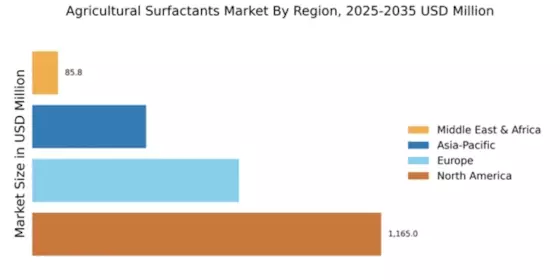
North America is poised to maintain its leadership in the Agricultural Surfactants Market, holding a significant market share of $1165.0M as of 2024. The region's growth is driven by increasing agricultural productivity demands, advancements in surfactant technology, and supportive regulatory frameworks. The rising adoption of precision farming techniques further fuels the demand for effective surfactants, enhancing crop yields and sustainability. The United States and Canada are the leading countries in this market, with major players like BASF SE, Dow Inc., and Huntsman Corporation dominating the landscape. The competitive environment is characterized by continuous innovation and strategic partnerships among key players, ensuring a robust supply chain. The presence of established agricultural practices and a focus on sustainable farming solutions contribute to the region's strong market position.
Europe : Emerging Regulatory Landscape
Europe's Agricultural Surfactants Market is valued at $690.0M, driven by stringent regulations aimed at promoting sustainable agricultural practices. The region's commitment to environmental protection and food safety is a key catalyst for market growth. Increasing demand for organic farming and eco-friendly surfactants aligns with the EU's Green Deal, which emphasizes reducing chemical inputs in agriculture, thereby enhancing the market's potential. Leading countries such as Germany, France, and the UK are at the forefront of this market, with key players like Clariant AG and Evonik Industries AG actively participating. The competitive landscape is marked by innovation in product formulations and a shift towards biobased surfactants. The presence of robust research institutions and collaboration between industry and academia further strengthens the market's growth trajectory.
Asia-Pacific : Rapidly Growing Market Potential
The Asia-Pacific region, with a market size of $380.0M, is rapidly emerging as a significant player in the Agricultural Surfactants Market. The growth is fueled by increasing agricultural output, rising population demands, and the adoption of modern farming techniques. Countries like China and India are witnessing a surge in demand for effective surfactants to enhance crop productivity and efficiency, supported by government initiatives promoting agricultural innovation. China and India are the leading countries in this market, with a competitive landscape featuring both local and international players. Companies like Nufarm Limited and Croda International Plc are expanding their presence in the region. The market is characterized by a focus on cost-effective solutions and the development of products tailored to local agricultural needs, ensuring a robust growth trajectory in the coming years.
Middle East and Africa : Untapped Market Opportunities
The Middle East and Africa region, with a market size of $85.77M, presents untapped opportunities in the Agricultural Surfactants Market. The growth is driven by increasing agricultural activities, particularly in countries like South Africa and Egypt, where there is a rising need for effective crop management solutions. The region's diverse climatic conditions necessitate the use of specialized surfactants to enhance agricultural productivity and sustainability. South Africa is a key player in this market, with a growing number of local and international companies entering the landscape. The competitive environment is evolving, with a focus on developing products that cater to the unique agricultural challenges faced in the region. As awareness of sustainable farming practices increases, the demand for innovative surfactants is expected to rise significantly.
Key Players and Competitive Insights
The Agricultural Surfactants Market is characterized by a dynamic competitive landscape, driven by increasing demand for crop protection and sustainable agricultural practices. Key players such as BASF SE (DE), Dow Inc. (US), and Clariant AG (CH) are strategically positioned to leverage innovation and sustainability in their operations. BASF SE (DE) focuses on developing advanced formulations that enhance the efficacy of agricultural products, while Dow Inc. (US) emphasizes digital transformation and precision agriculture solutions. Clariant AG (CH) is actively pursuing partnerships to expand its product portfolio, particularly in biobased surfactants, which aligns with the growing consumer preference for environmentally friendly solutions. Collectively, these strategies contribute to a competitive environment that prioritizes innovation and sustainability as core growth drivers.In terms of business tactics, companies active in the Agricultural Surfactants Market are increasingly localizing manufacturing to reduce costs and optimize supply chains. The market appears moderately fragmented, with several key players exerting influence over their respective segments. This structure allows for a diverse range of products and innovations, fostering competition that drives advancements in agricultural surfactants.In November Evonik Industries AG (DE) announced the launch of a new line of biodegradable surfactants aimed at reducing environmental impact. This strategic move not only aligns with global sustainability trends but also positions Evonik as a leader in eco-friendly agricultural solutions. The introduction of these products is likely to attract environmentally conscious consumers and enhance the company's market share in the surfactants segment.In October Solvay SA (BE) entered into a strategic partnership with a leading agricultural technology firm to develop innovative surfactant solutions tailored for precision farming. This collaboration is expected to enhance product performance and provide farmers with more effective tools for crop management. By integrating advanced technologies, Solvay aims to strengthen its competitive position and respond to the evolving needs of the agricultural sector.In September Clariant AG (CH) expanded its production capacity for specialty surfactants in response to rising demand in the agricultural sector. This expansion is indicative of Clariant's commitment to meeting market needs and enhancing its operational efficiency. By increasing production capabilities, Clariant is likely to improve its market responsiveness and solidify its standing among key competitors.As of December the Agricultural Surfactants Market is witnessing trends such as digitalization, sustainability, and the integration of artificial intelligence in product development. Strategic alliances are increasingly shaping the competitive landscape, enabling companies to pool resources and expertise for innovation. The shift from price-based competition to a focus on technological advancement and supply chain reliability is evident. Moving forward, competitive differentiation will likely hinge on the ability to innovate and deliver sustainable solutions that meet the demands of a rapidly evolving agricultural landscape.
Key Companies in the Agricultural Surfactants Market include
Industry Developments
Q2 2024: BASF launches new bio-based agricultural surfactant 'Agnique Bio 500' for sustainable crop protection BASF announced the launch of 'Agnique Bio 500', a new bio-based surfactant designed to improve the efficacy of crop protection products while reducing environmental impact. The product is targeted at markets in Europe and North America.
Q2 2024: Dow opens new agricultural surfactant production facility in Brazil Dow inaugurated a new manufacturing plant in São Paulo, Brazil, dedicated to producing advanced agricultural surfactants to meet growing demand in Latin America and support sustainable farming practices.
Q3 2024: Evonik partners with Syngenta to develop next-generation surfactants for crop protection Evonik Industries announced a strategic partnership with Syngenta to co-develop innovative surfactant technologies aimed at enhancing the performance and sustainability of crop protection products.
Q3 2024: Solvay receives regulatory approval for new non-ionic surfactant in the EU Solvay secured European Union regulatory approval for its latest non-ionic surfactant, enabling its use in a range of agricultural applications across member states.
Q4 2024: Stepan Company acquires agricultural surfactant assets from Clariant Stepan Company completed the acquisition of Clariant's agricultural surfactant business, expanding its portfolio and global reach in the crop protection sector.
Q4 2024: Croda International announces $50M investment in US surfactant R&D center Croda International revealed plans to invest $50 million in a new research and development center in Illinois focused on agricultural surfactant innovation and sustainable solutions.
Q1 2025: Bayer launches 'EcoSpread', a biodegradable surfactant for precision agriculture Bayer introduced 'EcoSpread', a biodegradable surfactant designed to optimize the application of crop protection products and minimize environmental impact, targeting precision agriculture markets.
Q1 2025: Adama signs distribution agreement with UPL for surfactant products in India Adama entered into a distribution partnership with UPL to supply its agricultural surfactant products across India, aiming to strengthen its presence in the region's fast-growing crop protection market.
Q2 2025: Syngenta unveils new surfactant technology for improved herbicide performance Syngenta launched a proprietary surfactant technology designed to enhance the efficacy and environmental profile of its herbicide products, with initial rollout in North America and Europe.
Q2 2025: Nouryon announces partnership with Corteva Agriscience for sustainable surfactant development Nouryon and Corteva Agriscience formed a partnership to co-develop sustainable surfactant solutions for crop protection, focusing on reducing chemical runoff and improving application efficiency.
Q3 2025: BASF expands agricultural surfactant production capacity in China BASF announced the expansion of its agricultural surfactant manufacturing facility in Nanjing, China, to meet rising demand for crop protection products in the Asia-Pacific region.
Q3 2025: Solvay appoints new head of agricultural surfactants division Solvay named Dr. Marie Dupont as the new head of its agricultural surfactants division, tasking her with driving innovation and global growth in sustainable crop protection solutions.
Future Outlook
Agricultural Surfactants Market Future Outlook
The Agricultural Surfactants Market is projected to grow at a 5.23% CAGR from 2025 to 2035, driven by increasing demand for sustainable agricultural practices and enhanced crop yields. The future of the Agricultural Surfactants Market is defined by the transition toward bio-based, "green" formulations and precision spray technologies. Driven by stricter chemical residue regulations and surging food demand, the market is prioritizing biodegradable adjuvants and nano-emulsions to enhance pesticide efficacy while minimizing environmental runoff.
New opportunities lie in:
Development of biodegradable surfactants for eco-friendly formulations. Expansion into precision agriculture technologies for targeted application. Partnerships with agrochemical companies for integrated product offerings.
By 2035, the Agricultural Surfactants Market is expected to exhibit robust growth, reflecting evolving agricultural needs.
Market Segmentation
Agricultural Surfactants Market Crop Type Outlook
Cereals
Fruits
Vegetables
Oilseeds
Agricultural Surfactants Market Application Outlook
Herbicides
Insecticides
Fungicides
Adjuvants
Agricultural Surfactants Market Formulation Type Outlook
Liquid
Granular
Powder
Emulsifiable Concentrate
Agricultural Surfactants Market Chemical Composition Outlook
Nonionic Surfactants
Anionic Surfactants
Cationic Surfactants
Amphoteric Surfactants
Report Scope
MARKET SIZE 2024
2320.77(USD Million)
MARKET SIZE 2025
2468.74(USD Million)
MARKET SIZE 2035
4083.83(USD Million)
COMPOUND ANNUAL GROWTH RATE (CAGR)
5.23% (2025 - 2035)
REPORT COVERAGE
Revenue Forecast, Competitive Landscape, Growth Factors, and Trends
BASE YEAR
2024
Market Forecast Period
2025 - 2035
Historical Data
2019 - 2024
Market Forecast Units
USD Million
Key Companies Profiled
BASF SE (DE), Dow Inc. (US), Huntsman Corporation (US), Clariant AG (CH), Solvay SA (BE), Evonik Industries AG (DE), Nufarm Limited (AU), Croda International Plc (GB), Wilbur-Ellis Company (US)
Segments Covered
Application, Formulation Type, Crop Type, Chemical Composition
Key Market Opportunities
Increasing demand for sustainable agricultural practices drives innovation in the Agricultural Surfactants Market.
Key Market Dynamics
Rising demand for eco-friendly agricultural surfactants drives innovation and regulatory compliance in sustainable farming practices.
What is the projected market valuation for the Agricultural Surfactants Market in 2035?
The projected market valuation for the Agricultural Surfactants Market in 2035 is 4083.83 USD Million.
What was the market valuation of Agricultural Surfactants in 2024?
The market valuation of Agricultural Surfactants in 2024 was 2320.77 USD Million.
What is the expected CAGR for the Agricultural Surfactants Market from 2025 to 2035?
The expected CAGR for the Agricultural Surfactants Market during the forecast period 2025 - 2035 is 5.23%.
Which companies are considered key players in the Agricultural Surfactants Market?
Key players in the Agricultural Surfactants Market include BASF SE, Dow Inc., Huntsman Corporation, Clariant AG, Solvay SA, AkzoNobel N.V., Evonik Industries AG, Nufarm Limited, and Croda International Plc.
What are the main application segments of Agricultural Surfactants and their valuations?
The main application segments include Herbicides valued at 800.0 to 1400.0 USD Million, Insecticides at 600.0 to 1000.0 USD Million, Fungicides at 500.0 to 800.0 USD Million, and Plant Growth Regulators at 420.77 to 883.83 USD Million.
How do the formulation types of Agricultural Surfactants break down in terms of market valuation?
Formulation types include Liquid at 1160.39 to 2041.91 USD Million, Granular at 696.23 to 1220.95 USD Million, Powder at 348.11 to 610.48 USD Million, and Emulsifiable Concentrate at 116.04 to 210.49 USD Million.
What are the chemical types of Agricultural Surfactants and their respective market values?
Chemical types include Nonionic Surfactants valued at 800.0 to 1400.0 USD Million, Anionic Surfactants at 600.0 to 1000.0 USD Million, Cationic Surfactants at 400.0 to 700.0 USD Million, and Amphoteric Surfactants at 520.77 to 983.83 USD Million.
What end-use segments are present in the Agricultural Surfactants Market?
End-use segments include Agricultural at 800.0 to 1400.0 USD Million, Horticultural at 600.0 to 1000.0 USD Million, Forestry at 400.0 to 700.0 USD Million, and Turf and Ornamental at 520.77 to 983.83 USD Million.
How does the Agricultural Surfactants Market's growth potential appear in the coming years?
The Agricultural Surfactants Market appears poised for growth, with a projected valuation increase from 2320.77 USD Million in 2024 to 4083.83 USD Million by 2035.
What factors might influence the growth of the Agricultural Surfactants Market during the forecast period?
Factors influencing growth may include advancements in agricultural practices, increasing demand for crop protection products, and innovations from key players like BASF SE and Dow Inc.
Author
Author
Snehal Singh
Manager - Research
High acumen in analyzing complex macro & micro markets with more than 6 years of work experience in the field of market research. By implementing her analytical skills in forecasting and estimation into market research reports, she has expertise in Packaging, Construction, and Equipment domains. She handles a team size of 20-25 resources and ensures smooth running of the projects, associated marketing activities, and client servicing.
read more
Co-Author
Varsha More
Senior Research Analyst
Experienced business professional with a demonstrated history of working in the CFnB industry. Skilled in market research, and market estimation. Strong professional with a Masters focused in marketing management.
The secondary research process involved comprehensive analysis of agrochemical regulatory databases, chemical safety publications, crop science journals, and authoritative agricultural organizations. Key sources included the US Environmental Protection Agency (EPA), European Chemicals Agency (ECHA), European Food Safety Authority (EFSA), Food and Agriculture Organization (FAO), US Department of Agriculture (USDA), OECD Chemicals and Biotechnology Committee, WHO Pesticide Evaluation Scheme (WHOPES), EU Pesticides Database (EU Commission), US Geological Survey (USGS) Pesticide National Synthesis Project, National Pesticide Information Center (NPIC), Agriculture and Agri-Food Canada (AAFC), EU Eurostat Agricultural Database, and national agricultural ministry reports from key producing markets. These sources were employed to compile agrochemical usage statistics, surfactant registration data, ecotoxicological studies, agricultural practice trends, and regulatory compliance landscapes for non-ionic, anionic, cationic, and amphoteric surfactant technologies across synthetic and bio-based substrates.
Primary Research
Qualitative and quantitative insights were obtained by interviewing supply-side and demand-side stakeholders during the primary research process. The supply-side sources consisted of CEOs, VPs of R&D, regulatory compliance chiefs, and commercial directors from agricultural surfactant manufacturers, agrochemical formulators, and adjuvant companies. The demand-side sources included procurement managers from large-scale agricultural cooperatives, farming consortiums, and distributor networks, as well as principal agronomists and crop protection consultants. Market segmentation was validated across herbicide, fungicide, and insecticide applications through primary research. Additionally, bio-based surfactant development pipelines were confirmed, and insights regarding precision agriculture adoption patterns, pricing volatility associated with petrochemical feedstocks, and sustainability certification dynamics were obtained.
Primary Respondent Breakdown:
By Designation: C-level Primaries (32%), Director Level (31%), Others (37%)
By Region: North America (32%), Europe (30%), Asia-Pacific (28%), Rest of World (10%)
Market Size Estimation
Revenue mapping and agrochemical adjuvant consumption analysis were employed to determine the global market valuation. The methodology comprised the following:
Identification of over 40 significant manufacturers and formulators in North America, Europe, Asia-Pacific, and Latin America
Product mapping of surfactant chemistries that are non-ionic, anionic, cationic, and amphoteric Substrate analysis of petroleum-based synthetic and plant-derived bio-based feedstocks Application segmentation for insecticides, herbicides, fungicides, and plant growth regulators
Analysis of annual revenues that are specific to agricultural surfactant portfolios, as reported and modeled
Manufacturers that account for 65–70% of the global market share in 2024 are included in the coverage.
Extrapolation utilizing bottom-up (agrochemical volume × surfactant loading rates × ASP by crop type and region) and top-down (manufacturer revenue substantiation and agrochemical industry spend-ratio analysis) methodologies to calculate segment-specific valuations
“This is really good guys. Excellent work on a tight deadline. I will continue to use you going forward and recommend you to others. Nice job”
Noah MalgeriCo-Founder
“Thanks. It’s been a pleasure working with you, please use me as reference with any other Intel employees.”
Joseph AguayoSales Operations & Pricing Manager
“Thanks for sending the report it gives us a good global view of the Betaïne market.”
Peter Groot koerkampAccount and Business Manager
“Thank you, this will be very helpful for OQS.”
La Terria DoddProgram Support Specialist
“We found the report very insightful! we found your research firm very helpful. I'm sending this email to secure our future business.”
Younghwan ChoiSenior Retail Manager
“I am very pleased with how market segments have been defined in a relevant way for my purposes (such as "Portable Freezers & refrigerators" and "last-mile").
In general the report is well structured. Thanks very much for your efforts.”
Mark IrwinManagement Consultant
“I have been reading the first document or the study, ,the Global HVAC and FP market report 2021 till 2026. Must say, good info! I have not gone in depth at all parts, but got a good indication of the data inside!”
Rob KooikerGroup Product Manager HVAC & Fire Protection GMA
“We got the report in time, we really thank you for your support in this process. I also thank to all of your team as they did a great job.”
Akif MorogluStrategy & Business Development Director
“The Automotive 48V ECU Components Procurement Intelligence Study” was a complex project, but the Market Research Future (MRFR) team handled it with quality, agility, and customer-centricity. They delivered all requested data on time and within the agreed scope. The team, including Shubhendra Anand and Rahul Gotadki, was always readily available to clarify questions and swiftly implement necessary adjustments, driving the project to a successful conclusion within a very demanding timeframe.
I would also like to specifically commend Akshay Agarwal for his responsiveness and support at every stage—from our initial inquiry on May 6th through to final delivery on June 18th. His dedication made the entire process seamless.”
Guilherme Gomes MartinsProduct Management Director