×
Request Free Sample ×

Kindly complete the form below to receive a free sample of this Report

* Please use a valid business email

Leading companies partner with us for data-driven Insights

clients tt-cursor
Hero Background

Air Independent Propulsion Systems Market

ID: MRFR/AD/1847-HCR
111 Pages
Swapnil Palwe
October 2025

Air Independent Propulsion Systems (AIP) Market Research Report Information by Type (Stirling, MESMA, Fuel Cells, and Others), Fit (Line Fit and Retro Fit), and Region (North America, Europe, Asia-Pacific, Middle East Africa, and Latin America) Forecast till 2035

Share:
Download PDF ×

We do not share your information with anyone. However, we may send you emails based on your report interest from time to time. You may contact us at any time to opt-out.

Air Independent Propulsion Systems Market Infographic
Purchase Options

Air Independent Propulsion Systems Market Summary

As per MRFR analysis, the Air Independent Propulsion Systems Market Size was estimated at 1900.0 USD Million in 2024. The Air Independent Propulsion Systems industry is projected to grow from 2000.0 in 2025 to 3100.0 by 2035, exhibiting a compound annual growth rate (CAGR) of 4.48 during the forecast period 2025 - 2035.

Key Market Trends & Highlights

The Air Independent Propulsion Systems Market is poised for substantial growth driven by technological advancements and increasing defense investments.

  • Technological advancements in propulsion systems are enhancing the operational capabilities of submarines and unmanned underwater vehicles.
  • North America remains the largest market for air independent propulsion systems, while the Asia-Pacific region is experiencing the fastest growth.
  • The submarine segment continues to dominate the market, whereas the unmanned underwater vehicle segment is emerging rapidly.
  • Rising demand for submarine capabilities and geopolitical tensions are key drivers propelling market expansion.

Market Size & Forecast

2024 Market Size 1900.0 (USD Million)
2035 Market Size 3100.0 (USD Million)
CAGR (2025 - 2035) 4.48%

Major Players

Kockums AB (SE), Thyssenkrupp AG (DE), Navantia SA (ES), Mitsubishi Heavy Industries Ltd (JP), DCNS (FR), General Dynamics Corporation (US), BAE Systems plc (GB), Lockheed Martin Corporation (US), Northrop Grumman Corporation (US)
Air Independent Propulsion Systems Market Trends

The Air Independent Propulsion Systems Market is currently experiencing a notable evolution, driven by advancements in technology and increasing demand for submarines with enhanced stealth capabilities. This market segment is characterized by a shift towards more efficient and environmentally friendly propulsion systems, which are essential for modern naval operations. The integration of air-independent propulsion technologies allows submarines to operate for extended periods without surfacing, thereby improving their operational effectiveness and strategic advantage. As nations invest in their naval capabilities, the focus on developing advanced propulsion systems is becoming increasingly pronounced. Moreover, the competitive landscape of the Air Independent Propulsion Systems Market is marked by collaborations between defense contractors and government entities. These partnerships aim to foster innovation and accelerate the development of next-generation propulsion technologies. Additionally, the growing emphasis on reducing the environmental impact of military operations is likely to influence future designs and applications within this sector. As the market continues to evolve, it appears poised for growth, driven by technological advancements and changing defense strategies.

Technological Advancements

Recent innovations in battery technology and fuel cells are enhancing the efficiency and performance of air-independent propulsion systems. These advancements are likely to lead to longer operational durations and reduced maintenance requirements, making them more attractive to naval forces.

Increased Naval Investments

Countries around the globe are prioritizing investments in their naval capabilities, particularly in submarine fleets. This trend suggests a growing recognition of the strategic importance of advanced underwater warfare systems, which could drive demand for air-independent propulsion technologies.

Environmental Considerations

There is a rising awareness regarding the environmental impact of military operations. As a result, the Air Independent Propulsion Systems Market may see a shift towards greener technologies, which could influence future designs and operational practices.

Air Independent Propulsion Systems Market Drivers

Market Growth Projections

The Global Air Independent Propulsion Systems Market (AIP) Industry is projected to experience substantial growth over the next decade. With a market value anticipated to reach 108.5 USD Billion in 2024 and further expand to 208.4 USD Billion by 2035, the industry is poised for a compound annual growth rate of 6.12% from 2025 to 2035. This growth trajectory reflects the increasing investments in advanced submarine technologies and the strategic importance of AIP systems in modern naval warfare. The market dynamics suggest a robust future for AIP systems as nations prioritize enhancing their underwater capabilities.

Increasing Naval Defense Budgets

The Global Air Independent Propulsion Systems Market (AIP) Industry is significantly influenced by the rising naval defense budgets across various nations. Countries are increasingly recognizing the strategic importance of advanced submarine capabilities, leading to increased investments in AIP technologies. For instance, nations like India and Australia are expanding their naval fleets, incorporating AIP systems to enhance stealth and operational range. This trend is likely to propel the market, with projections indicating a growth to 208.4 USD Billion by 2035. The anticipated compound annual growth rate of 6.12% from 2025 to 2035 underscores the sustained commitment to enhancing naval defense capabilities.

Technological Advancements in AIP Systems

The Global Air Independent Propulsion Systems Market (AIP) Industry is witnessing rapid technological advancements that enhance the efficiency and effectiveness of submarines. Innovations in fuel cell technology, such as polymer electrolyte membrane fuel cells, are gaining traction, allowing submarines to operate underwater for extended periods without surfacing. This trend is particularly evident in countries like Germany and Sweden, which have successfully integrated these systems into their naval fleets. As a result, the market is projected to reach 108.5 USD Billion in 2024, with a robust growth trajectory expected as nations prioritize modernization of their naval capabilities.

Growing Demand for Submarine Modernization

The Global Air Independent Propulsion Systems Market (AIP) Industry is experiencing a surge in demand for submarine modernization programs. Many navies are recognizing the need to upgrade their aging fleets to maintain operational effectiveness. AIP systems are a critical component of these modernization efforts, providing enhanced stealth and endurance. Countries like Brazil and South Korea are actively pursuing modernization initiatives, integrating AIP technologies into their submarines to extend their operational capabilities. This trend is likely to contribute to the market's growth, as nations invest in advanced technologies to ensure their naval forces remain competitive.

Geopolitical Tensions and Maritime Security

The Global Air Independent Propulsion Systems Market (AIP) Industry is also shaped by escalating geopolitical tensions and the need for enhanced maritime security. Nations are increasingly investing in AIP systems to bolster their underwater warfare capabilities, particularly in regions with territorial disputes. For example, the South China Sea has seen heightened military activity, prompting countries like Japan and Vietnam to enhance their submarine fleets with AIP technologies. This strategic shift is likely to drive market growth as nations seek to secure their maritime interests and maintain a competitive edge in naval warfare.

Environmental Regulations and Sustainability

The Global Air Independent Propulsion Systems Market (AIP) Industry is increasingly influenced by stringent environmental regulations and a global push towards sustainability. AIP systems, particularly those utilizing fuel cells, offer a cleaner alternative to traditional diesel-electric propulsion, aligning with international efforts to reduce emissions. Countries are adopting these technologies not only to comply with regulations but also to enhance the operational capabilities of their submarines. This trend is evident in European nations, where environmental considerations are integral to defense procurement strategies. The growing emphasis on sustainability is expected to further stimulate market growth in the coming years.

Market Segment Insights

By Application: Submarine (Largest) vs. Unmanned Underwater Vehicle (Fastest-Growing)

In the Air Independent Propulsion Systems Market, the application segment is primarily dominated by submarines, which account for the largest share of market activities. Surface vessels also play a significant role, but they are outpaced by the growing demand for advanced submarine technology in naval operations. Unmanned underwater vehicles (UUVs) are emerging as a competitive segment due to their increasing adoption in military and commercial applications, reflecting a dynamic shift in the market landscape. The growth trends within this segment are largely driven by advancements in underwater technology and an increasing focus on naval operations that require stealth and endurance. The rise of autonomous systems is propelling the UUV sector, making it the fastest-growing category. Enhanced operational capabilities for submarines, including stealth features and energy efficiency, further solidify their standing as the dominant application.

Submarine (Dominant) vs. Unmanned Underwater Vehicle (Emerging)

Submarines represent the dominant application in the Air Independent Propulsion Systems Market due to their critical role in modern naval warfare and strategic deterrence. They require advanced air-independent systems to enhance their stealth capabilities and operational endurance. The technology here is often more matured and integrated, reflecting a consistent investment in upgrading existing platforms. On the other hand, unmanned underwater vehicles are emerging as a game-changer, fueled by their cost-effectiveness and versatility in missions such as reconnaissance, surveillance, and environmental monitoring. UUVs are swiftly gaining traction, appealing to both military and civilian sectors, and showcasing innovative capabilities that position them as a vital component of future naval strategies.

By Technology: Fuel Cell Technology (Largest) vs. Stirling Engine Technology (Fastest-Growing)

In the Air Independent Propulsion Systems Market, Fuel Cell Technology commands the largest share, primarily due to its efficiency and eco-friendliness. This technology is widely adopted in various defense applications, particularly in submarines, which require long operational durations without surfacing. Stirling Engine Technology, on the other hand, is rapidly gaining traction as the fastest-growing segment thanks to advancements in performance and reductions in size, enabling easier integration into smaller vessels. Market players are increasingly investing in research to enhance the applicability of Stirling engines, further accelerating their adoption in diverse markets. The distribution of these technologies is influenced by the demand for sustainable and reliable power solutions in naval and underwater operations. The trend towards minimizing environmental impact is pushing the market towards more innovative solutions, leading to the emergence of Hybrid Systems that combine different technologies. These systems are expected to gain momentum as they offer versatile applications and operational benefits. The overall growth is driven by the need for enhanced endurance and operational capabilities in marine platforms, which will continue to propel these specific technologies forward.

Fuel Cell Technology: Dominant vs. Stirling Engine Technology: Emerging

Fuel Cell Technology stands out as the dominant force in the Air Independent Propulsion Systems Market, characterized by its high efficiency and lower emissions compared to traditional power sources. It excels in providing extended submerged operation times, making it a preferred choice for military applications. Meanwhile, Stirling Engine Technology is emerging as a competitive alternative, primarily due to ongoing innovations that enhance its efficiency and compactness. This technology is recognized for its ability to operate on various fuels, including renewable sources, appealing to environmentally conscious military designs. The rise of hybrid systems, which may integrate both fuel cell and Stirling engine technologies, reflects the industry's response to the growing pressure for reducing the ecological footprint while maximizing performance.

By End Use: Defense (Largest) vs. Commercial (Fastest-Growing)

The Air Independent Propulsion Systems Market is primarily segmented into Defense, Commercial, and Research and Development areas. Among these, the Defense sector captures the most significant share, owing to the increasing investment in naval capabilities and the modernization of submarines across various nations. This segment remains a focal point for various military applications, emphasizing the strategic importance of naval power in modern warfare. The Commercial segment, although currently smaller in size, is witnessing rapid growth as emerging maritime industries recognize the potential benefits of Air Independent Propulsion Systems. As global shipping continues to expand, there is an increasing demand for efficient and environmentally friendly propulsion technologies. The ongoing developments in this sector are further amplified by technological advancements and regulatory pressures towards sustainability in maritime operations.

Defense: Naval Applications (Dominant) vs. Commercial: Emerging Opportunities (Emerging)

In the Air Independent Propulsion Systems Market, the Defense sector, particularly through naval applications, holds a dominant position due to its critical role in national security and military operations. Submarines employing this technology benefit from enhanced stealth capabilities and operational range, thus playing a pivotal role in strategic maritime defense postures. On the other hand, the Commercial segment is characterized by emerging opportunities, driven by the need for innovations that enhance fuel efficiency and reduce emissions in shipping operations. As industries pivot towards sustainable practices, the adoption of Air Independent Propulsion Systems offers significant competitive advantages in terms of cost savings and compliance with environmental regulations.

By Power Source: Hydrogen (Largest) vs. Electric (Fastest-Growing)

In the Air Independent Propulsion Systems Market, the power source segment is dominated by hydrogen, which has established a stable share owing to its environmentally friendly characteristics and increasing adoption in various sectors. Following hydrogen, electric propulsion systems are gaining traction as they contribute to reduced emissions and meet modern energy efficiency standards. Methanol and diesel, while still relevant, are experiencing slower growth rates as industry focus shifts towards cleaner alternatives.

Hydrogen (Dominant) vs. Electric (Emerging)

Hydrogen power systems currently represent the dominant force within the Air Independent Propulsion Systems market due to their high energy density and low environmental impact. These systems are widely recognized for their ability to enable longer operational ranges, making them ideal for naval applications. Conversely, electric power sources are emerging rapidly, appealing to new technological advancements and government policies supporting cleaner energy solutions. While electric systems offer benefits such as reduced noise and operational simplicity, the challenge lies in battery limitations and charging infrastructures. As technological innovations advance, both hydrogen and electric power sources are expected to play pivotal roles in the evolution of propulsion systems.

By System Type: Closed Cycle (Largest) vs. Hybrid Cycle (Fastest-Growing)

In the Air Independent Propulsion Systems Market, the Closed Cycle system is the dominant player, capturing the largest share due to its efficiency and reliability in powering submarines and underwater vessels. This system leverages a closed loop of steam, significantly enhancing endurance without the need for surface replenishment. Meanwhile, the Open Cycle system accounts for a smaller share, primarily utilized in niche applications and facing stiff competition from more advanced technologies. Market demand is increasing, especially for the Closed Cycle, driven by naval fleets looking to enhance their stealth capabilities. Growth trends indicate a shifting focus towards Hybrid Cycle systems, which are emerging as a vital segment due to their potential to combine the advantages of closed and open cycle systems. This segment is witnessing the fastest growth, propelled by advancements in technology and increasing energy efficiency requirements. The growing emphasis on reducing carbon footprints and maximizing operational range in military operations also fuels this trend. Market players are investing in R&D to innovate and enhance hybrid systems, further driving their adoption in maritime applications.

Closed Cycle (Dominant) vs. Open Cycle (Emerging)

The Closed Cycle propulsion system is characterized by its ability to operate without external air supply, making it particularly suitable for prolonged underwater missions. Its dominant position is attributed to its well-established performance and reliability in military applications, signifying its importance in modern naval warfare. In contrast, the Open Cycle system, while still relevant, is deemed an emerging segment due to its adaptability to various applications and innovation in design. It typically allows for simpler engineering but comes with limitations related to operational time underwater. Despite these challenges, the Open Cycle is being re-evaluated for specific operational contexts, with ongoing development aimed at enhancing its efficiency and operational capabilities, reflecting the evolving needs of the defense sector.

Get more detailed insights about Air Independent Propulsion Systems Market

Regional Insights

North America : Market Leader in Innovation

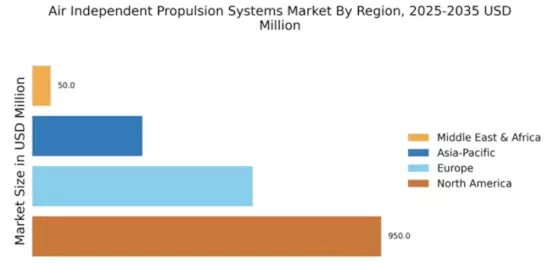
North America is poised to maintain its leadership in the Air Independent Propulsion Systems market, holding a significant share of 950.0M in 2025. The region's growth is driven by increasing defense budgets, technological advancements, and a focus on enhancing naval capabilities. Regulatory support for advanced military technologies further fuels demand, ensuring a robust market environment. The United States stands out as a key player, with major companies like General Dynamics Corporation and Lockheed Martin Corporation leading the charge. The competitive landscape is characterized by innovation and strategic partnerships, enabling the region to stay ahead in the development of cutting-edge propulsion systems. North America's commitment to defense modernization solidifies its position as a market leader.

Europe : Emerging Hub for Technology

Europe is witnessing a significant transformation in the Air Independent Propulsion Systems market, with a market size of 600.0M in 2025. The region's growth is propelled by increasing investments in defense and security, driven by geopolitical tensions and the need for advanced naval capabilities. Regulatory frameworks are evolving to support innovation, enhancing the market's attractiveness for new technologies. Leading countries such as Germany, France, and Spain are at the forefront, with companies like Thyssenkrupp AG and DCNS making substantial contributions. The competitive landscape is marked by collaboration among nations and industries, fostering innovation and efficiency. As Europe strengthens its defense posture, the demand for advanced propulsion systems is expected to rise significantly.

Asia-Pacific : Growing Demand for Naval Capabilities

The Asia-Pacific region is emerging as a vital player in the Air Independent Propulsion Systems market, with a projected size of 300.0M in 2025. The growth is driven by increasing naval modernization efforts, particularly in countries like Japan and India, where there is a strong emphasis on enhancing maritime security. Regulatory support for defense initiatives is also a key factor in this growth trajectory. Japan and India are leading the charge, with companies like Mitsubishi Heavy Industries Ltd playing a crucial role in developing advanced propulsion technologies. The competitive landscape is characterized by a mix of domestic and international players, fostering innovation and collaboration. As regional tensions rise, the demand for sophisticated naval systems is expected to escalate, further propelling market growth.

Middle East and Africa : Emerging Market Potential

The Middle East and Africa region is gradually developing its Air Independent Propulsion Systems market, with a size of 50.0M in 2025. The growth is primarily driven by increasing defense budgets and a focus on modernizing naval capabilities. Countries in this region are recognizing the importance of advanced propulsion systems to enhance their maritime security and operational effectiveness. Key players in this region are beginning to emerge, with nations like South Africa and the UAE investing in advanced technologies. The competitive landscape is still in its nascent stages, but there is a growing interest in partnerships with established global players. As regional conflicts persist, the demand for advanced naval systems is likely to increase, presenting opportunities for growth in this market.

Key Players and Competitive Insights

The Air Independent Propulsion Systems Market is currently characterized by a dynamic competitive landscape, driven by technological advancements and increasing demand for stealth capabilities in naval warfare. Key players such as Kockums AB (Sweden), Thyssenkrupp AG (Germany), and Mitsubishi Heavy Industries Ltd (Japan) are at the forefront, each adopting distinct strategies to enhance their market positioning. Kockums AB focuses on innovation in submarine technology, particularly in enhancing the efficiency of air-independent propulsion systems, while Thyssenkrupp AG emphasizes strategic partnerships to bolster its supply chain and expand its global footprint. Mitsubishi Heavy Industries Ltd is investing heavily in research and development to integrate advanced materials and digital technologies into its propulsion systems, thereby enhancing operational capabilities.

The business tactics employed by these companies reflect a concerted effort to localize manufacturing and optimize supply chains, which is crucial in a moderately fragmented market. The competitive structure is shaped by the collective influence of these key players, who are increasingly collaborating to leverage shared technologies and resources. This collaborative approach not only enhances their competitive edge but also fosters innovation across the sector, as companies seek to address the evolving demands of modern naval operations.

In November 2025, Kockums AB (Sweden) announced a strategic partnership with a leading technology firm to develop next-generation air-independent propulsion systems. This collaboration is expected to enhance the efficiency and stealth capabilities of their submarines, positioning Kockums as a leader in advanced naval technology. The strategic importance of this partnership lies in its potential to accelerate innovation and reduce time-to-market for new propulsion solutions, thereby strengthening Kockums' competitive advantage.

In October 2025, Thyssenkrupp AG (Germany) unveiled a new manufacturing facility dedicated to the production of air-independent propulsion systems. This facility is designed to optimize production processes and reduce costs, which could significantly enhance Thyssenkrupp's market share. The establishment of this facility underscores the company's commitment to localizing production and improving supply chain efficiency, which are critical factors in maintaining competitiveness in the global market.

In September 2025, Mitsubishi Heavy Industries Ltd (Japan) launched a new initiative aimed at integrating artificial intelligence into its air-independent propulsion systems. This initiative is anticipated to improve operational efficiency and decision-making processes in naval operations. The strategic significance of this move lies in its alignment with current trends towards digitalization and automation, which are increasingly shaping the future of military technology.

As of December 2025, the competitive trends in the Air Independent Propulsion Systems Market are heavily influenced by digitalization, sustainability, and the integration of AI technologies. Strategic alliances are becoming more prevalent, as companies recognize the need to collaborate in order to innovate and meet the demands of modern warfare. Looking ahead, competitive differentiation is likely to evolve from traditional price-based competition to a focus on innovation, technological advancements, and supply chain reliability, as companies strive to deliver superior products and services in an increasingly complex market.

Key Companies in the Air Independent Propulsion Systems Market market include

Future Outlook

Air Independent Propulsion Systems Market Future Outlook

The Air Independent Propulsion Systems Market is projected to grow at a 4.48% CAGR from 2024 to 2035, driven by technological advancements, increasing defense budgets, and rising demand for stealth capabilities.

New opportunities lie in:

  • Development of hybrid propulsion systems for enhanced efficiency.
  • Expansion into emerging markets with naval modernization programs.
  • Partnerships with defense contractors for integrated propulsion solutions.

By 2035, the market is expected to solidify its position as a critical component of naval defense strategies.

Market Segmentation

Air Independent Propulsion Systems Market End Use Outlook

  • Defense
  • Commercial
  • Research and Development

Air Independent Propulsion Systems Market Technology Outlook

  • Fuel Cell Technology
  • Stirling Engine Technology
  • Thermal Energy Conversion
  • Hybrid Systems

Air Independent Propulsion Systems Market Application Outlook

  • Submarine
  • Surface Vessel
  • Unmanned Underwater Vehicle
  • Naval Operations

Air Independent Propulsion Systems Market System Type Outlook

  • Closed Cycle
  • Open Cycle
  • Hybrid Cycle

Air Independent Propulsion Systems Market Power Source Outlook

  • Hydrogen
  • Methanol
  • Diesel
  • Electric

Report Scope

MARKET SIZE 20241900.0(USD Million)
MARKET SIZE 20252000.0(USD Million)
MARKET SIZE 20353100.0(USD Million)
COMPOUND ANNUAL GROWTH RATE (CAGR)4.48% (2024 - 2035)
REPORT COVERAGERevenue Forecast, Competitive Landscape, Growth Factors, and Trends
BASE YEAR2024
Market Forecast Period2025 - 2035
Historical Data2019 - 2024
Market Forecast UnitsUSD Million
Key Companies ProfiledKockums AB (SE), Thyssenkrupp AG (DE), Navantia SA (ES), Mitsubishi Heavy Industries Ltd (JP), DCNS (FR), General Dynamics Corporation (US), BAE Systems plc (GB), Lockheed Martin Corporation (US), Northrop Grumman Corporation (US)
Segments CoveredApplication, Technology, End Use, Power Source, System Type
Key Market OpportunitiesAdvancements in fuel cell technology enhance efficiency in the Air Independent Propulsion Systems Market.
Key Market DynamicsTechnological advancements in Air Independent Propulsion Systems drive competitive dynamics and influence naval defense strategies.
Countries CoveredNorth America, Europe, APAC, South America, MEA

Market Highlights

Author
Swapnil Palwe
Team Lead - Research

With a technical background as Bachelor's in Mechanical Engineering, with MBA in Operations Management , Swapnil has 6+ years of experience in market research, consulting and analytics with the tasks of data mining, analysis, and project execution. He is the POC for our clients, for their consulting projects running under the Automotive/A&D domain. Swapnil has worked on major projects in verticals such as Aerospace & Defense, Automotive and many other domain projects. He has worked on projects for fortune 500 companies' syndicate and consulting projects along with several government projects.

Leave a Comment

FAQs

What is the estimated market value of the global air-independent propulsion systems for submarine?

global air-independent propulsion systems for submarine is estimated to acquire the market value of USD 208.4 Billion by 2035

At what CAGR is the global air-independent propulsion systems for submarine market likely to expand?

global air-independent propulsion systems for submarine is likely to expand at a CAGR of 6.12% by 2035.

Who are the renowned players of the global air-independent propulsion systems for submarine market?

General Dynamics Corporation (U.S.), Kongsberg Gruppen ASA (Norway), Naval Group (France), and United Shipbuilding Corporation (Russia) are some of the renowned players of the global air-independent propulsion systems for submarine market.

Which region is expected to grow at the highest CAGR?

The APAC region is anticipated to grow at the highest CAGR during the forecast period.

Download Free Sample

Kindly complete the form below to receive a free sample of this Report

Compare Licence

×
Features License Type
Single User Multiuser License Enterprise User
Price $4,950 $5,950 $7,250
Maximum User Access Limit 1 User Upto 10 Users Unrestricted Access Throughout the Organization
Free Customization
Direct Access to Analyst
Deliverable Format
Platform Access
Discount on Next Purchase 10% 15% 15%
Printable Versions