Independent Software Vendor Market Summary
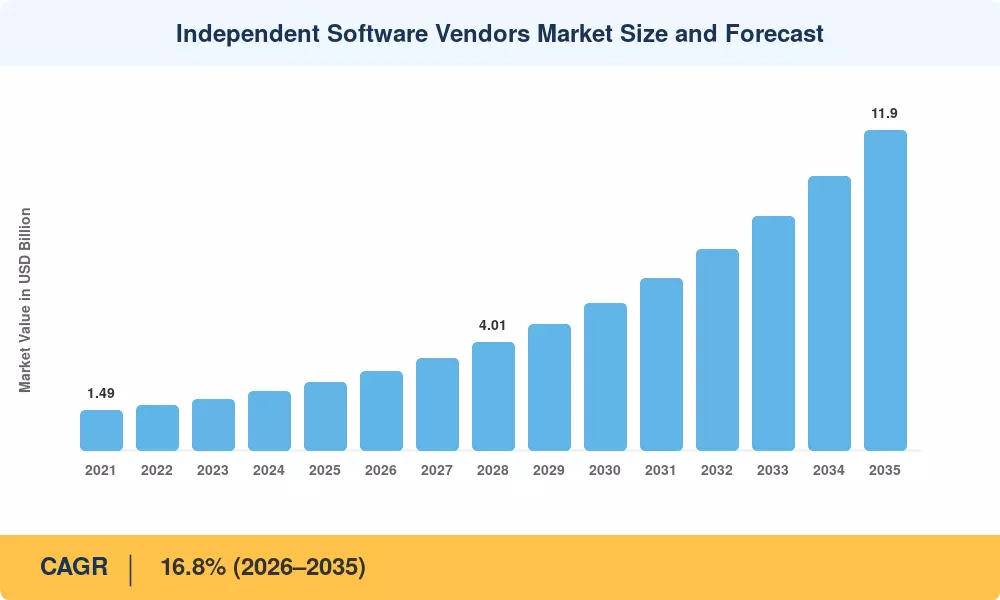
The Independent Software Vendors Market reached USD 2.52 billion in 2025 and is projected to grow from USD 2.94 billion in 2026 to USD 11.90 billion by 2035, registering a compound annual growth rate of 16.8% during the forecast period. Enterprise spending on cloud-native applications accelerated sharply in 2024–2025 as organizations moved to retire monolithic legacy stacks, and hyperscaler co-sell programs — particularly those offered by AWS, Microsoft Azure, and Google Cloud — have cut customer-acquisition costs for independent software vendors by an estimated 30–40%, channeling procurement dollars toward specialized solutions [1].
At the heart of the Independent Software Vendors Market is a technology change that is replacing custom-built, on-premise enterprise programs with modular, API-first platforms provided as subscription services. A 2024 GitHub survey found that generative-AI coding helpers have cut average product-development timelines by about 25%, allowing smaller vendor teams to provide competitive sets of features that previously required hundreds of engineers [2]. Globally, investments in the ISV ecosystem from venture capital and private equity exceeded USD 48 billion in 2024, indicating investor confidence in the potential for significant consolidation in the sector [3].
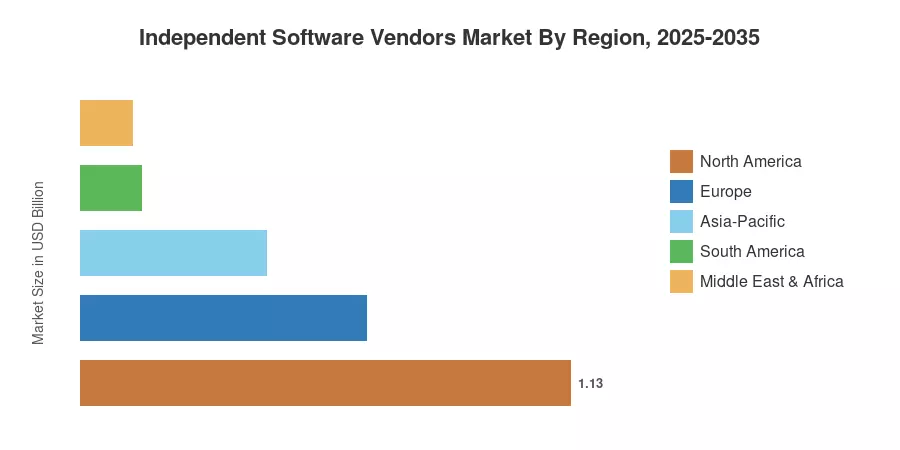
North America accounted for ~45% revenue share of the Independent Software Vendors Market in 2025, owing to the presence of the headquarters of hyperscalers, enterprise IT expenditures, and a well-established culture of SaaS buying. Asia-Pacific is the fastest-growing region, with an anticipated 17.1% CAGR through 2035, driven by digital-government mandates in India, Japan and South Korea. Europe is the second-largest region with a ~26% share and has a lasting demand driver in GDPR-related compliance software. The coming decade will be kind to providers with vertical know-how combined with platform-grade extensibility as enterprises around the world migrate from horizontal platforms to profoundly vertical domain applications.
Key Report Takeaways
• By Deployment
- Cloud-based implementations captured approximately 63% of Independent Software Vendors Market revenue in 2025, reflecting the structural migration of enterprise budgets toward operating-expense subscription models.
- On-premise deployments retained share primarily in defense, critical infrastructure, and financial services environments subject to strict data-residency requirements.
• By End-User Enterprise Size
- Large enterprises accounted for roughly 76% of the Independent Software Vendors Market in 2025, leveraging dedicated procurement teams and multi-year enterprise license agreements.
- The SME segment is expanding at approximately 16.7% CAGR through 2035, aided by low-code onboarding flows and usage-based pricing tiers.
• By Geography
- North America commanded the largest share of the Independent Software Vendors Market at an estimated 45% in 2025.
- Asia-Pacific is the fastest-growing region, advancing at roughly 17.1% CAGR through 2035, with India and South Korea leading adoption.
- Europe contributed approximately 26% of the total market value, anchored by regulatory-technology demand and public-sector digitization.
Market Size and Forecast (2021–2035)
Market Research Future (MRFR) forecasts are based on direct interviews with ISV executives, hyperscaler channel managers, and enterprise procurement officials, as well as secondary analysis of quarterly software-revenue disclosures and venture-funding databases. Historical numbers (2021–2024) are reconciled to public SaaS and perpetual-license sales of the top 50 independent software providers globally.





















.webp?v=1787579641)
