Air Traffic Control Equipment Market (2025 - 2035)

ID: MRFR/AD/5572-CR
100 Pages
Shubham Munde
Last Updated: June 25, 2026
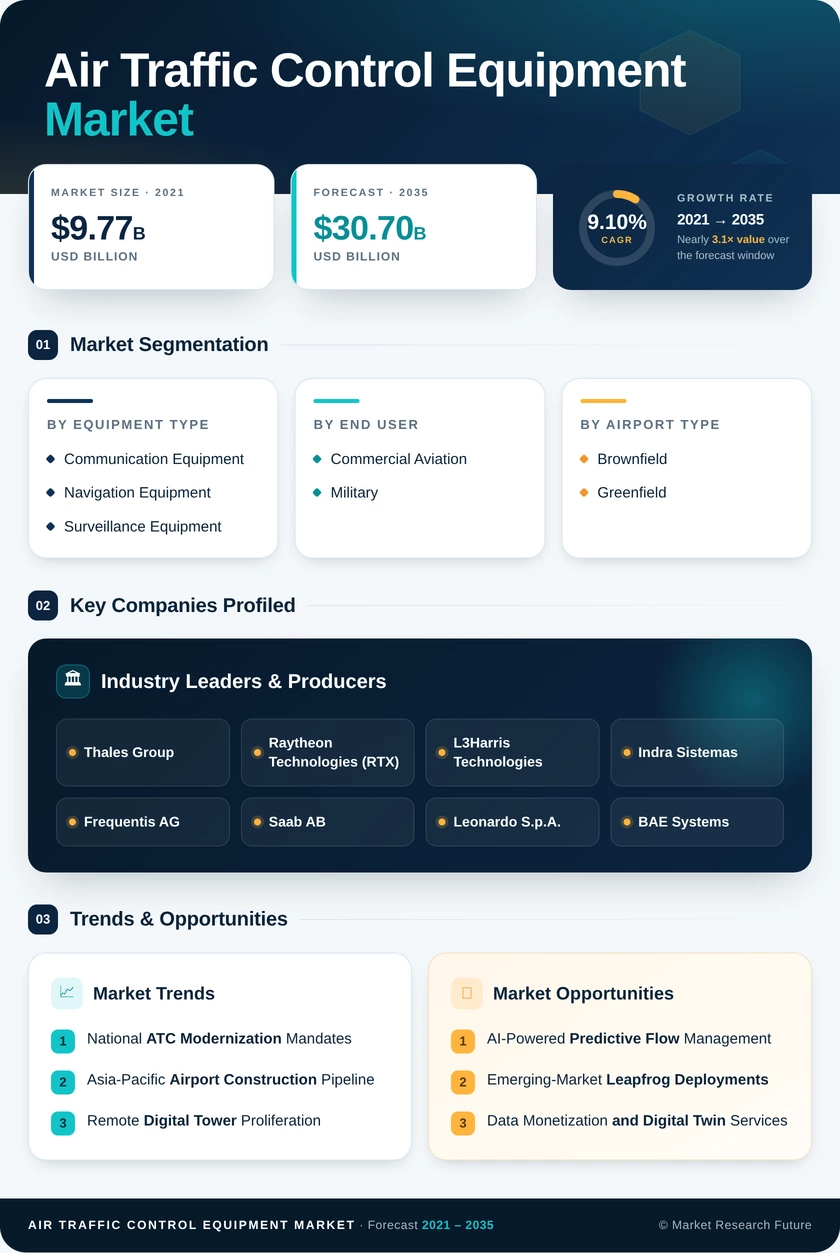
Air Traffic Control Equipment Market Size, Share, Industry Trend & Analysis Research Report Information By Equipment Type (Communication Equipment, Navigation Equipment, Surveillance Equipment), By End User (Commercial Aviation, Military), By Airport Type (Brownfield, Greenfield), By Investment Category (New Installations, Modernization & Upgradation), By Region (North America, Europe, Asia-Pacific, South America, Middle East & Africa) – Forecast Till 2035
Air Traffic Control Equipment Market
Market Size
Forecast Period2025-2035
CAGR (2025-2035)9.10%
2025 Market SizeUSD 12.93 billion
2035 Market SizeUSD 30.70 billion
Key Players
Thales Group
Raytheon Technologies
L3Harris Technologies
Indra Sistemas
Frequentis AG
Saab AB
Opportunities
  • AI-Powered Predictive Flow Management
  • Emerging-Market Leapfrog Deployments
  • Data Monetization and Digital Twin Services
  1. 1 Market Overview |
    1. 1.1 Study Assumptions & Market Definition |
    2. 1.2 Scope of the Study |
    3. 1.3 Research Methodology
  2. 2 Market Summary & Key Takeaways
  3. 3 Market Dynamics |
    1. 3.1 Market Drivers Analysis | |
      1. 3.1.1 FAA NextGen and National ATC Modernization Mandates | |
      2. 3.1.2 Asia-Pacific Greenfield Airport Construction Surge | |
      3. 3.1.3 Remote Digital Tower Proliferation | |
      4. 3.1.4 Satellite-Based Navigation Expansion | |
      5. 3.1.5 Unified Civil-Military Airspace Programs | |
      6. 3.1.6 AI-Driven Conflict Detection and Flow Optimization | |
      7. 3.1.7 Urban Air Mobility Corridor Integration |
    2. 3.2 Market Restraints Analysis | |
      1. 3.2.1 High Capital Cost and Long Procurement Cycles | |
      2. 3.2.2 Spectrum Congestion and Interference Risks | |
      3. 3.2.3 Cybersecurity Vulnerabilities in Networked ATC | |
      4. 3.2.4 Skilled Workforce Shortage for Digital Systems | |
      5. 3.2.5 Regulatory Fragmentation Across National ANSPs |
    3. 3.3 Market Opportunity Analysis | |
      1. 3.3.1 AI-Powered Predictive Flow Management | |
      2. 3.3.2 Emerging-Market Leapfrog Deployments | |
      3. 3.3.3 Data Monetization and Digital Twin Services | |
      4. 3.3.4 Urban Air Mobility Corridor Integration | |
      5. 3.3.5 Counter-UAS Surveillance Convergence |
    4. 3.4 Industry Value Chain Analysis |
    5. 3.5 Porter's Five Forces Analysis
  4. 4 Global Air Traffic Control Equipment Market Size & Forecast (2021–2035) |
    1. 4.1 Historical Market Size (2021–2025) |
    2. 4.2 Current & Forecast Market Size (2026–2035) |
    3. 4.3 Market Size by Revenue (USD billion) |
    4. 4.4 Year-over-Year Growth Analysis
  5. 5 Segmentation Analysis |
    1. 5.1 By Equipment Type | |
      1. 5.1.1 Communication Equipment | |
      2. 5.1.2 Navigation Equipment | |
      3. 5.1.3 Surveillance Equipment |
    2. 5.2 By End User | |
      1. 5.2.1 Commercial Aviation | |
      2. 5.2.2 Military |
    3. 5.3 By Airport Type | |
      1. 5.3.1 Brownfield | |
      2. 5.3.2 Greenfield |
    4. 5.4 By Investment Category | |
      1. 5.4.1 New Installations | |
      2. 5.4.2 Modernization & Upgradation
  6. 6 Regional Analysis |
    1. 6.1 North America | |
      1. 6.1.1 United States | |
      2. 6.1.2 Canada | |
      3. 6.1.3 Mexico |
    2. 6.2 Europe | |
      1. 6.2.1 Germany | |
      2. 6.2.2 United Kingdom | |
      3. 6.2.3 France | |
      4. 6.2.4 Italy | |
      5. 6.2.5 Spain | |
      6. 6.2.6 Nordic Countries | |
      7. 6.2.7 Russia | |
      8. 6.2.8 Rest of Europe |
    3. 6.3 Asia-Pacific | |
      1. 6.3.1 China | |
      2. 6.3.2 India | |
      3. 6.3.3 Japan | |
      4. 6.3.4 South Korea | |
      5. 6.3.5 ASEAN | |
      6. 6.3.6 Rest of Asia-Pacific |
    4. 6.4 South America | |
      1. 6.4.1 Brazil | |
      2. 6.4.2 Argentina | |
      3. 6.4.3 Rest of South America |
    5. 6.5 Middle East & Africa | |
      1. 6.5.1 Saudi Arabia | |
      2. 6.5.2 UAE | |
      3. 6.5.3 South Africa | |
      4. 6.5.4 Egypt | |
      5. 6.5.5 Rest of MEA
  7. 7 Competitive Landscape |
    1. 7.1 Market Share Analysis (2025) |
    2. 7.2 Competitive Benchmarking Matrix |
    3. 7.3 Company Profiles | |
      1. 7.3.1 Thales Group | |
      2. 7.3.2 Raytheon Technologies (RTX) | |
      3. 7.3.3 L3Harris Technologies | |
      4. 7.3.4 Indra Sistemas | |
      5. 7.3.5 Frequentis AG | |
      6. 7.3.6 Saab AB | |
      7. 7.3.7 Leonardo S.p.A. | |
      8. 7.3.8 BAE Systems | |
      9. 7.3.9 Northrop Grumman | |
      10. 7.3.10 Honeywell International
  8. 8 Future Outlook & Strategic Recommendations (2026–2035) |
    1. 8.1 AI-Autonomous Operations and Cognitive ATC |
    2. 8.2 Platform Economics and Software-Defined Towers |
    3. 8.3 Electrification and Sustainable ATM |
    4. 8.4 Spectrum Convergence and Integrated Surveillance
  9. 9 Recent Developments & News
  10. 10 Frequently Asked Questions (FAQs)
  11. 11 Report Scope & Methodology |
    1. 11.1 Study Period & Base Year |
    2. 11.2 Data Sources & Citations |
    3. 11.3 Abbreviations
  12. 1 LIST OF TABLES
  13. 2 LIST OF FIGURES

Segmentation Quick Reference

DimensionSub-SegmentsDominant SegmentFastest Growing Segment
Equipment TypeCommunication Equipment, Navigation Equipment, Surveillance EquipmentCommunication EquipmentRemote & Digital Tower Modules
End UserCommercial Aviation, MilitaryCommercial AviationMilitary
Airport TypeBrownfield, GreenfieldBrownfieldGreenfield
Investment CategoryNew Installations, Modernization & UpgradationModernization & UpgradationNew Installations
RegionNorth America, Europe, Asia-Pacific, South America, Middle East & AfricaNorth AmericaAsia-Pacific


Market Segmentation Overview

By Equipment Type

Sub-SegmentKey Trend
Communication EquipmentTransition from analog VHF voice to VDL Mode-2 and CPDLC data-link protocols
Navigation EquipmentAdoption of SBAS/GBAS precision-approach systems per ICAO PBN mandates
Surveillance EquipmentShift from primary radar reliance toward ADS-B, multilateration, and wide-area surveillance.


Communication equipment remains the largest contributor to the Air Traffic Control Equipment Market by equipment type, reflecting mandated upgrades to data-link ground stations across major en-route centers globally. Surveillance equipment is the fastest-moving segment as ADS-B Out compliance deadlines drive sensor deployments in previously non-radar airspace.

By End User

Sub-SegmentKey Trend
Commercial AviationTraffic recovery and fleet expansion are driving control-system capacity upgrades.
MilitaryProcurement of tactical deployable towers and defense-grade surveillance networks


Commercial aviation anchors demand with over two-thirds of spending, tied directly to global passenger traffic growth. Military procurement is accelerating as defense agencies invest in mobile ATC units for expeditionary and dual-use applications.

By Airport Type

Sub-SegmentKey Trend
BrownfieldCyclical replacement of aging consoles and radar at existing hubs
GreenfieldFull-suite installations at newly constructed airports in India, China, and the Middle East


Brownfield modernization dominates current spending, given the extensive installed base of pre-2005 systems reaching end-of-life. Greenfield sites are the faster-growth pocket, driven by aggressive airport construction pipelines across Asia-Pacific and the Middle East.

By Investment Category

Sub-SegmentKey Trend
New InstallationsDriven by greenfield airports and remote-tower deployments
Modernization & UpgradationFueled by regulatory obsolescence mandates and NextGen/SESAR program spending


Modernization commands the majority of investment as legacy systems face regulatory-driven replacement timelines. New installations are growing at a faster clip, propelled by the simultaneous buildout of greenfield airports and the rollout of entirely new digital-tower centers.


 

Download PDF ×

We do not share your information with anyone. However, we may send you emails based on your report interest from time to time. You may contact us at any time to opt-out.