Request Free Sample ×

Kindly complete the form below to receive a free sample of this Report

* Please use a valid business email

Leading companies partner with us for data-driven Insights

clients tt-cursor
Hero Background

Aircraft Heat Exchanger Market

ID: MRFR/AD/21217-HCR
128 Pages
Triveni Bhoyar
Last Updated: June 01, 2026
Aircraft Heat Exchanger Market Size, Share, Industry Trend & Analysis Research Report: By Type (Air-to-Air Heat Exchangers, Air-to-Liquid Heat Exchangers, Liquid-to-Liquid Heat Exchangers, Oil Coolers), By Material (Aluminum, Titanium, Stainless Steel, Copper), By Application (Engine Cooling, Environmental Control System (ECS), Fuel System, Hydraulic System), By End User (Commercial Airplanes, Business Jets, Military Aircraft, Unmanned Aerial Vehicles (UAVs)) and By Regional (North America, Europe, South America, Asia Pacific, Middle East and Africa) - Forecast to 2035
Download PDF ×

We do not share your information with anyone. However, we may send you emails based on your report interest from time to time. You may contact us at any time to opt-out.

  1. 1 Market Overview |
    1. 1.1 Study Assumptions & Market Definition |
    2. 1.2 Scope of the Study |
    3. 1.3 Research Methodology
  2. 2 Market Summary & Key Takeaways
  3. 3 Market Dynamics |
    1. 3.1 Market Drivers Analysis | |
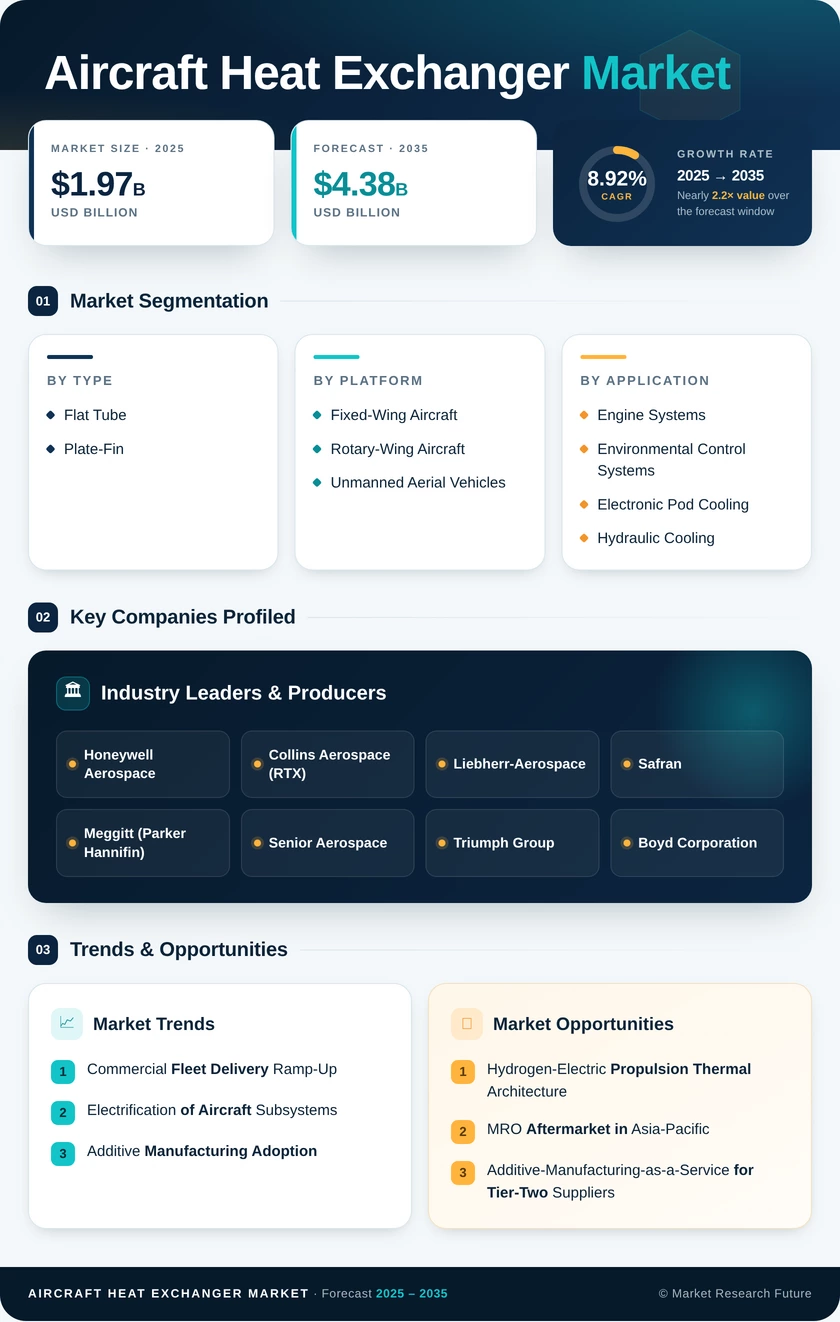
      1. 3.1.1 Commercial Fleet Delivery Ramp-Up | |
      2. 3.1.2 Electrification of Aircraft Subsystems | |
      3. 3.1.3 Additive Manufacturing Adoption | |
      4. 3.1.4 Tighter Cabin Air-Quality Regulations | |
      5. 3.1.5 Hydrogen Fuel-Cell Propulsion R&D | |
      6. 3.1.6 Defense Modernization & Sustainment | |
      7. 3.1.7 MRO Aftermarket Expansion |
    2. 3.2 Market Restraints Analysis | |
      1. 3.2.1 Titanium and Specialty-Alloy Cost Volatility | |
      2. 3.2.2 Certification Lead Times for AM Parts | |
      3. 3.2.3 Supply-Chain Concentration Risk | |
      4. 3.2.4 Intellectual Property Barriers to MRO Competition | |
      5. 3.2.5 Weight-Budget Trade-Offs in Legacy Platforms |
    3. 3.3 Market Opportunity Analysis | |
      1. 3.3.1 Hydrogen-Electric Propulsion Thermal Architecture | |
      2. 3.3.2 MRO Aftermarket in Asia-Pacific | |
      3. 3.3.3 Additive-Manufacturing-as-a-Service for Tier-Two Suppliers | |
      4. 3.3.4 Data-Driven Predictive Maintenance | |
      5. 3.3.5 Defense Directed-Energy Weapon Cooling |
    4. 3.4 Industry Value Chain Analysis |
    5. 3.5 Porter's Five Forces Analysis
  4. 4 Global Aircraft Heat Exchanger Market Size & Forecast (2021–2035) |
    1. 4.1 Historical Market Size (2021–2025) |
    2. 4.2 Current & Forecast Market Size (2026–2035) |
    3. 4.3 Market Size by Revenue (USD Billion) |
    4. 4.4 Year-over-Year Growth Analysis
  5. 5 Segmentation Analysis |
    1. 5.1 By Type | |
      1. 5.1.1 Flat Tube | |
      2. 5.1.2 Plate-Fin |
    2. 5.2 By Platform | |
      1. 5.2.1 Fixed-Wing Aircraft | |
      2. 5.2.2 Rotary-Wing Aircraft | |
      3. 5.2.3 Unmanned Aerial Vehicles |
    3. 5.3 By Application | |
      1. 5.3.1 Engine Systems | |
      2. 5.3.2 Environmental Control Systems | |
      3. 5.3.3 Electronic Pod Cooling | |
      4. 5.3.4 Hydraulic Cooling |
    4. 5.4 By Vendor | |
      1. 5.4.1 OEM | |
      2. 5.4.2 Aftermarket
  6. 6 Regional Analysis |
    1. 6.1 North America | |
      1. 6.1.1 United States | |
      2. 6.1.2 Canada | |
      3. 6.1.3 Mexico |
    2. 6.2 Europe | |
      1. 6.2.1 Germany | |
      2. 6.2.2 United Kingdom | |
      3. 6.2.3 France | |
      4. 6.2.4 Italy | |
      5. 6.2.5 Spain | |
      6. 6.2.6 Nordic Countries | |
      7. 6.2.7 Russia | |
      8. 6.2.8 Rest of Europe |
    3. 6.3 Asia-Pacific | |
      1. 6.3.1 China | |
      2. 6.3.2 India | |
      3. 6.3.3 Japan | |
      4. 6.3.4 South Korea | |
      5. 6.3.5 ASEAN | |
      6. 6.3.6 Rest of Asia-Pacific |
    4. 6.4 South America | |
      1. 6.4.1 Brazil | |
      2. 6.4.2 Argentina | |
      3. 6.4.3 Rest of South America |
    5. 6.5 Middle East & Africa | |
      1. 6.5.1 Saudi Arabia | |
      2. 6.5.2 UAE | |
      3. 6.5.3 South Africa | |
      4. 6.5.4 Egypt | |
      5. 6.5.5 Rest of MEA
  7. 7 Competitive Landscape |
    1. 7.1 Market Share Analysis (2025) |
    2. 7.2 Competitive Benchmarking Matrix |
    3. 7.3 Company Profiles | |
      1. 7.3.1 Honeywell Aerospace | |
      2. 7.3.2 Collins Aerospace (RTX) | |
      3. 7.3.3 Liebherr-Aerospace | |
      4. 7.3.4 Safran | |
      5. 7.3.5 Meggitt (Parker Hannifin) | |
      6. 7.3.6 Senior Aerospace | |
      7. 7.3.7 Triumph Group | |
      8. 7.3.8 Boyd Corporation | |
      9. 7.3.9 TAT Technologies | |
      10. 7.3.10 Aerojet Rocketdyne (L3Harris)
  8. 8 Future Outlook & Strategic Recommendations (2026–2035) |
    1. 8.1 Electrification Supercycle and Megawatt-Class Thermal Loads |
    2. 8.2 Hydrogen-Ready Thermal Architectures |
    3. 8.3 Digital Twins and Predictive Thermal Analytics |
    4. 8.4 ESG Reporting and Lifecycle Carbon Accounting
  9. 9 Recent Developments & News
  10. 10 Frequently Asked Questions (FAQs)
  11. 11 Report Scope & Methodology |
    1. 11.1 Study Period & Base Year |
    2. 11.2 Data Sources & Citations |
    3. 11.3 Abbreviations
  12. 12 LIST OF TABLES |
  13. TABLE 1 Global Aircraft Heat Exchanger Market Size & Forecast, by Revenue (USD Billion), 2021–2035 |
  14. TABLE 2 Global Aircraft Heat Exchanger Market – Year-over-Year Growth Analysis, 2021–2035 |
  15. TABLE 3 Global Aircraft Heat Exchanger Market – Driver Impact Analysis |
  16. TABLE 4 Global Aircraft Heat Exchanger Market – Restraint Impact Analysis |
  17. TABLE 5 Global Aircraft Heat Exchanger Market Size, by Type, 2021–2035 (USD Billion) |
  18. TABLE 6 Global Aircraft Heat Exchanger Market Size, by Platform, 2021–2035 (USD Billion) |
  19. TABLE 7 Global Aircraft Heat Exchanger Market Size, by Application, 2021–2035 (USD Billion) |
  20. TABLE 8 Global Aircraft Heat Exchanger Market Size, by Vendor, 2021–2035 (USD Billion) |
  21. TABLE 9 Global Aircraft Heat Exchanger Market Size, by Region, 2021–2035 (USD Billion) |
  22. TABLE 10 North America Aircraft Heat Exchanger Market Size, by Country, 2021–2035 (USD Billion) |
  23. TABLE 11 Europe Aircraft Heat Exchanger Market Size, by Country, 2021–2035 (USD Billion) |
  24. TABLE 12 Asia-Pacific Aircraft Heat Exchanger Market Size, by Country, 2021–2035 (USD Billion) |
  25. TABLE 13 South America Aircraft Heat Exchanger Market Size, by Country, 2021–2035 (USD Billion) |
  26. TABLE 14 Middle East & Africa Aircraft Heat Exchanger Market Size, by Country, 2021–2035 (USD Billion) |
  27. TABLE 15 Competitive Benchmarking Matrix – Global Aircraft Heat Exchanger Market, 2025 |
  28. TABLE 16 Company Profiles – Key Players, Global Aircraft Heat Exchanger Market |
  29. TABLE 17 Recent Developments & Strategic Announcements, 2023–2025 |
  30. TABLE 18 Report Scope & Methodology Summary |
  31. TABLE 19 Detailed Sources and Citations |
  32. TABLE 20 North America Aircraft Heat Exchanger Market Size, by Type, 2021–2035 (USD Billion) |
  33. TABLE 21 North America Aircraft Heat Exchanger Market Size, by Platform, 2021–2035 (USD Billion) |
  34. TABLE 22 North America Aircraft Heat Exchanger Market Size, by Application, 2021–2035 (USD Billion) |
  35. TABLE 23 North America Aircraft Heat Exchanger Market Size, by Vendor, 2021–2035 (USD Billion) |
  36. TABLE 24 Europe Aircraft Heat Exchanger Market Size, by Type, 2021–2035 (USD Billion) |
  37. TABLE 25 Europe Aircraft Heat Exchanger Market Size, by Platform, 2021–2035 (USD Billion) |
  38. TABLE 26 Europe Aircraft Heat Exchanger Market Size, by Application, 2021–2035 (USD Billion) |
  39. TABLE 27 Europe Aircraft Heat Exchanger Market Size, by Vendor, 2021–2035 (USD Billion) |
  40. TABLE 28 Asia-Pacific Aircraft Heat Exchanger Market Size, by Type, 2021–2035 (USD Billion) |
  41. TABLE 29 Asia-Pacific Aircraft Heat Exchanger Market Size, by Platform, 2021–2035 (USD Billion) |
  42. TABLE 30 Asia-Pacific Aircraft Heat Exchanger Market Size, by Application, 2021–2035 (USD Billion) |
  43. TABLE 31 Asia-Pacific Aircraft Heat Exchanger Market Size, by Vendor, 2021–2035 (USD Billion) |
  44. TABLE 32 South America Aircraft Heat Exchanger Market Size, by Type, 2021–2035 (USD Billion) |
  45. TABLE 33 South America Aircraft Heat Exchanger Market Size, by Platform, 2021–2035 (USD Billion) |
  46. TABLE 34 South America Aircraft Heat Exchanger Market Size, by Application, 2021–2035 (USD Billion) |
  47. TABLE 35 South America Aircraft Heat Exchanger Market Size, by Vendor, 2021–2035 (USD Billion) |
  48. TABLE 36 Middle East & Africa Aircraft Heat Exchanger Market Size, by Type, 2021–2035 (USD Billion) |
  49. TABLE 37 Middle East & Africa Aircraft Heat Exchanger Market Size, by Platform, 2021–2035 (USD Billion) |
  50. TABLE 38 Middle East & Africa Aircraft Heat Exchanger Market Size, by Application, 2021–2035 (USD Billion) |
  51. TABLE 39 Middle East & Africa Aircraft Heat Exchanger Market Size, by Vendor, 2021–2035 (USD Billion)
  52. 13 LIST OF FIGURES |
  53. FIGURE 1 Aircraft Heat Exchanger Market Dynamics Overview |
  54. FIGURE 2 Industry Value Chain Analysis |
  55. FIGURE 3 Porter's Five Forces Analysis — Aircraft Heat Exchanger Market |
  56. FIGURE 4 Global Aircraft Heat Exchanger Market Size Trend (USD Billion), 2021–2035 |
  57. FIGURE 5 Aircraft Heat Exchanger Market Share, by Type (2025) |
  58. FIGURE 6 Aircraft Heat Exchanger Market Share, by Platform (2025) |
  59. FIGURE 7 Aircraft Heat Exchanger Market Share, by Application (2025) |
  60. FIGURE 8 Aircraft Heat Exchanger Market Share, by Vendor (2025) |
  61. FIGURE 9 Aircraft Heat Exchanger Market Share, by Region (2025) |
  62. FIGURE 10 North America Aircraft Heat Exchanger Market Share, by Country (2025) |
  63. FIGURE 11 Europe Aircraft Heat Exchanger Market Share, by Country (2025) |
  64. FIGURE 12 Asia-Pacific Aircraft Heat Exchanger Market Share, by Country (2025) |
  65. FIGURE 13 South America Aircraft Heat Exchanger Market Share, by Country (2025) |
  66. FIGURE 14 Middle East & Africa Aircraft Heat Exchanger Market Share, by Country (2025) |
  67. FIGURE 15 Competitive Landscape — Market Concentration & Key Player Positioning

Segmentation Quick Reference

Dimension Sub-Segments Dominant Segment Fastest Growing Segment
By Type Flat Tube, Plate-Fin Flat Tube Plate-Fin
By Platform Fixed-Wing Aircraft, Rotary-Wing Aircraft, Unmanned Aerial Vehicles Fixed-Wing Aircraft Unmanned Aerial Vehicles
By Application Engine Systems, Environmental Control Systems, Electronic Pod Cooling, Hydraulic Cooling Engine Systems Environmental Control Systems
By Vendor OEM, Aftermarket OEM Aftermarket
By Geography North America, Europe, Asia-Pacific, South America, Middle East & Africa North America North America


Market Segmentation Overview

By Type

Sub-Segment Key Trend
Flat Tube High-volume adoption in narrowbody ECS packs; mature manufacturing base
Plate-Fin AM-enabled weight reduction; growing in engine oil-cooling applications


Flat-tube heat exchangers remain the dominant type across commercial aviation due to their pressure-drop advantages and established supply chains. Plate-fin designs are gaining rapid traction as additive manufacturing unlocks topology-optimized geometries that reduce core weight by up to 30%, making them increasingly competitive for aircraft oil cooling heat exchanger and fuel-cooled aircraft heat exchanger applications.

By Platform

Sub-Segment Key Trend
Fixed-Wing Aircraft Largest installed base; driven by narrowbody delivery surge
Rotary-Wing Aircraft Steady demand from military and offshore utility helicopters
Unmanned Aerial Vehicles Fastest growth driven by fuel-cell propulsion and HALE missions


Fixed-wing aircraft generate the majority of demand due to the sheer scale of commercial and military jet fleets worldwide. UAVs are the fastest-growing platform as high-altitude long-endurance missions and fuel-cell-powered configurations push thermal-management requirements beyond legacy cooling approaches.

By Application

Sub-Segment Key Trend
Engine Systems Core demand driver across turbofan and turboprop fleets
Environmental Control Systems Fastest-growing application; driven by cabin air-quality regulation
Electronic Pod Cooling Niche growth in fighter EW and radar thermal management
Hydraulic Cooling Stable demand in rotary-wing and landing-gear subsystems


Engine systems lead by revenue share because every aircraft powerplant requires dedicated oil and fuel thermal-management assemblies. Environmental control systems are growing fastest as EASA CS-25 amendments and FAA cabin air-quality directives create both OEM and retrofit demand.

By Vendor

Sub-Segment Key Trend
OEM Revenue dominance tied to record aircraft order backlogs
Aftermarket Fastest-growing channel as fleet aging and regulatory upgrades accelerate MRO demand.


OEM sales reflect the backlog-driven production environment at Boeing and Airbus. At the same time, aftermarket growth is fueled by aging fleet retrofit cycles and expanding MRO capacity in Asia-Pacific and the Middle East.