Aircraft Line Maintenance Market (2025 - 2035)

Aircraft Line Maintenance Market Size, Share, Industry Trend & Analysis Research Report By Service Type (Line-Station Setup & Management, Component Replacement & Rigging, Engine & APU Service, AOG Services, Other Services), By Aircraft Type (Narrowbody, Widebody, Regional Jets, Freighter), By Maintenance Provider (Airline In-House, Independent MRO, OEM Service Centers), By Schedule Type (Routine Checks, Transit Checks), By Geography (North America, Europe, Asia-Pacific, South America, Middle East & Africa) - Forecast to 2035
ID: MRFR/AD/0911-HCR
103 Pages
Shubham Munde, Sejal Akre
Last Updated: August 05, 2026
Aircraft Line Maintenance Market
Market Size
Forecast Period2025-2035
CAGR (2025-2035)4.68%
2025 Market SizeUSD 27.48 Billion
2035 Market SizeUSD 43.42 Billion
Key Players
Lufthansa Technik
AAR Corp
STS Aviation Group
FL Technics
SR Technics
Swissport International
Opportunities
  • Expansion of Independent MRO Footprint at Secondary Airports
  • Data Monetization Through Predictive Analytics Platforms
  • Freighter and Cargo Conversion Aftermarket

Aircraft Line Maintenance Market Summary

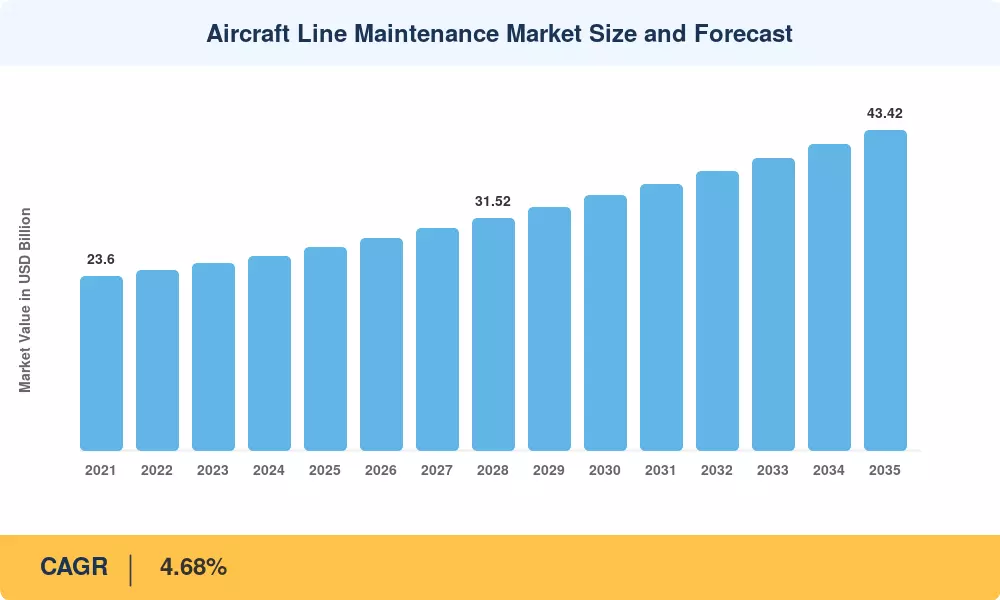
The Aircraft Line Maintenance Market reached an estimated USD 27.48 billion in 2025 and is projected to grow from USD 28.77 billion in 2026 to USD 43.42 billion by 2035, registering a CAGR of 4.68% during the forecast period. Two catalysts stand at the center of this trajectory: the rapid fleet expansion across emerging economies — IATA expects the global commercial fleet to surpass 40,000 aircraft by 2030 — and the accelerating trend among carriers to outsource transit and routine checks to third-party specialists [1]. Airlines under margin pressure increasingly view line maintenance as a variable cost center rather than a core operational function, shifting contractual volumes toward independent MROs.

A profound technological transformation is significantly altering the daily operations of the Aircraft Line Maintenance Market. AI-driven fault prediction, digital task tracking on ruggedized tablets, and drone-based fuselage scans are replacing legacy paper-based workcards and manual borescope inspections. The magnitude of capital that is being invested in next-generation service infrastructure is underscored by GE Aerospace's announcement of a USD 1 billion five-year MRO upgrade program [2]. Mobile service units are deployed at secondary airports to reduce ramp congestion at major centers further and compress turn-times.

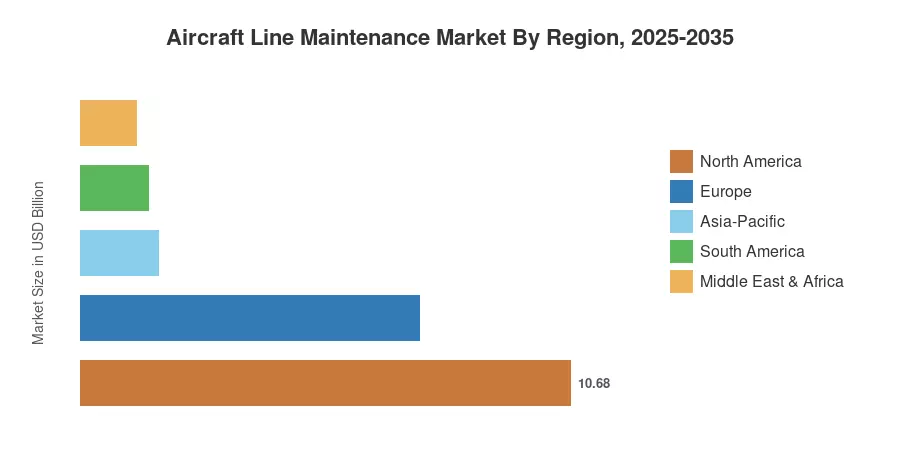
In 2024, North America held approximately 40.5% of the Aircraft Line Maintenance Market, which was bolstered by the world's largest single-aisle fleet and a mature MRO infrastructure. With a projected compound annual growth rate (CAGR) of 6.50% through 2035, the Asia-Pacific region is the fastest-growing [3]. This growth is primarily due to fleet deliveries in India, China, and Southeast Asia. The dense intra-European short-haul network is the reason for Europe's second-largest share, which is approximately 28.0%. Providers who combine digital capabilities with geographic reach will be rewarded in the coming decade.


Key Report Takeaways

• By Service Type

  • Line-station setup and management led the Aircraft Line Maintenance Market with a 47.10% revenue share in 2024, reflecting the critical role of permanent ground infrastructure at high-frequency hubs.
  • AOG (Aircraft-on-Ground) services are forecast to register a 6.11% CAGR through 2035, as unscheduled repair demand intensifies alongside fleet aging.

• By Aircraft Type

  • Narrowbody jets dominated the Aircraft Line Maintenance Market in 2024, generating a 51.0% share driven by LCC fleet growth and single-aisle utilization rates exceeding 12 block-hours per day.
  • Freighter maintenance is positioned as the fastest-expanding aircraft category at a projected 6.77% CAGR through 2035, fueled by e-commerce logistics and cargo conversion programs.

• By Maintenance Provider

  • Airline in-house operations captured an estimated 59.5% of the Aircraft Line Maintenance Market in 2024, although outsourcing momentum is accelerating.
  • Independent MROs registered the fastest growth trajectory at an 8.31% CAGR, winning contracts through flexible labor pools and multi-OEM certifications.

• By Schedule Type

  • Routine checks accounted for the majority of Aircraft Line Maintenance Market revenue in 2024, exceeding a 68% share.
  • Transit checks are forecast to expand at a 5.60% CAGR through 2035 as airline scheduling tightens minimum ground times.

• By Region

  • North America held the dominant position in the Aircraft Line Maintenance Market in 2024, supported by legacy carrier MRO investment and FAA regulatory rigor.
  • Asia-Pacific is expected to grow fastest at a 6.50% CAGR, driven by fleet inductions across India, China, and ASEAN nations.


Market Size and Forecast (2021–2035)

Market Research Future derives historical estimates from airline financial disclosures, MRO industry surveys (ARSA, IATA MRO Forecast), and OEM service revenue filings. Forecast projections apply a bottom-up model calibrated to fleet growth schedules, utilization trends, and maintenance-cost-per-flight-hour benchmarks across aircraft families.
Aircraft Line Maintenance Market Size and Forecast
Our Impact
Enabled $4.3B Revenue Impact for Fortune 500 and Leading Multinationals
Partnering with 2000+ Global Organizations Each Year
30K+ Citations by Top-Tier Firms in the Industry

Driver Impact Analysis

Driver ~% Impact on CAGR Geographic Relevance Impact Timeline
Fleet expansion in emerging economies +0.95% Asia-Pacific, MEA Medium-term (2–4 yr)
Airline outsourcing of line checks +0.80% Global Short-term (≤2 yr)
Digital workcard and AI fault prediction adoption +0.65% North America, Europe Medium-term (2–4 yr)
Rising single-aisle utilization rates +0.55% Global Short-term (≤2 yr)
OEM MRO capacity investment programs +0.50% North America, Europe Long-term (≥4 yr)
Secondary airport growth and mobile service units +0.40% Europe, Asia-Pacific Medium-term (2–4 yr)
Tighter regulatory compliance mandates +0.30% Global Long-term (≥4 yr)


Fleet Expansion in Emerging Economies

Boeing's 2024 Commercial Market Outlook projects that carriers in Asia-Pacific will absorb over 19,500 new aircraft deliveries through 2043, with India alone expecting to more than triple its commercial fleet from roughly 700 to over 2,500 units [3]. Each incremental aircraft generates recurring demand for daily pre-flight inspections, overnight checks, and periodic component swaps — tasks that fall squarely within the Aircraft Line Maintenance Market. Countries like Vietnam, Indonesia, and the Philippines are simultaneously expanding airport infrastructure, creating new line stations that require staffing, tooling, and certification investments from both carriers and independent providers.

Airline Outsourcing of Line Checks

IATA’s 2024 Airline Industry Economic Performance report states that non-fuel unit costs were 8–10% over 2019 levels; therefore, carriers were looking to optimise every discretionary cost line [9]. Line maintenance, formerly the exclusive province of in-house employees, is moving to third-party contracts. Carriers can convert set manpower to variable per-check rates, gaining flexibility during seasonal demand fluctuations. This trend of outsourcing immediately increases the addressable Aircraft Line Maintenance Market for independent MROs and OEM service networks.


Digital Workcard and AI-Driven Predictive Maintenance

Airbus’s Skywise technology analyzes more than 20 petabytes of fleet data today, which allows for predictive diagnosis of component degradation before it leads to an AOG event [10]. Digital workcards eliminate paper-based job tracking and cut the average time to complete a check by 15-20%, according to pilot projects at Delta TechOps and Lufthansa Technik. This efficiency improvement, in the Aircraft Line Maintenance Market, translates to more on-wing time, fewer gate delays and a tangible ROI that fuels more widespread use by mid-tier carriers.


OEM MRO Capacity Investment Programs

GE Aerospace's USD 1 billion five-year MRO investment program — encompassing new service centers in Poland, Singapore, and Brazil — signals a strategic pivot by power-plant OEMs into aftermarket dominance [2]. Pratt & Whitney has similarly expanded its GTF overhaul network to address the growing installed base of PW1000G engines. These capital commitments reshape the competitive dynamics of the Aircraft Line Maintenance Market, as OEM-backed service centers offer integrated diagnostics that independent providers struggle to replicate without licensed tooling.


Restraints Impact Analysis

The restraint impacts below represent estimated negative contributions to demand growth. They are directional and should not be subtracted from the headline CAGR linearly.

Restraint ~% Impact on CAGR Geographic Relevance Impact Timeline
Skilled technician shortage −0.70% Global Long-term (≥4 yr)
Supply-chain delays for critical parts −0.55% Global Short-term (≤2 yr)
High certification and regulatory compliance costs −0.40% North America, Europe Medium-term (2–4 yr)
Airport infrastructure congestion −0.30% Europe, Asia-Pacific Medium-term (2–4 yr)
Cybersecurity risks in connected maintenance systems −0.20% North America, Europe Long-term (≥4 yr)


Skilled Technician Shortage

Boeing's 2024 Technician Outlook forecasts the global aviation sector will need 716,000 new maintenance technicians by 2043 — roughly 35,800 per year — to offset retirements and support fleet growth [13]. The Aircraft Line Maintenance Market is acutely exposed because line work demands multi-type ratings, ramp safety certifications, and willingness to operate in shift-based, all-weather environments. Recruitment competition from defense, space, and adjacent industries compounds the shortfall, pushing labor costs upward and constraining the pace at which independent MROs can open new line stations.

Supply-Chain Delays for Critical Parts

Persistent bottlenecks in aerospace supply chains — driven by raw material shortages, forging capacity limits, and OEM production ramp-up difficulties — extend component lead times from weeks to months [14]. When a line-replaceable unit is unavailable, an aircraft can slip from a routine transit check into a costly AOG event, eroding carrier confidence in scheduled maintenance windows. These delays ripple through the Aircraft Line Maintenance Market by inflating inventory holding costs and forcing providers to maintain larger safety stocks at distributed line stations.

Certification and Regulatory Compliance Costs

Meeting EASA Part-145 or FAA Part 145 approval requirements entails substantial investment in training records, tool calibration programs, quality audits, and facility standards [12]. For smaller independent MROs seeking to enter or expand within the Aircraft Line Maintenance Market, these compliance costs create a meaningful barrier. Regulatory harmonization between jurisdictions remains incomplete, compelling multi-region operators to maintain parallel quality systems.


Aircraft Line Maintenance Market Opportunities

Expansion of Independent MRO Footprint at Secondary Airports

As low-cost carriers shift capacity to secondary and regional airports, dedicated line stations at these locations remain underserved. Independent MROs that establish pre-positioned crews and mobile tool kits at underserved airfields can capture outsourced contracts from carriers reluctant to invest in permanent infrastructure. The Aircraft Line Maintenance Market stands to benefit as these airports grow scheduled frequencies.

Data Monetization Through Predictive Analytics Platforms

Maintenance providers sitting on years of fault-log data, component life-cycle records, and environmental exposure metrics hold a monetizable asset. By packaging anonymized analytics into benchmarking services or fleet health dashboards, MROs can unlock recurring SaaS-style revenue streams beyond wrench-turning. This business-model shift diversifies revenue within the Aircraft Line Maintenance Market.

Freighter and Cargo Conversion Aftermarket

E-commerce volume growth — estimated at 8–10% annually through the decade — is pushing express freight operators to convert aging passenger aircraft into freighters [16]. Each conversion extends the airframe's service life by 15–20 years, creating sustained demand for line checks tailored to cargo-door mechanisms, reinforced floor structures, and supplemental fire-suppression systems. The Aircraft Line Maintenance Market's freighter segment therefore represents a durable expansion pocket.

Emerging-Market Joint Ventures and PPP Models

Governments in the Middle East and Southeast Asia are investing in aviation MRO ecosystems through public-private partnerships. Saudi Arabia's GACA Vision 2030 aviation strategy and Indonesia's MRO hub development at Batam are creating greenfield line-maintenance capacity that multinational providers can access via joint ventures. These partnerships de-risk entry and accelerate local certification.

Sustainability-Linked Maintenance Practices

Airlines pursuing Science Based Targets initiative (SBTi) commitments increasingly evaluate maintenance partners on environmental performance — waste recycling rates, hazardous material management, and fuel-burn reduction through improved on-wing engine performance [17]. Providers who invest in sustainable practices can differentiate within the Aircraft Line Maintenance Market and command premium pricing from ESG-conscious carriers.


Aircraft Line Maintenance Market Future Outlook

AI-Augmented Line Maintenance and Digital Twins

By 2030, digital twin platforms are expected to cover over 60% of the global narrowbody fleet, enabling real-time virtual replicas that predict component degradation hours before a physical inspection would catch it [10]. Within the Aircraft Line Maintenance Market, this shift will compress unscheduled AOG events and allow providers to pre-position parts and personnel algorithmically. Carriers adopting AI-augmented workflows could reduce line-check duration by up to 25%, translating to measurable improvements in aircraft dispatch reliability.

Platform Economics and MRO-as-a-Service

The rise of platform-based MRO marketplaces — connecting airlines with certified providers through standardized digital contracts — is introducing Uber-like dynamics into the Aircraft Line Maintenance Market. Platforms reduce search costs for carriers at spoke airports and enable smaller MROs to fill capacity gaps. IBA Group estimates that platform-mediated line maintenance transactions could account for 12–15% of the global market by 2032 [20].

Sustainable Aviation and Fleet Transition Effects

ICAO's CORSIA scheme and the EU's ReFuelEU Aviation mandate are accelerating fleet renewal toward next-generation narrowbodies with improved fuel efficiency. Each wave of fleet transition generates a dual effect within the Aircraft Line Maintenance Market: legacy aircraft require heavier maintenance as they age. At the same time, new-generation platforms demand new type-rated technicians and tooling investments. IATA projects airlines will spend USD 175 billion on sustainable aviation fuel infrastructure by 2040, indirectly shaping MRO investment decisions [21].

Workforce Transformation and Augmented-Reality Training

Addressing the 716,000-technician shortfall projected by Boeing will require fundamentally new approaches to training and retention [13]. Augmented-reality (AR) headsets that overlay wiring diagrams and torque specifications onto the physical aircraft are already in trial at Lufthansa Technik and STS Aviation Group. The Aircraft Line Maintenance Market will increasingly compete for talent using AR-enhanced onboarding, flexible shift models, and career-pathway programs that bridge the gap between vocational education and ramp-ready certification.


Aircraft Line Maintenance Market Segmentation

By Service Type

Segment Key Metric Primary Demand Driver
Line-Station Setup & Management 47.10% share (2024) Hub infrastructure requirements
Component Replacement & Rigging USD 5.94 Billion (2024) Aging fleet part-swap frequency
Engine & APU Service 4.88% CAGR (2026–2035) LEAP/GTF shop-visit intervals
AOG Services 6.11% CAGR (2026–2035) Unscheduled event urgency
Other Services USD 1.81 Billion (2024) Cabin, avionics, minor structural


Line-station setup and management commands the largest share of the Aircraft Line Maintenance Market because carriers and independent MROs must invest in permanent infrastructure — tooling, ground support equipment, hangar access, and certified personnel — at every airport where they operate scheduled checks. High-frequency hubs like Atlanta, London Heathrow, and Dubai require multi-shift staffing to handle 50+ daily turns. AOG services, while smaller in absolute terms, carry the highest per-event revenue because of the urgency premium: airlines pay substantial surcharges for immediate dispatch of mobile repair teams to remote airfields.

By Aircraft Type

Segment Key Metric Primary Demand Driver
Narrowbody 51.0% share (2024) LCC fleet growth, high utilization
Widebody USD 7.25 Billion (2024) Long-haul network recovery
Regional Jets 4.21% CAGR (2026–2035) Scope-clause evolution
Freighter 6.77% CAGR (2026–2035) E-commerce, P2F conversions


Narrowbody jets constitute the backbone of the Aircraft Line Maintenance Market due to sheer fleet numbers: the global A320/737 family fleet exceeds 20,000 aircraft. These platforms fly 8–14 sectors daily in LCC configurations, generating proportionally higher check frequencies than widebody long-haul operations. Freighter maintenance is the segment's growth story — each passenger-to-freighter conversion extends an airframe's economic life and introduces specialized check requirements around cargo loading systems and structural reinforcements.

By Maintenance Provider

Segment Key Metric Primary Demand Driver
Airline In-House 59.5% share (2024) Operational control, legacy investment
Independent MRO 8.31% CAGR (2026–2035) Outsourcing trend, multi-OEM flexibility
OEM Service Centers USD 3.04 Billion (2024) Warranty-linked work, proprietary diagnostics


Airline in-house operations still dominate the Aircraft Line Maintenance Market, reflecting decades of sunk investment in training academies, tooling, and airport-lease agreements. Major carriers like Delta, Lufthansa, and Singapore Airlines view line maintenance as a core competency. Independent MROs, however, are gaining ground at an 8.31% CAGR by offering carriers variable-cost structures and geographic flexibility — particularly valuable for airlines expanding into new route networks without the capital commitment of building proprietary line stations.

By Schedule Type

Segment Key Metric Primary Demand Driver
Routine Checks 68.2% share (2024) Regulatory mandated, predictable scheduling
Transit Checks 5.60% CAGR (2026–2035) Tighter turn-times, hub congestion


Routine checks — encompassing daily, weekly, and A-check intervals — anchor the Aircraft Line Maintenance Market because airworthiness directives mandate them and cannot be deferred. Transit checks, performed during short ground stops between flights, are growing faster as airlines reduce scheduled ground times below 45 minutes on competitive routes, demanding rapid inspection and rectification capabilities from line crews.


Regional Market Share Analysis

Region Key Metric Primary Investment Themes
North America 40.5% share (2024) Legacy fleet overhauls, digital MRO adoption
Europe 28.0% share (2024) Short-haul density, EASA harmonization
Asia-Pacific 6.50% CAGR (2026–2035) Fleet inductions, greenfield MRO hubs
South America USD 1.49 Billion (2024) LCC growth, regional connectivity
Middle East & Africa USD 1.22 Billion (2024) Hub airline expansion, PPP investment
Total USD 26.37 Billion (2024)

The Aircraft Line Maintenance Market exhibits a pronounced geographic concentration, with North America and Europe together accounting for roughly two-thirds of global revenue. Asia-Pacific is closing the gap rapidly, propelled by fleet growth that outpaces all other regions.


North America

Country Key Metric Key Driver
US 78.2% of regional share (2024) Largest single-aisle fleet globally
Canada 12.5% of regional share (2024) WestJet, Air Canada fleet renewal
Mexico 4.87% CAGR (2026–2035) VivaAerobus, Volaris expansion


The United States remains the gravitational center of the Aircraft Line Maintenance Market in North America, home to the world's densest network of Part 145 certified repair stations. FAA reauthorization legislation in 2024 allocated additional resources to inspector staffing, signaling continued regulatory rigor [12]. Canada's investment in CFM LEAP engine service capability at Montreal-based facilities positions the country as a narrowbody aftermarket hub. At the same time, Mexico benefits from low labor costs and proximity to US carriers, attracting line-station investments from AAR Corp and others.

Europe

Country Key Metric Key Driver
Germany 24.8% of regional share (2024) Lufthansa Technik's global footprint
UK 19.3% of regional share (2024) Long-haul widebody hub demand
France 5.22% CAGR (2026–2035) Air France Industries modernization
Italy USD 0.51 Billion (2024) Atitech expansion at Naples hub
Spain 4.95% CAGR (2026–2035) Tourism-driven seasonal capacity
Nordic Countries USD 0.41 Billion (2024) SAS restructuring, regional fleet growth
Russia 3.10% CAGR (2026–2035) Sanctions limiting access to Western MROs
Rest of Europe USD 0.72 Billion (2024) Eastern European MRO cost arbitrage


Europe's Aircraft Line Maintenance Market is shaped by the density of intra-European short-haul operations — over 9 million commercial departures annually — and by EASA's Part-145 framework, which enables mutual recognition of maintenance approvals across member states [18]. Lufthansa Technik's network of line stations spanning 50+ airports gives it unmatched European coverage, while competitors like SR Technics and Czech Airlines Technics target cost-sensitive carriers.

Asia-Pacific

Country Key Metric Key Driver
China 30.1% of regional share (2024) COMAC C919 fleet entry, domestic growth
India 7.18% CAGR (2026–2035) IndiGo fleet tripling, new airports
Japan USD 0.88 Billion (2024) ANA, JAL widebody overhauls
South Korea 5.85% CAGR (2026–2035) Korean Air-Asiana merger synergies
ASEAN 6.92% CAGR (2026–2035) LCC proliferation, MRO hub ambitions
Rest of Asia-Pacific USD 0.34 Billion (2024) Emerging carrier startups


Asia-Pacific represents the most dynamic growth theater in the Aircraft Line Maintenance Market. India's Udaan regional connectivity scheme and the commissioning of Noida International Airport are creating new demand nodes, while China's ambition to reduce reliance on Western MRO providers is driving domestic capacity build-out around COMAC platforms [3]. ASEAN nations, led by Singapore, Malaysia, and Indonesia, are competing to establish full-service MRO clusters.

South America

Country Key Metric Key Driver
Brazil 62.5% of regional share (2024) GOL, LATAM fleet modernization
Argentina 4.40% CAGR (2026–2035) Flybondi, JetSmart expansion
Rest of South America USD 0.22 Billion (2024) Regional carrier network development


Brazil anchors South America's Aircraft Line Maintenance Market, with ANAC-certified repair stations at Guarulhos, Galeão, and Confins supporting both domestic and foreign carriers. GOL's fleet standardization on the Boeing 737 MAX simplifies line-check logistics, while LATAM's post-restructuring fleet renewal is generating incremental work packages for third-party providers.

Middle East & Africa

Country Key Metric Key Driver
Saudi Arabia 5.98% CAGR (2026–2035) GACA Vision 2030, Riyadh Air launch
UAE 33.8% of regional share (2024) Emirates, Etihad hub operations
South Africa USD 0.15 Billion (2024) SAA restructuring, fleet renewal
Egypt 5.15% CAGR (2026–2035) EgyptAir expansion, tourism rebound
Rest of MEA USD 0.19 Billion (2024) Ethiopian Airlines growth corridor


The UAE functions as the region's MRO anchor, with Emirates Engineering Centre handling over 150 aircraft types. Saudi Arabia is poised to become the fastest-growing country within MEA's Aircraft Line Maintenance Market as the planned launch of Riyadh Air — targeting a 100+ aircraft fleet by 2030 — creates step-change demand for line-station infrastructure [19]. African carriers, led by Ethiopian Airlines, are gradually building indigenous maintenance capability to reduce ferry-flight costs to overseas MRO facilities.


Aircraft Line Maintenance Market By Region, 2025-2035

Competitive Benchmarking

The Aircraft Line Maintenance Market exhibits medium concentration. The top five players collectively hold an estimated 30–38% revenue share, with Lufthansa Technik and AAR Corp anchoring the upper tier. Below the top tier, a fragmented long tail of regional MROs and airline in-house operations serves localized markets. Competitive differentiation increasingly depends on digital capability, multi-OEM certifications, and geographic footprint breadth rather than scale alone.

Company Est. Revenue Share Range Key Offerings Strategic Positioning
Lufthansa Technik ~8–11% Line stations at 50+ airports, digital workcard platform Global full-service integrator
AAR Corp ~5–8% Fleet management, component pools, expeditionary MRO North America hub-and-spoke specialist
STS Aviation Group ~3–5% Line maintenance, aircraft modification, staffing Flexible workforce solutions
FL Technics ~3–5% Base/line maintenance, CAMO, training Cost-competitive European provider
SR Technics ~3–5% Engine services, component MRO, line checks Swiss-quality narrowbody specialist
Swissport International ~2–4% Ground handling integrated with line maintenance Scale at 300+ airports
Magnetic MRO (Avia Solutions Group) ~2–4% Line/base maintenance, asset management Eastern European cost arbitrage
BCT Aviation Maintenance ~1–3% Line maintenance at UK airports Regional UK specialist
Czech Airlines Technics ~1–3% Line/base maintenance, EASA/FAA certified Central European hub
Joramco ~1–3% Line/base maintenance, painting, interiors Middle East regional champion


Recent News & Developments

  • AAR Corp. (January 2025) – acquired Triumph Group's product support business to expand its commercial aircraft component repair and line support capabilities globally.
  • ST Engineering (May 2025) – partnered with major airlines to expand its line maintenance station network across regional airports in the Asia-Pacific region.


  • Lufthansa Technik (February 2025) – launched a new digital maintenance analytics product suite designed to optimize line station turnarounds and reduce AOG risks.


Aircraft Line Maintenance Market Report Scope

Parameter Details
Market Scope Aircraft Line Maintenance Market — global coverage
Study Period 2021–2035
CAGR (2026–2035) 4.68%
Base Year Market Size USD 27.48 Billion (2025)
Forecast End Market Size USD 43.42 Billion (2035)
Fastest Growing Segment Independent MROs (8.31% CAGR)
Companies Profiled 10 major players
Valuation Currency USD Billion
Methodology Bottom-up demand modeling calibrated to fleet growth, flight-hour trends, and MRO cost-per-hour benchmarks; triangulated with top-down revenue analysis of OEM and MRO financial disclosures


FAQs

How do airlines typically structure line-maintenance contracts with third-party MROs?
Most contracts use a fixed-fee-per-flight-cycle or per-check pricing model, with AOG callouts billed separately at premium hourly rates. Contract durations typically range from three to five years with annual volume guarantees [9].
What certifications should procurement teams verify when selecting a line-maintenance provider?
Verify EASA Part-145 or FAA Part 145 approval for each aircraft type in your fleet, plus station-specific airworthiness authority approvals for every airport served. Cross-check the provider's human-factors training compliance records [12].
How does the LEAP engine's maintenance profile differ from CFM56 for line checks?
LEAP engines use ceramic matrix composite components and 3D-printed fuel nozzles that require specialized borescope procedures during line inspections. On-wing intervals are longer, but each inspection demands higher technician skill levels [2].
What role do mobile maintenance units play in reducing AOG downtime?
Mobile units deploy certified technicians and tooling to airports lacking permanent line stations, cutting AOG resolution time by 30–50% compared to ferrying the aircraft to a maintenance hub [11].
How are cybersecurity regulations affecting digital maintenance adoption?
EASA's NPA 2024-03 mandates risk assessments for connected maintenance systems, requiring MROs to implement encrypted data links and access controls on electronic workcard platforms [15].
What financing mechanisms support independent MRO expansion into new geographies?
Export credit agencies, aviation-focused private equity, and airport authority PPP frameworks are the three primary financing channels for greenfield line-station investments [20].
How does the Aircraft Line Maintenance Market differ between full-service carriers and low-cost carriers in terms of outsourcing behavior?
LCCs outsource 60–70% of line maintenance to minimize fixed costs, while full-service carriers retain more in-house capability for operational control. This divergence shapes contract volumes for independent providers [9].    
Author
Author
Author Profile
Shubham Munde LinkedIn
Team Lead - Research
Shubham brings over 7 years of expertise in Market Intelligence and Strategic Consulting, with a strong focus on the Automotive, Aerospace, and Defense sectors. Backed by a solid foundation in semiconductors, electronics, and software, he has successfully delivered high-impact syndicated and custom research on a global scale. His core strengths include market sizing, forecasting, competitive intelligence, consumer insights, and supply chain mapping. Widely recognized for developing scalable growth strategies, Shubham empowers clients to navigate complex markets and achieve a lasting competitive edge. Trusted by start-ups and Fortune 500 companies alike, he consistently converts challenges into strategic opportunities that drive sustainable growth.
Co-Author
Co-Author Profile
Sejal Akre LinkedIn
Senior Research Analyst
She has over 5 years of rich experience, in market research and consulting providing valuable market insights to client. Hands on expertise in management consulting, and extensive knowledge in domain including ICT, Automotive & Transportation and Aerospace & Defense. She is skilled in Go-to market strategy, industry analysis, market sizing, in depth company profiling, competitive intelligence & benchmarking and value chain amongst others.
Download Free Sample

Kindly complete the form below to receive a free sample of this Report

Download PDF ×

We do not share your information with anyone. However, we may send you emails based on your report interest from time to time. You may contact us at any time to opt-out.
















