×
Request Free Sample ×

Kindly complete the form below to receive a free sample of this Report

* Please use a valid business email

Leading companies partner with us for data-driven Insights

clients tt-cursor
Hero Background

Allyl Polyether Market

ID: MRFR/CnM/32945-HCR
111 Pages
Chitranshi Jaiswal
October 2025

Allyl Polyether Market Research Report By Application (Adhesives, Coatings, Plastics, Textiles), By Formulation Type (Liquid, Solid, Powder), By End Use Industry (Automotive, Construction, Consumer Goods, Electronics), By Chemical Composition (Allyl Glycidyl Ether, Allyl Alcohol, Allyl Phenol) and  By Regional (North America, Europe, South America, Asia Pacific, Middle East and Africa)  - Forecast to 2035.

Share:
Download PDF ×

We do not share your information with anyone. However, we may send you emails based on your report interest from time to time. You may contact us at any time to opt-out.

Allyl Polyether Market Infographic
Purchase Options

Allyl Polyether Market Summary

As per MRFR analysis, the Allyl Polyether Market Size was estimated at 2.374 USD Billion in 2024. The Allyl Polyether industry is projected to grow from 2.51 in 2025 to 4.375 by 2035, exhibiting a compound annual growth rate (CAGR) of 5.71 during the forecast period 2025 - 2035.

Key Market Trends & Highlights

The Allyl Polyether Market is experiencing robust growth driven by sustainability and technological advancements.

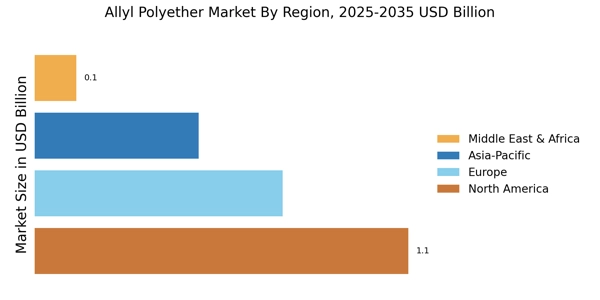
  • North America remains the largest market for allyl polyether, driven by its extensive applications in various industries.
  • Asia-Pacific is identified as the fastest-growing region, reflecting a surge in demand from emerging economies.
  • The adhesives segment holds the largest share, while the coatings segment is witnessing the fastest growth due to innovative applications.
  • Key market drivers include sustainability initiatives and regulatory support, which are propelling the adoption of allyl polyether across diverse sectors.

Market Size & Forecast

2024 Market Size 2.374 (USD Billion)
2035 Market Size 4.375 (USD Billion)
CAGR (2025 - 2035) 5.71%

Major Players

Hexion Inc (US), Mitsubishi Chemical Corporation (JP), BASF SE (DE), Huntsman Corporation (US), SABIC (SA), Arkema S.A. (FR), DOW Inc (US), Momentive Performance Materials Inc (US)

Allyl Polyether Market Trends

The Allyl Polyether Market is currently experiencing a dynamic phase characterized by evolving applications and increasing demand across various industries. This versatile polymer is utilized in sectors such as coatings, adhesives, and composites, where its unique properties enhance product performance. The growing emphasis on sustainable materials is likely to drive innovation within this market, as manufacturers seek to develop eco-friendly alternatives that meet regulatory standards. Furthermore, advancements in production technologies may lead to improved efficiency and cost-effectiveness, thereby attracting new entrants and expanding the overall market landscape. In addition, The Allyl Polyether Market. Industries are increasingly recognizing the benefits of incorporating allyl polyethers into their formulations, which can result in enhanced durability and resistance to environmental factors. As research and development efforts continue to flourish, the market appears poised for growth, with potential opportunities emerging in emerging economies. Overall, the Allyl Polyether Market seems to be on a trajectory of expansion, driven by innovation, sustainability, and a growing awareness of the material's advantages across diverse applications.

Sustainability Initiatives

The trend towards sustainability is becoming increasingly prominent within the Allyl Polyether Market. Manufacturers are focusing on developing eco-friendly formulations that align with environmental regulations. This shift not only addresses consumer preferences for greener products but also encourages innovation in production processes.

Technological Advancements

Technological progress is playing a crucial role in shaping the Allyl Polyether Market. Enhanced production techniques are likely to improve efficiency and reduce costs, making allyl polyethers more accessible to a broader range of industries. This could lead to increased adoption and diversification of applications.

Rising Demand in Emerging Markets

Emerging markets are showing a growing interest in allyl polyethers, driven by industrialization and infrastructure development. As these regions expand their manufacturing capabilities, the demand for high-performance materials is expected to rise, presenting new opportunities for market participants.

Allyl Polyether Market Drivers

Regulatory Support

Regulatory support is emerging as a vital driver for the Allyl Polyether Market. Governments worldwide are increasingly implementing regulations that promote the use of safer and more sustainable materials. This regulatory landscape encourages industries to transition towards allyl polyethers, which are often viewed as safer alternatives to conventional chemicals. For instance, regulations aimed at reducing volatile organic compounds (VOCs) in products have led to a heightened interest in allyl polyethers, which typically exhibit lower VOC emissions. Additionally, incentives for using environmentally friendly materials further bolster the market. As regulatory frameworks continue to evolve, the Allyl Polyether Market is likely to see increased adoption and integration of these materials across various applications.

Sustainability Initiatives

The increasing emphasis on sustainability initiatives is a pivotal driver for the Allyl Polyether Market. As industries strive to reduce their environmental footprint, the demand for eco-friendly materials has surged. Allyl polyethers, known for their biodegradable properties, align well with these sustainability goals. This shift is particularly evident in sectors such as construction and packaging, where companies are actively seeking alternatives to traditional materials. According to recent data, the market for sustainable materials is projected to grow at a compound annual growth rate of over 10% in the coming years. This trend not only reflects consumer preferences but also regulatory pressures that encourage the adoption of greener solutions. Consequently, the Allyl Polyether Market stands to benefit significantly from this growing focus on sustainability.

Technological Advancements

Technological advancements play a crucial role in shaping the Allyl Polyether Market. Innovations in production processes and formulations have led to enhanced performance characteristics of allyl polyethers, making them more appealing to various applications. For instance, advancements in polymerization techniques have improved the efficiency and cost-effectiveness of allyl polyether production. This has resulted in a broader range of products that cater to specific industry needs, such as adhesives, coatings, and composites. Furthermore, the integration of smart technologies in manufacturing processes is expected to streamline operations and reduce waste, thereby increasing profitability. As industries continue to adopt these technological innovations, the Allyl Polyether Market is likely to experience robust growth, driven by the demand for high-performance materials.

Rising Demand in Emerging Markets

The rising demand in emerging markets is a significant driver for the Allyl Polyether Market. As economies in regions such as Asia-Pacific and Latin America continue to develop, there is an increasing need for advanced materials in various sectors, including automotive, construction, and consumer goods. The expanding middle class in these regions is also contributing to higher consumption rates of products that utilize allyl polyethers. Market data indicates that the Asia-Pacific region alone is expected to account for a substantial share of the allyl polyether market by 2026, driven by rapid industrialization and urbanization. This trend presents lucrative opportunities for manufacturers and suppliers within the Allyl Polyether Market, as they seek to establish a foothold in these burgeoning markets.

Growing Applications in Diverse Industries

The growing applications of allyl polyethers across diverse industries serve as a compelling driver for the Allyl Polyether Market. These materials are increasingly utilized in sectors such as automotive, electronics, and healthcare due to their unique properties, including chemical resistance and flexibility. For example, in the automotive industry, allyl polyethers are used in coatings and adhesives that enhance vehicle performance and durability. Similarly, in the electronics sector, they are employed in encapsulation and insulation applications. The versatility of allyl polyethers allows for their integration into a wide range of products, thereby expanding their market reach. As industries continue to explore innovative applications, the Allyl Polyether Market is poised for sustained growth, driven by the demand for multifunctional materials.
Market Segment Insights

By Application: Adhesives (Largest) vs. Coatings (Fastest-Growing)

The Allyl Polyether Market's application segment exhibits a diverse distribution among adhesives, coatings, plastics, and textiles. Currently, adhesives hold the largest market share, reflecting their critical role across industries such as construction and automotive. Coatings, while smaller in comparison, showcase significant growth potential due to increasing demand in the automotive and architectural sectors for enhanced durability and aesthetics. Textiles and plastics continue to serve niche segments, rounding out the application spectrum.

Adhesives: Dominant vs. Coatings: Emerging

Adhesives are currently the dominant application in the Allyl Polyether Market, primarily due to their extensive usage in various industries, including construction, packaging, and automotive, where bonding strength and durability are essential. The versatility of adhesives in providing various functionalities makes them crucial for many applications. On the other hand, coatings represent an emerging segment, benefitting from advancements in formulation technology to deliver improved performance characteristics, such as resistance to chemical exposure and environmental factors. Their growing importance in enhancing product lifespan and environmental sustainability positions coatings as an increasingly valuable segment in the market.

By Formulation Type: Liquid (Largest) vs. Powder (Fastest-Growing)

In the Allyl Polyether Market, the formulation types are primarily categorized into Liquid, Solid, and Powder. Among these, Liquid formulations hold the largest market share, attributed to their versatility and widespread applicability across various industries. Solid formulations follow, while Powder formulations are gaining traction due to their growing popularity in specific applications. The distribution indicates a clear preference for Liquid formulations, reflecting their established demand and usage in formulations requiring quick and efficient processing.

Liquid (Dominant) vs. Powder (Emerging)

Liquid formulation types of Allyl Polyether Market remain dominant in the market, largely due to their ease of use and ability to dissolve quickly in mixtures, which is critical for many industrial applications. These formulations are frequently employed in industries such as coatings, adhesives, and formulations requiring high reactivity and low viscosity. On the other hand, Powder formulations are emerging rapidly, becoming a preferred choice for applications that require extended shelf life and controlled dosage. The growth in Powder formulations can be attributed to innovations in processing techniques and the demand for materials in specific formulations that require precise concentrations without compromising stability.

By End Use Industry: Automotive (Largest) vs. Electronics (Fastest-Growing)

In the Allyl Polyether Market, the automotive industry commands the largest share, driven primarily by the increasing demand for lightweight materials and enhanced performance in vehicles. As automotive manufacturers adopt advanced composites and polymer materials for their production, the segment is poised for sustained growth. Following closely, the electronic sector shows promising growth, fueled by technological advancements and the rising need for sophisticated materials that enhance electronic devices' performance and durability. The growth trends for the automotive and electronics segments illustrate a dynamic shift in consumer preferences and industry innovations. While the automotive sector continues to benefit from advancements in automotive technology and environmental regulations, the electronics sector is emerging rapidly due to the proliferation of smart devices and the demand for lightweight, high-performance materials. This dual momentum is expected to shape the future landscape of the Allyl Polyether Market significantly.

Automotive: Dominant vs. Electronics: Emerging

The automotive segment stands out as the dominant force in the Allyl Polyether Market, characterized by its extensive application in manufacturing parts that require high durability and lightweight properties. Automotive manufacturers prefer allyl polyether due to its exceptional mechanical and thermal properties, which enhance vehicle performance and fuel efficiency. On the other hand, the electronics segment is emerging vigorously, driven by innovation in consumer electronics and electrical components. Electronics manufacturers are increasingly adopting allyl polyether to meet the rising demands for miniaturization and improved thermal stability in devices. This competition between a dominant automotive segment and an emerging electronics segment illustrates the versatility of allyl polyether, catering to diverse industrial needs.

By Chemical Composition: Allyl Glycidyl Ether (Largest) vs. Allyl Alcohol (Fastest-Growing)

The Chemical Composition segment of the Allyl Polyether Market features a diverse range of products, with Allyl Glycidyl Ether commanding the largest market share. This segment's distribution reflects various applications in the industry, showcasing the significance of both established and emerging chemical compositions. Allyl Alcohol and Allyl Phenol also contribute to market dynamics, offering unique properties that cater to specific industrial needs, thus creating a healthy competitive landscape. Growth trends within this segment are influenced by increasing demand for eco-friendly products and advancements in chemical technologies. Allyl Alcohol, in particular, is witnessing rapid growth due to its versatility and expanding applications in coatings, adhesives, and agrochemicals. The push towards sustainable and high-performance materials is expected to drive further innovation and expansion in the Allyl Polyether Market, enhancing its overall market trajectory.

Allyl Glycidyl Ether (Dominant) vs. Allyl Phenol (Emerging)

Allyl Glycidyl Ether is currently the dominant force within the Chemical Composition segment of the Allyl Polyether Market, renowned for its stability and effectiveness in various applications, including epoxy resins and coatings. Its ability to enhance product performance and environmental resistance positions it favorably against competitors. On the other hand, Allyl Phenol is emerging as a vital player, known for its unique chemical properties that promote antimicrobial effects and improve thermal stability in formulations. As the industry shifts towards innovative solutions, Allyl Phenol is gaining traction, driven by its potential in advanced applications. This dynamic interplay between dominant and emerging chemical compositions is expected to shape the future landscape of the Allyl Polyether Market.

Get more detailed insights about Allyl Polyether Market

Regional Insights

North America : Innovation and Demand Surge

North America is witnessing significant growth in the Allyl Polyether Market, driven by increasing demand in the automotive and construction sectors. The region holds approximately 45% of the global market share, making it the largest market for Allyl Polyether Market. Regulatory support for sustainable materials and innovations in chemical manufacturing are further propelling this growth. The United States is the leading country in this region, with major players like Hexion Inc and Huntsman Corporation dominating the landscape. The competitive environment is characterized by continuous innovation and strategic partnerships among key players. The presence of advanced manufacturing facilities and a strong focus on R&D are also contributing to the region's market strength.

Europe : Regulatory Support and Innovation

Europe is emerging as a significant player in the Allyl Polyether Market, driven by stringent regulations promoting eco-friendly materials and innovations in chemical processes. The region accounts for about 30% of the global market share, making it the second-largest market. The European Union's commitment to sustainability and circular economy initiatives is a key driver for market growth. Germany and France are the leading countries in this region, with companies like BASF SE and Arkema S.A. leading the charge. The competitive landscape is marked by a focus on sustainable practices and technological advancements. The presence of established chemical manufacturers and a robust regulatory framework further enhance the market's potential.

Asia-Pacific : Emerging Markets and Growth Potential

Asia-Pacific is rapidly becoming a key player in the Allyl Polyether Market, driven by industrialization and increasing demand from the construction and automotive sectors. The region holds around 20% of the global market share, with countries like Japan and China leading the charge. The growth is supported by favorable government policies and investments in infrastructure development. Japan is a significant contributor to the market, with major companies like Mitsubishi Chemical Corporation actively participating. The competitive landscape is evolving, with both established players and new entrants focusing on innovation and sustainability. The region's potential for growth is further enhanced by rising consumer awareness and demand for high-performance materials.

Middle East and Africa : Resource-Rich and Growing Demand

The Middle East and Africa region is witnessing a gradual increase in the Allyl Polyether Market, driven by growing industrial activities and demand for advanced materials. The region currently holds about 5% of the global market share, with potential for significant growth as infrastructure projects expand. Regulatory frameworks are evolving to support the chemical industry, fostering a conducive environment for market development. Countries like Saudi Arabia and South Africa are at the forefront of this growth, with key players such as SABIC making substantial investments in chemical manufacturing. The competitive landscape is characterized by a mix of local and international companies, focusing on innovation and sustainability to meet the rising demand for high-quality materials.

Allyl Polyether Market Regional Image

Key Players and Competitive Insights

The Allyl Polyether Market is currently characterized by a dynamic competitive landscape, driven by increasing demand across various applications, including coatings, adhesives, and composites. Key players such as Hexion Inc (US), Mitsubishi Chemical Corporation (JP), and BASF SE (DE) are strategically positioning themselves through innovation and regional expansion. Hexion Inc (US) has focused on enhancing its product portfolio with advanced formulations, while Mitsubishi Chemical Corporation (JP) emphasizes sustainability in its operations, aiming to reduce environmental impact. BASF SE (DE) is leveraging its extensive research capabilities to develop high-performance materials, thereby shaping a competitive environment that prioritizes technological advancement and sustainability.

In terms of business tactics, companies are increasingly localizing manufacturing to reduce lead times and optimize supply chains. The market appears moderately fragmented, with several players vying for market share, yet the collective influence of major companies is significant. This competitive structure allows for a diverse range of products and innovations, catering to the evolving needs of end-users while fostering a collaborative atmosphere among industry leaders.

In August 2025, Hexion Inc (US) announced a strategic partnership with a leading automotive manufacturer to develop next-generation adhesive solutions tailored for electric vehicles. This collaboration is poised to enhance Hexion's market presence in the automotive sector, aligning with the industry's shift towards electrification and lightweight materials. The partnership underscores Hexion's commitment to innovation and positions it favorably in a rapidly evolving market.

Similarly, in July 2025, BASF SE (DE) launched a new line of eco-friendly allyl polyethers designed for use in sustainable construction materials. This initiative not only reflects BASF's dedication to sustainability but also addresses the growing demand for environmentally responsible products. By integrating sustainability into its core offerings, BASF is likely to strengthen its competitive edge and appeal to a broader customer base.

Moreover, in September 2025, Mitsubishi Chemical Corporation (JP) unveiled a digital platform aimed at enhancing customer engagement and streamlining the supply chain for its allyl polyether products. This digital transformation initiative is expected to improve operational efficiency and foster closer relationships with clients, thereby enhancing Mitsubishi's market positioning. The move indicates a broader trend within the industry towards leveraging technology to optimize processes and enhance customer satisfaction.

As of October 2025, the competitive trends in the Allyl Polyether Market are increasingly defined by digitalization, sustainability, and the integration of artificial intelligence. Strategic alliances are becoming more prevalent, as companies recognize the value of collaboration in driving innovation and addressing market challenges. Looking ahead, it appears that competitive differentiation will evolve from traditional price-based strategies to a focus on innovation, technological advancements, and supply chain reliability, ultimately shaping a more resilient and forward-thinking market landscape.

Key Companies in the Allyl Polyether Market market include

Industry Developments

The  Allyl Polyether Market is currently witnessing significant developments, particularly in terms of partnerships and financial growth among key players such as Kraton Corporation, Mitsui Chemicals, BASF, and Huntsman Corporation. Increased demand for eco-friendly materials has been a focal point, pushing companies like Dupont and SABIC to innovate and expand their product lines to meet sustainability goals. Recent advancements in manufacturing technology have also contributed to the market's growth, enhancing production efficiency. Notably, Evonik Industries and Eastman Chemical have focused on expanding their operations to cater to the rising  demand.

There are ongoing strategic initiatives to explore mergers and acquisitions among these players as companies assess potential synergies. LG Chem and Kumho P and B have shown interest in consolidating their positions via strategic alignments. As the market gears towards evolving customer preferences, RPG Life Sciences and DOW are actively exploring new segments for product diversification. The collective efforts by these companies are indicative of a dynamic marketplace, benefiting from both technological innovations and strategic collaborations, shaping the landscape of the  Allyl Polyether Market.

Future Outlook

Allyl Polyether Market Future Outlook

The Allyl Polyether Market is projected to grow at a 5.71% CAGR from 2024 to 2035, driven by increasing demand in coatings, adhesives, and advanced materials.

New opportunities lie in:

  • Development of bio-based allyl polyether products
  • Expansion into emerging markets with tailored solutions
  • Investment in R&D for high-performance applications

By 2035, the Allyl Polyether Market is expected to achieve robust growth and enhanced market presence.

Market Segmentation

Allyl Polyether Market Application Outlook

  • Adhesives
  • Coatings
  • Plastics
  • Textiles

Allyl Polyether Market End Use Industry Outlook

  • Automotive
  • Construction
  • Consumer Goods
  • Electronics

Allyl Polyether Market Formulation Type Outlook

  • Liquid
  • Solid
  • Powder

Allyl Polyether Market Chemical Composition Outlook

  • Allyl Glycidyl Ether
  • Allyl Alcohol
  • Allyl Phenol

Report Scope

MARKET SIZE 20242.374(USD Billion)
MARKET SIZE 20252.51(USD Billion)
MARKET SIZE 20354.375(USD Billion)
COMPOUND ANNUAL GROWTH RATE (CAGR)5.71% (2024 - 2035)
REPORT COVERAGERevenue Forecast, Competitive Landscape, Growth Factors, and Trends
BASE YEAR2024
Market Forecast Period2025 - 2035
Historical Data2019 - 2024
Market Forecast UnitsUSD Billion
Key Companies ProfiledMarket analysis in progress
Segments CoveredMarket segmentation analysis in progress
Key Market OpportunitiesGrowing demand for eco-friendly materials drives innovation in the Allyl Polyether Market.
Key Market DynamicsRising demand for eco-friendly materials drives innovation and competition in the Allyl Polyether market.
Countries CoveredNorth America, Europe, APAC, South America, MEA

Leave a Comment

FAQs

What is the projected market valuation of the Allyl Polyether Market by 2035?

The Allyl Polyether Market is projected to reach a valuation of 4.375 USD Billion by 2035.

What was the market valuation of the Allyl Polyether Market in 2024?

In 2024, the Allyl Polyether Market was valued at 2.374 USD Billion.

What is the expected CAGR for the Allyl Polyether Market during the forecast period 2025 - 2035?

The expected CAGR for the Allyl Polyether Market during the forecast period 2025 - 2035 is 5.71%.

Which companies are considered key players in the Allyl Polyether Market?

Key players in the Allyl Polyether Market include Hexion Inc, Mitsubishi Chemical Corporation, BASF SE, Huntsman Corporation, SABIC, Arkema S.A., DOW Inc, and Momentive Performance Materials Inc.

What are the main application segments of the Allyl Polyether Market?

The main application segments of the Allyl Polyether Market include Adhesives, Coatings, Plastics, and Textiles.

What is the valuation range for the Adhesives segment in the Allyl Polyether Market?

The valuation range for the Adhesives segment in the Allyl Polyether Market is projected to be between 0.712 and 1.325 USD Billion.

How does the valuation of the Powder formulation type compare to other types?

The Powder formulation type is expected to have a valuation range of 0.95 to 1.725 USD Billion, which is higher than both Liquid and Solid types.

What end-use industries are driving the demand for Allyl Polyether?

The end-use industries driving demand for Allyl Polyether include Automotive, Construction, Consumer Goods, and Electronics.

What is the projected valuation for the Chemical Composition segment of Allyl Polyether by 2035?

The projected valuation for the Chemical Composition segment, including Allyl Glycidyl Ether, Allyl Alcohol, and Allyl Phenol, is expected to grow significantly by 2035.

Download Free Sample

Kindly complete the form below to receive a free sample of this Report

Compare Licence

×
Features License Type
Single User Multiuser License Enterprise User
Price $4,950 $ $7,250
Maximum User Access Limit 1 User Upto 10 Users Unrestricted Access Throughout the Organization
Free Customization
Direct Access to Analyst
Deliverable Format
Platform Access
Discount on Next Purchase 10% 15% 15%
Printable Versions