×
Request Free Sample ×

Kindly complete the form below to receive a free sample of this Report

* Please use a valid business email

Leading companies partner with us for data-driven Insights

clients tt-cursor
Hero Background

Ambient Assisted Living Market

ID: MRFR/SEM/0509-CR
100 Pages
Shubham Munde
April 2018

Ambient Assisted Living Market Research Report Information by System (Safety & Security System, Communication System, Medical Assistance System, Power Management System, Entertainment, Transportation and Communication Systems and Others) By Sensors (Temperature Sensor, Occupancy Sensor, and Others), By Service (Customization & Renovation, Installation & Repair), and By Region (North America, Europe, Asia-Pacific, Middle East & Africa, and South America) - Industry Forecast till 2035

Share:
Download PDF ×

We do not share your information with anyone. However, we may send you emails based on your report interest from time to time. You may contact us at any time to opt-out.

Ambient Assisted Living Market Infographic
Purchase Options

Ambient Assisted Living Market Summary

As per MRFR analysis, the Ambient Assisted Living Market Size was estimated at 9846.22 USD Million in 2024. The Ambient Assisted Living industry is projected to grow from 12355.24 in 2025 to 119582.11 by 2035, exhibiting a compound annual growth rate (CAGR) of 25.48 during the forecast period 2025 - 2035.

Key Market Trends & Highlights

The Ambient Assisted Living Market is experiencing robust growth driven by technological advancements and an aging population.

  • The integration of smart home technologies is becoming increasingly prevalent in the Ambient Assisted Living Market.
  • User-centric design is gaining traction, ensuring that products meet the specific needs of users, particularly senior citizens.
  • Health monitoring solutions are emphasized, reflecting a growing demand for proactive health management among individuals with disabilities.
  • The aging population and rising healthcare costs are major drivers propelling market expansion in North America and Asia-Pacific.

Market Size & Forecast

2024 Market Size 9846.22 (USD Million)
2035 Market Size 119582.11 (USD Million)
CAGR (2025 - 2035) 25.48%

Major Players

Philips (NL), Siemens (DE), General Electric (US), Honeywell (US), Samsung (KR), IBM (US), Tunstall Healthcare (GB), Lifewatch (CH), Care Innovations (US), Omron (JP)

Ambient Assisted Living Market Trends

The Ambient Assisted Living Market is currently experiencing a notable evolution, driven by the increasing demand for innovative solutions that enhance the quality of life for the elderly and individuals with disabilities. This market encompasses a wide range of technologies and services designed to support independent living, promote safety, and facilitate communication. As the global population ages, the need for effective and user-friendly assistive technologies becomes more pronounced. Stakeholders in this sector are focusing on developing integrated systems that combine health monitoring, emergency response, and social engagement features, thereby addressing the multifaceted needs of users. Moreover, the Ambient Assisted Living Market is witnessing a shift towards personalized solutions that cater to individual preferences and lifestyles. Companies are investing in research and development to create adaptable technologies that can seamlessly integrate into users' daily routines. This trend is further supported by advancements in artificial intelligence and the Internet of Things, which enable smarter and more responsive environments. As a result, the market is poised for continued growth, with an emphasis on enhancing user experience and ensuring accessibility for all. The future landscape of this market appears promising, as it aligns with broader societal trends towards aging in place and maintaining autonomy for vulnerable populations.

Integration of Smart Home Technologies

The Ambient Assisted Living Market is increasingly integrating smart home technologies to create environments that enhance safety and comfort for users. These systems often include automated lighting, temperature control, and security features that can be managed remotely. Such integration not only simplifies daily tasks but also provides peace of mind for caregivers and family members.

Focus on User-Centric Design

There is a growing emphasis on user-centric design within the Ambient Assisted Living Market. Products and services are being developed with the end-user in mind, ensuring that they are intuitive and easy to use. This trend aims to reduce barriers to technology adoption, particularly among older adults who may be less familiar with digital interfaces.

Emphasis on Health Monitoring Solutions

The Ambient Assisted Living Market is placing a strong emphasis on health monitoring solutions that enable proactive management of health conditions. Wearable devices and remote monitoring systems are becoming increasingly popular, allowing for real-time health data collection and analysis. This trend supports timely interventions and enhances overall well-being for users.

Ambient Assisted Living Market Drivers

Aging Population

The Global Ambient Assisted Living Market Industry is significantly driven by the increasing aging population worldwide. As of 2024, the global population aged 65 and older is projected to reach approximately 1.5 billion, highlighting a growing need for innovative solutions to support independent living. This demographic shift necessitates the development of technologies that can assist older adults in their daily activities while ensuring their safety and well-being. The demand for ambient assisted living solutions is expected to rise, as these technologies can enhance the quality of life for seniors, allowing them to age in place and maintain their autonomy.

Rising Healthcare Costs

The escalating costs associated with traditional healthcare services are influencing the Global Ambient Assisted Living Market Industry. With healthcare expenditures rising globally, there is an increasing emphasis on cost-effective solutions that can reduce the burden on healthcare systems. Ambient assisted living technologies provide a viable alternative by enabling seniors to receive care in their homes, thereby minimizing hospital visits and institutional care costs. This shift not only alleviates financial pressure on families but also promotes a more sustainable healthcare model. As a result, the market is expected to witness a compound annual growth rate of 25.48% from 2025 to 2035, reflecting the growing preference for home-based care solutions.

Market Growth Projections

The Global Ambient Assisted Living Market Industry is poised for remarkable growth, with projections indicating a market size of 9.85 USD Billion in 2024. This growth trajectory is anticipated to continue, with estimates suggesting a substantial increase to 119.5 USD Billion by 2035. The compound annual growth rate during the period from 2025 to 2035 is expected to be 25.48%, underscoring the rising demand for innovative solutions that cater to the needs of an aging population. These figures reflect the increasing investment in research and development, as well as the growing recognition of the importance of ambient assisted living technologies in enhancing the quality of life for seniors.

Technological Advancements

Rapid advancements in technology are propelling the Global Ambient Assisted Living Market Industry forward. Innovations in smart home devices, wearable health monitors, and telehealth services are transforming how care is delivered to older adults. For instance, the integration of artificial intelligence and machine learning in ambient assisted living solutions enables personalized care and real-time monitoring of health conditions. These technologies not only improve the efficiency of care but also empower seniors to manage their health proactively. As the market evolves, the adoption of these advanced technologies is likely to drive substantial growth, with the industry projected to reach 119.5 USD Billion by 2035.

Consumer Awareness and Acceptance

Growing consumer awareness regarding the benefits of ambient assisted living technologies is shaping the Global Ambient Assisted Living Market Industry. As more individuals become informed about the advantages of these solutions, including improved safety, health monitoring, and enhanced quality of life, acceptance rates are rising. Educational campaigns and community outreach programs are playing a crucial role in disseminating information about available technologies. This heightened awareness is likely to drive demand, as families seek to implement these solutions for their elderly loved ones. Consequently, the market is expected to expand, reflecting the increasing recognition of the value of ambient assisted living in supporting aging populations.

Government Initiatives and Funding

Government initiatives aimed at promoting independent living for seniors are a key driver of the Global Ambient Assisted Living Market Industry. Various countries are implementing policies and funding programs to support the development and adoption of ambient assisted living technologies. For example, initiatives that provide financial incentives for the installation of smart home devices and assistive technologies are becoming increasingly common. These efforts not only enhance accessibility but also encourage innovation in the sector. As governments recognize the importance of supporting their aging populations, the market is likely to experience significant growth, aligning with the projected increase in demand for ambient assisted living solutions.

Market Segment Insights

By Application: Remote Monitoring (Largest) vs. Emergency Response (Fastest-Growing)

The Ambient Assisted Living Market showcases a diverse range of application segments, with Remote Monitoring holding the largest share. This segment enables caregivers to monitor the health and safety of elderly individuals from a distance. Following closely is the Emergency Response segment, which is rapidly gaining traction as it supports immediate assistance in critical situations, appealing to tech-savvy caregivers. Other notable segments like Medication Management, Social Interaction, and Health Management are crucial but have a smaller market presence compared to these two leading applications.

Remote Monitoring (Dominant) vs. Emergency Response (Emerging)

Remote Monitoring remains a dominant force within the Ambient Assisted Living Market by facilitating continuous oversight of patients' health through connected devices and smart technology. It allows families and health professionals to track vital signs and detect potential issues early. In contrast, the Emergency Response segment is emerging as a vital solution, characterized by its speed and effectiveness in crisis situations. This segment benefits from advancements in wearable technology and smartphone applications, offering instantaneous alerts and quick communication with emergency services, thus enhancing user safety and peace of mind.

By End Use: Senior Citizens (Largest) vs. Individuals with Disabilities (Fastest-Growing)

In the Ambient Assisted Living Market, the segment composition highlights Senior Citizens as the largest demographic, driving a significant portion of the market demand. Meanwhile, Individuals with Disabilities are emerging as the fastest-growing segment, driven by increasing awareness and the need for accessible solutions tailored to their unique challenges. Chronic Illness Patients, Caregivers, and Healthcare Providers also contribute to the overall market dynamics, but their shares are comparatively smaller in terms of market distribution. As the population ages and the prevalence of disabilities rises globally, the demand for innovative assisted living solutions is accelerating. Growth in this segment is propelled by advancements in technology, such as wearable health devices and smart home systems, designed to enhance the quality of life for these groups. Furthermore, there is an increasing emphasis on personalized care, which is transforming the landscape of assisted living, making it more adaptive to the needs of Senior Citizens and Individuals with Disabilities.

Senior Citizens: Dominant vs. Individuals with Disabilities: Emerging

The segment of Senior Citizens is characterized by its substantial market presence, as this demographic often requires comprehensive support systems to maintain independence while ensuring safety. With an emphasis on services that enhance daily living, such as monitoring systems, mobility aids, and health management tools, Senior Citizens represent a critical target for companies in the Ambient Assisted Living Market. Conversely, Individuals with Disabilities are rapidly emerging as a pivotal segment, driven by a growing demand for tailored technologies that address specific needs, including mobility and communication challenges. This emerging group is increasingly prioritized in product development, reflecting a shift towards inclusivity and the enhancement of quality of life through targeted assisted living solutions.

By Technology: Wearable Devices (Largest) vs. Smart Home Solutions (Fastest-Growing)

The Ambient Assisted Living Market is experiencing a significant shift in technological adoption, with wearable devices holding the largest market share. These devices are integral for monitoring health parameters and providing real-time feedback to users and caregivers. Following this, smart home solutions are rapidly gaining traction, providing enhancements in comfort and safety for the elderly population, and collectively contributing to an increasingly tech-driven living environment. Emerging trends are driving the growth of these technologies, particularly in the areas of IoT integration and AI advancements. Telehealth services and mobile applications are also contributing to market expansion, facilitating remote healthcare access and enhancing patient engagement. Robotics, while still developing, is anticipated to play a larger role in providing assistance and companionship, indicating a trend toward more automated and intelligent living frameworks.

Wearable Devices: Dominant vs. Robotics: Emerging

Wearable devices are revolutionizing the Ambient Assisted Living Market by providing continuous health monitoring, fall detection, and activity tracking. Their dominance stems from the emphasis on individual health management and preventive care, appealing to both users and caregivers alike. In contrast, robotics as an emerging technology is poised to complement these devices by offering physical assistance and companionship, thereby improving quality of life for the elderly. While still at an early stage, innovations in robotic technology are being developed to enhance mobility, perform daily tasks, and connect with smart home systems, creating a synergy that can further enhance the living conditions of seniors.

By Service Type: Installation Services (Largest) vs. Support Services (Fastest-Growing)

In the Ambient Assisted Living Market, the distribution of service types reveals notable insights into market dynamics. Installation Services represent the largest segment, primarily driven by the increasing demand for integrated living solutions that require setup and configuration. Following closely are Support Services, which are quickly gaining traction as more consumers seek ongoing assistance and reassurance in managing their ambient living environments. The diversification of service needs is evident among end-users, reflecting their specific requirements for tailored assistance. The growth trends in this segment are closely tied to demographic shifts, with an aging population increasingly looking for solutions that foster independence while ensuring safety. Additionally, the rise of smart home technologies enhances the demand for Maintenance and Training Services, as users require regular updates and education to optimize their systems. Emerging trends in digital support are further propelling growth in Support Services, indicating a shift towards continuous engagement and remote assistance.

Installation Services (Dominant) vs. Support Services (Emerging)

Installation Services in the Ambient Assisted Living Market are characterized by their critical role in the deployment of technology tailored to enhance the quality of life for seniors and individuals with disabilities. This segment enjoys a dominant position as it lays the foundational framework upon which all other services operate. Conversely, Support Services are emerging as a crucial component, reflecting a growing recognition of the need for continuous user engagement and assistance post-installation. These services encompass troubleshooting, ongoing maintenance, and user training, positioning them as essential for ensuring long-term satisfaction and functionality of ambient living solutions. The interplay between established Installation Services and the burgeoning Support Services highlights a holistic approach to care, where initial setup is complemented by ongoing support.

By Product Type: Monitoring Systems (Largest) vs. Communication Devices (Fastest-Growing)

The Ambient Assisted Living Market showcases a diverse range of product types, notably, Monitoring Systems, Communication Devices, Mobility Aids, Environmental Control Systems, and Safety Devices. Monitoring Systems currently hold the largest market share as they are integral in ensuring the health and safety of individuals requiring assistance. These systems include various technologies like health monitoring software and wearables, which provide real-time data and alerts to caregivers and families, enhancing the overall quality of care. On the other hand, Communication Devices are rapidly gaining traction as the fastest-growing segment within this market. This surge is driven by advancements in technology that enable more seamless interaction between seniors and their caregivers. Features such as video calling, voice assistants, and user-friendly interfaces are increasingly being tailored for older adults, promoting independence and connectivity, making this segment particularly appealing in today’s digital landscape.

Monitoring Systems (Dominant) vs. Communication Devices (Emerging)

Monitoring Systems are a dominant force in the Ambient Assisted Living Market, equipped with advanced technologies that enable constant surveillance of the well-being of elderly and disabled individuals. These systems typically incorporate sensors, cameras, and data analytics, providing caregivers with crucial information on vital signs and daily activities. As aging populations grow, the relevance of Monitoring Systems is further emphasized due to their ability to improve patient outcomes and reduce hospital readmissions. Conversely, Communication Devices are categorized as an emerging segment, driven by significant technological advancements. These devices are designed to facilitate easier communication between seniors and their families or medical professionals, thus boosting social engagement and mental health. Features like simplified interfaces and accessibility options result in increased usability for the elderly, setting the stage for sustained growth.

Get more detailed insights about Ambient Assisted Living Market

Regional Insights

North America : Market Leader in AAL Solutions

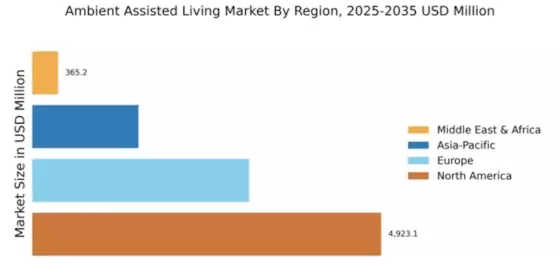
North America is poised to maintain its leadership in the Ambient Assisted Living (AAL) market, with a projected market size of $4923.11 million by December 2025. Key growth drivers include an aging population, increasing healthcare costs, and a rising demand for innovative healthcare solutions. Regulatory support, such as the Affordable Care Act, encourages the adoption of AAL technologies, enhancing market growth prospects. The competitive landscape in North America is robust, featuring major players like Philips, General Electric, and Honeywell. The U.S. leads the market, driven by technological advancements and significant investments in healthcare infrastructure. The presence of established companies fosters innovation, while partnerships with healthcare providers enhance service delivery, ensuring a comprehensive approach to AAL solutions.

Europe : Emerging Market with Growth Potential

Europe's Ambient Assisted Living market is on a growth trajectory, with a market size of €3057.86 million anticipated by December 2025. Factors driving this growth include an increasing elderly population, government initiatives promoting smart home technologies, and a focus on enhancing the quality of life for seniors. The European Union's Digital Single Market strategy supports the integration of AAL solutions, fostering innovation and accessibility across member states. Leading countries in this region include Germany, the UK, and France, where significant investments in healthcare technology are evident. Key players such as Siemens and Tunstall Healthcare are actively contributing to market expansion. The competitive landscape is characterized by collaborations between technology firms and healthcare providers, ensuring that AAL solutions are tailored to meet the specific needs of the aging population.

Asia-Pacific : Rapidly Growing AAL Sector

The Asia-Pacific region is witnessing rapid growth in the Ambient Assisted Living market, projected to reach $1500.0 million by December 2025. Key drivers include a rising elderly population, increasing urbanization, and a growing awareness of healthcare technologies. Governments are implementing policies to support the adoption of AAL solutions, enhancing the overall market environment and encouraging investment in innovative technologies. Countries like Japan, China, and Australia are leading the charge in AAL adoption, with significant contributions from companies such as Omron and Samsung. The competitive landscape is evolving, with local startups emerging alongside established players, fostering innovation and tailored solutions for the region's unique demographic challenges. This dynamic environment is set to propel the AAL market forward in Asia-Pacific.

Middle East and Africa : Emerging Market with Challenges

The Ambient Assisted Living market in the Middle East and Africa is gradually developing, with a projected market size of $365.25 million by December 2025. Key growth drivers include an increasing elderly population and a rising demand for healthcare solutions. However, challenges such as limited infrastructure and varying regulatory frameworks across countries may hinder rapid growth. Governments are beginning to recognize the importance of AAL technologies, which could catalyze future market expansion. Leading countries in this region include South Africa and the UAE, where investments in healthcare technology are gaining momentum. The competitive landscape is characterized by a mix of local and international players, including Lifewatch and Care Innovations. As awareness of AAL solutions grows, the market is expected to evolve, addressing the unique needs of the aging population in this diverse region.

Key Players and Competitive Insights

The Ambient Assisted Living Market is currently characterized by a dynamic competitive landscape, driven by an increasing demand for innovative solutions that enhance the quality of life for the aging population. Key players such as Philips (NL), Siemens (DE), and General Electric (US) are at the forefront, each adopting distinct strategies to solidify their market positions. Philips (NL) emphasizes innovation through its development of advanced health monitoring systems, while Siemens (DE) focuses on integrating smart home technologies to create seamless living environments. General Electric (US) appears to be leveraging its extensive experience in healthcare to expand its offerings in remote patient monitoring, thereby enhancing its competitive edge.

In terms of business tactics, companies are increasingly localizing manufacturing to reduce costs and improve supply chain efficiency. The market structure is moderately fragmented, with several players vying for market share, yet the influence of major companies remains substantial. This competitive environment fosters innovation and encourages collaboration among firms, as they seek to differentiate their offerings in a crowded marketplace.

In November 2025, Honeywell (US) announced a strategic partnership with a leading telehealth provider to enhance its remote monitoring capabilities. This collaboration is likely to bolster Honeywell's position in the market by integrating advanced telehealth solutions into its existing product lines, thereby addressing the growing demand for comprehensive health management systems. Such partnerships may also facilitate the development of more user-friendly interfaces, appealing to a broader demographic.

In October 2025, Samsung (KR) unveiled a new line of smart home devices specifically designed for elderly care, incorporating AI-driven features that promote safety and independence. This move not only showcases Samsung's commitment to innovation but also positions the company as a key player in the Ambient Assisted Living sector. By focusing on user-centric design and functionality, Samsung (KR) is likely to attract a significant share of the market, particularly among tech-savvy consumers seeking modern solutions for elder care.

In September 2025, IBM (US) launched a new AI platform aimed at enhancing predictive analytics in health monitoring. This initiative is expected to revolutionize how data is utilized in Ambient Assisted Living, allowing for more proactive health management. By harnessing the power of AI, IBM (US) is not only enhancing its product offerings but also setting a new standard for data-driven decision-making in the industry.

As of December 2025, the most pressing trends shaping competition in the Ambient Assisted Living Market include digitalization, sustainability, and the integration of AI technologies. Strategic alliances are increasingly pivotal, as companies recognize the value of collaboration in driving innovation. The competitive landscape is shifting from a focus on price to one centered on technological advancement and supply chain reliability. This evolution suggests that future differentiation will hinge on the ability to deliver innovative, sustainable solutions that meet the diverse needs of consumers.

Key Companies in the Ambient Assisted Living Market market include

Industry Developments

  • Q2 2024: Philips launches next-generation remote monitoring platform for elderly care Philips announced the launch of its new Ambient Assisted Living Market platform, designed to integrate AI-driven fall detection, medication reminders, and real-time health monitoring for seniors living independently. The platform aims to support healthcare providers and families in remote patient management.
  • Q2 2024: CarePredict Secures $29 Million in Series C Funding to Expand AI-Powered Senior Care Solutions CarePredict, a provider of AI-driven ambient assisted living technologies, raised $29 million in Series C funding to accelerate the deployment of its wearable and sensor-based solutions for senior living communities and home care.
  • Q1 2024: Essence Group Partners with Tunstall Healthcare to Deliver Advanced Telecare Solutions in Europe Essence Group announced a strategic partnership with Tunstall Healthcare to co-develop and deploy next-generation telecare and ambient assisted living solutions across European markets, focusing on remote monitoring and emergency response for elderly populations.
  • Q2 2024: Siemens Healthineers acquires minority stake in smart home health startup Senniors Siemens Healthineers acquired a minority stake in Senniors, a Spanish startup specializing in ambient assisted living and smart home health monitoring, to strengthen its digital health portfolio and expand into the European home care market.
  • Q1 2024: Legrand launches new range of connected home devices for assisted living Legrand introduced a new suite of connected home products tailored for ambient assisted living, including smart sensors, voice-activated controls, and emergency alert systems, targeting both residential and institutional care settings.
  • Q2 2024: Vayyar Care Receives CE Mark for 4D Imaging Fall Detection Sensor Vayyar Care, a provider of touchless monitoring solutions, received CE Mark approval for its 4D imaging sensor, enabling commercial deployment of its fall detection and activity monitoring technology in European assisted living facilities.
  • Q1 2024: ADT Health partners with Amazon Alexa to enhance voice-activated emergency response for seniors ADT Health announced a partnership with Amazon Alexa to integrate voice-activated emergency response features into its ambient assisted living solutions, allowing seniors to request help hands-free in case of emergencies.
  • Q2 2024: Resideo Technologies acquires LifeWhere to bolster predictive health monitoring in smart homes Resideo Technologies acquired LifeWhere, a predictive analytics company, to enhance its ambient assisted living offerings with advanced health monitoring and predictive maintenance for smart home environments.
  • Q1 2024: Philips and Teladoc Health expand partnership to deliver remote care for aging populations Philips and Teladoc Health expanded their partnership to integrate Philips' ambient assisted living technologies with Teladoc's telehealth platform, aiming to provide comprehensive remote care and monitoring for elderly patients.
  • Q2 2024: Japan’s SoftBank invests in IoT startup Z-Assist for elderly care solutions SoftBank invested in Z-Assist, a Japanese IoT startup focused on ambient assisted living, to accelerate the development and deployment of smart sensors and AI-driven monitoring systems for senior citizens in Japan.
  • Q1 2024: Alarm.com launches Wellness Platform for independent senior living Alarm.com launched its new Wellness Platform, featuring ambient sensors, AI-powered activity tracking, and emergency alerts, designed to support independent living and safety for seniors at home.
  • Q2 2024: French startup Domalys raises €15 million to scale smart monitoring for care homes Domalys, a French company specializing in ambient assisted living solutions, raised €15 million in funding to expand its smart monitoring systems for care homes and elderly residents across Europe.

Future Outlook

Ambient Assisted Living Market Future Outlook

The Ambient Assisted Living Market is projected to grow at a 25.48% CAGR from 2024 to 2035, driven by technological advancements, aging populations, and increasing healthcare demands.

New opportunities lie in:

  • Development of AI-driven health monitoring systems
  • Integration of smart home technologies for elderly care
  • Expansion of telehealth services tailored for seniors

By 2035, the market is expected to be robust, reflecting substantial growth and innovation.

Market Segmentation

Ambient Assisted Living Market End Use Outlook

  • Senior Citizens
  • Individuals with Disabilities
  • Chronic Illness Patients
  • Caregivers
  • Healthcare Providers

Ambient Assisted Living Market Technology Outlook

  • Wearable Devices
  • Smart Home Solutions
  • Telehealth Services
  • Mobile Applications
  • Robotics

Ambient Assisted Living Market Application Outlook

  • Remote Monitoring
  • Emergency Response
  • Medication Management
  • Social Interaction
  • Health Management

Ambient Assisted Living Market Product Type Outlook

  • Monitoring Systems
  • Communication Devices
  • Mobility Aids
  • Environmental Control Systems
  • Safety Devices

Ambient Assisted Living Market Service Type Outlook

  • Installation Services
  • Maintenance Services
  • Consultation Services
  • Training Services
  • Support Services

Report Scope

MARKET SIZE 20249846.22(USD Million)
MARKET SIZE 202512355.24(USD Million)
MARKET SIZE 2035119582.11(USD Million)
COMPOUND ANNUAL GROWTH RATE (CAGR)25.48% (2024 - 2035)
REPORT COVERAGERevenue Forecast, Competitive Landscape, Growth Factors, and Trends
BASE YEAR2024
Market Forecast Period2025 - 2035
Historical Data2019 - 2024
Market Forecast UnitsUSD Million
Key Companies ProfiledPhilips (NL), Siemens (DE), General Electric (US), Honeywell (US), Samsung (KR), IBM (US), Tunstall Healthcare (GB), Lifewatch (CH), Care Innovations (US), Omron (JP)
Segments CoveredApplication, End Use, Technology, Service Type, Product Type
Key Market OpportunitiesIntegration of artificial intelligence and smart home technologies enhances user experience in the Ambient Assisted Living Market.
Key Market DynamicsRising demand for innovative technologies enhances competitive forces in the Ambient Assisted Living Market.
Countries CoveredNorth America, Europe, APAC, South America, MEA

Market Highlights

Author
Shubham Munde
Research Analyst Level II

With a technical background in information technology & semiconductors, Shubham has 4.5+ years of experience in market research and analytics with the tasks of data mining, analysis, and project execution. He is the POC for our clients, for their consulting projects running under the ICT/Semiconductor domain. Shubham holds a Bachelor’s in Information and Technology and a Master of Business Administration (MBA). Shubham has executed over 150 research projects for our clients under the brand name Market Research Future in the last 2 years. His core skill is building the research respondent relation for gathering the primary information from industry and market estimation for niche markets. He is having expertise in conducting secondary & primary research, market estimations, market projections, competitive analysis, analysing current market trends and market dynamics, deep-dive analysis on market scenarios, consumer behaviour, technological impact analysis, consulting, analytics, etc. He has worked on fortune 500 companies' syndicate and consulting projects along with several government projects. He has worked on the projects of top tech brands such as IBM, Google, Microsoft, AWS, Meta, Oracle, Cisco Systems, Samsung, Accenture, VMware, Schneider Electric, Dell, HP, Ericsson, and so many others. He has worked on Metaverse, Web 3.0, Zero-Trust security, cyber-security, blockchain, quantum computing, robotics, 5G technology, High-Performance computing, data centers, AI, automation, IT equipment, sensors, semiconductors, consumer electronics and so many tech domain projects.

Leave a Comment

FAQs

How much is the Ambient Assisted Living market?

The Ambient Assisted Living market size was valued at USD 9846.22 billion in 2024

What is the market size for 2035, for the Ambient Assisted Living Market?

The global market is projected to reach USD 119582.11 billion by 2035

What is the growth rate of the Ambient Assisted Living market?

The global market is projected to grow at a CAGR of 25.48% during the forecast period, 2025 to 2035.

Which region held the largest market share in the Ambient Assisted Living market?

North America had the largest share in the global market

Who are the prominent players in the Ambient Assisted Living market?

Siemens AG (Germany), Honeywell International, Inc. (U.S.), UTC (Chubb Community Care), Panasonic Corporation (Japan), and ABB Group

Download Free Sample

Kindly complete the form below to receive a free sample of this Report

Compare Licence

×
Features License Type
Single User Multiuser License Enterprise User
Price $4,950 $5,950 $7,250
Maximum User Access Limit 1 User Upto 10 Users Unrestricted Access Throughout the Organization
Free Customization
Direct Access to Analyst
Deliverable Format
Platform Access
Discount on Next Purchase 10% 15% 15%
Printable Versions