×
Request Free Sample ×

Kindly complete the form below to receive a free sample of this Report

* Please use a valid business email

Leading companies partner with us for data-driven Insights

clients tt-cursor
Hero Background

Ambient Lighting Market

ID: MRFR/SEM/2852-HCR
200 Pages
Ankit Gupta
October 2025

Ambient Lighting Market Research Report Information By Type (Down Lighting, Surface Mounted Lighting, Suspended Lighting, Track Lighting), By Applications (Residential, Commercial), And By Region (North America, Europe, Asia-Pacific, And Rest Of The World) – Industry Size, Share and Forecast Till 2035

Share:
Download PDF ×

We do not share your information with anyone. However, we may send you emails based on your report interest from time to time. You may contact us at any time to opt-out.

Ambient Lighting Market Infographic
Purchase Options

Ambient Lighting Market Summary

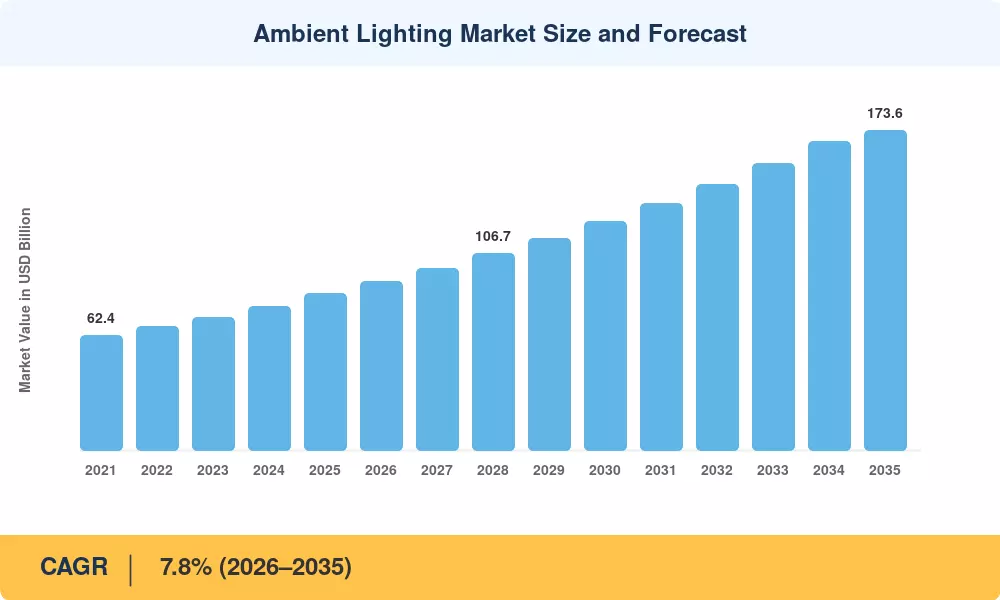
As per MRFR analysis, the Ambient Lighting Market Size was estimated at 78.21 USD Billion in 2024. The Ambient Lighting industry is projected to grow from 86.02 USD Billion in 2025 to 222.74 USD Billion by 2035, exhibiting a compound annual growth rate (CAGR) of 9.98 during the forecast period 2025 - 2035.

Key Market Trends & Highlights

The Ambient Lighting Market is experiencing robust growth driven by technological advancements and changing consumer preferences.

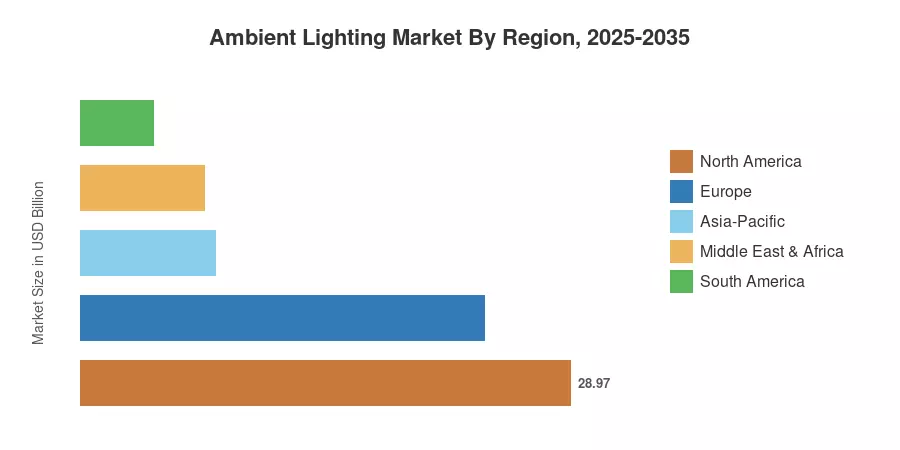
  • North America remains the largest market for ambient lighting, driven by high consumer spending and advanced infrastructure.
  • The Asia-Pacific region is the fastest-growing market, fueled by rapid urbanization and increasing disposable incomes.
  • The residential segment dominates the market, while the commercial segment is witnessing the fastest growth due to rising demand for innovative lighting solutions.
  • Key market drivers include the rising demand for smart homes and growing awareness of energy conservation, which are shaping consumer choices.

Market Size & Forecast

2024 Market Size 78.21 (USD Billion)
2035 Market Size 222.74 (USD Billion)
CAGR (2025 - 2035) 9.98%

Major Players

Philips Lighting (NL), Osram Licht AG (DE), General Electric (US), Acuity Brands (US), Cree, Inc. (US), Signify (NL), Zumtobel Group (AT), Havells India Limited (IN), Schneider Electric (FR)

Ambient Lighting Market Trends

The Ambient Lighting Market is currently experiencing a transformative phase, characterized by a growing emphasis on energy efficiency and aesthetic appeal. As consumers increasingly prioritize sustainable living, manufacturers are adapting their offerings to include eco-friendly materials and technologies. This shift not only aligns with environmental concerns but also enhances the overall user experience. Moreover, advancements in smart technology are reshaping the landscape, allowing for greater customization and control over lighting environments. The integration of smart home systems with ambient lighting solutions appears to be a driving force, as users seek seamless connectivity and enhanced functionality in their living spaces. In addition to technological innovations, the Ambient Lighting Market is witnessing a surge in demand across various sectors, including residential, commercial, and hospitality. This diversification suggests a broadening of applications, as businesses and homeowners alike recognize the importance of lighting in creating mood and atmosphere. The trend towards minimalistic and modern design further influences product development, with sleek and unobtrusive designs gaining traction. As the market evolves, it seems poised for continued growth, driven by consumer preferences for both style and sustainability.

Integration of Smart Technology

The incorporation of smart technology into ambient lighting solutions is becoming increasingly prevalent. This trend allows users to control lighting through mobile applications or voice commands, enhancing convenience and personalization. As smart home systems gain popularity, the demand for compatible ambient lighting products is likely to rise.

Focus on Energy Efficiency

A notable trend within the Ambient Lighting Market is the heightened focus on energy efficiency. Manufacturers are developing products that consume less power while providing optimal illumination. This shift not only addresses environmental concerns but also appeals to cost-conscious consumers seeking to reduce energy bills.

Emphasis on Aesthetic Appeal

The aesthetic aspect of ambient lighting is gaining importance, with consumers seeking products that enhance the visual appeal of their spaces. Designers are increasingly prioritizing sleek, modern designs that blend seamlessly with interior decor. This trend indicates a growing recognition of lighting as a key element in interior design.

Ambient Lighting Market Drivers

Rising Urbanization

Urbanization appears to be a pivotal driver for the Global Ambient Lighting Market Industry. As more individuals migrate to urban areas, the demand for innovative lighting solutions in residential and commercial spaces is escalating. This trend is particularly pronounced in developing countries, where urban centers are rapidly expanding. Enhanced ambient lighting not only improves the quality of life but also contributes to urban aesthetics and safety. The increasing population density in cities necessitates effective lighting solutions, which could potentially lead to a compound annual growth rate of 9.98% from 2025 to 2035, further solidifying the market's trajectory.

Technological Advancements

The Global Ambient Lighting Market Industry is experiencing a surge due to rapid technological advancements in lighting solutions. Innovations such as smart lighting systems, which can be controlled via mobile applications, are becoming increasingly prevalent. These systems not only enhance user experience but also contribute to energy efficiency. For instance, the integration of LED technology has led to a significant reduction in energy consumption, with some estimates suggesting up to 80% savings compared to traditional lighting. As these technologies evolve, they are expected to drive the market's growth, contributing to the projected market value of 78.2 USD Billion in 2024.

Increased Focus on Aesthetics

The Global Ambient Lighting Market Industry is witnessing a heightened focus on aesthetics in both residential and commercial environments. Consumers are increasingly seeking lighting solutions that not only serve functional purposes but also enhance the visual appeal of spaces. This trend is particularly evident in the hospitality and retail sectors, where ambient lighting plays a crucial role in creating inviting atmospheres. For instance, hotels are investing in sophisticated lighting designs to enhance guest experiences. As the demand for aesthetically pleasing environments grows, the market is expected to expand significantly, aligning with the projected market value of 78.2 USD Billion in 2024.

Growing Demand for Energy Efficiency

The Global Ambient Lighting Market Industry is likely to benefit from the increasing emphasis on energy efficiency across various sectors. Governments worldwide are implementing stringent regulations aimed at reducing energy consumption and carbon footprints. This trend is particularly evident in commercial spaces, where businesses are adopting ambient lighting solutions that not only enhance aesthetics but also comply with energy standards. For example, the transition to LED lighting has been a key driver, as these solutions consume significantly less energy. This shift is projected to propel the market to a value of 222.8 USD Billion by 2035, reflecting a growing awareness of sustainability.

Integration of IoT in Lighting Solutions

The integration of Internet of Things (IoT) technology into lighting solutions is emerging as a transformative driver for the Global Ambient Lighting Market Industry. Smart lighting systems equipped with IoT capabilities allow users to control and customize their lighting environments seamlessly. This trend is particularly appealing in smart homes and commercial buildings, where energy management and user convenience are paramount. The ability to monitor and adjust lighting remotely not only enhances user experience but also contributes to energy savings. As IoT adoption continues to rise, it is likely to propel the market towards a valuation of 222.8 USD Billion by 2035.

Market Segment Insights

By Application: Residential (Largest) vs. Commercial (Fastest-Growing)

The ambient lighting market demonstrates a varied distribution of application segments, with residential settings claiming the largest market share. This is largely due to rising consumer preferences for smart home solutions that enhance aesthetics and functionality. On the other hand, commercial applications are seeing rapid adoption, propelled by advancements in LED technology that allow businesses to create dynamic lighting environments that improve employee productivity and customer experiences. Growth trends in the ambient lighting market are significantly influenced by sustainability and energy efficiency, appealing to both residential and commercial sectors. Innovations in smart lighting systems, capable of being controlled via mobile apps and IoT devices, are particularly driving demand in commercial spaces. Furthermore, the industrial and architectural segments are emerging as key players, as businesses seek to leverage ambient lighting to boost safety and create inviting spaces.

Residential (Dominant) vs. Industrial (Emerging)

Residential ambient lighting stands as the dominant segment due to its multifaceted integration into home design and smart technologies. Homeowners increasingly opt for customizable lighting installations that enhance both comfort and aesthetic appeal. In contrast, the industrial ambient lighting segment is emerging, focusing on functionality and safety within work environments. Industries are recognizing the importance of well-designed lighting solutions to improve worker well-being and operational efficiency. While residential products prioritize aesthetic features, industrial applications emphasize durability and robustness, often utilizing specialized fixtures designed to operate in challenging environments.

By Technology: LED (Largest) vs. Smart Lighting (Fastest-Growing)

The Ambient Lighting Market exhibits a diverse technology segment, with LED lighting dominating due to its energy efficiency and longevity. Following closely are smart lighting solutions, which have gained significant traction due to the increasing trend towards home automation and energy management. Fluorescent, incandescent, and halogen options have seen a decline in market share as consumers shift toward more sustainable alternatives. Overall, the market landscape is increasingly influenced by innovation and consumer preferences favoring greener technologies. As the importance of energy efficiency rises, smart lighting is emerging as a key player, particularly among environmentally conscious consumers. Furthermore, innovations in connected lighting solutions have boosted their appeal, propelling their growth in the residential and commercial sectors. Fluorescent and halogen technologies continue to play a role but are being gradually replaced by more advanced LED and smart lighting systems as they become obsolete in comparison to evolving market demands.

Technology: LED (Dominant) vs. Smart Lighting (Emerging)

LED lighting is recognized as the dominant technology in the Ambient Lighting Market, favored for its energy efficiency, longevity, and versatility across applications in residential and commercial environments. It offers a range of color temperatures and dimming capabilities, appealing to consumers' aesthetic preferences and functional needs. Meanwhile, smart lighting is an emerging segment characterized by advanced features such as remote control, automated scheduling, and integration with smart home systems. This technology accommodates the growing demand for convenience and energy savings, tapping into the evolving landscape of connected devices. As consumers increasingly seek personalized and energy-efficient solutions, the smart lighting segment is positioned for significant growth, encouraging investment and innovation.

By End Use: Home Decor (Largest) vs. Office Lighting (Fastest-Growing)

The Ambient Lighting Market is primarily driven by home decor applications, which holds the largest market share, as consumers increasingly invest in aesthetically pleasing lighting solutions that enhance interior spaces. Office lighting follows as a significant contributor, representing a rapidly growing segment due to the need for improved workplace environments and productivity enhancements. Retail lighting, outdoor lighting, and theater lighting also play important roles in market dynamics, catering to specific consumer preferences and functional requirements.

Home Decor (Dominant) vs. Office Lighting (Emerging)

Home decor lighting exemplifies the dominant segment in the Ambient Lighting Market, characterized by a shift towards decorative and customizable lighting solutions. Consumers are increasingly prioritizing aesthetics, leading to a variety of styles and finishes. In contrast, office lighting is emerging as a critical area of growth, driven by the demand for ergonomic and energy-efficient solutions that promote employee well-being and productivity. As workplaces evolve with hybrid models, the emphasis on versatile and adjustable lighting systems continues to rise. Retail lighting focuses on creating engaging customer experiences, while outdoor and theater lighting address specific functional and artistic needs, collectively enriching the ambient lighting landscape.

Get more detailed insights about Ambient Lighting Market

Regional Insights

North America : Market Leader in Innovation

North America is poised to maintain its leadership in the ambient lighting market, holding a significant 39.0% share as of 2024. The region's growth is driven by increasing demand for energy-efficient lighting solutions and smart home technologies. Regulatory support for energy conservation and sustainability initiatives further catalyzes market expansion, encouraging investments in innovative lighting technologies. The competitive landscape is characterized by major players such as General Electric, Acuity Brands, and Cree, Inc., which are actively innovating to meet consumer demands. The U.S. leads the market, supported by a robust infrastructure and high consumer awareness regarding energy-efficient products. This competitive environment fosters continuous advancements in ambient lighting solutions, ensuring North America's dominance in the sector.

Europe : Sustainable Lighting Solutions

Europe is witnessing a robust growth trajectory in the ambient lighting market, with a market share of 25.0% as of 2024. The region's focus on sustainability and energy efficiency is a key driver, supported by stringent regulations aimed at reducing carbon emissions. Initiatives such as the EU's Green Deal promote the adoption of energy-efficient lighting solutions, further enhancing market growth. Leading countries like Germany, France, and the UK are at the forefront of this transition, with significant investments in smart lighting technologies. Key players such as Philips Lighting and Osram Licht AG are leveraging innovative solutions to cater to the growing demand. The competitive landscape is vibrant, with a strong emphasis on research and development to meet regulatory standards and consumer preferences.

Asia-Pacific : Emerging Market Potential

The Asia-Pacific region is emerging as a significant player in the ambient lighting market, holding a 12.0% share as of 2024. Rapid urbanization and increasing disposable incomes are driving demand for advanced lighting solutions. Governments are also implementing policies to promote energy efficiency, which is expected to further boost market growth in the coming years. Countries like China and India are leading the charge, with substantial investments in infrastructure and smart city projects. The competitive landscape features key players such as Havells India Limited and Schneider Electric, who are focusing on innovative product offerings. As the region continues to develop, the ambient lighting market is set to expand, driven by both consumer demand and regulatory support for sustainable practices.

Middle East and Africa : Untapped Market Opportunities

The Middle East and Africa region is gradually emerging in the ambient lighting market, with a market share of 2.21% as of 2024. The growth is primarily driven by increasing urbanization and infrastructural development, particularly in the Gulf Cooperation Council (GCC) countries. Government initiatives aimed at enhancing energy efficiency are also contributing to market expansion, creating opportunities for innovative lighting solutions. Countries like the UAE and South Africa are leading the market, with investments in smart city projects and sustainable infrastructure. The competitive landscape is still developing, with key players like Zumtobel Group beginning to establish a foothold. As awareness of energy-efficient lighting grows, the region is expected to see significant advancements in ambient lighting technologies.

Key Players and Competitive Insights

The Ambient Lighting Market is currently characterized by a dynamic competitive landscape, driven by technological advancements and a growing emphasis on energy efficiency. Key players such as Philips Lighting (NL), Osram Licht AG (DE), and Signify (NL) are at the forefront, each adopting distinct strategies to enhance their market positioning. Philips Lighting (NL) focuses on innovation through smart lighting solutions, while Osram Licht AG (DE) emphasizes sustainability and energy-efficient products. Signify (NL) has been actively expanding its digital offerings, indicating a collective shift towards integrating advanced technologies in lighting solutions, which shapes the competitive environment significantly.

In terms of business tactics, companies are increasingly localizing manufacturing to reduce costs and optimize supply chains. The market appears moderately fragmented, with several players vying for market share. However, the influence of major companies is substantial, as they set trends and standards that smaller firms often follow. This competitive structure suggests that while there is room for new entrants, established players maintain a stronghold through innovation and strategic partnerships.

In November 2025, Philips Lighting (NL) announced a partnership with a leading tech firm to develop AI-driven lighting systems aimed at enhancing user experience and energy management. This strategic move underscores the company's commitment to integrating cutting-edge technology into its product offerings, potentially positioning it as a leader in smart ambient lighting solutions. The collaboration is likely to enhance Philips' competitive edge by appealing to environmentally conscious consumers seeking advanced, energy-efficient products.

Similarly, in October 2025, Osram Licht AG (DE) launched a new line of sustainable lighting products that utilize recycled materials. This initiative not only aligns with global sustainability trends but also reflects the company's strategic focus on reducing its environmental footprint. By prioritizing eco-friendly solutions, Osram is likely to attract a growing segment of consumers who value sustainability, thereby enhancing its market presence.

In December 2025, Signify (NL) unveiled a new digital platform that integrates IoT capabilities into its ambient lighting systems. This platform allows users to control lighting remotely and customize settings based on their preferences. The introduction of this technology indicates a significant shift towards digitalization in the market, positioning Signify as a frontrunner in the integration of smart technology in lighting solutions.

As of December 2025, the Ambient Lighting Market is witnessing trends such as digitalization, sustainability, and AI integration, which are reshaping competitive dynamics. Strategic alliances among key players are becoming increasingly common, fostering innovation and enhancing product offerings. The competitive landscape is likely to evolve from traditional price-based competition to a focus on technological innovation, reliability in supply chains, and sustainable practices, suggesting that differentiation will hinge on these critical factors in the coming years.

Key Companies in the Ambient Lighting Market market include

Industry Developments

Q4 2024: ams OSRAM and Valeo Announce Collaboration to Revolutionize Vehicle Interiors with Dynamic Ambient Lighting Market ams OSRAM and Valeo announced a partnership to integrate the Open System Protocol (OSP) and OSIRE E3731i intelligent RGB LEDs, enabling dynamic, personalized ambient lighting in vehicle interiors for enhanced user experience and safety.

October 2023: Mercedes-Benz has taken the initiative to introduce the next-generation E-Class long-wheelbase luxury sedan to the Chinese market community. Cosmetic enhancements, interior modifications, new amenities, and a great deal more are all included in the next-generation E-Class.

Ambient lighting, a sunroof, temperature control with multiple zones, leatherette seats, heated and cooled seats, wireless charging, massaging seats, and a great deal more will be among the amenities that will be included in the critical features list.

The arrangement of the dashboard and the interior of the LWD are comparable to those of the ordinary variation; however, the LWD has greater space for the knees and the legs. In addition to that, it comes with rear seats that are motorized to recline and have an ottoman seating arrangement. In terms of its capabilities, the car is equipped with three screens: a digital instrument cluster measuring 12.2 inches, a touchscreen infotainment system measuring 14.4 inches, and an additional screen that is oriented toward the front passenger. 

Because of its expanded length, the E-Class LWB sedan has a rear door that is enlarged and a quarter glass that is positioned behind the rear door. This is in contrast to the regular version, which has a rear window that is integrated into the rear door or a rear window that is incorporated into the rear door. As far as its appearance is concerned, it is fashioned in the usual Mercedes-Benz fashion, complete with a wide grille, elegant headlights, and a redesigned front bumper that has massive intakes.

Additionally, it is equipped with multi-spoke alloy wheels and LED taillights that are both distinct and streamlined. Additionally, the bumper has been redesigned.

March 2022: Philips NV introduced an ambient experience and flexvision display with the Azurion system. The ambient experience provided by the flexvision display has been shown to minimize patient anxiety during interventional treatments, boost patient-staff competence, and improve workflows and efficiency.

February 2022: Samsung Electronics Co., Ltd. announced the newest micro LED. its goal has been achieved by 25 million micrometer-sized light-emitting diodes that individually produce color and light, creating an immersive experience through incredibly vibrant colors, impressive depth, and a heightened level of contrast and clarity.

Future Outlook

Ambient Lighting Market Future Outlook

The Ambient Lighting Market is projected to grow at a 9.98% CAGR from 2024 to 2035, driven by technological advancements, increasing consumer demand, and energy efficiency initiatives.

New opportunities lie in:

  • Integration of smart home technology for enhanced user experience.
  • Development of energy-efficient LED solutions targeting commercial sectors.
  • Expansion into emerging markets with tailored ambient lighting products.

By 2035, the Ambient Lighting Market is expected to achieve substantial growth and innovation.

Market Segmentation

Ambient Lighting Market End Use Outlook

  • Home Decor
  • Office Lighting
  • Retail Lighting
  • Outdoor Lighting
  • Theater Lighting

Ambient Lighting Market Technology Outlook

  • LED
  • Fluorescent
  • Incandescent
  • Halogen
  • Smart Lighting

Ambient Lighting Market Application Outlook

  • Residential
  • Commercial
  • Industrial
  • Architectural
  • Automotive

Report Scope

MARKET SIZE 202478.21(USD Billion)
MARKET SIZE 202586.02(USD Billion)
MARKET SIZE 2035222.74(USD Billion)
COMPOUND ANNUAL GROWTH RATE (CAGR)9.98% (2024 - 2035)
REPORT COVERAGERevenue Forecast, Competitive Landscape, Growth Factors, and Trends
BASE YEAR2024
Market Forecast Period2025 - 2035
Historical Data2019 - 2024
Market Forecast UnitsUSD Billion
Key Companies ProfiledPhilips Lighting (NL), Osram Licht AG (DE), General Electric (US), Acuity Brands (US), Cree, Inc. (US), Signify (NL), Zumtobel Group (AT), Havells India Limited (IN), Schneider Electric (FR)
Segments CoveredApplication, Technology, End Use
Key Market OpportunitiesIntegration of smart technology and energy efficiency drives growth in the Ambient Lighting Market.
Key Market DynamicsRising consumer preference for energy-efficient solutions drives innovation and competition in the ambient lighting market.
Countries CoveredNorth America, Europe, APAC, South America, MEA

Market Highlights

Author
Ankit Gupta
Senior Research Analyst

Ankit Gupta is an analyst in market research industry in ICT and SEMI industry. With post-graduation in "Telecom and Marketing Management" and graduation in "Electronics and Telecommunication" vertical he is well versed with recent development in ICT industry as a whole. Having worked on more than 150+ reports including consultation for fortune 500 companies such as Microsoft and Rio Tinto in identifying solutions with respect to business problems his opinions are inclined towards mixture of technical and managerial aspects.

Leave a Comment

FAQs

How much is the Ambient Lighting market?

The Ambient Lighting market size was valued at USD 78.21 billion in 2024.

What is the growth rate of the Ambient Lighting market?

The market is projected to grow at a CAGR of 9.98% during the forecast period, 2025 to 2035.

Which region held the largest market share in the market of Ambient Lighting?

North America had the largest share of the Ambient Lighting market.

Who are the key players in the Ambient Lighting market?

The key players in the market are Philips Lighting Holding, General Electric Company, Enterprise Lighting LTD, Unity Technologies SF, OSRAM Licht, Signify, Acuity Brands, Hubbell Lighting, Samsung Electronics Co. Ltd, The Zumtobel Group, Häfele GmbH & Co KG.

Which type led the market of Ambient Lighting?

The Surface Mounted Lighting category dominated the market in 2022.

Which Application had the largest market share in the market?

Residential had the largest share in the market for Ambient Lighting.

Download Free Sample

Kindly complete the form below to receive a free sample of this Report

Compare Licence

×
Features License Type
Single User Multiuser License Enterprise User
Price $4,950 $5,950 $7,250
Maximum User Access Limit 1 User Upto 10 Users Unrestricted Access Throughout the Organization
Free Customization
Direct Access to Analyst
Deliverable Format
Platform Access
Discount on Next Purchase 10% 15% 15%
Printable Versions